Author Name
Dr. Sanjay Kumar ,Shobhana Rana, Meenakshi Datta Ghosh, Sangeeth Verghese
Choose Report Type
Publication Date
Report Upload
Download
(1.1 MB)
Publisher Name
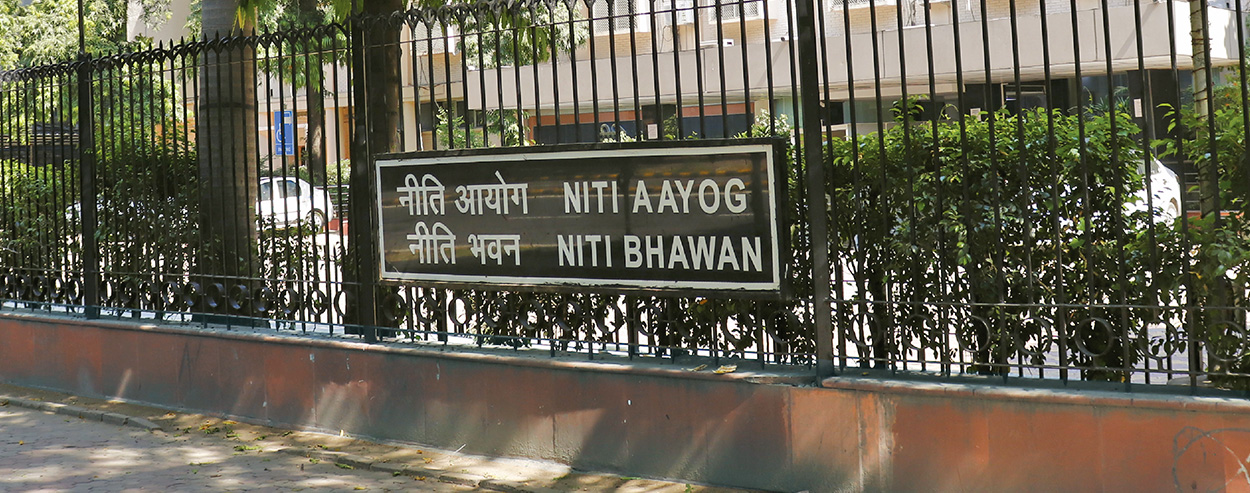
NITI Aayog
PDF Text
1
Inaugural Issue
December 2021 Journal of the Harvard Club of India: India at 752 3 Journal of the Harvard Club of India: India at 754
Published by:
The Harvard Club of India
B-43 First Floor
Middle Circle, Connaught Place
New Delhi 110 001
Tel: 011-40367900
Email: HarvardIndiaClub@Gmail.com
Website: http://www.harvardclubindia.com/
Editorial Board
Dr. Sanjay Kumar
Shobhana Rana
Meenakshi Datta Ghosh
Sangeeth Verghese
In Deep Gratitude
Prama Bhandari, Patron, Harvard Club of India
Members of the Harvard Club of India
Harvard Alumni Association
Office Bearers
Harvard Club of India Office Bearers (2021-2023)
Prama Bhandari (Patron)
Dr. Sanjay Kumar (President)
Abha Mehndiratta (Vice-President)
Ananya Awasthi (Secretary)
Irfan Alam (Treasurer)
Executive Committee Members (2021-2023)
Adwait Vikram Singh
Anirban Gangopadhyay
Manish Jain
Neiha Bansal
Ujwala Uppaluri
Vishal Sehgal
Editorial and Design: Write Media 5
Contents
Foreword 7
The Indian Republic Today: Work in Progress 9
n Pinky Anand
Choosing Sides: India’s and America’s Dangerous Choices 17
n David A. Andelman
An Exemplary Republic 25
n Vikram Bahri
Jammu and Kashmir: The Wasted Years 29
n Vijay Bakaya
Seeking Visibility and a Voice 35
n Ela R. Bhatt
Does Gandhiji Matter Any More? 43
n Kalyan Kumar Chakravarty
Long Journey Home: India’s ‘Tryst with Destiny’ in the Indo-Pacific 51
n Swagato Ganguly
Lessons from Covid-19: A Plan for Action 59
n Meenakshi Datta Ghosh nDr. Rakesh Sarwal
Leveraging Indian Start-ups 69
n Sunil K. Goyal nMohit Hira n Rajat Swarup
The Parsis in India: Small in Number, but Strikingly Significant 75
n Coomi Kapoor
Fireside Chat with Seema Kumari 81
n Dr. Sanjay Kumar
Reflections on Culture and Heritage 85
n Dr. Chuden T. Misra nDr. Navin Piplani
The Constitution of India: Showing the Way 93
n Sujit S. Nair
Rising to the Challenge 97
n Dr. Ganesh Natarajan
India @ 75: Driving Socio-economic Transformation through an
Urban Renaissance 103
n Hardeep S. Puri
The South Asian Symphony Orchestra: Building Bridges for Peace 111
n Nirupama Rao
Tackling Unseen Black Swans, Seen Black Elephants and
Known Black Jellyfish in India 115
n Tobby Simon
Digital Transformation Initiatives: Enabling Ease of Living 121
n Abhishek Singh
The Journey of a Republic is the Story of a Maturing Democracy 129
n Ajay Singh
Patriotism versus Nationalism 139
n Dr. Shashi Tharoor
A Screen and a Mirror: Seven Decades of Indian Cinema 143
n Vani Tripathi Tikoo (With research inputs from Akshat Agrawal)
How Innovative Social Changes Can Build a New Indian Political Playbook 153
n Ghanshyam Tiwari Journal of the Harvard Club of India: India at 756 7
am delighted to introduce the inaugural edition of the Journal of the Harvard
Club of India to the country, and to a wider global audience. We offer to you
a delectable array of some of India’s most prominent thought leaders as they
outline their vision for the country today, tracing where we have been and how
much further we need to traverse to preserve the sanctity of our beloved Republic.
The Harvard Alumni community is proud to have a significant number of voices
among these luminaries. The landscape of the Journal comprises a tour de
force of the arts, music, history, politics and technology and so much more. We
are deeply grateful to the authors for taking the time to pen their thoughts and
provide invaluable insights into our country, and the region as a whole. It is our hope that the
resultant tapestry presented here will enliven your spirits with its richness and ensure that
we all continue to do our best to add to the strength of this land.
The past and current club leadership deemed it important to build a repository of ideas
and thought-provoking views on India as it celebrates 75 years of Independence. I thank
Shobhana Rana, my predecessor and immediate past president of the club, for shepherding
the Journal to completion and for her wise counsel whenever I have needed it.
I wish to thank the Editorial Board, the Executive Committee members and all members
of the Harvard Club of India, as well as all the other members of the Harvard community
and the Harvard Alumni Association, for their encouragement and support of this edition.
We trust that you will enjoy it as much as we have relished giving it life.
Dr. Sanjay Kumar
President
Harvard Club of India
Foreword Journal of the Harvard Club of India: India at 758 9
The Indi an
Republic TODAY:
Work in Progress
Pinky Anand
The march of the Indian Republic has
been extraordinary. We are called a
subcontinent and, as a subcontinent,
we have challenges that are diverse
and often difficult as they have
no precedent. With time, we have
navigated these challenges, trying to
create a balance which reflects not
only our individual identities but also
our collective identities and aspirations
as a nation. Journal of the Harvard Club of India: India at 7510
he Indian Republic is a hard-won battle
with memories of an overlord ruling
our lands still alive. The annexation
of India started with the victory of
Robert Clive, the first British Governor
of the Bengal Presidency, over Nawab
Siraj-ud-daulah, the last independent
Nawab of Bengal, in 1757. India was
then slowly but surely annexed, to
the extent that, by the historic battle of 1857, the
country was left as an economic gold mine for
the biggest corporate of the time, the East India
Company. India was subsequently taken over by
the British Crown and became a part of the various
colonies of Great Britain.
It is in this context that, I believe, India’s
freedom is hard earned. After our territories
having been annexed for more than 200 years,
India launched one of the biggest revolts in living
memory. Today, when we look back at it, we can
see that for a country as wide and as diverse as the
Indian subcontinent, it was a very difficult move.
The mass uprisings and rebellion have given us
India or ‘Bharat’. It was indeed a battle well fought.
Freedom, however, was merely the first step.
We were free from foreign yoke, no doubt, but for a
country to be truly free, there has to be freedom in
the minds of its citizens. There has to be harmony
and a feeling of belongingness to a country and a
sense of duty towards its society. To achieve that
goal, the fledgling state of India commissioned
a body to create the Indian Constitution. Headed
by the incomparable Dr. B.R. Ambedkar, our
Constitution is a tome, aspiring to keep, at its core,
basic human rights and principles, ensuring to
us human and fundamental rights and acting as
the parens patriae (Latin for parent of the people)
to its citizens.
Reaching Out to the People
Populism, and populist policies, served us well
during our fight for Independence. The Father of the
nation, Mohandas Karamchand Gandhi, popularly
known as ‘The Mahatma’, was behind one of the
largest mass movements in the Indian freedom
struggle. The civil disobedience movement later
also became a template for the South African
freedom struggle and was greatly lauded for its
principles of non-violence and effectiveness.
Populist ideology was writ large in Gandhi’s anti-
modernist rhetoric and was an effective tool to bring
the British Government to its knees. It launched an
offensive that aligned all sections of society, from
the educated elites to the farmers, artisans and
landowners. It has to be agreed that it was only on
the back of these movements that India’s freedom
was achieved, and thus the Constitution framed,
promising our citizens that the Government would
be for the people, by the people and of the people.
This was reflected in the document drafted.
Although the Indian nation was built on a
populist movement, there is always a distinction
between ‘populist’ and ‘popular’. The difference
lies in a leader or a Government
that undertakes roles that might be
difficult, or not appeal to a section of
people, but have an overall positive
impact on the state. Strong leaders
are often not populist, but they are
usually popular and, in retrospect,
After our territories having been annexed
for more than 200 years, India launched one
of the biggest revolts in living memory. Today,
when we look back at it, we can see that for a
country as wide and as diverse as the Indian
subcontinent, it was a very difficult move 11
are remembered for their decisions, which at that
time may have received substantial criticism. The
political conduct of these leaders reflect their
authenticity in taking decisions that might not
appeal to some sections of the society; we can easily
see that the idea of vote bank politics does not play
a very large role in their election campaigns.
Cultivating Constitutional Morality
Today, when independent India is 75 years old,
it has become more important than ever for
us to look deep into our painstakingly drafted
Constitution and embody and bring to the fore its
true essence. The building pillar of our Constitution
is its essence, what we very recently have come to
debate as ‘constitutional morality’.
Constitutional morality means adherence to
the core principles of constitutional democracy.
The question that often plagues us is whether it is
a subjective idea or an objective one. Does it limit
itself simply to the provisions and the writ of the
Constitution? Or, does it have a subjective quality
to it, taking on its own life, and applying itself to
the changing social dynamics of today’s world,
while deriving its essence from the thread writ in
our Constitution? At 75, I think the country has now
found its answer, time and again interpreting the
Constitution as a living breathing body, capable of
applying itself to the challenges of the new world,
yet always keeping in mind its basic nature and
preserving its core essential values. The concept
of constitutional morality, however, does not limit
itself to simply human rights; it encompasses
within its paradigm constitutional values such as
the rule of law; social justice; democratic ethos;
popular participation in governance; individual
freedom; judicial independence; egalitarianism
and sovereignty. Though its meaning is clear, the
real world applications of these principles are a
different ball game altogether.
There exists a contrarian view on the subject,
which states that ideas such as constitutional
morality are subjective and widen the scope for
judicial discretion, delay and the uncertainty of
law. The need for constitutional morality, however,
is reflected in the following incident. While moving
the Draft Constitution in 1948, Dr. Ambedkar
quoted George Grote, the English historian who
was noted for his works on ancient Greece: “The
constitutional morality, not merely among the
majority of any community but throughout the
whole, is an indispensable condition of government
at once free and peaceable; since even any
powerful and obstinate minority may render the
working of a free institution impracticable without
being strong enough to conquer the ascendancy
for themselves.”
If we do not adhere to the essence of the
Constitution and interpret it without following the
ideology behind it, it is quite possible to pervert
the Constitution without changing its form. That
is what is taking place in India; that was exactly
what Adolf Hitler did in Germany. Without altering
the form of the Weimar Constitution, he destroyed
the entire constitutional spirit and, ultimately,
the Constitution itself. Professor Wadhwa in
‘D.C. Wadhwa vs. State of Bihar’ quotes the Roman
legalist, Julius Paulus (204
BC): “One who does
what a Statute forbids, transgresses the Statute;
one who contravenes the intention of a Statute
without disobeying its actual words, commits a
fraud on it.”
Our Constitution has been drafted for the
better administration of the country. When popular
ideologies, emotions and sentiments are muddled
up, it leads to subjectivity of judicial decisions
causing the interpretation to be populist, rather
The Indian Republic Today: Work in Progress Journal of the Harvard Club of India: India at 7512
than an attempt to interpret the
intention behind the Constitution.
If all judgments are given on the
basis of popular view or personal or
natural sentiment, then the primary
reason for which the Constitution
was drafted will be violated. There
will be no uniform platform or
guidelines for imparting justice and all decisions
will be personally inclined. The morals of a society,
or any group of people, are at best dynamic; they
change from time to time, depending on the
prevailing circumstances or the environment in
which these are created. An example that has
always remained in my mind regarding this is what
I was told about Afghanistan—a few decades ago,
it was a hub of knowledge and had a chic society
(if I may be excused for the term). Women used
to drive, nightclubs were open to both sexes and
Kabul had a roaring nightlife. Today, this society
lies desolate and war torn; the entire thought
process of what is acceptable or not has changed
in the years of strife that the country has,
unfortunately, suffered.
Interpreting the Constitution
We call the Constitution the sovereign power of
our nation and hence it becomes necessary for
the judiciary to keep in mind its basic structure
while rendering decisions. The judiciary has the
onerous task to sometimes give decisions that
might not seem to be acceptable; but it has to
balance these notions of custom to the essence of
what the Indian Constitution holds. The judiciary
also has the unenviable duty to try and interpret
the Constitution in a way that upholds the current
morals of society. Constitutional morality lends
itself to this complex process.
This trend is evident from the path-breaking
judgments that derive their essence from the
fountainhead of constitutional morality. The Court
relied on the doctrine to strike down the age-old
inequitable practice of ‘Triple Talaq’. Another
judgment was the Sabarimala one, although I have
a caveat, as it is in review before the Supreme
Court. The core of these judgments was the
same—to uphold the idea of equality and freedom
of religious practice. Although these principles are
not specifically addressed in the Constitution, they
have evolved, drawing from this core value.
In the Sabarimala judgment, the conundrum
was the bar of the entry of women in the temple
of Lord Ayyappa, by legal sanction by Rule 3 (b)
of the Kerala Hindu Places of Public Worship
(Authorisation of Entry) Rules 1965. The validity of
the rule and other provisions restricting the entry
of women was decided by the Supreme Court.
A Constitution Bench of the Supreme Court in
Sabarimala followed the path of Ambedkar. The
Court, by a majority of 4:1, struck down the practice
that barred the entry of women into Sabarimala. It
held that the exclusion of women between the ages
of 10 and 50 years from entering the shrine violates
the Constitution and its guarantee for equality and
non-discrimination on the basis of gender.
Another landmark judgment which recognised
the essence of the Constitution was Navtej Singh
Johar vs. Union of India, where Section 377 of the
Indian Penal Code was read down to exclude the
We call the Constitution the sovereign
power of our nation and hence it becomes
necessary for the judiciary to keep in mind its
basic structure while rendering decisions. The
judiciary has the onerous task to sometimes
give decisions that might not seem to
be acceptable 13
Victorian mores of homosexuality being a sin and
illegal. The Supreme Court drew upon this doctrine
to evolve freedom of choice to decriminalise
homosexuality and uphold the human right to be
able to choose your own sexual partner. The Chief
Justice of India, while debating on the nature of the
Constitution, stated: “Constitutional morality is not
confined to the literal text of the Constitution, rather,
it must seek to usher in a pluralistic and inclusive
society…It is the responsibility of all three organs
of the state to curb any propensity or proclivity of
popular sentiment or majoritarianism… Any attempt
to push and shove a homogeneous, uniform,
consistent and a standardised philosophy…would
violate constitutional morality. Freedom of choice
cannot be scuttled or abridged on the threat of
criminal prosecution and made paraplegic on the
mercurial stance of majoritarian perception.”
As a testament to the dynamic nature of the
Constitution, Justice Rohinton Nariman concisely
explained the rationale for reading down the Indian
Penal Code, holding that “homosexuality is not a
psychiatric disorder”, and that same-sex sexuality
is a normal variant of human sexuality, much like
heterosexuality and bisexuality. Also, there is no
scientific evidence that sexual orientation can be
altered by treatment. Justice Nariman relied on
the Latin maxim, cessante ratione legis, cessat
ispa lex (when the reason for a law ceases, the
law itself ceases) to strike down Section 377. The
rationale for the section, Victorian morality, had
long passed, he said.
“It is not left to majoritarian governments
to prescribe what shall be orthodox in matters
concerning social morality. The fundamental
rights chapter is like the North Star in the universe
of constitutionalism,” he emphasised.
Another paradigm shift ushered in was
the decriminalisation of adultery. Adultery was
criminalised in the Indian Penal Code, since its
inception and in the statutes before. Unfortunately,
the criminality attached to the offence was created
in such a way that only the man responsible was
liable for any action of adultery. The all-pervasive
Victorian ideal that women do not have the
agency to choose to be in a relationship outside
the marriage, or even be in a position to make the
choice to be involved with a married man, was
the theme song. With the change in times and the
feminist movement, the ideal was displaced and
debunked; however, the law remained static in India.
The Supreme Court, keeping in mind the principles
of equality and its new world applications, refused
to allow the law to continue, deeming it in violation
of our Constitution.
Justice Chandrachud, in his concurring
judgment, held that the law was also based on
sexual stereotypes that view women as being
passive and devoid of sexual agency. He held that
there was “manifest arbitrariness” in Section 497,
which deprived a woman of her agency, autonomy
and dignity. “Section 497 lacks an adequately
determining principle to criminalise consensual
sexual activity and is manifestly arbitrary,” he said.
Justice Chandrachud also questioned
how the law failed to recognise the
agency of a woman whose spouse
was engaged in a sexual relationship
outside of marriage. According
to Justice Misra, “Parameters of
fundamental rights should include
The Chief Justice of India, while debating
on the nature of the Constitution, stated:
“Constitutional morality is not confined to
the literal text of the Constitution, rather,
it must seek to usher in a pluralistic and
inclusive society…”
The Indian Republic Today: Work in Progress Journal of the Harvard Club of India: India at 7514
rights of women. Individual dignity is important
in a sanctified society. The system cannot treat
women unequally. Women can’t be asked to think
what a society desires.”
Both these judgments regarding the
decriminalisation of adultery and homosexuality
drew from the Aadhar judgment, recognising the
Right to Privacy as a fundamental one.
Upholding the Constitution
Our nation has three pillars of governance—the
legislature, the executive and the judiciary. In layman
terms, we understand the role of these as, the
legislature makes the laws, the executive executes
the laws, and the judiciary upholds the laws. It is
in this third pillar that constitutional morality lies.
The conscience of the judiciary is reflected in the
way the Constitution is upheld and interpreted.
Dr. Ambedkar raised the question of whether we
could presume such a diffusion of constitutional
morality when he stated: “Constitutional morality
is not a natural sentiment. It has to be cultivated.
We must realise that our people have yet to learn
it. Democracy in India is only a top-dressing on
an Indian soil, which is essentially undemocratic.”
He ended by observing, “In these circumstances
it is wiser not to trust the Legislature to prescribe
forms of administration. This is the justification for
incorporating them in the Constitution.”
Another significant stride taken by the Indian
Republic is according the status of fundamental
right to education, incorporating the Right to
Education Act within its annals and creating a
law for mandatory education. A huge reason why
India was viewed as the land of snake charmers
was due to the lack of formal global education.
While our ancient texts and scriptures are superior
to many, it was the lack of global education that
held us back. Education was also necessary to
improve opportunity access to our masses and
an important tool to improve, if not eradicate, the
menace of poverty that has plagued our country for
as long as memory goes. This was in furtherance
to Mohini Jain vs. State of Karnataka in 1992, when
the Supreme Court interpreted the Constitution to
have in itself the implied right to education as a
fundamental right under Article 21A.
The Supreme Court has been instrumental
in several such laws, where the Constitution has
been interpreted to have contained within itself
rights such as the right to clean air, or the right
to livelihood, despite the letter of law not having
spelled it out in as many words.
Independent India at 75 is a work in
progress. We laid down the structure of our
country in 1947 and from there, it has been
a constant endeavour to create, adapt and
reinvent a dynamic Constitution consistent with
the evolutionary process of the times and the
demands of civil society. There are multiple lines
along which India can be divided. In the face of all
the diversities in contemporary India, with all its
varied cultures, religions, worldviews, there is
one thing that holds the nation
together and it is constitutional
morality. For a society as
pluralistic as India to function
and thrive, there has to be an
acceptance of individual identities.
Further, a balance needs to be
We laid down the structure of our country
in 1947 and from there, it has been a constant
endeavour to create, adapt and reinvent a
dynamic Constitution consistent with the
evolutionary process of the times and the
demands of civil society 15
Pinky Anand was the Additional Solicitor General of India for two
terms and is a Senior Advocate at the Supreme Court of India with
a distinguished practice in diverse areas. She is the recipient of
the French National Order of Merit conferred by the President of
the French Republic. A Harvard Law School graduate and Inlaks
scholar, she has received several awards for excellence in law.
maintained between the needs of the individual
and the collective. Otherwise, there will be no
peace and no stability. The judgments of the
Supreme Court in Sabarimala, Triple Talaq as well
as the decriminalisation of homosexuality may
not adhere to the popular view of society. Indeed,
they have been deeply controversial and have, in
essence, divided factions of the population. There
was a furore over Sabarimala temple entry, some
claiming that the true women devotees of Ayyappa
would themselves not go to the temple, their faith
would not allow it. The Triple Talaq judgment dealt
with the extreme razor-thin line between religion
and rights accorded in a secular society. The thread
that emerges is that populism may not produce
the desired goals of equality and good conscience
consonant with current-day ethos. This is where
constitutional morality kicks in to forge the way
ahead and bridge the gap between yesterday,
today and tomorrow.
The Indian Republic Today: Work in Progress Journal of the Harvard Club of India: India at 7516 17
Choosing sides:
India’s and
America’s
dangerous
choices
David A. Andelman
The Indian subcontinent is rapidly
becoming a talisman of America’s
waning power and influence in the
region and in many other parts of the
world. Most frightening, the United
States appears to be choosing sides in
a losing battle to assure peace not only
in India and Pakistan, but far beyond. Journal of the Harvard Club of India: India at 7518
he error American administrations
have been making far back into the past
of the subcontinent is the same one
that Democrats and Republicans alike
have been committing most recently—
tilting (or at least being perceived as
tilting) resolutely toward India rather
than maintaining a more even-handed balance between Pakistan and India.
This position has only helped fuel the rise and now the return of the Taliban that will make this entire
region all that much more dangerous in the post-
American period in Afghanistan.
Rendering this period all the more dangerous
is the parallel perception that this entire region is up for grabs—effectively unchaining some of the major powers, but especially China and Russia, each with expansionist aspirations. All of this can only serve as a pernicious challenge to those who aspire to establish or maintain liberal democratic systems across the region. What America should be doing, and clearly this may be met with less than glee in many circles in India, is for the United States to demonstrate that it cares equally about the maintenance of democratic governments in every nation on the subcontinent and is prepared to do its best to assure such an outcome.
I have personally covered, as a journalist for The
New York Times, military takeovers in two nations on the subcontinent—when General Muhammad Zia-ul-Haq and his military junta seized power in Pakistan, overthrowing the democratic regime of Prime Minister Zulfiqar Al Bhutto in July 1977, and the military coup in Bangladesh in August 1975, when I spent hours talking with the then Foreign Minister and one-time President of Bangladesh,
Abu Sayeed Chowdhury. I also came to know General Zia quite well and dined in his modest home on the fringe of the military cantonment
in Rawalpindi. Both gentlemen expressed their devotion to democratic ideals, though clearly neither was fully prepared to adhere to them. India, too, has had a succession of leaders who have professed a devotion to democracy, although during Indira Gandhi’s Emergency I came into personal contact with her edict that no Times journalist would be
admitted to her nation and was left stranded for hours on the tarmac at New Delhi airport, unable even to enter the (air-conditioned) terminal.
None of these circumstances has turned me
from my determined belief that the United States needs to chart as independent and neutral a force as possible between each of these nations. And the stakes have clearly multiplied since the development and growth of powerful nuclear arsenals in both India and Pakistan. Moreover, as I came to learn from discussions in both capitals, the principal targets are each other. The vast bulk of these arsenals are not targeted at any external enemy—not China with whom both have clashed from time to time on their frontiers, nor Russia, nor further afield North Korea whose missiles could be within easy range of the entire subcontinent. I am persuaded that more than any other single reality, this deeply-held antipathy has had the most pernicious influence on political, diplomatic, certainly military and intelligence, but even social and cultural developments in both societies. No nation should be held hostage by its armaments, nor should any ally be forced to choose sides for any reason bearing on these fundamental realities. Yet this is precisely the situation America and its own allies have been forced into. Choose one side or another. Truly a Hobson’s choice—in other words, no real choice at all.
India has long, and quite justifiably,
worried about its frontiers. In 1884, the Raj, the
British rulers of India, which comprised the entire 19
subcontinent including what is today
India, Pakistan, Bangladesh and large
stretches of Afghanistan, came to the
conclusion that they no longer wanted
responsibility for the wild territories of
the Hindu Kush and what lay beyond
to the west and south. These lands
stretch from the impenetrable mountains they
straddle on the north where they merge with the
Karakoram Range, the Pamirs and the eternally
tense point where China, Pakistan and Afghanistan
converge, onward to the south where they connect
with the Spin Ghar Range near the Kabul River.
There have been tribes in these forbidding
hills of Afghanistan for 2,000 years or more. The
Greek historian Herodotus wrote in 440
BC of
the Pactrians, one of the “wandering tribes” that
occasionally helped comprise armies of Persia.
These were the Pashtuns of the time of the Raj,
who still dominate much of the mountains, caves
and valleys of Afghanistan and the North-West
Frontier Territories of Pakistan.
When the British assumed control over this
vast region, including at least in theory a large
stretch of Afghanistan, there was resistance. Twice
in the last quarter of the nineteenth century, British
troops battled forces of the Emir of Afghanistan.
The first began in November 1878 when forces
moved quickly into the Emir’s territory, defeating
his army and forcing him to flee. The British envoy,
Sir Louis Cavagnari and his entire mission who had
arrived in Kabul in September 1879, were promptly
massacred to the last man, touching off the second
Afghan war. This ended a year later when the British
overran the entire army of Emir Ayub Khan outside
Kandahar in southeastern Afghanistan, not far from
the frontier that was about to be established. These
wars, the diplomacy, manoeuvres and experience
dealing with the Afghan people who the British
encountered, persuaded the Raj that the price for
retaining control was simply far higher than it was
willing under any circumstances to pay.
So, in 1884, Lord Frederick Hamilton-Temple
Blackwood, the Marquess of Dufferin, Viceroy and
Governor of India, named Henry Mortimer Durand
a member of the Afghan Boundary Commission.
This was a critical post on at least two different
levels. First, Russia was also beginning the first of
what would turn out to be a succession of attempts
to push its own frontiers down into Afghanistan.
Afghanistan was seen by the Russians, then the
Soviets, then the Russians again, as a potential
buffer against encroachment from the British
Empire of that period, the potentially hostile and
disruptive tensions on the subcontinent today.
Ironically, Britain of the 1880s viewed Afghanistan
through a similar prism—eager for a firm line that
could not be crossed and that would keep the
wild mountain tribes and the legions of Russians
at bay. Durand headed off into the tribal lands of
the North-West Frontier Province, beyond which
lay Afghanistan. In 1885, a Russian delegation
appeared as well at a neutral meeting place—the
Zulfikar Pass. On July 16, 1885, The New York Times
published a “special dispatch from Jagdorabatem
via Meshed” of a “reported advance to Zulfikar
Pass,” that comprised “a large number of Russian
reinforcements [that] has arrived at Merv and Pul-i-
Khisti during the past fortnight”. At the same time,
“the British Frontier Commission [was] moving
nearer to Herat—the Afghans determined to resist
The United States needs to chart as
independent and neutral force as possible
between each of these nations. And the
stakes have clearly multiplied since the
development and growth of powerful nuclear
arsenals in both India and Pakistan
Choosing Sides: India’s and America’s Dangerous Choices Journal of the Harvard Club of India: India at 7520
invasion”. If this sounds sadly, desperately familiar,
it is because it was. History has never failed to
repeat itself in this part of the world. Durand and
his commission did finally succeed in arranging
a truce and, most important, an agreement to
establish a line to which his name was quickly
attached and has persisted in some fashion
or other until today. The Russians agreed to its
provisions since it allowed their forces to control
the sources of several critical canals. But it would
be some years before any of this became reality.
First, it was up to the Emir of Afghanistan to agree.
In April 1885, the British Viceroy, Lord Dufferin,
gave a lavish banquet in Rawalpindi where the Emir
praised the friendship between the two countries,
as well as Durand. The Viceroy of India promptly
named him his Foreign Secretary, the youngest
in the history of the British Empire. Over the next
eight years, Durand travelled frequently to the
hostile lands along the frontier, which he and his
British colleagues saw as populated by “absolute
barbarians…avaricious, thievish and predatory to
the last degree”. In 1893, Durand planted himself
permanently at the frontier, sitting day after day
with the bearded Emir, a series of rudimentary
maps spread out before them to carve out the
line that would define their mutual border. The
one last sticking point was Waziristan—then,
as now, a sprawling, provocative and unsettled
territory on the fringes of two empires. This was
one stretch that Britain wanted very much to retain
for the Raj, largely as a buffer. Durand could hardly
understand the Emir’s apparently desperate desire
to retain a place that “had so little population and
wealth”. Why? Durand asked. A simple one-word
explanation. “Honour,” the Emir responded. This
was easily satisfied by tripling the Emir’s annual
“subsidy” from the British Empire from six to
18 lakh rupees ($ 8,000 to $ 24,000). On November
12, 1893, the agreement was signed, though the
Emir really had no idea what he was signing since
the original was written in English, which he neither
spoke nor read.
Sir Olaf Caroe, who served as the last governor
of the North-West Frontier Province in what was
then India, and a first-hand expert on the Durand Line
which defined the western border of the territory
he governed, observed that “…the Agreement did
not describe the line as the boundary of India, but
as the frontier of the Emir’s [-ur-Rahman ] domain
and the line beyond which neither side would
exercise influence. This was because the British
Government did not intend to absorb the tribes into
their administrative system, only to extend their
own, and to exclude the Emir’s authority from the
territory east and south of the line…The Emir had
renounced sovereignty beyond the line.” But a host
of would-be interlopers from Soviet invaders to
Taliban freedom fighters to al-Qaeda terrorists, not
to mention American forces and their NATO allies,
ever fully came to appreciate that reality.
Afghanistan still refuses to recognise this
line, describing it as a colonial mandate imposed
by force of will, though Pakistan freely accepts it
as part of the legacy inherited, along
with its freedom, at the time of the
British exit from the subcontinent.
It remains one of the longest-standing,
firmest, yet utterly violent, unsettled
and admittedly quite porous such
red line.
No nation should be held hostage by its
armaments, nor should any ally be forced
to choose sides for any reason bearing
on these fundamental realities. Yet this is
precisely the situation America and its own
allies have been forced into 21
Cemetery of Empires
There is no doubt that Afghanistan stubbornly
retains its name as the cemetery of empires.
With the departure of Britain from the region,
the Russian empire, then the Soviet regime, now
perhaps again Russia will be trying to establish
some hegemony of a part or all of the region.
Communism came to an end in Russia largely on
the heels of the Kremlin’s failure at the end of the
last century.
The United States has come close to
concomitant failure in this century. Now it is very
much up to India to makes certain that democracy
itself does not come a cropper as a result of the
failures or profound imbalances poorly conceived
and disastrously executed.
Which is how we come now to the regime of
Narendra Modi. The current Indian Prime Minister
came to power at a most opportune moment.
Three years before the arrival of Donald Trump,
Modi was already in the process of asserting
his control over India as the nation’s 14th Prime
Minister—and making it quite clear what it would
take to cement his allegiance or friendship with
any of a host of foreign powers coming to pay
court. But it was not until the arrival of Trump as
President of the United States in January 2017 that
Modi truly found his soulmate. Ironically, however,
Trump was not the first American President to
have expressed his eagerness to embrace India’s
deeply conservative leader.
On June 5, 2016, The New York Times
observed, “There are few relationships between
President Obama and another world leader more
unlikely than the one he has with Prime Minister
Modi.” The Times continued that the two “have a
public warmth” that has been on display at each of
their seven meetings—two at the White House.
Of course, there are any number of reasons
that American presidents across the political
spectrum have found themselves attracted to
Indian leaders. And never more so than today.
First, India is on the verge (likely within the next
five years) of passing China to become the world’s
most populous nation. Certainly, it already is the
most populous democracy, which itself makes it
an appealing ally to a nation such as the United
States anxious to find a like-minded counterweight
to help neutralise Chinese expansionist ambitions
in Asia and beyond. Of course, India’s massive
economy and an exploding consumer sector
make it equally attractive to American firms
wanting to do business there. But the icing on this
already quite alluring cake is India’s geographic
positioning and the reality that its neighbour and
effectively arch enemy is also an ally of the utterly
anti-democratic Taliban who have just seized
control of Afghanistan.
None of which is to suggest that this is a
good idea. Playing favourites, especially among
regional competitors, is never a wise method of
conducting diplomacy. Yet that is largely what
America has been doing lately.
One might have thought that with the arrival
of Joe Biden, determined to chart a decidedly
different course from his predecessor, that there
would be at least a subtle shift, if not a 180 degree
turn. Not hardly. The nature of the early contacts
between the two Governments is indicative. So
far, Modi and the Indian Government have been
favoured with visits by America’s Secretary of
State Antony Blinken and Secretary of Defence
Lloyd Austin. The only senior American visitor to
Pakistan during Biden’s first year has been the
Deputy Secretary of State, Wendy Sherman, who
Prime Minister Imran Khan refused to meet, calling
Blinken’s remarks about Pakistan “ignorant”.
Choosing Sides: India’s and America’s Dangerous Choices Journal of the Harvard Club of India: India at 7522
Path for Peace
I have long believed that a substantial and
accelerating tilt toward India is what has
destabilised the subcontinent, led to an unmitigated
disaster in Afghanistan and only expanded the
advantages of China and its own expansionist
interests. As I have written for CNN, what Joe Biden
and Blinken have not wanted to tell Americans, and
certainly would never admit to Narendra Modi, the
path for peace in Afghanistan, and the removal of
a vast well of contention and violence throughout
the subcontinent, runs not through New Delhi, but
through Islamabad.
Even Russia and China have learned this
lesson and are scrambling. Their early support
for the Taliban is part of hedging their bets over
the reaction in their own homegrown Muslim
communities—the Chechens and the Uyghurs,
respectively. Neither country wants Afghanistan
to give safe harbour to Muslim liberation groups they consider to be terrorists. Still, they, along with Pakistan, which provided refuge to the Taliban
for years, are prepared to play into the vacuum
America is leaving—in Afghanistan and more broadly as well.
The fact is, there is little that could compel the
Taliban to meet the conditions for a full US troop withdrawal. The group is stronger now than it has been since 2001, and it recognises its current position of strength—especially with the support of its neighbouring ally Pakistan. If America is to get out—someday—there is one critical step that must be taken, starting now.
The US must become very good friends with
Pakistan—even if that means easing away from our close ties with India. Pakistan shares a 1,640-mile border with Afghanistan, otherwise known as the Durand Line, which was established by the
British in 1893. It is effectively one of the world’s
most enduring and contentious red lines. Pakistan,
and especially the Inter-Services Intelligence, the
military’s intelligence arm, has cast itself as the
Taliban’s protectors and underwriters in a bid to limit India’s influence. India, in turn, is wary that Pakistan will use Afghanistan as a base to launch attacks against its territory.
A Pakistan that is at least more neutral could be
prepared to reverse its role in bankrolling, arming, training and providing sanctuaries in the wild frontier provinces, all of which, as Human Rights
Watch observes, “contribute to making the Taliban
a highly effective military force”. Trump made no secret of his tilt toward India and Narendra Modi, which only unsettled Pakistan’s Imran Khan, a charismatic, Oxford-educated cricket champion
who sought to maintain some relationship with
Washington. While a new administration arrived in Washington in January 2021, it does not seem to be changing course when it comes to fostering a closer relationship with Pakistan.
The first of Biden’s calls with the Quad—the
Prime Ministers of Japan, Australia and India—may
have helped bolster American security interests
in the South and East China Seas, but it did
nothing to improve the United States’ position in
Afghanistan. When Blinken and Austin made their
first foreign visit to Japan and South Korea, Austin
went on to visit India, utterly ignoring Pakistan.
Moreover, with the United States and its
NATO allies now gone from Afghanistan, the whole equation has morphed again. There is no real sense that Pakistan has withdrawn any of its support from the Taliban. Nor, at the same time, is there any sense that the United States has begun to pivot back to a more even-handed set of relationships on the subcontinent. Yet, not in decades, has the United States had need of a more 23
sympathetic understanding, let alone
accommodation from Islamabad.
There is still the possibility, of
course, that Afghanistan will prove to
be the cemetery of the Taliban. But the
alternative is hardly more appealing.
Imagine how pernicious would an
Afghanistan that is in thrall of ISIS-K be. How safe
would India find itself?
So, somehow, the Biden administration must
be persuaded to understand the necessity of an
even-handed and balanced approach to both
nations on the subcontinent. I am confident that
such an approach would redound especially to
the benefit of India, assuring its safety in what
is becoming an increasingly dangerous and
challenging neighbourhood. I should hasten to
reassure my Indian readers that this should by
no means be seen as an abandonment in any
sense of the world’s largest democracy. Rather,
India should recognise its own advantages in
encouraging the United States to demonstrate—if
Washington is unable or unwilling to recognise
this itself—that the safety of Pakistan is intimately
entwined with the security of India. Pakistan’s
continued underwriting of the Taliban and its
excesses, without encouraging Afghanistan’s
new rulers to adopt positions that can integrate
them into the community of responsible nations,
can only further endanger India. Is this the
endgame India should be seeking?
It is critical to examine the neighbourhood. Who
is waiting there on the fringes of all these countries?
Russia and its near-abroad (Turkmenistan,
Uzbekistan and Tajikistan), whose strings Vladimir
Putin controls so definitively from the Kremlin,
is as interested as his predecessors back a
thousand years to cement and control what could
be a potentially existential threat to the southern
reaches of the greater Russian empire. While China
shares only a sliver of its frontier with Afghanistan,
it is becoming increasingly interested in who might
be pulling the strings in Afghanistan, but especially
Pakistan and by extension India with whom China
does share a substantial and often tendentious
frontier. As relations between the United States
and China remain frozen, the leadership in Beijing,
especially Xi Jinping, will have every incentive to
improve relations with nations that are seen to
share an unhappy relationship with Washington
It should be in the interest, however, of none
of these countries—Russia and the Stans, China,
Pakistan or India—to see Afghanistan utterly fail. Yet
it is already on the very brink of failure. At the end of
October, the Office of the Special Inspector General
for Afghanistan Reconstruction (SIGAR), long the
best single source of monitoring for what goes on
in that nation, reported some chilling statistics:
n The number of Afghans requiring humanitarian
assistance in 2021 has reached half of
Afghanistan’s total population, nearly double
that of 2020, and a six-fold increase compared
to four years ago.
n By September 2021, 14 million people—or
one out of three Afghans—were on the brink
of starvation.
n Wheat production is expected to drop by
31 per cent in 2021 compared to the previous
year, with a 62 per cent reduction in areas under
cultivation, leading to a shortfall of 2.46 million
metric tonnes of wheat.
India should recognise its own advantages
in encouraging the United States to
demonstrate—if Washington is unable or
unwilling to recognise this itself—that the
safety of Pakistan is intimately entwined with
the security of India
Choosing Sides: India’s and America’s Dangerous Choices Journal of the Harvard Club of India: India at 7524
n Kazakhstan reported that it is unwilling to export
its wheat to Afghanistan, given the country’s
inability to pay, increasing the risk of famine.
n By mid-2022, poverty levels in Afghanistan could
increase by between seven and 25 percentage
points, compared to 2020, with Afghanistan
facing near universal poverty, with 97 per cent
below the poverty line.
n The Afghani (AFN) currency depreciated
dramatically against the US dollar, devaluing
the AFN and further diminishing Afghan
households’ ability to purchase food and other
necessities. Afghanistan does not have the
technical capabilities to print its own currency.
A failed, increasingly desperate state border
on the subcontinent can be of no benefit to India.
So, what is to be done? Sadly, America continues
to grasp at straws. And India remains largely
on the sidelines. Yet, as the only nation on the
subcontinent with an ongoing working relationship
with America’s leadership, it needs to step up, and
quickly. Modi must help make Biden understand
the value of dealing openly and even-handedly with
Pakistan. First, of course, Modi himself needs to
accept this reality, as does the entire leadership of
the Government of India. It is in their interest and
indeed the interest of the entire globe. Nothing will
be gained by the further isolation of Pakistan, or
Afghanistan for that matter, and India will only be
potentially the most proximate loser. Peace across
the subcontinent, India’s neighbours moving toward
a condominium, can only help as India itself moves
into the position of the world’s largest and most
consequential nation.
David A. Andelman is a veteran foreign correspondent, historian,
author and commentator for CNN and NBC/Think. A chevalier of
the Légion d’Honneur, France’s highest civilian decoration, he was
twice the winner of the Deadline Club Award for best commentary.
Executive Director of The Red Lines Project, he is also the author
of five books, most recently A Red Line in the Sand: Diplomacy,
Strategy, and the History of Wars That Might Still Happen and host
of its Evergreen podcast. 25
An Exemplary
Republic
Vikram Bahri
A personal, nostalgic reflection on the
Republic of India as it stands today,
seen from the perspective of the
author’s grandfather, Sardari Lal Bahri,
who was a refugee from West Punjab
(now Pakistan). Also, a Harvardian
presents a SWOT analysis for India... Journal of the Harvard Club of India: India at 7526
awaharlal Nehru’s famous words at the
birth of Free India truly encapsulate the
aspirations of this great nation and its
people: “At the stroke of the midnight
hour, when the world sleeps, India will
awake to life and freedom.” Refugees
from Pakistan’s West Punjab included
many industrious entrepreneurs who
were going to become stakeholders
of Modern India, as we know it today. My paternal
grandfather, Sardari Lal Bahri, founder of the Jaipur
Golden Transport Group, wrote his own script,
which is a small, yet consequential, part of this
colossal epic, the Republic of India.
Born in a rural family in Sargodha District, West
Punjab, in 1905, Sardari Lal Bahri was the oldest
of seven children. The untimely death of his father
left him in a sink-or-swim situation at the age of 12.
His widowed mother sent him to the nearest city of
Sargodha to learn a craft for earning a livelihood.
“From the moment I first saw them in the city,
I fell in love with automobiles,” my grandfather
confided in me. In the early 1920s, Sardari Lal had
become a proficient driver, among the few who
dared to drive those moody beasts of steel and
wood. Not many people know that the earliest buses
ran on coal, such as a steam engine locomotive.
These coal-powered buses also served the
needs of goods transportation for the populace.
Traders would go to different towns for their work
and usually return with wares or produce for trade/
self-use. The birth of India was preceded and, in
many political ways, conceived by the end of the
Second World War. Many surplus transport vehicles
from the war were now available for civilian use.
Sardari Lal Bahri made innovative and productive
use of these war-beaten trucks, which ran on diesel
and were more pliable and versatile than any of the
automobile dinosaurs they had used before.
As my grandfather always lamented, “The
Republic of India was born with a silver spoon of
opportunity but in rags of colonial apathy.”
Ground for Growth
In 2009, Nobel Laureate Dr. Amartya Sen, at
the launch of his book, The Idea of Justice,
prophetically declared, “India is a nascent
democracy and, by nature, democracies always
evolve and flourish.” In my view, in the 73 years
since becoming a Republic, India has fascinatingly
evolved and flourished. I may be accused of
partisanship and optimism, but that is the DNA
of every refugee, anywhere in the world. In spite
of wars, natural disasters, sectarian strife and,
sometimes, condescending world opinion, India
has stood its ground with resilience and aplomb.
My grandfather came with almost nothing and
created one of India’s largest trucking companies.
He believed that we have to strive to succeed;
waiting for change or opportunity is akin to waiting
for rain with your mouth open to the skies.
In these momentous years, the Republic of
India has provided the essential ground for growth
that helped many entrepreneurs become iconic
success stories, including:
n Freedom from foreign rule/bias/tyranny.
n Protection from internal and external strife.
n Vibrant democracy to be able to choose one’s
own leaders.
n Laws and liberties to live with respect.
Obviously, there would be detractors to my
views and that is perfectly all right for this is not a
case of attempting to show the glass half-full. India
is not only an exemplary Republic when compared
to neighbouring States conceived from similar
circumstances but it shows character to even those
nations that flaunt “Republic” in their middle name. 27
The Republic of India @
73: SWOT Analysis
During my study at Harvard we were made to do
SWOT (Strengths, Weaknesses, Opportunities and
Threats) analyses for various business situations.
As an ode to the wonderful experience of learning at
Harvard, I am going to attempt a SWOT for India.
Strengths
n Largest democracy in the world: Enough has
been said about this unique distinction which
we carry with pride.
n Young workforce: As much as it imposes a
challenge to a nation, a youthful nation grows
and develops to the needs of its citizenry.
n Brilliant minds: We have some of the brightest
brains in the world who have excelled in every
area of human development.
n Software nerve centre of the world: With a
dramatically digitalising world, India is rightly
acknowledged as its back office.
Weaknesses
n Resources constraints: As much as the
Republic wants to shrug the endemic afflictions
of poverty, ill health and illiteracy, these demons
continue to hinder India’s march towards
becoming a developed nation.
n Sectarianism: Since pre-Independence,
crusaders such as Gandhi have been
relentlessly trying to eradicate sectarianism
with little success. The challenges posed by
this demon and its affiliates–communalism,
casteism and regionalism–pose a daunting
challenge to growth.
n Income and wealth disparity: Unfortunately,
since Independence, the disparity in income
and, therefore, wealth, opportunity and growth,
has been skewed. This poses a great challenge
to a democracy where a very small percentage
of wealthy taxpayers pay for the subsistence
of the country.
Opportunities
n Digitalisation: In the digitalised twenty-first
century, the traditional wealth indices are rapidly
getting obsolete. Rather than a nation’s wealth
of oil and natural resources, its demographic
dividends are being evaluated and compared.
India stands a strong chance of winning in
this new race.
n Competitive workforce: Owing to immense
competition for scarce educational and
infrastructural resources, our students
have learnt to strive and succeed at most
international forums/institutions. India’s
diligent workforce (both, blue- and white-
collared) is globally admired for its brilliance
and fortitude.
n Inclusive and conducive global environment:
The twenty-first century, in spite of its
challenges, is the safest, healthiest and most
inclusive century. There are no imperialist
armies or subjugated colonies. The
international community is ready to help,
educate, invest and thrive with India.
My grandfather came with
almost nothing and created one of
India’s largest trucking companies.
He believed that we have to strive
to succeed; waiting for change or
opportunity is akin to waiting for rain
with your mouth open to the skies
An Exemplary Republic Journal of the Harvard Club of India: India at 7528
Threats
n Nuclear proliferation: The biggest threat
to India and to the world comes from
human beings. Man has created too many
sophisticated weapons of death. With
intemperate neighbours, India needs to learn
to live with them in a multi-polar world.
n Pandemics: The fragility of humanity was
exposed by the COVID-19 pandemic. As we
Vikram Bahri is a New Delhi-based businessman who is
actively involved in the businesses of Logistics, Healthcare and
International Trade. He is also a Trustee of Jaipur Golden Hospital,
where he leads his family initiatives in philanthropy.
grow towards a smarter, connected and better
world, we are always going to be susceptible to
powers beyond our realm.
Indeed, the Republic of India is, today, in the
yardstick of nation-building, a toddler with a wobbly
walk and unsure step.
Looking ahead, I conclude with the words of
Robert Browning in his famous poem, ‘Rabbi Ben
Ezra’: “Grow old along with me, the best is yet
to be…” 29
Jammu and
Kashmir:
The Wasted Years
Vijay Bakaya
The problem of Jammu and Kashmir
has been the most persistent since
India’s Independence in 1947. The
situation reflects years of neglect
and vacillation as well as the missed
opportunities of resolution for this land
of ethereal beauty, where its people
are caught in the crossfire of history
and politics. Journal of the Harvard Club of India: India at 7530
ver since India attained its
Independence from colonial rule on
August 15, 1947, its former state,
now union territory of Jammu and
Kashmir (J&K), has remained the
most talked about subject among
the academicians, politicians and
historians of the world. During this
long and variegated discourse, a
narrative has taken shape around an assumption
that the territory of Jammu and Kashmir is a matter
of dispute between India and Pakistan, having
arisen at the time of the partition of India, when
the accession of this princely state took place.
Half-truths, misinformation and tendentious
interpretation of events have often blurred historical
facts. While unsolicited offers of mediation have
been made from time to time by some countries,
most have nudged both, Pakistan and India, to
resolve issues through dialogue. However, hardly
any country, except those which are India’s
permanent friends, has accepted the finality of
accession. A perception persists even after 75
years, among a majority of Muslim countries,
that J&K should have acceded to Pakistan and
not to India, as it was a Muslim majority state
and was contiguous with Pakistan, a Muslim
majority country. In their view, this mistake can
only be corrected by a referendum. This mindset
is reflective of the fantasy harboured by some
that history can be rewritten retrospectively. The
thought process is born out of a conflict between
fiction and reality; between perception and truth;
between objectivity and bias.
The historical fact, however, is that out of the
565 princely states in India, Jammu and Kashmir
was the only state whose relationship with the
Indian Union had not been decided at the time
of its Independence, as the ruling Maharaja Hari
Singh had sought time to decide whether to go to
Pakistan or India. He had to give up his vacillation
in the face of an invasion by the tribals of Pakistan,
supported by its army. This compelled him to
decide in favour of accession to India, which could
help militarily only if he became part of the Union
of India. This decision of the Maharaja would
also have had a closure, like the decision of other
Maharajas, had it not been taken under duress and
had the Prime Minister of Independent India, in a
gesture of gratuitous magnanimity, not promised
that the wishes of the people would be ascertained
later on; had he not ordered a unilateral ceasefire
in the country’s counter offensive against the
invaders and, finally, had he not referred the issue
to the United Nations.
Matter of Speculation
The promise that the Prime Minister made was
not necessary because under the Constitution of
that time, the rulers of the princely states had the
authority to decide, on behalf of the people, whether
they would like to join with Pakistan or India. All
other princely states took their decision before
August 15, 1947, but why Maharaja Hari Singh
dithered has remained a matter of speculation.
There is evidence to believe that Pakistan was
deliberating on Maharaja Hari Singh’s request for
more time; a standstill agreement was contemplated
and India did not intervene. It can safely be said that
if Pakistan had not forced Hari Singh’s hand, the fate
of J&K would have been decided after a leisurely
process of cogitation by Hari Singh of the pros and
cons of joining India or Pakistan. The fact remains
that he acceded to India and signed the same
Instrument of Accession that other princely states
had signed, with the same caveats, on October 26,
1947. Thus, there was no dispute. 31
But still, there are those who voice their concern
about this ‘Kashmir Dispute’ in various forums and
also refer to the UN Resolution of 1948. They forget
that it is no longer relevant, as its first condition that
Pakistan (declared in the Resolution as aggressor)
should vacate nearly 14,000 sq km of the land of
J&K occupied by it by force before the people’s
wishes can be ascertained has not been fulfilled
by Pakistan, which has defied and also distorted
the purport of this Resolution. It blames India and
many erudite scholars tend to agree that India is not
implementing the Resolution of the UN, which calls
for self-determination. This debate has mystified
the Kashmir dispute so much that all are asking for
a solution but no one is able to offer one.
The Kashmir Dispute
Against this backdrop, the ‘Kashmir Dispute’ gets
highlighted in essence as a demand for reversing
a decision taken 75 years ago by an authority
empowered by the law of the time to do so, on
behalf of the people. The larger dimension of such
a liberal and flexible attitude towards agreements/
treaties signed in the past through a legitimate
process is that there is no finality about any such
decision and it has to be endorsed by every new
generation. This thinking can lead to instability and
is dangerous. But for argument’s sake, even if this
were accepted to be the norm in international law,
it has already been tested in the context of Jammu
and Kashmir.
Sheikh Mohammed Abdullah, known as the
Sher-e-Kashmir (Lion of Kashmir), was the most
charismatic leader of Kashmir and had supported
Hari Singh’s decision to accede to India. He was
Prime Minister of J&K up to 1953. He was, in
a strange twist of history, arrested by his good
friend Jawaharlal Nehru, the then Prime Minister
of India, for treason and conspiracy to declare J&K
independent. While in jail for 11 years, he formed
a political outfit called the Plebiscite Front. This
Front was, however, banned from engaging in
any political activity but clandestinely it spread
the message that the future of J&K was to be
decided by the people in a referendum. All this,
while elections were held in which this Front could
not participate. Elected Governments, however,
carried forward the developmental agenda and, by
the time Sheikh Abdullah was released in 1964, the
idea of a referendum had lost its intensity.
After 1971, when Pakistan was dismembered
by India and Bangladesh was formed, Sheikh
Abdullah seems to have realised the futility of his
demand and, in 1975, he signed an Accord with
Indira Gandhi, the then Prime Minister, to disband
the Plebiscite Front and to give up the demand that
the wishes of the people have to be determined
whether they would go to Pakistan or stay with
India. He was made Chief Minister by removing a
duly elected one. Subsequently, in the elections held
in 1977, following the Accord, Sheikh Mohammad
Abdullah asked for a vote for Jammu and Kashmir
being an integral part of India. In an overwhelming
mandate through an internationally acknowledged
free and fair choice, the people of Jammu, Kashmir
and Ladakh voted for Sheikh Mohammad Abdullah
and his National Conference Party to govern
the state as part of the Republic of India. This
watershed milestone was the last in the chequered
journey of J&K. From here on a new era began in
While unsolicited offers of
mediation have been made
from time to time by some countries,
most have nudged both, Pakistan
and India, to resolve issues
through dialogue
Jammu and Kashmir: The Wasted Years Journal of the Harvard Club of India: India at 7532
which uncertainty ended and Sheikh Abdullah
resumed his unfinished task of revolutionary land
reforms, ensuring people’s participation in decision
making and giving them a place in the sun.
During the 22 years between 1953 and 1975,
after the initial convulsion of rage and betrayal
caused by Sheikh Abdullah’s arrest subsided,
there was no restless urge among the people for
Pakistan. They happily got involved in the vibrant
era of development and cultural renaissance, which
was ushered in by Chief Ministers committed to the
idea of India. The youth were engaged in sports and
healthy outdoor activities as part of their school
curriculum. To protect them from distractions,
many were sent to professional colleges in the rest
of the country, so that they could return as doctors,
engineers and so on. Peace and tranquil happiness
spread among the people. This alarmed Pakistan,
which waged a war in 1965.
The people of Kashmir rose in solidarity
against the aggression to thwart any attempt at
subterfuge and sabotage. “Beware you aggressor,
the Kashmiri is prepared” was the clarion call.
A ceasefire was declared under international
pressure and, in Tashkent, an agreement to restore
the status quo ante was signed. This was a lost
opportunity. India could have bargained as it was in a
position of strength for burying the ghost of the
‘Kashmir Dispute’.
Lost Opportunities
Thereafter, people lived their normal lives. Literacy
improved; women came out of their homes to
work as entrepreneurs and in the field of education
and the economy prospered as infrastructure
rapidly proliferated. During this period, there was
no expression of any attachment to the idea of
Pakistan and, after 1971, when India dismembered
East Pakistan to help bring Bangladesh into
existence, independent of West Pakistan, the
Kashmiri realised that Pakistan was just a
pipe dream.
At Simla (now Shimla), in 1971, in the
agreement by its name, India again lost an
opportunity. It gave away 90,000 Prisoners of
War without receiving anything in return except
a commitment by Zulfiqar Ali Bhutto, the Prime
Minister of Pakistan, that he would go back and
make his people accept the reality that the pursuit
of Kashmir was a chimera and take steps to
cement friendship with India. Instead, back home,
he announced that Pakistan would fight India for a
hundred years and bleed it with a thousand cuts.
During the late sixties, features that distinguished
J&K from the rest of the country, by means of Article
370 of the Indian Constitution, were diluted. The head
of Government was designated as Chief Minister
instead of Prime Minister; the head of state was
designated as Governor instead of Sadre Riyasat
and the jurisdiction of all Constitutional bodies such
as the Election Commission, the Supreme Court,
the Comptroller and Auditor General was extended
to the state. What remained was a separate
Constitution, which was a replica of the Indian
Constitution—two flags (national and state) and
the right of the Assembly to accept or reject Acts
passed by the Parliament. It was in this background
that the Accord of 1975 came as a momentous
denouement of all attempts of the past to finally get
the fact of Accession accepted by all.
Many elections were held in which people
participated enthusiastically for the issues
of development. They began to feel gradually
reconciled and happy with their fate in India. They
led a life like any other citizen of India, enjoyed
religious freedom and people of all faiths—Muslims,
Hindus, Sikhs and Buddhists—lived in harmony in a 33
shared cultural ethos. Everyone had the
right of free expression, the right of free
movement and economic liberty. They
participated with gusto in the national
festivals and got used to peace and the
absence of crime. The only violence
they resorted to was verbal, or, in reaction to
some provocation, they pelted stones.
Peace prevailed, discontent was absent and
the urge for Pakistan remained subdued among
the Muslims of Kashmir, especially as the goal
of prosperity seemed more achievable. This
restfulness in the population, particularly Kashmiri
Muslims, did not suit Pakistan. The dispute had
to be kept alive, discontent had to be generated
and means other than conventional war, which
had not succeeded, had to be found. Thus,
Operation Tupac was conceived in the late 1980s
by Muhammad Zia-ul-Haq, former President of
Pakistan. The components of the plan were to
lure the youth from Kashmir for training in arms,
which had found their way from Afghanistan;
to indoctrinate them with hatred for India and
to push them back into Kashmir to fight for the
freedom of the Muslims from Indian “oppression”.
They were made to love the thought of ‘Dying for
the Cause’ and 72 virgins in heaven would be
their reward.
These youth came back in droves in 1990,
with guns in their hands and passion in their eyes
and hearts. They promised to get freedom for a
population which was already free. For a while,
there was euphoria all round and these “freedom
fighters” were applauded and honoured. But, soon,
their aura disappeared as they got unmasked as
brutal killers and not crusaders for liberation. They
had to resort to coercion to make themselves
heard. Fear and terror engulfed society. This led
to the tragic exodus of the Kashmiri Hindus.
There also seemed to be a design to make
them leave. Hundreds of them, intellectuals,
professionals and young entrepreneurs were
brutally killed on the streets and in their homes
on the pretext that they were agents of India. In
panic, the whole population of Kashmiri Hindus
abandoned their houses, orchards and fields;
no one stopped them. They lived for many years
in tents and ghettos, 300 miles away in Jammu,
unable to understand why fate was so unkind.
Their children grew up in a quagmire of despair
and the old and infirm died, carrying with them
a deep hurt of uprooting and a painful nostalgia
for their past, which they could not recover.
Today, they still yearn to go back to the valley of
limpid streams, sylvan meadows, apple-filled
orchards and green undulating pastures. But, they
have no homes to go back to. The psyche of the
Kashmiri Muslims who stayed back was chilled
by a nightmare in which they saw blood; heard
bullet shots and grenade blasts and lived through
curfews, cordons and searches. They imbibed a
vocabulary associated with oppression.
The people lived in a phantasmagoria in
which threats and diktats under assumed names,
emanating from unknown sources, regulated
their day-to-day lives. They saw suicide bombers
and mutilated bodies. They heard terrorists
being glorified and troops being reviled. They
saw innocents being mistaken for militants and
shot dead by soldiers. They saw innocents being
mistaken for informers and shot dead by militants.
They saw daily turmoil and mayhem. All this
The psyche of the Kashmiri Muslims who
stayed back was chilled by a nightmare in
which they saw blood, heard bullet shots and
grenade blasts and lived through curfews,
cordons and searches
Jammu and Kashmir: The Wasted Years Journal of the Harvard Club of India: India at 7534
caused hysteria and stress on a large scale and,
all the while, the cause for which this price was
being paid remained unrealised.
The Kashmiri Muslim was left wondering
whether the dream he welcomed was the same
that was being pursued through terror. The
observer and the analyst talked about mindless
brutalities and human rights violations. No one
asked who picked up the gun first. For six years
after 1990, the administration concentrated on
fighting the terrorist on the one hand and alleviating
the suffering of the victim and maintaining essential
supplies on the other. But, after 1996, a semblance
of normalcy returned and the devastated life of
the people was salvaged through humane welfare
measures taken by an elected Government.
Jammu and Kashmir started moving ahead
again on the road to prosperity, but the damage
had been done; the mind had been scarred and
the soul had been shaken. The post-1990 born
generation of both Kashmiri Muslims and Kashmiri
Hindus is deeply scarred. They are the creatures
of turmoil. The Muslim youth nurse anger against
India and want Pakistan; the Hindu youth nurse
anger against the Muslim and want a homeland.
This is the end result of all attempts made by
successive political dispensations to solve the
‘Kashmir Dispute’.
The solution found in 1975 should have
closed the chapter but, ironically, it has sharpened
the focus on the dispute as never before. The
abrogation of Article 370 and 35A of the Indian
Constitution is the latest attempt. The Muslims
of Kashmir have been devastated by brutality,
which was alien to their spirit; the Kashmiri Hindu
has been devastated by being violently uprooted.
They have tried to cope with this nightmare. The
Muslim youth, who has been used by Pakistan to
die for a lost cause, is still caught in a mesh of
false dreams and the Kashmiri Hindu is busy in
the pursuit of replanting himself in a homeland.
Both are in search of a messiah who can hold
their hand and guide them on the road to peace
and contentment; who can retrieve for them the
paradise of Kashmir they have lost; who can return
to them their wasted years.
For Vijay Bakaya to be allotted to J&K after he qualified in the IAS
in 1970 was like the return of the native. Thereafter, he had the
opportunity to work as a civil servant in a state which threw up
challenges all the time. He reached the peak of the hierarchy and
retired as Chief Secretary after 36 years of an eventful career. 35
Seeking Visibility
and a Voice
Ela R. Bhatt
Only when it is organised can the
informal sector come into its own
and be effective. Only when unions
and cooperatives join hands to get
themselves heard can a Second
Freedom be achieved. The contribution
of women, in particular, is the pivot of
change that needs to be consolidated Journal of the Harvard Club of India: India at 7536
he most sustained experience of my
life since India’s Independence has
been the search for the Second
Freedom, the economic empowerment
of the poor, toiling women of India.
For me, this half-century has seen
constantly renewed fulfilments, in
spite of failures, disappointments and
even opposition in my public life.
As the struggle for Independence was won, the
atmosphere in the universities and civic life was
full of restless enthusiasm to rebuild the nation. I
am a product of that early atmosphere. I eagerly
remember those days in the university when I
had enthusiastically joined the upcoming student
leaders, including my future husband. I was a timid
college girl, yet I had gathered the courage to join
the efforts, like so many other young people at that
time, to try and make personal and public meaning
of the recently-gained freedom from foreign rule.
Our teachers sent us out to the people of India,
particularly to the rural poor. Our parents had their
doubts, but they did not stop us from our journey.
Over a period of time, we realised that the right to
vote was not enough for the poor and for the women.
They wanted a voice and visibility. As the poor,
they wanted more than just day-to-day survival. As
women, they wanted opportunities to learn and to
act. As workers in India’s unorganised sector, they
wanted to be a part of the labour movement. As
Dalits and minorities, they wanted to move in from
the margins to the mainstream. Yes, they wanted
a voice and visibility. It took still more
years for us to realise that this was
not possible without access to and
ownership of economic resources by
the poor women. Coming out of their
state of exploitation by family, society
and the state, these women wanted
to enjoy what I call Doosri Azadi: Second Freedom.
The First Freedom, political power, the country had
achieved in 1947. The Second Freedom, economic
power, is yet to be achieved. As I understood
Mahatma Gandhi, economic self-reliance was
as important for him as political independence.
He called economic poverty “a moral collapse”
of society. True, political change or technological
change does not necessarily remove poverty
because it does not remove economic exploitation.
The problem of poverty and the loss of freedom,
according to Gandhiji, are not separate.
I have seen, at close quarters, how a SEWA
member experiences economic freedom. When
she has a roof of her own, a farm of her own, a well
of her own, or trees of her own and, as she moves
towards full employment at her level, she has more
‘operational freedom’ on a day-to-day basis in her
world of work. She arrives at a bargaining position
in the dealings with the local vested interests,
inside or outside her own home. Land reforms, the
green revolution and water management were the
nationwide initiatives of the early years. It is in the
later years that they gained operational meaning.
As soon as I obtained my law degree, in 1954,
I joined the Textile Labour Association (TLA)
founded by Gandhiji in 1917, a unique trade union
built on the philosophy of trusteeship. The union
aimed at the total development of the workers, not
just economic. The TLA was known as ‘a laboratory
of human relations’. Here, I learnt the first lessons
of the trade union movement.
The First Freedom, political power, the
country had achieved in 1947. The Second
Freedom, economic power, is yet to be
achieved. As I understood Mahatma Gandhi,
economic self-reliance was as important for
him as political independence 37
In 1971, migrant women, working
as cart-pullers in Ahmedabad’s cloth
market, came to me. The women who
lived on the footpath were seeking help
for better living conditions. The next
month came the head-loader women
of the same cloth market, agitated about very low
rates of payment (30 paise per trip for carrying a
bale of cloth from a wholesaler to a retailer). They
felt exploited by the traders. Then followed the
used-garment dealer women who were in search
of credit facility from the recently-nationalised
banks. These women were paying 10 per cent per
day as interest rate to the moneylender. They felt
enslaved to the lenders. The women vendors of
downtown Manek Chowk market came seeking
protection from police harassment.
And, then, came Hawa Bibi of Patan, a bidi
(a type of cheap cigarette made of unprocessed
tobacco wrapped in leaves) roller who had lost
her work after 20 years from the contractor who
first started rejecting 50 per cent of her rolled
bidis, complaining they were “bad”. Ultimately, he
stopped giving her any material to roll bidis. Losing
her livelihood, a very agitated Hawa Bibi came to
the TLA office seeking ways to get justice. The
Labour Commissioner’s office had told her that
she was not a “worker” because she was “not
working”. Working in her home and on piece rate is
not considered ‘work’ by law. That was 1971.
In 1972, some of these urban, poor, self-
employed women workers came to the
meeting that I called in a public garden where
we formed our trade union. We called it the Self
Employed Women’s Association (SEWA). Gandhian
thinking has been the source of guidance for us
in forming the SEWA union. We wanted to be
both, workers and citizens, and not remain on the
margins of society.
Only two things were clear in my mind then.
First, when 89 per cent (now 92 per cent) of the
working population of the country engaged in the
self-employed and the informal sector economy is
outside the labour movement, there is no labour
movement worth its name. Second, about 80 per
cent of women in India are rural, poor, illiterate or
semi-literate and economically very active. So, in
the women’s movement of India, it is these women
who should be playing a leading role. Their major
pressing concerns were of economic survival:
poverty and exploitation. To fight them, the poor
have to organise and build collective strength—
only that much I knew. We had seen that among
the poor, all women work. A labour union of poor
women was the answer we found.
Why a women’s union? Because there is a
significant relationship between being a woman,
working in the informal sector and being poor. In
the informal sector, there are more economically
active women than men. Also, women are poorer
than men in the sector, because women are
working in lower income activities, most often
as casual workers, sub-contract workers, petty
vendors and hawkers.
Organising the Informal Sector
But nothing is easy. The Registrar of Unions was
not ready to register us as a trade union in 1972,
because we did not fit into his definition of a trade
union. For him, garment workers, cart pullers, rag
pickers, weavers, shepherds, embroiderers, dais
Why a women’s union? Because there is
a significant relationship between being a
woman, working in the informal sector and
being poor. In the informal sector, there are
more economically active women than men
Seeking Visibility and a Voice Journal of the Harvard Club of India: India at 7538
(midwives), forest produce gatherers were not
‘workers’. The Indian Census did not count them
among the working population, neither did our
economists. Such invisibility of women’s informal
work kept them powerless as producers, traders
and workers. This has become a matter of serious
concern about equity ever since. If women’s invisible,
informal work were to be fully counted, both the
share of informal workers in the workforce and the
estimates of the contribution of the informal sector
to the total output would increase.
Organising the informal sector is of absolutely
critical importance to the informal sector workers
themselves and, more broadly, to the labour
movement. Only when they are organised, can the
informal sector workers gain visibility and a voice.
That is when they can demand that their needs and
concerns be addressed at different levels. Without
being organised, they remain invisible to policy
makers and isolated from mainstream social
and economic institutions, particularly if they are
women. Because of their invisibility and isolation,
their problems are not well understood (if at all).
SEWA, as a trade union, started in 1972; it has
a membership of 530,000 self-employed women.
SEWA also organises members tradewise in
cooperatives, amounting to 86 cooperatives so
far. Joint action of trade unions and cooperatives
has been the strategy of SEWA, in order to make a
presence felt in the national economy.
For SEWA, women’s empowerment means
full employment and self-reliance. When there is
an increase in her income, security
of work and assets in her name,
she feels economically strong,
independent and autonomous. Her
self-reliance is not only considered
on her own individual basis, but
also organisationally. She has learnt
to manage her own organisation. She sits on the
boards and committees of her own union and
cooperative and takes decisions. She has learnt
to deal with traders, employers, officials and
bankers on equal terms; where earlier she was a
worker serving her master. She knows that without
economic strength she will not be able to exercise
her political rights in the village panchayat.
However, basically, she has to have adequate
work, which ensures her income as well as food
and social security and that, in turn, ensures at
least healthcare, childcare, insurance and shelter.
Unlike those in the formal sector, the workers and
the producers in the unorganised, informal, self-
employed sector have to attain full employment on
their own, through their own organisations.
Another component of empowerment for poor
women is self-reliance; self-reliance in terms of
financial self-sufficiency and management, as well
as in terms of decision making. For them, collective
empowerment is more important than being
individually powerful. With collective strength,
she is able to combat the outside exploitative and
corrupt forces such as moneylenders, the police
or blackmarketers. As her economic strength and
self-reliance grows, a woman’s respect within the
family and the community soon follows.
Kamala, a bidi worker, became a senior
organiser in SEWA. Today, she heads her caste
council. She is helping the community take larger
decisions. Her SEWA union committee has been a
training ground for her public life.
Organising the informal sector is of
absolutely critical importance to the informal
sector workers themselves and, more broadly,
to the labour movement. Only when they are
organised, can the informal sector workers
gain visibility and a voice 39
Which types of organisations can
lead to empowerment? Not those that
are charitable in nature or are controlled
by one person. The truly empowering
ones should belong to the women
workers themselves. It should be owned
by them and democratically controlled
by them too. The dairy cooperative of
the women in village Rupal put up a severe fight to
the land grabbers (men) of the village who wanted
to usurp the cooperative’s fodder farm. ‘Vanraji’,
the Women’s Tree Growers Cooperative, fought the
bharwads (shepherds) in court, to retain the waste
land acquired from the Government for collective
plantations. ‘Haryali’, the Vegetable Vendors
Cooperative, managed their cooperative so well
that from their surplus, they gifted a building to the
SEWA union. The union helped the vendors in the
cooperative to win a case in the Supreme Court to
establish their right of place in the Manek Chowk
Market of Ahmedabad where they have been
vending for the last three generations, when they
were being pushed out by the authorities.
These organisations help their members to
enter the mainstream. The SEWA Cooperative Bank
was able to bring the illiterate, poor women workers
and producers to the mainstream, formal banking
system. They are now able to deal with the Reserve
Bank of India at par with other Government banks;
the auditors of the Federal Bank have to discuss
(may be for the first time) banking and audit
issues with the Board of Directors of SEWA Bank,
who are self-employed women representatives of
artisans, labourers, hawkers and vendors, sitting
together at the same table. This provides a unique
opportunity for exposure and dialogue to both
sides. Sure, the SEWA Cooperative Bank would
not have been able to perform effectively if there
was no SEWA, the umbrella union organisation of
self-employed women. Similarly, SEWA would not
have been able to take up causes effectively if
there was no standby, in the form of SEWA Bank,
to provide financial support to SEWA Members.
The collectiveness of the organisation
generates tremendous power and strength for its
members, even in their individual lives. Famidabi
of Bhopal, a bidi worker, on her way to attend the
bidi workers meeting in Ahmedabad, dropped her
burqa forever. Karimabe, the leader of the chindi
(cotton waste cloth) workers of Dariapur, openly
confronted her own brother who represented
the employers. She represented the chindi
workers while negotiating a wage rise with the
Labour Commissioner.
When women organise on the basis of their
work, their self-esteem grows and they realise the
fact that they are ‘workers’ and ‘producers’ and
active contributors to the national income and not
merely somebody’s wife, mother or daughter. While
participating in the organisation and management
of her cooperative or union, her self-confidence
and competence grows; a sense of responsibility
grows and leadership within her grows. A SEWA-
UNESCO study of 873 SEWA leaders found that
52 per cent of them perceive themselves as the
head of the household and 20 per cent as joint
heads. The same self-worth is reflected in their
answers: It is necessary to be (i) economically
strong, (ii) for women to own assets, (iii) since
women work equal to men, they should have equal
Which types of organisations can lead
to empowerment? Not those that are
charitable in nature or are controlled by
one person. The truly empowering ones
should belong to the women workers
themselves. It should be owned by them
and democratically controlled by them too
Seeking Visibility and a Voice Journal of the Harvard Club of India: India at 7540
rights. Of all the women surveyed, 100 per cent
answered as above and 67 per cent of the leaders
also added to the last statement, saying that
women work more than men.
When women are workers/producers and
form their own organisations, they are also able
to break new grounds. For instance, teachers and
mothers forming SEWA’s Childcare Cooperative;
doctors and dais forming healthcare cooperatives
and traditional midwives running drug counters at
municipal hospitals, thereby propagating the use of
rational drugs vis-à-vis brand-named patent drugs.
Another example is ‘Soundarya’, the Cleaners’
Cooperative that won a historic court case by
establishing their right to negotiate employment
conditions with the Company’s Employees’ Union.
SEWA has made an effort to federate these
cooperatives, serving their needs for technical and
managerial assistance in production and marketing
while SEWA Bank provides the financial services.
Cooperatives and trade unions are two
structures which satisfy the needs of women
workers and small producers of the weaker
sections, because these organisations are member-
owned, member-controlled and democratic in
nature. They are both part of already established,
mainstream, national and international structures
with networks all the way down to their members.
Both cooperatives and trade unions started as
movements of the poor, disadvantaged working
class. It is only in the last few decades that trade
unions have become a movement limited to those
in the formal sector, that is, in industrial plants and
offices and cooperatives, a vehicle for mostly the
better-off farmers and traders. We need to go to
the roots of the cooperatives, which arose from the
labour movement.
Interaction between cooperatives and trade
unions is mutually strengthening to each other,
in order to make a dent in the national economy
and in raising the bargaining power as well as the
political visibility of the poor.
Influencing Policy Impact
SEWA has consciously and consistently perceived
its role as influencing the policy-making process
by participating as a representative organisation
of the unorganised sector workers. For them the
bargaining and negotiating is with the state and
public policies. This means creating impact to
influence, educate and reorient the direction of
change as envisaged by policy makers. It may be
making amendments in the law or lobbying for new
laws for home workers or street vendors or it may
be related to reclaiming the right to have access
to credit or raw materials or information, know-
how or market infrastructure. Grassroots workers
at national and international levels are involved in
formulating policies; hence, as a representative
organisation of self-employed workers, we have to
be effective at all these levels.
Planning for the Future
The future of women workers or, in fact, all workers
is the most challenging. Today, some basics of
trade unionism are changing, with globalisation,
through the enormous increase in the power of
transnational corporations. There is a decline in the
state’s role of administering the social compromise,
which the transnational capital no longer needs
because it now operates at a global level where it
can escape the political control of society at the
national level. Also, trade unionism is changing,
and will change further, through the rise of a global
labour market. Countries underbid each other in
an effort to preserve or attract foreign investment. 41
At the end, it is the workers who
suffer. This is why the challenge
of the globalisation of capital is,
above all, a challenge of unions’
internationalism. In fact, it seems
that a real trade union movement is
yet to be built.
Therefore, we as women workers have to
consider a political agenda, a trade union agenda
and, most important, an organising agenda. At a
world level, only 13 per cent or so of wage workers
are organised into unions and, if the informal sector
is added, this figure would drop to 4 or 5 per cent.
In Japan, it fell from 56 per cent to 25 per cent
during the last decade and, in the USA, it fell from
35 to 13 per cent. Northern Europe is an exception
where the workers have held their own.
Much of this has to do with the changing
structure of the enterprise. Most companies are
reducing direct employment to a core workforce
and then subcontracting their operations. A modern
company is mainly the coordinator and the work
is done on its behalf by others. Sub-contracting
cascades down from one sub-contractor to the
other, eventually ending up with the home-based
worker, with conditions and wages worsening as
one moves to the outer circle.
What the unions have not done is to follow their
members and to follow the work. Their membership
has shrunk, as has their core constituency. This is
the story of industrialised countries. We in India,
too, are moving on the same track. For this reason,
the organising of the informal sector is a vital
necessity for the trade union movement, also in
what remains of the formal sector. The informal
sector is growing everywhere, in both, industrialised
and developing countries. The European Union
used to call it ‘atypical’ work, but what is becoming
‘atypical’ is permanent, regular, paid employment.
The good news is that workers in the informal
employment are taking the situation into their
own hands. Being workers, they do what workers
do naturally, whenever they have a chance:
they organise.
Successful organising in the informal sector,
and also in the service trades, means women
in the trade union movement. If we are serious
about organising the majority of workers, it needs
to open the unions far more to women than has
been the case so far. We women need to enter the
union movement in a big number. Our number has
been in the informal sector, not the formal sector,
because a vast majority of workers in the informal
sector are women, including all those in casual,
temporary, part-time employment. Opening trade
unions to the informal sector workers or women
not only means taking them on board along
with the specific demands of women, but also
changing the work style and the culture of the
trade unions’ movement.
These workers rarely engage in typical
collective bargaining, although they do social
bargaining. This calls for a re-thinking on what is a
worker and what is a union. This kind of organising
can only be done by unions that see themselves as a
social movement; it cannot be done by companies.
This brings me to our structures. We need to ask
ourselves whether our present structures are the
most effective ones to respond to the challenges
of globalisation. I am not only referring to the need
to overcome the fragmentation of the movement
because of a multiplicity of organisations who
Interaction between cooperatives and trade
unions is mutually strengthening to each
other, in order to make a dent in the national
economy and in raising the bargaining power
as well as the political visibility of the poor
Seeking Visibility and a Voice Journal of the Harvard Club of India: India at 7542
perpetuate political divisions, which have already
become irrelevant.
Other questions arise. What sense does
company-based unionism make at a time when
companies are merging or are being taken over
so frequently? Do industrial unions make sense
at a time when such boundaries are shifting
in economic reality and also workers change
employers several times in their working lives,
with periods of unemployment in between? Why
should they have to change unions every time they
change employment?
As Dan Gallin says, can we think of one union
card for life? Should we not make our organising
job easier for the members? We need to think
Ela Ramesh Bhatt is an Indian cooperative organiser, activist
and Gandhian, who founded the Self-Employed Women’s
Association of India (SEWA) in 1972. She is the current
Chancellor of the Gujarat Vidyapith. A lawyer by training,
Bhatt is a part of the international labour, cooperative, women
and micro-finance movements and has won several national and
international awards. In 2011, Harvard University honoured her for
her “life and work” that has had a “significant impact on society”.
again about the role of general unions in the new
organising context. Who can be our allies in the
labour movement? I suggest cooperatives. We
have to study to what extent a joint action of union
and cooperatives can be a strategy to impact the
Government policies in the new economy.
Last, borders are dissolving in larger political
and economic entities. Trans-border unions is
another thought that needs to be considered today.
International unionising has become a necessity
when globalisation imposes stresses on union
organisation. These will be pressing questions
for women workers in the near future. In essence,
the informal sector is the future of the labour
movement, where women will be leaders. 43
Does G andhiji
Matter Any More?
Kalyan Kumar Chakravarty
A look at the relevance of Gandhiji’s
thoughts on the Indian economy,
rural and urban, in relation to India’s
development policy. His thoughts have
assumed great relevance as a direct
commentary on and a critique of
current proto-colonial policies pursued
by the Indian Government and for their
bearing on the origin of the ongoing
pandemic and environmental crisis.
Care needs to be taken that Gandhiji
is not sacrificed at the altar
of globalisation, corporatisation
and commercialisation. Journal of the Harvard Club of India: India at 7544
andhiji is conveniently not around
so that one can pay him lip service
and forget about following him.
Gandhiji improvised every item
in the inventory of saintliness:
austerity, poverty, silence, chastity
and charity, without being baptised
or ordained, and attempted to apply
his principles to the here and now.
1
His advice, not to sow dragon’s teeth and create
further trouble,
2
would be relevant in political
as well as economic domains today. Gandhiji’s
pursuit of an ecological rather than a technological
civilisation, co-existence rather than conflict, is
now given only lip service. The real Swaraj, Home
Rule or Self Rule, in Gandhiji’s definition, would be
based, not on the exchange of colonial for proto-
colonial majority rule, King Log for King Stork, for
abuse of authority by a predatory few, but by the
acquisition by everybody of the capacity to resist
authority when abused.
For Gandhiji, the talisman for democracy is
the respect for the voice of the poorest and the
humblest. So, he said, “Whenever you are in doubt
or when the self becomes too much for you, apply
the following test. Recall the face of the poorest
and weakest man whom you may have seen, and
ask yourself, if the step you contemplate is going
to be of any use to him? Will he gain anything by
it? Will it restore control over his life and destiny?
Will it lead to Swaraj for the hungry and spiritually
starving millions?” Speaking to Louis Fischer
about his socialism, he inscribed, on a handbook
of Marxism, the words, “All for each and each
for all”. He described democracy as the art and
science of mobilising the entire physical, economic
and spiritual resource of the people in the service
of the common good of all. He spoke about the
action of an individual becoming irresistible and
all-pervasive in its effect, when he reduced himself
to zero.
3
He asked for the elimination of all caste
distinctions, inter-caste marriages and asserted
that all Hindus should take pride in being called
bhangis. To him, among saints, Shera was a barber,
Sajana, a butcher, Gora, a potter, Raidas, a cobbler,
Khamela, an untouchable, Tuka Ram, a Kunbi. He
added that the subjection of Indians to the empire
was retributive justice meted out to Hindus by
God. If they considered untouchability as part of
religion, they could not attain Swaraj.
4
He lived and
described himself as a farmer, weaver, spinner,
and scavenger, used a steel nib in a country-made
glass inkstand, and lived on a diet of goat’s milk
and fruits. He adapted John Ruskin’s Gospel
of Labour from his book, Unto this Last, and the
philosophy of body labour, working with the poor,
from Tolstoy’s affirmations in his essays, ‘What I
Believe in My Religion’, or ‘Death of Ivan Ilyich’. Yet,
he himself said, “Let no one say that he is a follower
of Gandhi…I know what an inadequate follower I
am of myself.”
5
Gandhiji described the village as an ecological
organism based on the dignity of manual
labour, as against the technology of large-scale
manufacturing. He opposed the extractive British
colonial economy, in which land was turned into
a commodity, impoverished, mortgaged and
auctioned to pay dues, in cash, not in produce, and
people were driven to death in famines. The Paisley
and Manchester mills were enriched by the British
at the cost of Bengal silk weavers, who were forced
to sell to monopoly purchasers, buying without
paying duty, in free trade. The East India Company
guaranteed the industrial assets of Lancashire and
Yorkshire, and transferred to India the liability of a
huge public debt, including interest on borrowing.
The cost of numerous wars, conducted by the
British outside India, the Indian Railways, used by 45
the British for moving army and trade, were
financed from India’s revenues, on which
their profits were imposed as a charge. The
British policy has been brought back as a
policy of internal colonisation, free trade and
large infrastructural investments, steered
by a few favoured corporate agencies, at
the expense of rural India, in complete
reversal of Gandhiji’s policy. He proposed a revival
of village republics as industry hubs, based on
a household-centred, decentralised, cooperative
system of functions and services, production and
consumption, for subsistence and self-sufficiency,
and installed the spinning wheel as a symbol of lost
identity. In his plan, the village was not to be a mere
appendage to the city, which, rather, had to meet
the needs of a village. He preached an ethics of
living, husbanding of natural resources, non-fiscal
water and forest management, biomass budget,
a symbiotic, mutually beneficial association, for
natural metabolism, of animal, human, humus,
micro and plant life. He suggested an approach
of non-violence to the earth, respect for soil
as a living laboratory rather than inert matter,
cattle-based organic farming, cottage crafts as
ancillary to agriculture, small-scale, diversified
cooperative farming, for developing an equitable
and just economy.
The universal access to multidisciplinary,
vocational and moral education, advocated
since the inception of the Indian Republic, and
incorporated in the National Education Policy
2020, was part of Gandhi’s scheme at Wardha
in Nai Talim, which proposed educational
reconstruction, based on an equilibrium of body,
mind and spirit, sanitation, hygiene, nutrition and
self-help, to create a non-exploitative social order,
based on freedom and equality of all to grow.
6
His
Tolstoy Farm was built as a model village republic
of peasants and workers, which abjured private
property and accepted community ownership and
responsibility. Gandhian principles of sustainable
development were founded on micro-level
regional planning, focused on rural reconstruction
and the reversal of the proto-colonial policy of
compromising ability to cater to the future needs
for survival and well-being, to meet present
consumerist luxury needs, for the profit and self-
aggrandisement of a few. His self-contained but
interdependent village republics would control
the means of mass production and produce for
themselves, using intermediate rather than mega
technology, minus boom bust interventions and
the soul-destroying competition of unregulated
markets. These principles were practiced and
elaborated by J.C. Coomarappa at Sabarmati, for
village renewal.
In 1934, Gandhiji resigned from the Congress
to carry on his campaign against untouchability,
promote village industry and education, based
on craft and labour. In an article in Harijan, which
appeared two days after his death, he wanted
the Congress to dissolve into village industries
associations, Loksewak, Harijan and Go Sewak
Sangh, to serve villages. He asserted that the
Congress had won political freedom to win
economic, social and moral freedom. It must get
out of the weedy and unwieldy growth of rotten
and pocket boroughs, which has, since then,
infected all political parties today.
7
Gandhiji suggested an approach
of non-violence to the earth, respect
for soil as a living laboratory, cattle-
based organic farming, cottage crafts
as ancillary to agriculture, small-scale,
diversified cooperative farming, for
developing an equitable, just economy
Does Gandhiji Matter Any More? Journal of the Harvard Club of India: India at 7546
Gandhiji’s apprehension that democracy could
not survive without people having the courage to
defend it, is proving to be a reality. The policy of the
current dispensation in the Central Government
is to create a virtual, proto-colonial economy, in
which the villages, instead of being nurtured for a
self-governing, interdependent economy, are being
transformed into colonial outposts for exploitation
by a few select large urban corporate groups. A
systematic assault is being made on the federal and
democratic structure and rule of law and equality
before law, enshrined in the Constitution. The saintly
image of Mahatma Gandhi is avidly pursued by
India’s rulers today, through dramatic gestures, while
his principles are thrown to the wind. The name of
Lord Rama, used by Gandhiji to unite people, is being
used to divide people, on the basis of religion, caste
and partisan loyalty, while Rama’s itinerary through
the hills and forests of the country, inhabited by the
poorest of the poor, is being destroyed by giving
environmental clearance for infrastructural projects
in these fragile and sensitive areas. Hundreds
of thousands of the poor have been dying in
unplanned, precipitate, total lockdown, migration,
demonetisation, citizenship issue-based agitation,
lack of relief and implementation of schemes,
suicides due to loss of employment, without any
count available to the Central Government. The
Central Government is responsible for a drastic fall
in GDP, unprecedented budget deficit, unregulated
pollution, and marginalisation of nearly 90 per cent
of cultivators, owning less than two hectares of
land, by throwing them before corporate assault.
The Indian Government has furthered the colonial
policy of exploiting rural labour for parasitical urban
industry, negating the Gandhian concept of village
republics. It has imposed the Farmers’ Produce,
Trade and Commerce Bill to resume the colonial
policy by opening the rural hinterland to free trade
by corporate agencies. By an expansive definition,
cash crops, food, fodder, articles of animal
husbandry have been included in this trade as
agricultural produce. A euphemism such as
choice-based, alternative markets has been
used to obscure the blatant objective of ensuring
e-commerce, agribusiness and cartelisation by
large corporate urban hoarders, who can dictate
a homogenised market through contractual
transactions, in subinfeudal alliance with large
village landholders, through unregulated production,
collection, aggregation, at all levels, wholesale,
retail, processing, exporting and milling. The Central
Government has assumed overriding powers over
states in appeal or dispute resolution.
In order to work towards the objective
of generating rural employment, using rural
labour, resources, knowledge and skills, the
Government has to reverse the amendment in
the Environment Impact Assessment procedures,
and stop condoning ex post facto violations of
environmental precautions, for pursuing mega
developmental, infrastructural projects, focused on
contract-oriented construction. Gandhiji’s concern
with sustainability would not favour the pursuit
of machine learning for skilling village labour for
urban industry, which is hardly developed to absorb
the labour. The Make In, Digital, Skill, Smart, Startup
India projects of the Central Government must be
reoriented to generate employment, using labour
in rural Bharat, instead of harvesting such labour,
through machine learning, for corporate industry
in urban India, which is hardly developed to absorb
such labour. The Swachh Bharat Mission has
to be implemented with care for water sources,
with local help, rather than through contractual
labour. It assumes quite incorrectly that India is
Swachh and only Bharat is Aswachh, which has
been disproved by the spread of the pandemic to 47
villages from polluted, industrialised cities,
through massive migration and reverse
migration, a direct consequence of the denial
of Gandhiji’s suggestion to create village-
based employment.
At this time, when an agitation by farmers
is going on against Farm Bills, rushed through
the Parliament as Ordinances, without prior
consultation with the Opposition, it is appropriate
to remember the background of the agitation of
farmers, led by Gandhiji at Champaran and Kheda.
He fought oppressive taxes, imposed in the midst of
crop blight and the British attempt to force farmers
to plant indigo in place of food crops. Under his
direction, Sardar Patel led the farmers in Kheda,
Gujarat, which was afflicted by flood and drought,
to oppose ruthless extraction of revenue. The
respect professed for multilingualism, diversity and
the local context in the 2020 National Education
Policy is being violated in practice by concentrating
on machine learning, for employing rural children in
industrial pockets, instead of orienting education for
containing them in local employment. The artificial
divide being created by such policies between India
and Bharat must be given up, so that the villages
are nurtured, on the Gandhian principle, for a
self-governing, interdependent economy, instead
of being transformed into colonial outposts of
urban India.
Urban Economy
Gandhiji did not deny the existence of India’s fabled
cities of Hastinapur and Indraprastha—Delhi,
Agra and Jodhpur. He thought out, articulated
and implemented his concepts of Satyagraha,
pluralism, ethics and tolerance in Johannesburg
in 1906, Ahmedabad mill workers’ protest in 1918,
Bombay anti-Rowlatt Act movement in 1919,
epic post-Partition fasts in Delhi and Kolkata,
and in missions to London. However, he spoke
of the machine civilisation based on labour-
saving devices and life-corroding competition as
synonymous with the atrophy of human limbs.
8
During his visit to the Great Paris Exhibition in
1899, he saw the Eiffel Tower as a monument to
human folly, a trinket for children, but was fired by
people’s devotion before the image of the Virgin
in the Notre Dame. According to him, Christianity
was disfigured when it went to the West and the
region had to be delivered from itself to save the
world from destruction. At Ahmedabad, he issued
16 leaflets, announcing the dignity of ordinary
and necessary chores. He spoke of one who eats
without offering sacrifice in bread labour, as eating
stolen food. He was speaking after Bondaref,
Tolstoy and the Rig Veda. He wanted to destroy
capitalism, not capital, through the trusteeship of
superfluous wealth, in a joint enterprise of labour
and capital, with reciprocal rights and duties for
benefit of the poor. A true labour collective would
automatically attract capital, removing distinction
and conflict between capital and labour. Even if
the capital or talent were foreign, he wanted them
to be under effective Indian control. His model for
urban development would abjure current resource
and capital-intensive approaches of using land,
water and forests far in excess of actual need,
while discharging unmanageable amounts of
waste. It would reorganise the migrant slums and
colonies into decentralised, self-sustaining wards,
and animate them with a sense of community
Gandhiji wanted to destroy capitalism,
not capital, through the trusteeship of
superfluous wealth, in a joint enterprise
of labour and capital, with reciprocal
rights and duties for benefit of the poor
Does Gandhiji Matter Any More? Journal of the Harvard Club of India: India at 7548
ownership, control and responsibility, for cultural
and environmental self-determination, elaborated
in his book Hind Swaraj. It would be based on
his principle of “more from less, for more”, for
getting greater performance rather than bigger
profits, from fewer resources, for more people. His
model would logically lead to replacing motorised
vehicles by selective pedestrianisation, reducing
the distance travelled to work, improving
cardiovascular respiration in traffic, and dispensing
with urban conurbation.
Universal Cooperation
Gandhiji’s proposal for a cooperative
commonwealth of rural India, based on the
decentralisation of authority and self-help, was
based on the postulate that, to the extent the
people of India were enabled to do things for
themselves independently of the Government, to
that extent India was free. It was a warning against
the trap into which developing countries were
walking with their eyes wide open, a trap described
by Aldous Huxley as one of electricity plus heavy
industry minus birth control, equalling misery,
totalitarianism and war. Gandhiji was India’s pledge
to its own future unity and final synthesis.
9
Gandhiji tried to convert Homo Sapiens into
Homo Humanus. He placed social rate of return over
economic rate of return; use over exchange value;
seed diversity over commodity diversity; combined
rationality in ends and means of existence, and
showed the way to span the widening gulf between
growing gross national product and shrivelling
human lives. He proposed the dispersion rather than
concentration of industry, production by masses
against mass production, equitable rather than
equal distribution, and demonstrated the possibility
of a globalisation from below. He treated human and
non-human communities as part of the same living
organism of nature and created bio-cultural safety
protocols, to arrest the reduction of all sacred and
ecological categories to economic and production
categories. His plea for justice, economic and social,
liberty of thought and expression, equality of status
and opportunity, recognised as Constitutional goals,
remains to be realised.
Gandhiji’s approach of development without
destruction has to be resumed to strive for a
self-sufficient moral rather than an exploitative
economy, to care for rather than exploit the earth,
to satisfy needs of all rather than the greed of a
few, for subsistence rather than affluence. Such
an economy would be managed with rural urban
cooperation attracting capital through non-violent
combination. He quoted the example of the beehive
as a principle for his action programme, geared to
Sarvodaya, uplift of all. The swarm hangs in cluster,
clinging to one another at hiving time. It does not
rise or fly together and can be shifted to another
place only when one bee spreads its wings and flies
away, for others to follow. Gandhiji set the example
for the faint-hearted today by flying out alone in a
quest for freedom of body, mind and soul.
10
In Hind
Swaraj, he spoke of this lonely quest, based on moral
economics, voluntary poverty and non-possession.
He preached passive resistance, non-cooperation,
civil disobedience, not only against the arms race,
tyranny, intolerance and criminalisation, but also
against economic inequality and environmental
degradation. He anticipated Prof. Mahbub ul Haq,
the harbinger of Human Development Reports, when
he listed the seven deadly malaises contributing
to the unsustainable nature of contemporary
civilisation as wealth without work; pleasure without
conscience; science without humanity; knowledge
without character; politics without principle;
commerce without morality and worship without 49
sacrifice. Policy-makers have to go back to him to
move away from the current path of growth without
equity, described by Prof. Haq as jobless minus
new employment; ruthless, sharpening income
disparities; voiceless, without political freedom;
rootless, with erosion of cultural, socio-economic
identity; powerless, with squandering of resources,
required by future generations. If Gandhiji had lived,
it would have become necessary to assassinate him
again and again. His assassination is going on every
day, every minute, through the deliberate violation of
his theory and the practice of economy, governance,
polity, treatment of individual, minority, women, the
poor and socially disadvantaged, his pursuit of
self-abnegation, non-violent non-cooperation, or an
egalitarian democracy and economy.
11
The UN flag
was at half mast at Gandhiji’s assassination, which
should become, metaphorically, a perpetual feature,
with the slaughter of all the principles he embodied
and practiced in his life.
References
1. Erik H. Erikson, 1969, Gandhi’s Truth: On the Origins of
Militant Nonviolence, W.W. Norton & Company, p. 253.
2. M.K. Gandhi, 1968, Hind Swaraj or Indian Home
Rule, Selections from Gandhi by Nirmal Kumar Bose,
Navajivan Publishing House, Ahmedabad, pp. 99, 142,
146, 162, 166; Erikson, p. 198.
3. Harijan, October 6, 1948, p. 342; Pyarelal, 1980,
Mahatma Gandhi—the Last Phase, Navajivan
Publishing House, pp. 65, 132, 656-57, 776.
4. Hind Swaraj, pp. 178, 224, 229, 298-99.
5. Erikson, 1969, p. 89.
6. M.K. Gandhi 1968; Pyarelal 1980, p. 619.
7. Harijan, February 1, 1948, p. 4; Pyarelal 1980,
pp. 678, 685.
8. Young India, 21.4, 1927; 12.4, 1924; 23.3, 1931;
From Yeravada Mandir, 1935. Translated from
Gujarati by Valji Govindji Desai, Navajivan Publishing House, Ahmedabad.
9. Sudhir Ghosh, 1967, Gandhi’s Emissary. Houghton
Mifflin Company, Boston, pp. 3, 5, 270, 272-73.
10. Hind Swaraj, pp. 170, 686; Krishna Kripalani. 1958.
‘All Men are Brothers: Life and Thoughts of Mahatma
Gandhi, as told in his own words,’ UNESCO, p. 179.
11. Erikson 411; Pyarelal. 1965. Mahatma Gandhi: The
Early Phase, Navajivan Publishing House, 1, 9, 15-16, 336-37; Hind Swaraj, 44.
Dr. Kalyan Kumar Chakravarty has headed developmental,
educational and cultural sectors in Madhya Pradesh and
Chhattisgarh; National Museums in Delhi and Bhopal; Lalit Kala
Akademi, Indira Gandhi National Centre for Arts and National
University of Educational Planning and Administration in Delhi. He
has taken museums out to communities, to nurse their habitats and
knowledge systems and taken institutions out of preoccupation
with events and exhibitions, to engage them in building relations.
He has been internationally published, across disciplines.
Does Gandhiji Matter Any More? Journal of the Harvard Club of India: India at 7550 51
Long Journey
Home: Indi a’s ‘Tryst
with Destiny’ in
the Indo-P acific
Swagato Ganguly
India is a critical hub for connections
across the continent. What we
need is to turn from landscapes to
seascapes in our vision to reconnect
with our friends and contend with
our detractors. If we can overcome
the challenges and focus on the
opportunities, we would have gone a
long way towards fulfilling our goals
that were outlined in 1947. Journal of the Harvard Club of India: India at 7552
s India’s Independence was dawning, the
Indian Council for World Affairs convened,
at Jawaharlal Nehru’s urging, a grand
meeting of Asian leaders in Delhi—
the ‘Asian Relations Conference’.
Delivering the conference’s inaugural
address on March 23, 1947, Nehru
told his audience, “One of the notable
consequences of the European
domination of Asia has been the isolation of the
countries of Asia from one another. India always
had contacts and intercourse with her neighbour
countries in the northwest, the northeast, the east
and the southeast. With the coming of British rule
in India these contacts were broken off and India
was almost completely isolated from the rest
of Asia.”
While passages to and from India came to
be yoked to Britain’s during the era of European
domination of Asia, India had, prior to that, always
been a great trading power. And its most intimate
contacts had been with its Asian, Arab and African
neighbours, through the old Silk Route or across
the Indian Ocean rim. Seventy-five years after
India’s Independence, the dynamic Asia of yore
has come to be revived although, for a multiplicity
of reasons, India’s reconnection with it can at best
be seen as partial. South Asia today, for example, is
among the least economically integrated regions
in the world—having crawled backwards, in some
respects, since 1947.
Nehru’s Pan-Asianist Vision
Part of this can be attributed to the poisoned chalice of Partition, Independence’s doppelgänger that continues to weigh heavily on the subcontinent’s present. Many would also find fault with the ideational constructs embedded in Nehru’s
pan-Asianist vision, which foresaw India and China as the principal poles of a revived Asian order and overlooked the impediments in the way, such as a radical communist movement seizing power in China or the advent of territorial nationalism in Asia generally.
That pan-Asianist approach would push
Nehru into decisions that seem utterly alien by the standards of today’s realpolitik—such as passing over the offer of a permanent UN Security Council seat to India when the Americans and then the Soviets proposed it during the 1950s. This was because Nehru thought that including communist China’s representatives was a more important question for the UN to ponder. Such acts of noblesse oblige have few rewards in geopolitics, as India was to discover repeatedly. Indeed, a permanent seat on the UN Security Council is something the Indian establishment would give an arm and a leg for today; but it remains out of reach, not least because of China’s stonewalling of it.
There has also been a misreading of history
in India, with durable consequences. The British envisaged Indian history as a wave of foreign
invasions, thus setting up precedents for their own conquest of India. This, as scholar-diplomat Shivshankar Menon has argued, has had the unfortunate effect of centring the subcontinent’s history around the Indus and Gangetic plains, bypassing the south as well as India’s coastal areas, which have
The pan-Asianist approach would push
Nehru into decisions that seem utterly alien
by the standards of today’s realpolitik—such
as passing over the offer of a permanent
UN Security Council seat to India when the
Americans and then the Soviets proposed it
during the 1950s 53
rich histories as vibrant trading and
manufacturing centres. Relatedly, in keeping
with the classical Latin dictum of divide et
impera, taught to the Raj’s administrators,
India’s history was periodised in religious
terms, which may have culminated in
Partition and continues to be internalised
in contemporary South Asia, fueling conflict
within and across nations.
The Colonial Experience
Responding to the historical trauma of the East
India Company’s conquest of India, the nationalist
imagination has tended to be leery not only of
multinational corporations in general but also
of Indian businessmen who might potentially
collaborate with them (such as Jagat Seth did
with the East India Company, easing its path to
power). This perspective ignores several nuances
of history. For one, the Company was granted
monopoly rights over all trade with India and Asia
and was in bed with the British state in all sorts
of ways, including by being bailed out when in
financial trouble. In other words, if the Company
represented capitalism, it hardly functioned within
a well-regulated free market where rival corporate
entities competed with each other on a reasonably
level playing field; rather, it represented the
worst excesses of collusive ‘crony’ capitalism. For
another, it was allowed to maintain an army that
was double the size of the British army itself by
1803—a situation that can hardly be replicated in
modern times.
A certain reading of the colonial experience
produced a general tendency of circling the
wagons. It predisposed the nationalist imagination
towards being excessively jealous of national
sovereignty, whatever the opportunity cost,
and to be suspicious of the West and of free
markets—giving rise to the problem of what Arvind
Subramanian, recent Chief Economic Advisor to
the Government, calls “stigmatised capitalism”. By
keeping markets on a tight leash, India refused to
follow in the footsteps of the more uninhibited and
freewheeling ways of East Asia’s ‘tiger’ economies.
Moreover, the ‘foreign hand’ is a spectre that returns
often in national politics, strongly in the 1970s and
once again in contemporary times.
Independent India stressed self-reliance, autarky,
import substitution and leaned towards state control
of the economy’s “commanding heights”. Economic
crises have triggered limited moves towards reform
and deregulation, as happened after the 1991
“balance of payments” crisis and after sanctions
were imposed on India for conducting nuclear tests
in 1998. But these have been tactical rather than
strategic responses to India’s economic problems,
with their underlying impulses running dry soon
after the immediate crisis had passed.
Thus, even as Nehru’s 1947 address to the
Asian Relations Conference revealed a yearning
for connectedness, those hopes have often been
dashed. In April 1955, picking up from the 1947
conference, representatives from 29 Asian and
African nations gathered in Bandung, Indonesia, to
discuss peace, decolonisation and the role of the
Third World in the Cold War. However, Bandung
proved to be a limited success from the Indian point
of view.
Responding to the historical trauma
of the East India Company’s conquest
of India, the nationalist imagination
has tended to be leery not only of
multinational corporations in general but
also of Indian businessmen who might
potentially collaborate with them
Long Journey Home: India’s ‘Tryst with Destiny’ in the Indo-Pacific Journal of the Harvard Club of India: India at 7554
When Nehru, as one of the key organisers of
the conference, made an impassioned speech,
spelling out his vision of non-alignment and
the need to steer clear of Cold War geopolitics,
those principles did not find universal resonance.
If India saw itself as a natural leader of Asia due
to its size, ancient civilisation and early start as
an independent nation, that view was not widely
shared. Nehru’s assessment of non-alignment and
renunciation of geopolitics did not gel because
many delegates represented nations already
aligned to one or the other of the Cold War blocs,
including the People’s Republic of China, who
Nehru made a point of inviting to the conference as
well as of closely supporting its delegate, Premier
Zhou Enlai (Filipino delegate Carlos Romulo noted
how Nehru played “mother hen” to Zhou through
the conference).
Following the formation of the Association of
South East Asian Nations (ASEAN) in 1967, initially
a group of five countries, fearing communist
subversion and with close security ties to the
United States, India was approached to become a
full dialogue partner in 1975 and 1980, but spurned
both the approaches. New Delhi also remained
cold to northeast Asian nations such as Japan
and South Korea, and shunned Taiwan. As a result,
India was locked out of a region that enjoyed
rapid export-led growth and development, spurred
by Japanese investment, during the 1970s and
1980s. By the end of the Cold War, India’s maritime
and trade linkages across much of the Indo-Pacific
region had degraded considerably.
This prompted a rethink during the 1990s,
not only because the Cold War had ended and the
Soviet Union’s dissolution made the rationale for
non-alignment ring hollow, but also because East
Asia’s ‘miracle’ economies themselves offered
possible models of what India might want to
emulate to chart a path out of its relative economic
stagnation and the persistence of mass poverty
(although, as noted above, this was never a path
that India would adopt uninhibitedly). Thus, not
only India’s economic policies but also its foreign
policy underwent realignment in the early 1990s
with Prime Minister P.V. Narasimha Rao at the
helm, and ‘Look East’ was born. Since then, ‘Look
East’ has been re-branded as ‘Act East’ with the
advent of the Modi administration—broadly along
the same parameters but with more attention paid
to the security dimension of India’s presence in
the Indo-Pacific.
India was accepted as a sectoral dialogue
partner of ASEAN in 1992 and a full dialogue
partner in 1995. It became a member of the
ASEAN Regional Forum, featuring security
dialogues among key players in the Indo-Pacific
region, in 1996. The first ASEAN-India Summit
was held in Phnom Penh, Cambodia, in 2002,
and this conference became an annual feature. A
milestone for India’s ‘Look East’ policy was reached
when the ASEAN-India free trade area came into
existence on January 1, 2010, bringing
together a market of 1.8 billion people
with a combined GDP of $ 2.8 trillion.
Since then, trade between ASEAN and
India has almost doubled, reaching
$ 87 billion in 2019–20. However, strains
have emerged in the trade relationship,
as both sides have complained of
A milestone for India’s ‘Look East’
policy was reached when the ASEAN-India
free trade area came into existence on
January 1, 2010, bringing together a market
of 1.8 billion people with a combined GDP
of $ 2.8 trillion. Since then, trade between
ASEAN and India has almost doubled 55
significant non-tariff barriers, while India
would like rules of origin for imports from
ASEAN—which often result in Chinese
goods gaining low-tariff access to the
Indian market by being re-routed through
ASEAN nations—to be toughened.
India’s relationships with other East
Asian powers, apart from China, have also
improved considerably. Japan started paying
more attention to India during the nineties, after
overcoming its disappointment with New Delhi’s
1998 nuclear tests. It has poured in around $ 31
billion in investments into the Indian economy over
the last two decades. It is also the top overseas
funder of infrastructure projects in India. Japanese
financial and technical aid, for example, contributed
a great deal towards the construction of New
Delhi’s world class metro network.
Similarly, India has enhanced its engagement
with South Korea and Australia in recent times. It
has signed comprehensive economic partnership
agreements with South Korea (2009), Japan (2011)
and Singapore (2005). Within South Asia itself,
India signed the South Asia Free Trade Agreement
(SAFTA) with its neighbours, which came into effect
in 2006. SAFTA has seen India’s bilateral trade with
its South Asian neighbours, a weak spot since
Independence, grow from $ 6.8 billion in 2005–06
to $ 28.5 billion in 2018–19. This uptick in trade,
however, has mostly been with Bangladesh and
Nepal, with Pakistan a notable exception.
A Re-emerging Economy
If we go back in time, seventeenth century
India was—relative to global norms—urbanised,
commercialised and an export superpower.
According to British economic historian Angus
Maddison, India’s share of the world economy
declined from 24.4 per cent in 1700 to 4.2 per
cent in 1950. Its share of global industrial output
dipped from 25 per cent in 1750 to 2 per cent by
1900. China showed similar declines, but over
the last four decades has transformed itself into
the world’s factory hub and is recuperating its
former historical position more powerfully than
India. More broadly speaking, the Indo-Pacific
region, estimated to account for 60 per cent of
global GDP and two-thirds of global GDP growth
currently, may be reverting to its historical mean.
It may make sense, therefore, to speak of India
not so much as an emerging economy but as a
re-emerging economy, in the midst of a high-
growth region which has embarked on a journey
of re-discovery.
It is worth remembering that the period when
India enjoyed unprecedentedly high rates of growth
happened to broadly align with the era of ‘high’
globalisation before the financial crash of 2008;
the subsequent wave of populist and nativist rulers
who decry global interconnectedness brought that
era to an end. While it may be correct to argue
that the financial crash itself is owing to flawed
policies that marked the globalised era, which
were instrumental in ushering in the populist wave
that was to follow, enhanced protectionism and
turning away from global markets will not do much
to restore growth. Even if that happens to be the
zeitgeist of the day, India would do well to adopt
a contrarian approach by opening itself up, both
economically and politically, to global markets
Long Journey Home: India’s ‘Tryst with Destiny’ in the Indo-Pacific
India has enhanced its engagement
with South Korea and Australia in recent
times. It has signed comprehensive
economic partnership agreements with
South Korea (2009), Japan (2011) and
Singapore (2005) Journal of the Harvard Club of India: India at 7556
and ideas. Global and regional circumstances do
influence India and this needs to be taken into
account in its thinking to a much greater degree.
Apart from the internal barrier of a proclivity
to turn inwards and hide from the world, there are
some external roadblocks it must face. Partition’s
poisoned chalice has meant that Pakistan sees
India’s growth and progress as detrimental to its
interests. While ancient India may have prospered
by connecting to the old Silk Routes, modern India
finds that its access to continental Asia, across its
land borders to the north, is hindered or blocked.
Since China inflicted a humiliating defeat on
India in the 1962 war, it has acted, in concert with
Pakistan with which it has an all-weather strategic
alliance, to constrain India’s choices—perhaps as a
pre-emptive strike to prevent the emergence of a
potential rival in continental Asia.
India needs to turn to the oceans for
connectivity and the Indo-Pacific littoral looms
large in importance. New Delhi could take a leaf
out of the proclamation made by China’s President
Xi Jinping in 2015: “the traditional mentality that
land outweighs sea must be abandoned”. Under
Xi, China has emerged as a relentless geopolitical
actor, intent on revising the post-World War Two
liberal international order in ways that it considers
more favourable to itself. It has, for instance, made
expansive territorial claims in the South China Sea
through which a lot of India’s (and global) trade
passes, by declaring a ‘nine-dash line’ that encloses
most of it—ignoring the ruling of an arbitral tribunal
set up by the UN Convention on the Law of the
Sea that repudiated those claims. Alongside, it is
rapidly expanding its military and naval power, has
acquired ports through the Indo-Pacific region and
militarised and used coercive grey zone tactics in
its land and maritime boundary disputes with its
neighbours, including with India.
This represents a challenge to Indian interests,
but also opportunity. The challenge arises because
apart from its land routes, India could also find sea
routes blocked. That is why India has, of late, become
a votary of a “free and open Indo-Pacific”, a phrase
originally coined by Prime Minister Shinzo Abe of
Japan (which faces similar challenges). That very
challenge, however, could lead India to rediscover
the Indo-Pacific, in the manner that Nehru dreamed
of in 1947and thus become a stimulus for action.
China disavows the term “Indo-Pacific” and
never uses it in its lexicon because, as opposed
to the earlier “Asia-Pacific”, it gives India a certain
geopolitical weight and seems to get away from
China’s centrality in Asia. However, as Australian
strategic thinker Rory Medcalf has written, the
Indo-Pacific region “has become the global centre
of strategic and economic gravity, just as the
North Atlantic was for much of the nineteenth and
twentieth centuries”. This has driven the United
States to execute a “pivot to Asia” when President
Obama was at the helm and then, during the
Trump administration, to formulate a full-blown
“Indo-Pacific strategy”; while European nations, too,
are beginning to articulate their Indo-Pacific
strategies. This, then, could become India’s moment
of opportunity.
Indo-Pacific Navies
If sea lanes are to be kept open then India will have
to project naval power, but India’s Navy has long
been seen as the “Cinderella service” of its armed
forces. However, there are signs that this is starting
to change as more resources are allocated to the
navy, which is stepping up to its role of being a “net
security provider” in the Indo-Pacific region. It has
cooperated with ASEAN as well as other Indo-Pacific
navies to carry out combined patrolling against 57
piracy and other threats, and played a role in
humanitarian relief, following the cataclysmic
2004 tsunami. It also participates in joint
military exercises. For example, starting 1995,
it has been organising the biennial Milan
exercises, generally near the Andaman and Nicobar
Islands, which is drawing in an ever-larger number
of navies belonging to neighbouring countries. For
the 2022 edition of Milan, the navies of as many
as 46 nations have been invited. India has also
enhanced other defence contacts with Southeast
and Northeast Asian nations, especially Japan.
Security collaboration between India and the
United States is also growing and the armies, navies
and air forces of both countries now routinely hold
joint exercises, which in some cases are meant to
enhance interoperability between them. India has
also entered the Quadrilateral Security Dialogue
with three other major Indo-Pacific powers—Japan,
Australia and the United States. The Quad, as it is
known, shares the goal of ensuring a “free and open
Indo-Pacific” and a “rules-based maritime order
in the East and South China Seas”, and holds joint
naval exercises titled Operation Malabar. The Quad
has also pledged to respond to the health and
economic impacts of the COVID-19 pandemic in the
Indo-Pacific region, leveraging the strengths of each
of its four members and roping in three more Indo-
Pacific states to form a “Quad Plus”—South Korea,
Vietnam and New Zealand.
If joining the Quad can be characterised as a
strategic pivot by India towards East Asia, this year
has seen the makings of another ‘Quad’ that could
be India’s pivot to West Asia.In October, US Secretary
of State, Antony Blinken, participated in a virtual
meeting with the foreign ministers of India, Israel
and the United Arab Emirates to discuss “expanding
economic and political cooperation in the Middle
East and Asia, including through trade, combating
climate change, energy cooperation and increasing
maritime security”. If these ‘Quads’ come to fruition,
India will have broken through the strategic roadblock
it faces on its land borders to the north, by utilising
its extended coastline and revitalising long-standing
maritime links to its east and west. The two ‘Quads’
could be a platform for a ramified and full-blooded
Indo-Pacific policy on India’s part, utilising its
geographic centrality in the region. It is to be noted
that China, too, has a comprehensive and ambitious
Indo-Pacific policy even if it decries the name—the
‘Road’ part of Beijing’s “Belt and Road Initiative”
(the ‘Belt’ part is constitutedby Beijing’s equally
comprehensive plans for the Eurasian landmass).
Following the end of the Cold War, the ‘non-
alignment’ course that Nehru set for Indian foreign
policy has given rise to new avatars variously
labeled ‘multi-alignment’, ‘strategic autonomy’ or
‘non-alignment 2.0’. However, as fresh geopolitical
competition shapes up in the Indo-Pacific, New
Delhi may no longer have the luxury of serially
choosing its alignments. Instead, it will have to
make some hard choices. Indeed, it may best be
positioned to gain leverage and actively shape the
world order if it embraces a role as a ‘swing state’
determining the Indo-Pacific balance. It may be
worthwhile recalling what Nehru himself once
said: “there is no non-alignment when it comes
to China”.
Another hard choice it will have to make is in
the realm of geoeconomics, an essential building
block for a successful geopolitic. Here, as already
noted, turning inward will not do, if India is not to
repeat the mistakes of its past. It must not only be
Long Journey Home: India’s ‘Tryst with Destiny’ in the Indo-Pacific
Following the end of the Cold War, the
‘non-alignment’ course that Nehru set
for Indian foreign policy has given rise to
new avatars Journal of the Harvard Club of India: India at 7558
open to ideas but also open itself to free trade
and investment deals, reversing the tendency of
upping trade barriers and raising average applied
tariff over the last four years. A return to the export
pessimism of yesteryear will only produce the
same results as yesteryear; as India’s middle class
is a limited one, rapid GDP growth has necessarily
to be driven by buoyant exports. As economists
will point out, an import tax is also an export tax.
If imports grow faster than exports, the solution
to that is not so much raising barriers as raising
India’s economic competitiveness. This is a task
the political class must devote itself to, instead
of resorting to short-term populist measures. A
closed and insular India is unlikely to elicit much
support or interest, let alone excitement, among
its South, East or West Asian neighbours.
At present, looking at recent initiatives in
India’s neighbourhood such as ‘Look East/Act
East’ or the Quad, while New Delhi is making up for
past neglect with some smart forays in expanding
its geopolitical role in the Indo-Pacific region, this
seems decoupled from a ramified and well thought
through geoeconomic perspective. The Quad,
too, need not be conceived of purely in terms of
security or humanitarian aid, but can have an
economic component as well. A weak economy
cannot provide a sufficient foundation for an
effective multilateral or plurilateral diplomacy
that wins friends and influences people in India’s
neighbourhood, or even for the projection of power
that being a net security provider requires.
If these gaps can be filled, then Nehru’s dream
of a larger Asian federation—with India as a
critical hub for connections across the continent—
may turn out to be not so much ill-founded as
merely premature. And, India would have
gone a long way towards fulfilling its ‘tryst
with destiny’ that was voiced when it won
freedom in 1947.
Swagato Ganguly is Consulting Editor, The Times of India and
Research Affiliate, Lakshmi Mittal South Asia Institute, Harvard
University. He has worked across editorial pages of Indian
newspapers and was Editorial Page Editor, The Times of India, from
2009 to 2021. His two most recent books are: (as author) Idolatry
and the Colonial Idea of India: Visions of Horror, Allegories of
Enlightenment, Routledge, 2018 and (as editor/curator) Destined to
Fight?: India and Pakistan 1990–2017, Times Group Books, 2017. 59
Lessons from
Covid-19: A Plan
for Ac tion
Meenakshi Datta Ghosh
Dr. Rakesh Sarwal
The need for a National Public Health
Agency in India is of crucial relevance
today. Along with a responsive public
health system, we need to focus
on preventive healthcare and the
promotion of healthy lifestyles. The
country, as it marks its 75th year of
Independence, must remember that it
is essential to bring in structural change
for effective public health governance. Journal of the Harvard Club of India: India at 7560
he COVID-19
1
pandemic has exposed
the inadequacy of public health
systems worldwide and drawn
attention to the fact that governance
matters. This was an emergency
that required a more coordinated,
multisectoral response, inside as well
as outside of the Government. We, in
India, cannot afford to lose sight of
the important learnings that have emerged.
Public health, or the science of the health of
populations, is variously defined as protecting and improving the health of people and communities,
as also “fulfilling society’s interest in assuring
conditions in which people can be healthy”.
2
Modern public health involves 12 essential functions to ensure healthy people. Let us begin by taking a look at what national public health agencies, such as the US Centers for Disease Control and Prevention (CDC), are empowered and mandated to do (Table 1).
At the core of all public health functions is
surveillance, which leads to corrective action. Concurrently, high-quality laboratory testing is an essential component when initiating a public health response to public health emergencies, natural disasters, emerging threats and even bio-terrorism. In the late 1990s, one among several missions identified for US federal departments and agencies
was the ability of the US Department of Health and Human Services (HHS) to identify threat agents, conduct epidemiologic investigations and provide public health as well as medical and pharmaceutical support. The CDC articulated the importance of accelerating progress towards a world safe and secure from infectious diseases. It engaged the Association of Public Health Laboratories (APHL), a membership organisation in the United States representing the laboratories that protect the health and safety of the public, and other partners in strategic discussions in order to determine how best to meet the overarching goals of “prevent, detect and respond”. This ensured that all existing resources were brought to bear in the effort to strengthen infectious disease detection systems.
The Laboratory Response Network (LRN) is
the US’s laboratory emergency response system for biological, chemical and radiological threats and other public emergencies such as natural disasters. Founded in 1999 by the Association of Public Health Laboratories, CDC and the Federal Bureau of Investigation (FBI), to improve US readiness for bio-terrorism, the LRN began with only 17 laboratories and has, since, expanded to approximately 160 member facilities, which include both domestic and international laboratories and thousands of sentinel clinical laboratories,
which
form the foundation of the system.
3
Table 1: Essential Public Health Functions
Source: https://apps.who.int/iris/handle/10665/272597
1. Disease surveillance 7. Governance
2. Disease prevention 8. Financing
3. Population-based healthcare services 9. Health promotion
4. Emergency preparedness 10. Health protection/legislation
5. Social participation11. Research
6. Communication12. Human Resources 61
The basis of the LRN is a unified operational
plan and standardisation of laboratory testing.
This enables a test result generated from one
LRN member laboratory to be the same as a result
generated from another network laboratory, thus
providing for rapid, high-confidence results to
inform public health decisions. The LRN has many
strategic partners. This allows for links between
local, state and federal public health laboratories
on the one hand and, simultaneously, with
sentinel clinical, food, veterinary, environmental
and agricultural laboratories; as well as with
international laboratory centres.
Figure 1 indicates the LRN Structure
4
for responding to biological threats. The national, reference and sentinel laboratories work as an integrated network that builds on
individual laboratory capacity. This greatly strengthens the overall response to public
health emergencies.
Constitutional Provisions in India
The COVID-19 pandemic has shown the critical need for India to acquire a modern public health structure. Despite facing a triple burden of diseases,
5
undernutrition and maternal mortality,
the emerging challenges of non-communicable diseases (NCDs) and the problems directly related to globalisation, such as pandemics and the health consequences of climate change, we need to put in
place a system that can identify, track and prevent disease, while continually promoting the health
of its people.
Lessons from COVID-19: A Plan for Action
Figure1: Laboratory Response
Network Structure in the USA
Figure 2: Disease Surveillance Cycle
CDC ATLANTA
Source: Lesson 1: Introduction to Epidemiology.
Section 4: Core Epidemiologic Functions. CDC Atlanta.
National
Labs
Definitive
characterisation
Confirmatory
testing
recognise
rule-out
refer
Reference
Labs
Sentinel
Labs
Health
Department
Feedback
Reporting
Public and
Healthcare
Providers
l
Clinicians
l
Laboratories
l
Hospitals
Figure 2 demonstrates how disease
surveillance is meaningful only if feedback and
reporting is obtained and synchronised from
public and private healthcare providers, clinicians
and laboratories. Journal of the Harvard Club of India: India at 7562
Upfront, a critical foundation of any public
health action is data. However, data on vital
statistics, cause of death, burden of disease(s),
with routine and regular updates in real time, to
guide public health action are largely missing or
inaccurate.
6,7,8
Against this backdrop, containing
two spells of the COVID-19 pandemic was a
herculean task, well accomplished by a national
effort. The Constitution of India categorises
responsibility for Government functions into three,
based on whether these are in the exclusive realm
of the Central Government, in the domain of the
State Governments, or whether they are a joint
Table 2: Constitutional Provisions on Public Health in India
Part and Article of the
Constitution of India
Reference to Public Health
Directive Principles of State Policy—
Article 47
The state shall regard the raising of the level of
nutrition and the standard of living of its people and the
improvement of public health as among its primary duties
Sixth Schedule (Articles 244 [2] and
275 [1] on Administration of Scheduled
Areas and Tribal Areas):
Provisions as to the Administration of
Tribal Areas in the states of Assam,
Meghalaya, Tripura and Mizoram
3. Powers of the District Councils and Regional Councils
to make laws
(f) any other matter relating to village or town
administration, including village or town police and public
health and sanitation
Seventh Schedule
(Article 246 on the subject matter of laws made by the Parliament and by the legislatures of states)
List I—Union List 28. Port quarantine, including hospitals connected
therewith
List II—State List 6. Public health and sanitation; hospitals and dispensaries
List III—Concurrent List 18. Adulteration of foodstuffs and other goods
responsibility, the last listed in the Concurrent List.
The fact remains that the Union Government has
a salient role in the management of epidemics
and health emergencies (Tables 2 and 3), a
task entrusted to the Ministry of Health (MoH),
Government of India.
However, serious anomalies are visible.
While the Centre exercises a great deal of power
through fiscal control, planning and policy making,
supported by the knowledge and expertise of
the national institutes, responsibility for health
outcomes, public health and enforcement of
legislation remains with the states. 63
Public Health Agencies in India
The National Centre for Disease Control (NCDC)
9
was set up in 2009 by enhancing the National
Institute of Communicable Diseases (NICD). It is
the nodal agency for disease surveillance and has
its mandate limited to the investigation of disease
outbreaks, referral diagnostic services countrywide
for communicable diseases, besides training and
research. There is no designated agency in the
country to gather, collate and process routine
health intelligence, plan and manage public health.
Though the Allocation of Business Rules clearly
assigns the responsibility of managing epidemics
to the Central Government, Ministry of Health and
Family Welfare (MoHFW), COVID-19 saw multiple
agencies, such as the Indian Council of Medical
Research (ICMR), a research organisation that
guides elements of the national response, having to
supplement these functions; leading to overlap and
gaps. Further, the NCDC has not been able to grow
to the stature of, for instance, the CDC in the USA. A number of factors have contributed to the present
stalemate. Dual responsibility between the Centre
and the states has added a layer of complexity.
With the Integrated Disease Surveillance
Programme (IDSP), the NCDC sought to maintain a decentralised laboratory-based, IT-enabled disease surveillance ‘hub and spoke’ system for epidemic-prone diseases, assisted by a trained Rapid Response Team (RRT). This role and the functionality of the NCDC was, however, never dovetailed into the primary and secondary public healthcare set up at district levels and below. The absence of any publicly available dashboard for disease trends greatly limits action on the NCDC’s surveillance data or insights. The IDSP and the state labs reporting COVID infections did not employ any
statistically significant sampling methodology,
such as that used in the Sentinel Sites of the
National AIDS Control Programme (NACP). Thus,
their findings were neither robust nor replicable.
The NCDC has remained within the MoHFW
under the aegis of the Director General of Health
Services, under-staffed and under-funded, minus
comprehensive all-India coverage. It does not have
Table 3: Distribution of Business as per Allocation of Business Rules, 1961
(Second Schedule)
Union Territories Business
9. Public health hospitals and dispensaries
Union Business
8. Matters relating to epidemics: Problems connected with supply of medicines, effects of
malnutrition and shortage of drinking water leading to various diseases as a result of
natural calamities
12. (h) Prevention of the extension from one state to another of infectious or contagious diseases
affecting human beings
(i) Prevention of adulteration of foodstuffs and drugs
Lessons from COVID-19: A Plan for Action Journal of the Harvard Club of India: India at 7564
the mandate or the authority to perform essential
public health functions and is not accountable for
public health failures.
When COVID-19 struck in India, the NCDC
could not be immediately called upon to connect
the dots. In these circumstances, it has never
been easy to monitor disease burden and trends
in the country. It has been even more difficult
to detect, diagnose and control outbreaks until
these become widespread, at which point public
outcry compels public action. In constraining its
public health efforts within a tightly controlled
department with scant public health orientation,
India may be continuing to lose touch with “the
science and art of preventing disease, prolonging
life and improving quality of life”.
10
India has been unable to grow a public health
cadre. This is costing us dearly.
The Way Forward
Most developed countries have in place a Public Health Act that defines the roles, responsibilities
and powers of authorities responsible for promoting
the health of populations. In the USA, it is known
as the Public Health Service Act.
11
Notification
of diseases is an international obligation under the International Health Regulations (IHR), 2005,
1. A designated agency with the authority to perform public health functions, including by
directive to state agencies. It is responsible for providing basic sanitary and healthcare services
and for the health of the population in its jurisdiction
2. This empowered agency holds public consultations, seeks expert opinion and coordinates
with other departments
3. It lays down guidelines on preventive activities to be carried out to achieve public health
objectives, as surveillance
4. The agency has the power to collect data from the public and private healthcare
establishments in the state on public health matters, analyse it and advise the Government
5. It issues guidelines for the declaration of public health emergency and lays down standards
for public heath regulatory and promotional functions such as surveillance; it also
enforces regulations
6. The agency holds the power to direct any person and/or establishment to carry out or desist
from any activity, or to change any condition, as deemed necessary for promoting public health
7. It has an annual health status report and plans for local areas to prevent disease, safeguarding
and improving the health of populations in their jurisdiction
8. The agency conducts public health investigations for the prevention of disease and promotion
of health
9. Evaluation of the performance is done through implementation of their plans
10. A public health cadre
Table 4: Key Features of Public Health Function in the Exemplar State of Kerala
Source: From the Kerala Public Health Ordinance, 2021, accessed from https://prsindia.org/files/bills_acts/bills_states/kerala/2021/
Ordinance%2044%20of%202021%20Kerala.pdf 65
of the World Health Organization (WHO) to which
India is a signatory and requires effective nation-
wide disease surveillance capacity. Of the eight
essential country-level core capacities (CCs)
listed in the IHR of the WHO, at least five fall
one way or another, within the realm of disease
surveillance and laboratory testing and tracking.
These are CC 3 (surveillance), CC 4 (response),
CC 5 (preparedness), CC 6 (risk communication)
and CC 8 (laboratory).
States such as Kerala
12
have in place public
health legislation that provides a legal foundation to agencies authorised to perform public health functions down to the village levels.
In India, we have the Epidemic Diseases Act
of 1897, a colonial era law that was put in place to address the outbreak and mass spread of the bubonic plague in Mumbai (then Bombay). The
law authorises the Centre and states with special
powers that are required to implement containment measures to control the spread of disease. It does not provide a comprehensive framework for
handling an ‘epidemic disease’; it does not prescribe or specify agency, authority and responsibilities, or the need for the citizen’s involvement, or public health-related communication. The absence of a public
health legislation, designating and empowering a national nodal agency with the responsibility for preventing disease and promoting health, has led to national disease control programmes running in vertical silos; overlaps between agencies as well as glaring gaps in authority and accountability. A legislation focused on preventing and managing epidemics has been awaiting legislative approval since 2017,
13
but still falls short of addressing the
larger issues of public health governance.
With hindsight, a national legislation
14
(Public
Health Bill, 2017) pending in the Parliament could very quickly be strengthened in consultation with the
states and, based on the experience of states such as Kerala, updated and enacted. Since, currently, no agency in the country is either empowered or accountable and responsible for performing essential public health functions, including disease surveillance, India needs a national public health agency with a footprint across all states and union territories to collect, collate, analyse and disseminate health information. The proposed National Public Health Agency needs to be given the independence required for its effective functioning and be preferably placed at an arm’s length from the programme divisions of the Ministry. The Indian Constitution gives the Central Government sufficient powers to enact such a law and operate a national Public Health Agency on the lines of a National Investigation Agency, or the Goods and
Services Tax Council.
In India, a roadmap for a robust disease
surveillance system in the country has been laid in Vision 2035,
15
a NITI Aayog Report that
recommends a network of labs and an empowered agency to collect surveillance information, based on updated legislation. The Integrated Health Information Platform (IHIP) will integrate the data on the incidence of disease spread across different portals, so that the information disseminated is comprehensive and publicly accessible. The Disease Surveillance Cycle needs to be spelled out fully in the new National Public Health Act, with no
caveats or exceptions made.
In India, a roadmap for a robust
disease surveillance system in
the country has been laid in Vision
2035, a NITI Aayog Report that
recommends a network of labs
and an empowered agency to
collect surveillance information
Lessons from COVID-19: A Plan for Action Journal of the Harvard Club of India: India at 7566
Health Governanace
It is time to pursue the recurrent demand for an
Indian Medical Service, along the lines of other civil
services such as the Indian Administrative Service,
the Indian Foreign Service and the Indian Police
Service. A Parliamentary Committee has recently
favoured forward movement in this direction.
The High Level Group of the Fifteenth Finance
Commission, too, has recommended the creation of an Indian Medical Service. Medicine is now
being appreciated as much as a social science,
which cannot be straitjacketed into an exclusively clinical, medical treatment approach. Any Indian Medical Service would need to encompass a
diversity of skill sets.
India needs stewardship at block, sub-division,
district, state and national levels to establish
References:
1
COVID-19 was declared a ‘Public Health Emergency
of International Concern’ by the WHO on January 30,
2020. emergency-committee-regarding-the-outbreak-
of-novel-coronavirus-(2019-ncov), 2005. Available
from: https://www.who.int/news-room/detail/30-01-2020-statement-on-the-second-meeting-of-the
international-health-regulations
2
Institute of Medicine (US) Committee for the Study
of the Future of Public Health. The Future of Public Health. Washington (DC): National Academies Press (US); 1988. Summary and Recommendations. Available from: https://www.ncbi.nlm.nih.gov/books/NBK218215/
3
Association of Public Health Laboratories, Sentinel
Laboratory Partnerships and Outreach Subcommittee of the Public Health Preparedness and Response
Committee. Definition of sentinel clinical laboratories.
October 2012. http://www.aphl.org/aphlprograms/
preparedness-and-response/partnerships-and-outreach/Documents/PHPR_2013Nov_Sentinel-Laboratory-Definition.pdf
Accessed May 5, 2014
4
Biosecur Bioterror. September 1, 2014; 12(5):
274–283. doi: 10.1089/bsp.2014.0039
5
Orenstein W.A., Bernier R.H. Surveillance: Information
for Action. Pediatr Clin North Am 1990; 37:709–
The Triple Burden: Disease in Developing Nations,
Frenk, Julio; Gómez-Dantés, Octavio. Harvard
International Review; Cambridge Vol. 33, Issue 3
(Fall 2011): 36
6
Three New Estimates of India’s All-Cause Excess Mortality
during the COVID-19 Pandemic, accessed from: https://
www.cgdev.org/publication/three-new-estimates-indias-
all-cause- excess-mortality-during-covid-19-pandemic
7
Variation in COVID-19 Data Reporting Across India: 6
Months into the Pandemic, accessed from https://link.
springer.com/article/10.1007/s41745-020-00188-z
8
Disparity in the Quality of COVID-19 Data Reporting
Across India, accessed from https://bmcpublichealth.biomedcentral.com/articles/10.1186/s12889-021-
11054-7#citeas
9
National Centre for Disease Control was constituted after
the National Institute for Communicable Diseases
(NICD) was upgraded
10
Winslow, Charles-Edward Amory (1920). The Untilled Fields
of Public Health. Modern Medicine. 2 (1306):183 -191.
Bibcode: 1920Sci....51...23W. doi:10.1126/science.51.1306.23. PMID 1738891. An American bacteriologist, Dr. Winslow believed that equal in weight with scientific ideas about
health and disease was a commitment to social justice—that social ills must be the first conquest in the “conquest of epidemic disease”.
11
Public Health Service Act of the USA, accessed from
https://www.govinfo.gov/content/pkg/COMPS-8773/pdf/COMPS-8773.pdf
more effective health governance, with an eye
on cross-sectoral health policies and integrated
strategies that will enhance monitoring,
evaluation, besides accountability mechanisms
and capacities. Along with the MBBS trained
doctor, we need as much a focus on the prevention of ill health as well as the promotion of healthy lifestyles. This will come about only if we make space for family medicine specialists, integrative medicine trained personnel, public health specialists and so on.
In the circumstances, it might be prudent to
adopt a more inclusive nomenclature such as the Indian Health Service, which would bring in healthcare-oriented training and mindsets to man positions at district and below district levels, as much as in State Governments as in
the National Government. 67
Meenakshi Datta Ghosh, IAS, HKS, is a career bureaucrat. As
Secretary, Local Self-Government, she has led consensus among
13 Central Ministries and State Governments to devolve the
implementation of development programmes to local governments.
As Special Secretary and Director, NACO, she reversed business
as usual, introduced treatment in India, de-stigmatised HIV/
AIDS and accelerated its decline. She is the principal author of
India’s National Population Policy which, even today, guides our
socio-demographic goals. She is also the principal author of the
National Action Plan for Blood Safety, 2003. This mandates the
accreditation of blood banks, storage of blood in frontline facilities,
and revelation of HIV status to the result-seeking donor.
Dr. Rakesh Sarwal IAS, PG (Medicine), Ph.d, Public Health,
John Hopkins University, USA, has, as Additional Secretary and
Principal Advisor Health, Niti Aayog, led ‘Best Practices in the
performance of District Hospital in India’, ‘Vision 2035: Public
Health Surveillance in India’, ‘Health Insurance for India’s Missing
Middle’, and ‘Study on the Not-for-Profit Hospitals in India’. He
launched the Maharatna Scheme (as Joint Secretary, Department of
Public Enterprises); the AYUSH Research Portal (as Joint Secretary
AYUSH), besides numerous initiatives in Tripura. His interests
include yoga, mentoring and gardening.
12
The Kerala Public Health Ordinance, 2021, accessed from
https://prsindia.org/files/bills_acts/bills_states/kerala/2021/
Ordinance%2044%20of%202021%20Kerala.pdf
13
The Public Health (Prevention, Control and Management
of Epidemics, Bio-terrorism and Disasters) Bill, 2017, accessed from http://www.indiaenvironmentportal.org.in/content/440076/the-public-health-prevention-control-and- management-of-epidemics-bio-terrorism-
and-disasters-bill-2017/
14
The Public Health (Prevention, Control and
Management of Epidemics, Bio-terrorism and Disasters) Bill, 2017, accessed from http://www.indiaenvironmentportal.org.in/content/440076/the-public-health-prevention-control-and- management-of-epidemics-bio-terrorism-and-
disasters-bill-2017/
15
Vision 2035: https://niti.gov.in/sites/default/
files/202012/PHS_13_dec_web.pdf
Lessons from COVID-19: A Plan for Action Journal of the Harvard Club of India: India at 7568 69
Leveraging Indian
Start-ups
Sunil K. Goyal Mohit Hira
Rajat Swarup
At a time when the economy has been
adversely impacted, it is important to
look at ways in which employment
can be generated by unlocking
funding options for start-ups who
create livelihood. From governmental
policy changes to individual mindset
shifts, this is a detailed perspective
on investment opportunities to spur
economic growth in India. Journal of the Harvard Club of India: India at 7570
ndia is a land of entrepreneurs, of start-
ups, of men and women who have often
risked everything they have to set up a
business on their own—with or without
investors. And, contrary to popular belief,
you do not have to travel to India’s Silicon
Valley, Bangalore, to find them; nor do
you need to set up virtual meetings
because they exist all around us.
Consider the auto driver who ferries you to
work. Or the Ola cab driver. Or even the roadside
chaiwallah who serves up hundreds of steaming
hot cups of tea to the MBAs who hop down from
their airconditioned offices…every one of them
is an entrepreneur, a start-up if you like. None
of them may fit the stereotype of the disruptive
techie we usually invest in, but they inspire us
every day. Each of the millions who set up a small
business or abandon a secure job to strike out
on their own are entrepreneurs. And every time
someone sets up a venture of his (or her) own,
they initiate a virtuous cycle that impacts society
by creating livelihood opportunities.
Historically, in post-Independence India, it was
the public sector and the Government who were
responsible for job creation. Even the Provident
and Pension Funds of that time channelled our
investments to Government securities as they
were contributing to the growth of the economy.
But, as India unshackled its economy in 1991 and
society matured, innovation and entrepreneurship
increased. Today, in many sectors, economic
growth is being led by start-ups.
As early-stage venture capitalists, we have had
a ringside view of ups and downs, of excitement and
despair, and, eventually, of reinvention. At YourNest,
we invest in founders who we call ‘Challengineers’,
whose persistence and unwavering belief in an idea
ensures that, as an individual, s/he is able to build
an institution that doesn’t just reward investors but
also impacts society in multiple ways, including
employment generation.
An International Labour Organization (ILO)
report estimates that COVID-19 led to 114 million
people losing their jobs in 2020, globally. In August
2020, ILO estimated that 4.1 million Indians had
been rendered jobless by the pandemic—a figure
that is probably on the lower side. At a time when
the country is faced with an unprecedented
unemployment crisis, every job created will make a
positive difference to a household and will alter the
immediate local economy as well as the revival of
the national economy, over time. While data always
tell a story, it is often more useful to spot trends that
emerge from these figures: NASSCOM confirmed
that, “in 2019, technology start-ups created 60,000
new jobs” and this is likely to increase even if we
see a blip in 2020-21.
With a record number of Unicorns being
created in the first five months of 2021, and each
of them helping generate employment, India
continues to consolidate its position as the world’s
third-largest start-up ecosystem. We should
now aim to become the world’s largest and
the best start-up ecosystem. This is not
wishful thinking, not something that can
transform our country at multiple levels.
We are now at an inflection point where
beyond the handful of Venture Capitalists
(VCs) who are supported by institutional
At a time when the country is faced
with an unprecedented unemployment
crisis, every job created will make a positive
difference to a household and will alter the
immediate local economy as well as
the revival of the national economy,
over time 71
and individual investors, every Indian citizen can
be a micro-funder of start-ups and thus spur
employment. Consider a few initiatives that some
of us have been advocating:
Unlocking Wealth in
Charitable Trusts
Religious trusts are major repositories of wealth
donated by disciples and followers. The Vatican,
for instance, is reported to be worth $ 10 billion
or more; media reports indicate that the richest
temple trust in the world—the Padmanabhaswamy
Temple in Thiruvananthapuram—is, even by
conservative estimates, valued at approximately
$ 17 billion without accounting for the value of its
accumulated antiques, which could multiply this
amount by at least 10 times. Many similar temple
trusts such as those of Tirupati Balaji, Shirdi Sai
Baba, Vaishno Devi, Siddhi Vinayak and Golden
Temple are known to conservatively hold on to their
wealth or invest it only in Government securities.
Almost all of them also saw a surge in so-called
donations during the 2016 demonetisation.
A Government that has advocated and
executed projects to boost almost all the sectors
of the economy, must also focus on this locked-
in wealth. While current rules prevent charitable
institutions from deploying the contributions from
their funds in anything that is not specifically
mentioned, is it time to reform this too? A policy
change can potentially go a long way in bringing
in more funding options to India’s entrepreneurs
and start-ups.
Imagine the multiplier effect on employment
generation if thousands of Government-
recognised start-ups begin seeing capital inflows
via these religious institutions. At present, the
wealth in funds/trusts is mandated to be invested/
deposited as per their respective guidelines and
there is no provision for investments in alternate
investment funds (AIFs). Even if these trusts/funds
invest 5-10 per cent towards entrepreneurship or
venture capital, it will facilitate the creation of the
largest pool of capital for venture capitalists in the
next decade.
In effect, we will create a cascade of
entrepreneurship and job creation. If the policies
pertaining to investment/deposit of such trusts/
funds are amended to include investment in AIFs
Category-I, then, by further investment in start-ups,
they can generate direct and indirect employment
in huge numbers, giving a boost to the economy.
From our own experience, we know this is
possible: as of June 2021, YourNest Venture Capital
(AIF Category-I) has generated over 1,800 direct
and many more indirect jobs from 27 invested
start-ups across its two funds, most of whom
are enterprise-driven, B2B (business to business)
firms. These jobs were created by investing
Rs. 173 crore. Now imagine the quantum leap
in employment if start-ups were funded from
currently idle assets.
In addition, these start-ups have also generated
innumerable employment opportunities indirectly
through their partners. In 2020–21 alone, about
170,000 jobs were created by recognised start-
ups and a recently-released report by Startup
India states that almost 550,000 jobs have been
created by approximately 50,000 start-ups over
a five-year period. To enable India’s charitable/
religious trusts to invest a part of their corpus in the
start-up ecosystem, we need an amendment of
Section 11(5) of the Income Tax Act, 1961, which
pertains to modes of investments/deposits made
by charitable/religious trust. This section can
include “Investment by acquiring of units of SEBI
registered AIF (Category I & II)”.
Leveraging Indian Start-ups Journal of the Harvard Club of India: India at 7572
If we remain focused on the fact that idle
wealth should be unlocked for the benefit of the
economy, then employment generation will get an
actual boost, leading towards a positive rush in the
Indian economy.
Access to Capital
Despite multiple efforts of structured funding,
access to capital remains a challenge for start-up
founders. If they had access to debt funding and
if we could multiply angel investors 100 times
from, say, 3,000 to 300,000, we could start seeing
clear action.
MSMEs continue to face problems in
converting their trade receivables into liquid funds
and B2B start-ups usually wait 45-120 days to
realise their sales revenues, though they have to
fund for GST and TDS from their own resources
shortly after invoicing.
A fine piece of legislation called ‘Trade
Receivable Discounting System (TreDS)’, an online
bill discounting platform that helps cash-starved
MSMEs raise funds by selling their receivables,
is inaccessible to start-ups who do not have the
threshold of Rs. 500 crore revenue and cannot avail
this facility. Once the platform opens up to individual
investors who can fund invoice discounting,
they will earn a higher rate of interest than mere
fixed deposits; cash-strapped start-ups will also
benefit immensely.
If we can multiply the base of angel investors,
we will be able to rotate High Networth Individuals
(HNI) capital faster. While demonetisation helped
bring idle capital into the banking system, it got
allocated to listed equity market, debt mutual
funds and insurance funds, which do not create
jobs. We need to now tap another idle asset of the
wealthy to recycle their funds and trigger a bigger
economic activity.
Exercising the Active Choice
in the National Pension Scheme
Today, investors in the National Pension Scheme
(NPS) are allowed to participate in the high growth
start-up sector by committing a portion of their
investments in what is termed an ‘Active Choice’.
But, the perception towards the NPS is that of a
mere tax-saving instrument where we make a tax-
free contribution of Rs. 50,000 a year or contribute
10 per cent of our basic pay voluntarily and then
don’t bother about it. Most investors have no idea
where and how their savings are allocated by NPS
or its impact.
Active Choice allows individual and corporate
contributors (Tier 1 contributors) to allocate up to
five per cent of their NPS investments to assets in
Category A that represents ‘Alternative Investment
Funds’, including instruments such as CMBS,
MBS, REITS, AIFs, InvITs, among others. SEBI has
enabled the growth of these polling vehicles, called
Alternate Investment Funds, through well-
developed regulations in 2012.
Consider a few data points: The
total Assets Under Management (AUM)
under Tier 1 as of February 26, 2021,
amounted to a staggering Rs. 42,822.73
crore. However, a mere 0.16 per cent,
Rs. 68.37 crore, has been chosen by
Despite multiple efforts of structured
funding, access to capital remains a
challenge for start-up founders. If they had
access to debt funding and if we could
multiply angel investors 100 times
from, say, 3,000 to 300,000, we could start
seeing clear action 73
active investors to be deployed in Scheme A.
Default options of Equity, G-Sec and Corporate
Bonds are the most preferred (in that order). The
analysis shows that, of the Rs. 68.37 crore under
Scheme A, 66 per cent is managed by private-
sector pension fund managers. In comparison, the
same set of managers hold 54 per cent of the total
assets invested.
Clearly, there is an opportunity as well
as a responsibility among private and public
sector pension fund managers to inform and
educate NPS subscribers to exercise their Active
Choice and shift the permissible five per cent to
Scheme A. Depending on the Government to do
so is a convenient passing of the buck—as always,
we relinquish our responsibility and miss a larger
opportunity in nation-building—investing in listed
companies and Government bonds has minimal
impact on employment generation. Instead, a
sustained campaign to shake off inertia and get
subscribers to invest in Scheme A actively will
have a quantum impact on the distribution—Rs. 68
crore can grow 31x to Rs. 2,141 crore.
Imagine if this pool were available to start-up
founders and the multiplier effect on job creation
and the nation’s catapulting as a formidable start-
up ecosystem on the global stage. If we become a
nation of “micro-funders”, we will help create a new
set of start-ups across sectors. Nothing will boost
employment in India’s landmark Independence
year more than this.
Everyone of us can, and must, contribute to
job creation and wealth generation in a way that
makes India a benchmark for other economies.
Leveraging Indian Start-ups
Sunil K. Goyal is the Managing Director of YourNest Venture
Capital, an early-stage VC fund now launching its third fund of
US$ 75 million.
Mohit Hira, an advertising and marketing professional, is a
Venture Partner at YourNest. He is also Co-Founder, Myriad
Partners, a brand and business network.
Rajat Swarup is a Senior Investment Analyst at the fund who
analyses investee companies and helps portfolio companies
grow and scale. Journal of the Harvard Club of India: India at 7574 75
The P arsis in Indi a:
Small in Number,
but Strikingly
Significant
Coomi Kapoor
The Parsi community has made some
of the greatest contributions to the
country’s growth since the eighth
century, when the early settlers came
to India from Persia and made it
their home. Dwindling numbers have
not taken away from the fact that,
as India celebrates its 75th year of
Independence, the contributions of
several leading Parsis have helped
shape the nation. Journal of the Harvard Club of India: India at 7576
he extraordinary success of the
Parsi community in India is a striking
example of the country’s plurality.
The Parsis are descendants of a
small group of Persian refugees
who practised the ancient religion of
Zoroastrianism and fled to the west
coast of India between the eighth
and tenth centuries. India gave them
space and acceptance and they, in turn, enriched
the environment of their adopted homeland,
especially over the last two-and-a-half centuries.
The community can boast among its ranks some
of the best-known names in modern Indian history,
prompting Mahatma Gandhi to remark, “In numbers
the Parsis are beneath contempt, in contributions
beyond compare.”
Affectionately termed the ‘Grand Old Man
of India’, Dadabhai Naoroji was a founder of
the Congress party and one of the original
spokespersons of the Swadeshi movement.
He was also the first Asian to be elected to the
British Parliament. Bhikaiji Cama, an ardent
woman revolutionary and an important figure in
India’s freedom struggle, unfurled the precursor
of the Indian flag at a conference in Germany,
almost 40 years before the country won
its Independence.
A fierce nationalist and a stubborn, eccentric,
highly principled inventor, Ardeshir Godrej’s best-
known innovations included indigenous locks
and vegetable oil soap. The brilliant scientist,
Homi Bhabha, was the father of India’s nuclear
programme. And yet another prominent Parsi,
Sam Maneckshaw, was the first Indian Army Chief
to be elevated to the rank of Field Marshal after
leading India to its most decisive military victory
ever—the 1971 war against Pakistan, which led to
the formation of Bangladesh.
Feroze Gandhi was an independent thinking,
crusading Parliamentarian who married Indira
Nehru. He fathered India’s pre-eminent political
dynasty, though the Gandhis, with political
shrewdness, changed the spelling from the
anglicised ‘Ghandi’ to that favoured by the
Mahatma and opted to stick with their
mother’s Hindu faith rather than their father’s
Zoroastrianism. And the descendants of the
founder of Pakistan, Mohammed Ali Jinnah, are
Parsis who made their home in India; businessman
Nusli Wadia is Jinnah’s only grandson.
Zubin Mehta, one of the twentieth century’s
most renowned conductors of Western classical
music, is a Parsi. As was Farrokh Bulsara, though
he did not advertise his Parsi origins, preferring
to be known as ‘Freddie Mercury’, the iconic lead
singer of the rock band Queen. And, as the world
reels from the consequences of the coronavirus
pandemic, it is a pair of Parsis, Cyrus Poonawalla
and his son Adar, to whom we turn in hope as the
world’s largest producers of vaccines.
The Parsis are among the wealthiest
communities in India. Probably the country’s
largest industrial group and certainly its most
diverse and respected, the Tata Group, is
controlled by a Parsi, Ratan Tata. The founder
of the 153-year-old company, Jamsetji Tata, is
considered the father of Indian industry. Among
his many visionary ideas was the steel industry,
a hydropower plant and India’s first institute of
higher education in science and technology,
the Indian Institute of Science in Bengaluru.
The Tatas retained very little of their wealth but
used it instead for philanthropy, setting up many
pioneering welfare institutions, including the Tata
Institute of Social Sciences, the Tata Centre for
Cancer Research and Treatment, the Tata Institute
of Fundamental Research and the Tata Centre for 77
the Performing Arts. Today, some
66 per cent of Tata Sons, the group’s
holding company, is controlled by
charitable trusts. In fact, the Tata
Trusts is one of the world’s three
largest philanthropic trusts.
Followers of the prophet Zarathustra—who
is believed to have been born in Central Asia and
lived sometime between 1500
BC and 2000 BC—the
Parsis practise Zoroastrianism, considered the
world’s oldest monotheistic religion. Older than
Judaism, Christianity and Islam, it exercised a
profound influence on these later religions on issues
such as heaven, hell and the Day of Judgement.
They see themselves as inheritors of the glorious
traditions of two great ancient Persian empires,
the Achaemenid (550-330
BC) and the Sassanid
(
AD 224-651). After Persia came under Arab control
following the Battle of Nahavand around
AD 642,
the Persians who refused to convert to Islam
were persecuted.
Some migrant Persian Zoroastrians are said
to have landed in three ships at the Sanjan port
in Gujarat around the eighth century. Historians
believe that the Parsis did not come at one point
but in batches over the next two centuries. The
local people referred to the new arrivals as Parsis
since they come from the Pars region in Iran.
As early as the fifteenth century, some in
the community had moved from their traditional
occupations of agriculture and artisanship to trade.
They were trading from Gujarat with merchants
in Persia, Arabia and Southeast Asia. It was with
the arrival of Europeans in India that the Parsis
really came into their own, perhaps because they
eschewed caste, appeared to have few religious
and social taboos and were uninhibited about
mixing with foreigners. Added to this relative
openness was the adventurous spirit of a migrant
community that knew it had to seize every
opportunity to establish itself in its new homeland.
They learnt the languages of the Europeans and
developed a reputation with their colonial masters
for hard work, honesty and integrity and become
agents for various Portuguese, Dutch, French and
English companies. As their wealth increased,
these merchants went on to become brokers and
money lenders.
The Parsis were among the first residents of
the islands of Bombay, other than the fisherfolk. In
fact, they came to Bombay even before the islands
were gifted in 1688 to England by the Portuguese
king as part of his daughter Catherine’s dowry. In
1736, Lovji Wadia, a renowned Parsi Surat-based
shipbuilder, was commissioned by the East India
Company to move to Bombay and construct
a dry dock. By the mid-eighteenth century, the
Parsis were one of the most important mercantile
communities in West India. The phrase ‘trade with
China’ euphemised what was mostly the export
of opium, which had officially been banned for
domestic consumption by the Chinese authorities.
Parsi traders obtained opium from Central India
and sold it to Chinese smugglers and, in return,
imported Chinese goods such as tea, silk, copper
and gold. The Jivanji brothers were the first Parsis
to travel to China in 1756 and establish a firm in
Canton. They later took the name ‘Readymoney’
to indicate their affluence and their willingness to
lend money.
A Parsi surname is usually indicative of a
person’s background. Unlike Hindu surnames,
Perhaps even more than their early entry
into commerce and industry, the key to Parsi
success can be attributed to the emphasis
they placed on education, realising that this
was the road to advancement
The Parsis in India: Small in Number, but Strikingly Significant Journal of the Harvard Club of India: India at 7578
which often denote caste, Parsi surnames usually
indicate a place of origin or occupation. They
have a plethora of surnames indicating specific
professions such as Reporter, Master, Contractor,
Doctor, Vakil (lawyer), Daruwala (liquor seller),
Kapadia (cloth merchant) Clubwala, Canteenwala
and so on. There is even an actual surname,
Sodawaterbottleopenerwala, from which a popular
Parsi restaurant has taken its name.
In the nineteenth century, the richest Parsi by
far was Sir Jamsetjee Jejeebhoy, who had extensive
trade ties with China. He became the first Indian
baronet, the first Indian juror and a director of the
first savings bank in Bombay, which was opened
in 1835. His philanthropy was legendary and not
limited to his own community. He set up more than
125 charitable institutions. The entire causeway
linking Mahim to the mainland, for instance, was
constructed by Sir Jamsetjee so that people would
not need to hire a ferry to get from Bandra to
Mahim. When the British imposed a grazing fee on
cattle owners, he bought grasslands where all the
city’s residents could graze their cattle for free. This
area is still known as Charni (grazing) Road.
Wealthy Parsis are responsible for many of the
iconic buildings, statues and structures that are the
landmarks of the older part of Bombay, including
the ornate Flora Fountain, once the city’s centre and
the stately Bombay University convocation hall with
its gothic facade. Several of South Mumbai’s main
arteries, Dadabhai Naoroji Road, Madame Cama
Road and Nariman Point, are named after Parsis, as
are many of the city’s pioneering institutions such
as the Sir J.J. School of Art, the Sir J.J. Hospital, the
Petit Library and the Jehangir Art Gallery.
Cynics sometimes say the opium business was
the ugly secret behind Parsi wealth and charity. And
while it is true that the China trade played a major
role in the amassing of several Parsi fortunes,
it was essentially education and early entry into
industrialisation under British colonial rule that
was responsible for the community’s prosperity.
By the mid-nineteenth century, after the first Opium
War (1839-42), Parsi merchants began to retreat
from the China trade and search for new areas to
do business. The Parsis were at the vanguard of
industrialisation and commerce in West India. It
was thanks to a Parsi, Jejeebhoy Dadabhoy, that
steam navigation was introduced on the west coast
of India. The impetus for establishing the cotton
industry in Bombay owed much to the Parsis.
Three Parsi families—the Petits, the Wadias and
the Tatas—dominated the manufacture of cotton
in Bombay. Until 1925, the community controlled
about 30 per cent of Bombay’s cotton mills.
Perhaps even more than their early entry into
commerce and industry, the key to Parsi success
can be attributed to the emphasis they placed
on education, realising that this was the road to
advancement. The statistics are telling. In 1860,
for instance, there were more Parsi students in
high schools in Bombay compared to all other
communities, despite the fact that they constituted
a mere 10 percentage of the city’s population. In
the early 1920s, Parsis formed .03 per cent of the
country’s population, but they earned 7 per cent of
the engineering degrees, 5 per cent of the medical
degrees, 2 per cent of the science degrees and
1 per cent of all Western degrees granted in India.
There are well-known Parsis in fields as diverse
as law, finance, medicine social work, cinema and
sports. Author Amitav Ghosh pointed out that
“Many, if not most, of the institutions and practices
which define modern India can be traced back to
Parsi origins.” The Bollywood film industry evolved
from Parsi theatre, and the first Indian cricket team
was formed in 1848 by Parsi members of the
Oriental Cricket Club. A few years later, the Parsi 79
Cricket Club beat England during its 1886 tour to
India—a historic feat. In the twentieth century, the
heyday for the Parsis in cricket was in 1961–62
when Nari Contractor led the Indian cricket team
against the West Indies. The Indian Eleven included
four Parsis—Polly Umrigar, Farokh Engineer and
Rusi Surti, apart from Contractor.
The Parsi legacy is so inextricable from
contemporary Indian history that much is either
forgotten or unremarked upon. For instance, few
are aware of the pioneering role played by a Parsi
businessman in the growth of India’s dairy industry,
established in the 1920s in Anand, Gujarat. Most
Indians are also ignorant of the fact that the chikoo
fruit, native to Central America, was introduced to
India by the Parsi textile magnate Sir Dinshah Petit.
The first indigenous biscuit, the surti batasa or
butter biscuit, was created by Faramji Dotivala, who
was experimenting with stale bread from a bakery
bequeathed to him by the Dutch after they left
Surat. The Parsi soda manufacturing firm, Pallonjis,
predates Coca-Cola and Pepsi; old fashioned,
uniquely Parsi, beverages, such as raspberry
soda and bottled mango juice, are still served at
Parsi weddings.
The ability to borrow and amalgamate is also
evident in the innovations of Parsi food, perhaps
one of the oldest examples of fusion cuisine. The
Parsis combined the flavours of Persia, where fruit
and nuts are common embellishments in savoury
dishes, with the spices of Gujarat, Maharashtra
and Goa. They also borrowed elements from
the cuisines of the British and Portuguese and,
occasionally, from the French.
That so many from the community have
excelled and found a place in the annals of
contemporary Indian history is all the more
remarkable when weighed against their numbers.
Today, there are an estimated 50,000 Parsis (the
2011 census put it at 57,000 but the number has
declined since) in a country of over 1.3 billion
people. Since the Parsi population has been
declining at a rate of around 10 to 12 per cent
each decade, demographers estimate that it will
soon be down to 23,000, putting it in the category
of a vanishing tribe. The continued existence
of the Parsis hangs in balance. Parsi numbers
may, however, be declining precipitously but the
indomitable spirit of the people and their outsized
influence on India cannot be easily snuffed out.
Coomi Kapoor is Consulting Editor to the Indian Express newspaper
chain. She has also worked for India Today, Sunday Mail, India Post,
Motherland and The Illustrated Weekly. Her book The Tatas, Freddie
Mercury and other Bawas was recently released. Her earlier book,
The Emergency, was a bestseller.
The Parsis in India: Small in Number, but Strikingly Significant Journal of the Harvard Club of India: India at 7580 81
Fireside Chat with
Seema Kumari
Dr. Sanjay Kumar
Excerpts from a conversation with
a young girl from Dahu, a remote
village in Jharkhand, who has proved
that both, physical and psychological
journeys are possible through grit and
determination. A daughter of labourers,
Seema has faced considerable
challenges, yet managed to excel in
football, graduate from the Yuwa class
of 2021 and receive a full scholarship
from Harvard University. Journal of the Harvard Club of India: India at 7582
Sanjay: Seema, how does it feel when a superstar
such as Priyanka Chopra tweeted about
you after hearing about your admission
to Harvard? I quote, “Educate a girl and
she can change the world. Such an
inspiring achievement. Bravo, Seema, I
can’t wait to see what you do next.”
Seema: When I first saw the tweet, I just could not believe it but, after a few hours, when people started messaging me and my principal also mentioned it, I was
so excited.
Sanjay: Let’s trace your journey to the present day, beginning with your childhood. If you could tell us about your family because, I am sure, they must have worked very hard to raise kids like you.
Seema: Mummy, Papa and my elder brother live in a joint family with my uncles and aunts, we are 19 in all. Dahu is around 25 km from Ranchi. Here, parents do not give much freedom to girls and they are considered a burden, and want to get them married at the earliest. When I was a child, I also used to think that they will get me married soon and I will have to live a life like the other women in the village, with domestic violence. Then, during Yuwa 2009, which was held in Hutub village, Franz Gastler, an American, asked the girls what they wanted to play and they said football.
Sanjay: Which year was that?
Seema: 2012.
Sanjay: How old were you at that time?
Seema: I was nine. I joined them and really enjoyed playing football. Then, after some days, I got shoes and socks, which we never wore. In 2013, for the very first time, some girls went to Spain to play in the Donosti Cup tournament. I wished I could also go out there and see other countries. In 2014, we played the
USA Cup.
Sanjay: What was the turning point in your life?
Seema: When I started learning about my own society, about child marriage, domestic violence and gender discrimination and realised that these should not happen.
Sanjay: How has playing football changed
your life?
Seema: I started making a lot of friends.
Sanjay: Did you see any changes in yourself?
Seema: I think I was becoming more confident; I was really scared of the ball at the beginning. I was working in a team and becoming a responsible person, I was also the vice-captain. I was handling a few responsibilities.
Sanjay: How has your experience with Yuwa changed your life?
Seema: It started in 2013, when we were attending workshops where we learnt about child marriage, domestic violence, personal hygiene, menstruation and so on.
Sanjay: Did you have to deal with any cultural shock when you went to the US?
Seema: A lot. I hadn’t been to a grocery shop before and when I went there, there were so many things…packed, canned and frozen food. Those were all new for me.
My experience with Yuwa
started in 2013, when we were
attending workshops where
we learnt about child marriage,
domestic violence, personal
hygiene, menstruation and so on 83
Sanjay: It must have been quite a challenge. How
did you feel after coming back?
Seema: I didn’t know how to react to
people’s comments.
Sanjay: You are a role model for many girls in your village in Jharkhand. What’s your one suggestion to the Government of Jharkhand for adolescent girls?
Seema: Child marriage is something that should not happen, which is in the Constitution.
Sanjay: Indeed Seema, education is the key. I am sure there are many students listening to us and they would be interested in knowing about your application process. When did you decide to apply to colleges in the US and how did you start?
Seema: I started by applying to many colleges that I would be eligible for. My English wasn’t that good as I had not studied in an English medium school. As I could not take the TOEFL or the SAT/SET, I was looking for other options. I didn’t ever think that I would get into Harvard. The first college I applied to was Ashoka University and I got a full scholarship. I had applied to 22 colleges, one in India, one in Singapore and 20 in the US. I got into Ashoka Middlebury College and Trinity Hartford. I heard from Harvard,
Columbia, Princeton and the University of Pennsylvania. I checked UPenn first and then turned to Harvard where the interview went off very well. My admissions officer was super nice and she made me feel as if she was an old friend. I took a loan from Yuwa.
Sanjay: Were you worried about life at Harvard?
Seema: The life of a typical Harvard student is really hard.
Sanjay: You are both, smart and intelligent.
Seema: Not really. There are many things that I have to learn, such as essay writing and stuff like that. But the community is
really welcoming.
Sanjay:
I’m sure you will not face any trouble and
you will be taken care of. Tell us, who is your inspiration?
Seema:
My parents, who work really hard. Also,
people such as Sundar Pichai inspire me. And then, of course, Priyanka Chopra; the way she has been helping with education and gender equality is motivating. Bill Gates as well, he has been trying to help the world with the Gates Foundation.
Sanjay: Seema, what next?
Seema: I have applied for the Global Student prize. If I get into that I will have some finance to start an organisation for women that would help to fight domestic violence. I would also like to write books about women as well as books for children. I did start writing one a year-and-a-half ago and I hope it comes out really soon.
Sanjay: What is this book about?
Seema: My journey and a lot about Yuwa.
Sanjay: How did you manage during the
COVID-19 pandemic?
Seema: It was a very difficult time for me. I had to
work hard and be a good time manager.
I didn’t ever think that I would
get into Harvard. The first college
I applied to was Ashoka University
and I got a full scholarship. I had
applied to 22 colleges, one in India,
one in Singapore and 20 in the US.
I took a loan from Yuwa.
Fireside Chat with Seema Kumari Journal of the Harvard Club of India: India at 7584
After I graduated in March, besides
working on my book, I really have not
done much, just watching movies on my
laptop with my cousins.
Sanjay: What is that one factor that keeps you motivated at all times?
Seema: Right now I just feel that I have a very bright future which I should be working hard for. The trust and love that my parents have given me is incomparable. If I am independent, I want to take care
of my family, my brother, the way they have helped me. I would love to travel with them.
Sanjay: What will you miss about your village?
Seema: Celebrating festivals.
Sanjay: Do you want to give any message to the youth of your age or in general?
Seema: Appreciate your family because they are with us no matter what. Also, just believe that whatever you want will happen, you need to be patient.
Sanjay: So, patience is key and whatever you want to do, you must pursue in order to succeed. Seema, it was a pleasure talking to you and we, especially the Harvard Club of India and the Harvard community, are there to support you.
Dr. Sanjay Kumar is President of the Harvard Club of India and
also the India Country Director of the Lakshmi Mittal and Family
South Asia Institute. 85
Reflec tions on
Culture and
Heritage
Dr. Chuden T. Misra Dr. Navin Piplani
The Indian National Trust for Art and
Cultural Heritage, better known as
INTACH, has played a pioneering role
in the cultural sector in India and South
Asia. Today, it is well placed to set out a
fresh agenda for culture and heritage in
an India that looks forward to charting
new pathways for heritage and, at
the same time, addressing the global
challenges of sustainable development,
climate change and gender inequality. Journal of the Harvard Club of India: India at 7586
ndia, in 1947, bruised after 200 years of
British rule, emerged with a regained sense
of self-worth. It was obtained after a long
and spirited fight with the colonial invaders
and traders who had, perhaps, shipped away
not only the grains and food of the people
of Madras and Bengal, reducing them to
skeletons, but practically all the artefacts,
jewels and much more from a country that
was fabled to be so rich that all the ships of Europe
were heading towards it in the 1500s and 1600s.
Thus, it is obvious that the founding fathers who were
building India on the debris of colonialism had very
little time to cogitate too deeply on saving the vast
and precious heritage of India. Nonetheless, it is to
their genius that we owe the fact that, while framing
the Constitution of India, the Central Legislation
mentions the allocation of responsibilities to the
Union and state to enact, legislate, administer and
maintain the ancient monuments and archaeological
sites and remains in India. These form the tangible
Protected Heritage of India.
Being a country with a rich and diverse culture
of a subcontinental proportion, India is dotted
with cultural assets from Ladakh to Kanyakumari
and Kutch to Dibrugarh; in a cultural timescape
cradling a long and uninterrupted history of
civilisations. While travelling across the country,
one has always wondered—is there any corner
of the land that does not have its own historical,
natural or cultural distinctiveness?
What makes India incredible—is it its culture and
heritage? What makes Indians irresistible—is it their
values and traditions, which evoke considerable
amazement of the living heritage it presents? This
‘living’ aspect of India’s heritage is most significant
and one that connects the past, present and future.
A connection that nurtures a strong trans-cultural
and inter-generational sharing of life values.
Undisputedly, the cultural landscape and
value systems have evolved and transformed over
the past several millennia and continue to do so.
However, there are certain historical markers that
would have shaped and refined the collective
understanding of culture and heritage as a nation.
Without getting into the rhetoric of partisan history
and colonial suppression of the ancient, historical
and recent past, we will cast our view on the
developments that shaped India’s perspective on
heritage since the late nineteenth century.
Archaeological Survey of India
It was in February 1871 that the Archaeological
Survey of India (ASI) was set up as a dedicated
department of the Government and Lord
Cunningham was appointed its first Director
General. The department was entrusted with the
task of undertaking a complete survey of the
country and preparing a systematic record and
description of all ‘architectural and other remains
that are either remarkable for their antiquity, their
beauty or their historical interest’ (ASI website).
Since then, the ASI has been doing a commendable
job towards the documentation, protection,
preservation, conservation and management of
ancient monuments and sites in India.
The ASI functions under the Ministry of Culture,
Government of India. It is the custodian of 3,686
ancient monuments and archaeological sites
and remains, the protection and preservation of
which is governed by the Ancient Monuments and
Archaeological Sites and Remains Act (AMASR),
958, revised in 2010. The revised Act is known
as the Ancient Monuments and Archaeological
Remains (Amendment and Validation) Act, 2010.
These sites receive legal protection and are,
therefore, known as ‘protected sites’. 87
The ASI is also the nodal agency, acting
on behalf of India as a state party, for the
nomination of heritage sites to the United Nations
Educational, Scientific and Cultural Organisation
(UNESCO) World Heritage List. To recall, the
cultural and natural heritage and sites that are of
outstanding universal value from the historical,
aesthetic, ethnological, anthropological, artistic,
scientific, conservation or natural beauty
perspective are known as World Heritage Sites.
This is the highest level of recognition accorded
to a heritage site and brings prestige and pride
to the inscribed site and the country within which
the site is located. Currently, India has 40 World
Heritage Sites, including both, natural and cultural
heritage. Dholavira, a Harappan city in Gujarat and
the Kakatiya Rudreshwara (Ramappa) Temple
in Telangana are the most recently (July 2021)
inscribed sites on the World Heritage List.
In addition to these 3,600-plus iconic
monuments and sites, there are around 5,000
heritage buildings and sites that are under the
protection of the Departments of Archaeology of
the respective states. Add to these a few thousand
more sites, which are protected by urban local
bodies and municipalities. This would bring
the total to about 10,000 monuments, historic
buildings and archaeological sites which are under
‘legal’ protection of the Central, state or local
Government. This number may seem impressive
when considered in isolation.
Now, compare this to that of island nations
such as the United Kingdom, which has
about 500,000 ‘legally protected’ monuments,
structures and sites, and New Zealand, which has
about 143,000 heritage buildings and sites under
the protected list. Suddenly, the number of protected
heritage and sites in the Indian subcontinent starts
to appear incredibly few and embarrassing. One
wonders—is that all that a historically and culturally
rich nation such as India, at least 10 times larger
than the UK and NZ, has to showcase and celebrate
as ‘heritage’?
Indian National Trust for
Art and Cultural Heritage
This is the key question that was perhaps asked
by some of the leading thinkers and cultural
practitioners, that proved to be a turning point, and
yet another historical marker in the field of culture
and heritage. In answer to this critical thought lies
the birth of the Indian National Trust for Art and
Cultural Heritage (INTACH) on January 27, 1984.
It was for the care and conservation of
innumerable historic buildings and sites across the
subcontinent, those that were not under any kind
of legal protection, that INTACH was founded as a
membership-based non-government organisation
(NGO). It is the largest NGO in the country,
working for the documentation, conservation and
management of ‘unprotected’ heritage and sites.
In this sense, the mandate and responsibility of
INTACH is much wider and greater than that of the
ASI, State Departments of Archaeology (SDA) or
allied Government Departments.
The primary task entrusted to INTACH, at its
inception, was listing and documentation of the
‘lesser known’ or ‘unknown’ architectural heritage
and sites. From none (in 1984) to about 75,000 (in
2021), the passion and efforts of INTACH volunteers
have come a long way and demonstrated that
there is much more to ‘incredible India’ than a few
thousand iconic monuments. The listers have
gone deep and beyond the known urban limits,
into unknown territories, forest lands, river islands,
mountain sites, rugged valleys, sandy deserts,
abandoned villages and so forth to literally dig
Reflections on Culture and Heritage Journal of the Harvard Club of India: India at 7588
out the history and culture of India
manifested in these hundreds and
thousands of historic buildings and
heritage sites.
INTACH has penetrated the
cultural, social and geographical fabric
of India with 200-plus chapters at the
state and local levels. It is the chapters,
technical divisions, conservation laboratories and
thousands of volunteers that work hand-in-hand to
help INTACH achieve its rather ambitious mission
and objectives. INTACH has been working on
conservation projects, technical guidance notes
and handbooks, heritage education for the youth,
awareness programmes, policy and research as
well as training and capacity-building activities
across the subcontinent and overseas.
The technical divisions address almost
all the aspects of heritage—Architectural
Heritage; Art and Material Heritage; Natural
Heritage; Intangible Cultural Heritage; Heritage
Education and Communication; Crafts and
Community; Listing; Heritage Tourism; Knowledge
Centre and INTACH Heritage Academy for training,
research and capacity building. The conservation
laboratories are strategically located in Delhi,
Lucknow, Bhubhaneswar, Kolkata, Bengaluru,
Jodhpur and Mumbai in order to provide scientific
investigation and conservation treatment facility
covering a large part of the country and a diverse
section of society.
However, for the innumerable ‘unprotected’
heritage of India, the challenges are far greater and
task much more complex. In the absence of any
institutionalised framework for the conservation
and care of this vast cultural resource, a need
was felt to develop a policy document that would
guide the conservation of unprotected heritage.
Here again, INTACH took the lead and formulated
a Charter for the Conservation of Unprotected
Architectural Heritage and Sites in India
(2004), popularly known as the INTACH Charter.
It was authored by Prof. A.G. Krishna Menon, an
eminent conservationist, assisted by the co-author
of this paper, a conservation architect trained at
the University of York.
INTACH Charter
We reproduce the preamble of the INTACH Charter
containing the essence and conceptual differences
of the idea and practice of conservation between
India and the West:
‘Drawing upon the experience of the Indian
National Trust for Art and Cultural Heritage
(INTACH) in conserving the unprotected
architectural heritage and sites of India within an
institutional framework for two decades;
‘Respecting the invaluable contributions of
the Archaeological Survey of India and State
Departments of Archaeology in preserving the
finest monuments of India;
‘Valuing ASI’s pioneering role in promoting
scientific methods of practice and establishing
highest standards of professionalism in
preserving monuments;
‘Acknowledging the importance and relevance
of principles enunciated in the various international
Charters adopted by UNESCO, International Council
on Monuments and Sites (ICOMOS), et al;
INTACH has penetrated the cultural, social
and geographical fabric of India with 200-plus
chapters at the state and local levels. It is the
chapters, technical divisions, conservation
laboratories and thousands of volunteers that
work hand-in-hand to help INTACH achieve its
rather ambitious mission and objectives 89
‘Conscious however, that a majority of
architectural heritage properties and sites in
India still remain unidentified, unclassified
and unprotected, thereby subject to attrition
on account of neglect, vandalism and
insensitive development.
‘Recognising the unique resource of the ‘living’
heritage of Master Builders/Sthapatis/Sompuras/
Raj Mistris who continue to build and care for
buildings following traditions of their ancestors;
‘Recognising, too, the concept of
jeernodharanam, the symbolic relationship binding
the tangible and intangible architectural heritage
of India as one of the traditional philosophies
underpinning conservation practice;
‘Noting the growing role of a trained cadre of
conservation architects in India who are redefining
the meaning and boundaries of contemporary
conservation practices;
‘Convinced that it is necessary to value and
conserve the unprotected architectural heritage
and sites in India by formulating appropriate
guidelines sympathetic to the conducts in which
they are found;
‘We, members of INTACH, gathered here in New
Delhi on the 4th day of November, 2004, adopt the
following Charter for Conservation of Unprotected
Architectural Heritage and Sites in India.’
The majority of India’s architectural heritage
and sites are unprotected. Many unprotected
sites are still in use and the manner in which they
continue to be kept in use represent the ‘living’
heritage of India. This heritage is manifested in both
tangible and intangible forms, defining
the composite culture of the country. The
Charter lays out the conservation ethics
of authenticity, conjecture, integrity,
rights of indigenous community, respect
for the contribution of all periods,
inseparable bond with setting, minimal intervention
and minimal loss of fabric, reversibility, legibility,
demolish/rebuild and relationship between the
conservation professional and the community.
It is critical to note that the National
Conservation Policy and the INTACH Charter
are not in conflict with each other. The two are
complementary to each other, and strengthen the
conservation context in India by responding to the
needs of both—protected and unprotected heritage.
The two approaches to heritage conservation and
management are distinct and address the issues
and challenges that are specific to context. With
evolving concepts and understanding of heritage,
the conceptual boundaries of monumental and
non-monumental heritages are getting redefined.
The notions of intangible cultural heritage and
living heritage, which are intrinsic to monuments,
sites and urban heritage, are gaining attention. The
role of community participation is being recognised
as key to the safeguarding and management of
cultural assets.
It would be worth looking at one of the key
projects undertaken by INTACH to showcase
its inclusive approach to heritage conservation.
INTACH follows the mandate—find out what
needs to be conserved and conserve it. The former
involves the extensive listing of historic sites;
and the latter focuses on the preservation and
restoration of the historic fabric, including adaptive
reuse of the built heritage.
One such mapping was done under the
‘National Mission for Clean Ganga’. INTACH
Reflections on Culture and Heritage
It is critical to note that the National
Conservation Policy and INTACH Charter
are not in conflict with each other. The
two are complementary to each other, and
strengthen the conservation context in India Journal of the Harvard Club of India: India at 7590
undertook the task to identify the built,
natural and intangible heritage, in a
holistic manner, associated with the
sacred river Ganga. Along the entire
stretch from Gaumukh to Ganga Sagar,
a geo-cultural area of 2,510 km was
surveyed for the initiative. More than
2,000 unknown heritage sites,
unprotected by the Government, have been
discovered and listed along the Ganga in the
states of Uttarakhand, Uttar Pradesh, Bihar,
Jharkhand and West Bengal.
Since pre-historic times, civilisations have
depended on the Ganga for sustenance; this
sacred relationship between a city and its river
has also been highlighted in a state-of-the-art,
Virtual Experiential Museum in Man Mahal,
Varanasi. The museum was designed and curated
by INTACH, and the project was sponsored by the
Ministry of Culture. It exhibits the cultural expanse
of the ancient city, ranging from its historicity
to its architectural landscape, multi-ethnic
intangible heritage, mythological significance and
sacred geography.
One of the challenging works undertaken by
INTACH right at the ghats of Ganga in Varanasi is
the conservation and adaptive reuse of the Balaji
Ghat palace (built in 1735), which had partially
collapsed by 2000. The funding was from the
World Monuments Fund (WMF) and American
Express (Amex). INTACH’s work on this project
was recognised with the “Certificate of Exceptional
Accomplishment awarded in recognition of
outstanding efforts towards positive change during
the 2012 World Monument Watch”.
The documentation and conservation process
implemented by INTACH has created archives
of its own, which never existed before and, thus,
established conservation priorities and benchmarks
in the recording of heritage within India. The active
involvement of the organisation in preserving the
cultural heritage across the country has led to
widespread awareness and encouragement at
a local level. Thus, the organisation has become
a guiding tool over the years for the emerging
professionals and enthusiasts within this field.
The breadth and depth of knowledge generated
over the years on matters related to the culture and
heritage of India is now being made accessible
and transferrable from the education and training
perspective. In 2018, INTACH instituted its own
Post-Graduate Diploma in Heritage Studies, which
builds upon the accumulated intellectual wealth
of the organisation. The multi-disciplinary, inter-
disciplinary and trans-disciplinary course cuts
across the various technical divisions, and is set up
under the aegis of INTACH Heritage Academy and
INTACH Knowledge Centre. The primary aim of
the course is to nurture students into well-rounded
professionals and ‘guardians of heritage’.
Some of the key benefits of this one-year
full-time course include gaining an informed
perspective on the protection, preservation
and continuity of the significant aspects of
culture and its expression; developing a critical
understanding of the history, theory and ethics of
heritage conservation; learning practical skills by
working alongside traditional master craftsmen
and heritage specialists; building connections
with heritage experts, cultural practitioners,
Since pre-historic times, civilisations have
depended on the Ganga for sustenance; this
sacred relationship between a city and its
river has also been highlighted in a state-of-
the-art, Virtual Experiential Museum in
Man Mahal, Varanasi. The museum was
designed and curated by INTACH 91
Dr. Chuden T. Misra is Member Secretary, Indian National Trust for
Art and Cultural Heritage.
Dr. Navin Piplani is Principal Director, INTACH Heritage Academy.
research organisations, and being part of a wider
conservation community; and, immersing in
stimulating debates at masterclasses, seminars
and continuous professional development
modules. The diploma and allied courses have gained considerable success, not only in India, but in a wider international context. It is a strategic vision to scale up the INTACH Heritage Academy into a world class education and training institute with its own campus, infrastructure and facilities.
It is indeed evident that INTACH has played a
pioneering role in the cultural sector in India and
wider South Asia. It has emerged as a thought leader in the region with its guiding presence in several neighbouring countries, namely, Nepal, Cambodia and Thailand. With its invaluable expertise and experience, INTACH is appropriately placed to set out a ‘new agenda’ for culture and heritage in the ‘new India’. Like the entire nation, INTACH looks forward to articulating new pathways for heritage in a wider context and addressing the global challenges of sustainable development, climate change, gender inequality and so much more.
Reflections on Culture and Heritage Journal of the Harvard Club of India: India at 7592 93
The Consti tution
of Indi a: Showing
the W ay
Sujit S. Nair
After a hard-won Independence in 1947,
the most challenging moment for India
was to give shape to the aspirations
of its people. A Constitution had to be
drafted for the country’s newly-formed
status as a guide to securing justice,
liberty, equality and fraternity for the
generations to come. Journal of the Harvard Club of India: India at 7594
e will be celebrating our 73rd
Republic Day on January 26,
2022. When India became
independent on August 15,
1947, a drafting committee,
under the chairmanship of
Dr. B.R. Ambedkar, was set up
to draft a permanent Indian
Constitution on August 29,
1947. And, on January 26, 1950, the Constitution
of India came into effect. It was a guide to let all
of us know our duties and fundamental rights. As
the country’s supreme law, it established the
powers, procedures and duties for different
Government institutions.
American politician, Patrick Henry, has an
interesting view on how the Constitution should be
regarded by the common man. He believes that it is
not an instrument for the Government to restrain its
people; it is an instrument for the people to restrain
the Government. I do hope that the Republic of
India starts strictly enforcing those laws by which
the common man can be empowered to demand
answers from people in positions of power, without
any fear of retribution. Our Constitution is probably
one of the best in the world, but where we lack is
in the implementation of the laws mentioned in it.
This has led to the common man being let down
by the system and not receiving the protection that
he has a right to by the laws of the land. I hope that
the Republic of India at 73 starts strictly enforcing
checks and balances so that the citizens are
protected from powerful people in the Government.
Values of the Constitution
I believe that the Constitution of India provides
the framework for the Government to carry out
a number of positive steps that can address the
hopes and aspirations of the common man and
help society achieve its goals. Over the course
of the past few centuries, Indian society has
developed deeply entrenched inequalities based
on caste, creed and so on. If the country strictly
enforces the laws enshrined in the Constitution, we
can evolve into a twenty-first century progressive
society that is free of caste and various other forms
of discrimination.
Basic rights to citizens, which the Government
is not allowed to trespass, have been provided
by our Constitution. This has been achieved by
specifying certain fundamental rights, which the
Government cannot violate. I hope that, after 73
years, the country can enforce these aspects of
the Constitution so that the people of India can
lead a more meaningful life.
Given the diversity of our population, the
Indian Constitution has set up a few basic rules
that will ensure that there will always be minimal
coordination among the leaders representing the
various strata of society, including religion, caste
and so on.
These rules of engagement are important
because without them we will have a situation
where people will feel insecure as they will not
know what the members of other groups could do
to them. India must intensify those mechanisms
which will ensure that these rules are
known to society at large and, hence,
provide an assurance to its citizens that
everybody should follow them and, in
case the rules are not followed, they will
be liable for punishment.
Our Constitution is probably one of the
best in the world, but where we lack is in the
implementation of the laws mentioned in it.
This has led to the common man being let
down by the system 95
There are strict laws in our Constitution
to prevent corruption among public
servants who can be imprisoned or fined
if they do not adhere to them. I would like
to see an India where these mechanisms
are further implemented. I believe that our
Constitution has a number of provisions
to ensure that all citizens get access to adequate
nutrition, clothing and housing. If the country can
diligently deliver these rights to its citizens, we
will not hear stories of people dying of starvation
or homelessness. I hope to see a day when India
implements these social security benefits so that
the basic requirements of its citizens are taken
care of by the state, irrespective of the financial
situation of the individual.
It is important for us as Indians to be aware
of our fundamental rights and duties. It is also
important for us to carry out our fundamental duties
and commitments. Actions performed by even one
citizen can change lives; when these actions are
amplified by other members of society, it can have a
positive impact on the entire country. Therefore, we
also have a responsibility to assist the Government
in building a strong and powerful nation.
I hope to see a day when India
implements these social security benefits
so that the basic requirements of its
citizens are taken care of by the state,
irrespective of the financial situation of
the individual
Sujit S. Nair hosts summits at the European Parliament and the
UK Parliament to promote trade and relationship in the EU-India-UK
trilateral corridor.
The Constitution of India: Showing the Way Journal of the Harvard Club of India: India at 7596 97
Rising to
the Challenge
Dr. Ganesh Natarajan
India is at a cross roads. With an
economy ravaged by COVID and
hostile attacks by China threatening its
defences, the country is in a weak position in the league of nations and
has to make concerted efforts in
diplomacy, economic growth and
industry progress to claim a place at
the high table of successful nations.
This article analyses the possibilities
and sets out pathways by which the
country can succeed. Journal of the Harvard Club of India: India at 7598
Where are we in the league table
of successful nations?
Two Sides of the Coin
Just in the past two weeks, three occurrences have
raised fundamental questions in my mind about the
‘Idea of India’. A proud Indian who grew up reciting
the pledge, ‘India is my country and all Indians are
my brothers and sisters’; sang patriotic songs at
the podium when the then Prime Minister Indira
Gandhi visited my hometown Ranchi in the sixties
and still stands up and sings the national anthem
when it is played at a movie theatre, a Rotary Club
meeting or any other place and time, I have had
unwavering faith in our “tryst with destiny”. But, as
we near an India at 75 milestone in 2022 and take
stock of our achievements and shortcomings, it
is good to ask some immediate questions, even if
there are no immediate answers.
Occurrence 1: We have witnessed the
unedifying sight of corpses wrapped in yellow
shrouds dumped on the banks of the Ganges and
an intrepid reporter travelling by boat, road and
foot to get to the root of these uncounted deaths.
And the reporter, writing a column in an American
newspaper, laments about India’s neglect of both
the living and the dead in the COVID crisis.
Occurrence 2: There have been sullen acts of
commission and omission of some of the world’s
large social media giants to neither implement
nor question the rules that are part of the IT Act,
in the full conviction that the millions of users and
followers would dissuade India from going the
China way and banning some of these biggies for
the country.
Occurrence 3: An amazing initiative has
emerged in the city of Pune, where a COVID
Response collaborative of industry, Government,
civil society and citizens has not only raised over
Rs. 100 crore (US$ 15 million) for relief and
equipment to hospitals but also shaped an
exemplary response to the second wave of COVID.
What do these occurrences tell us about the
psyche of our country, 75 years after Independence?
For one, successive governments and we the
people, who had the ability to make a difference,
have let down the aspirations and hopes of our
country to truly make India a global success story.
Except for brief patches in our history and a few
industry sectors such as IT Services, where India
has been able to hold its head high after proven
prowess, we have remained sadly an underdog and
watched rather than participated in the successful
march of many nations in the West, the leap to
economic success of the Asian Tigers a few
decades ago and, more recently, the success of
even Vietnam and Bangladesh in delivering value
to their citizens beyond what we are doing. Today,
we are surrounded by unfriendly countries such
as China and Pakistan and our former allies in our
neighbourhood are being wooed by the mighty
dragon. The future could be sad if Chinese carriers
start prowling the Indian Ocean because China
believes its only possible equal is the USA.
The core malaise that India has struggled with
is that the institutions of the country have not kept
pace with fast growth expectations and the private
sector has often played a ‘wait and watch’ game
and avoided significant investments. There has
been a tendency for the Government to get into the
business of business, micromanage the economy
and expand the administrative state, increasing
the uncertainty for private sectors from India
and abroad and reducing incentives to invest and
compete. The erosion in the rule of law has also
resulted in asymmetry of the behaviour of officials
and politicians towards private entrepreneurs and 99
there is a dire need to scale back state intervention
and create an environment where entrepreneurs
can partner with the Government to truly build
the nation.
Are there solutions that we can start developing
that can get us back in the reckoning? Let’s peel
that onion slice by slice.
The China-India-US equations
In just one year, China’s talk of an Asian Century
has been proved to be idle rhetoric and multiple
questions have been raised about China’s clear
desire to be the dominant power in Asia and,
eventually, the world! When the conflict erupted in
Doklam and then Ladakh, the immediate response
was to mobilise our troops and the Indian Army
gave a fitting reply to the aggressors. Some
economic responses followed with the banning
of Chinese apps and an emotional boycott of
Chinese goods. But is that a recipe for the future?
Or can there be a response guided by strategic
patience and collaborative policies with the USA
and other democratic powers that can change the
geo-political equations of the world?
A paper we have recently published at the
Pune International Centre attempts to see these
problems on a larger scale, in terms of space, time
and force. How can diplomacy and economic policy
work in an intertwined fashion, to best further India’s
interests? At present, India is in a weak position
when compared with China. Whether we look at
GDP numbers, state capacity, and the capabilities of
the best firms, the extent of internationalisation, the
mastery of science and technology or the quality of
the top intellectuals—China is significantly ahead of
India. And economically, we are currently no match.
China in 1962 was at roughly Indian levels of GDP.
China’s economy has risen from US$ 305 billion in
1980 to 14 trillion in 2019. In the same period, India’s
rose from 189 billion to 2.9 trillion.
Given the deep suspicion that exists regarding
China’s intentions in various parts of the world today
and the poor demographics of Chinese society’s
ageing population, there are good reasons why
selective investments in key industry segments can
enable India to have less dependence on China and,
in many sectors, compete and succeed to put India
in the lead, as we have done in IT Services. India can
grow at eight per cent while China may only grow
at four per cent to emerge at a level of 40 trillion
for India vs 53 trillion for China by 2041. In some
industry segments, such as rare earths and telecom,
we must at least move towards ‘atmanirbhar’ or
self-reliance. In others, such as chemicals,
pharma and automotive, we can endeavour to
be an alternative supply chain to China. And in
places where we have missed the bus in the past,
electronic hardware and textiles, we can and must
move towards global dominance.
To move in this direction, there is a case for three
groups of restrictions: Limit companies controlled
by the Chinese state from a controlling stake in a
hotlist of sensitive infrastructure assets; steering
clear of Chinese-controlled technological standards;
and disrupting surveillance of Indian persons. These
three areas require careful, sophisticated work and
strong government and industry partnerships.
On the diplomatic front, confronting China alone
would be unwise. It is essential to build coalitions.
There are three groups of natural allies for India—the
great democracies of the world, who worry about
the global prominence of an authoritarian China;
the countries on China’s borders, who are all facing
difficulties just as India is; and the countries in India’s
region who can potentially have positive exposure to
Indian success, given that proximity matters greatly
in cross-border economic and cultural activities.
Rising to the Challenge Journal of the Harvard Club of India: India at 75100
India’s natural ally at a time when China’s
aggressive postures threaten the world is the USA.
With the Biden administration having just taken
over, India has to go beyond the QUAD partnership
with that country and Australia and Japan and forge
a strong axis with America. Both countries are in
favour of a rules-based alignment of democratic
intent resulting in multilateral policies in Asia as well
as the rest of the world. Wariness of China’s ability to
arm twist them through supply chain restrictions in
key industrial areas should give India an opportunity
to position itself initially as the principal China Plus
One partner for manufacturing and, eventually, as a
credible alternative supply chain hub.
The US, in its urgency to get the country back
on a high-growth track, is expected to be self-
centred and India will have to make efforts to be
seen as a democratic and reliable partner. This also
places a responsibility on Indian Governments to
seize this opportunity by being a true partner with
predictable policies that make it easy for large
American investments in our country. We have to
proactively build economic and trade partnerships
without trade or non-trade barriers on either side or
a complete avoidance of retrospective taxation or
recurrence of Harley Davidson type issues in any
product category. This is a partnership that has to
be nurtured and can play a big role in countering
the large threat of China. Diplomacy needs to play a
much bigger role in future domestic policy making,
than has ever been the case in Indian history.
From Coalitions Outside to
Collaboration Within
After battling COVID for more than a year and
experiencing the world’s worst decline in GDP, there
is no doubt that we have to develop a united front
to face the challenges of the present and future and
put India on a 20-year growth path. Let us break up
these internal imperatives into five areas and see
where we stand and how we can build success in
each of these fronts.
1. Industrial renaissance: India needs to look
at robust industrial growth and become a China Plus One alternate supply chain source in many areas and even attempt to be globally dominant in some areas like we have done in IT. While there are sectors such as rare earths, where China is dominant with large natural deposits in the country, India can restore the balance in chemicals and telecom and restore the balance in agriculture with a judicious choice of organic produce, grains, fruits and flowers to augment the massive rice and wheat production that we are seeing. In specific sectors such as electronics and electric mobility, India does have the ability to invest heavily, provide productivity-linked incentives and woo both, global and Indian majors to be large investors in the design and manufacturing for the core ICT layer and autonomous, electric and connected vehicles for the new economy. We have been guilty of letting manufacturing slip in share of GDP over the years, losing out to a galloping services sector but the 30 billion dollar incentives through the PLIs and the imperative to accelerate the investments in manufacturing facilities demonstrate a new intent to redress the situation, essential for our ambitions to result in real growth.
2. Healthcare and pharma: Today, India is
in a truly abysmal state in healthcare, particularly in the small towns and villages where primary healthcare centres are woefully under-equipped. In the cities, private healthcare is dominant and creating a huge divide between those who can pay for expensive medication and hospitalisation and those who look to the Government to take care of their needs. The Ayushman Bharat initiative, with its 101
focus on bringing a minimum level of healthcare to
all in the “aspirational” districts, has yet to scale and
it is hoped that post COVID, the burning platform will
ensure serious transformation across the country.
In the pharma segment, while Indian-made
COVID vaccines such as Covaxin have more than
matched the efficacy of Chinese vaccines, the Indian
drugs industry still has large dependence on Active
Pharma Ingredients (APIs) sourced from China,
which makes the entire industry vulnerable. A recent
announcement by the Government to work with
specific companies to commence the production
of APIs is a good step but there is a lot of catching
up to do for India’s pharma market, valued at around
US$ 20 billion, to approach China’s enormous size
of over US$ 140 billion. A challenge, which, like in
the case of ICT manufacturing, can prove to be an
area where India can scale rapidly.
3. Education, innovation and research: While
the scale of education in the country, at school, undergraduate and postgraduate levels, has been huge, not enough has been achieved in terms of technology incorporation in the pedagogy or quality of institutions. As a quick comparison, the top Chinese University (Tsinghua) is at Rank 23 in The Time Higher Education Supplement while the Indian Institute of Science, the top Indian University, is ranked above 300. Indian orientation is very much towards STEM but full-stack capabilities in social sciences, humanities and the fine arts has been woefully lacking. Research output has been very weak in the country with the publication of peer-reviewed papers far inferior in quantity and quality to both the US and China. This also calls in question the capability for innovation, which at both, university and corporate levels have been low, with R&D investments as well as patent filing being low in comparison with peers and what should ideally be in evidence to build market leadership
position in key economic sectors. Barriers between academia and industry needs to be removed to enable collaboration in all areas of intellectual capacity development.
4. Employment and entrepreneurship:
This has been an area of concern in the country for the last three years and more with formal full employment lower than desirable and partial and under-employment prevalent in the rural and small town economies. COVID has also pushed many citizens below the poverty line and a major effort is needed to create sustainable livelihoods. It is clear that the traditional formats of skilling people for jobs and motivating young folks to become entrepreneurs has not been very successful. The Skills India Mission and the National Skills Development Corporation had good intentions but could not deliver the aspiration needed in youth to choose a skills programme and pursue it through to completion and subsequent employment. Similarly, the Start-Up India Mission worked for the highly motivated youth, particularly in the tech sector, but didn’t really enable youth looking for jobs to create large organisations. In recent times, the success of Pune City Connect in creating a 10,000 slum youth trained and 60 per cent placed model has given hope that new models can and will emerge. The success of the Aspen Institute’s Global Opportunity Youth Network initiative, supported by Accenture and Pune City Connect, is also enabling new modes of micro and nano entrepreneurship to evolve. India lives in hope.
5. Collaborative models: Everything is
possible in this country and anywhere if there is a shared vision and a vision that the community can evolve, which inspires all the participants in an ecosystem to get involved and take actions towards that shared vision. The success of Pune City Connect over the last five years and
Rising to the Challenge Journal of the Harvard Club of India: India at 75102
the Pune COVID response programme, Mission
Vayu, in the first and second wave of COVID in
Pune has underlined this collaboration success.
In both cases, corporations, Government, social
enterprises, civil society and passionate citizens
have come together and worked with a sense of
purpose and large doses of commitment to make
success happen.
From Here to There—
The Path is Clear
India at 75 is a land of enormous potential but
unfulfilled promises. There has been great
intent displayed by many outstanding citizens in
public service, administration, industry, research
and academia. No country can boast better or
more sincere leaders than Atal Bihari Vajpayee,
Manmohan Singh, Ratan Tata, Kumarmangalam
Birla, Raghunath Mashelkar, Baba Amte and
dozens of others. But time and again, we have
fallen short and we stand today, after a COVID
battering, in danger of being relegated to a second
rate status in the league of nations. However, the
confidence still exists in all passionate Indians,
none more than this author, that, as a country,
we will rise to the challenge and prove that we
have it in us, in the words of our sage Swami
Vivekananda to “Arise, awake and stop not till the
goal is reached”.
Dr. Ganesh Natarajan is Chairman of 5F World, Honeywell
Automation India and Lighthouse Communities Foundation.
He was earlier CEO of Zensar Technologies and APTECH Limited for
25 years. Case studies on Dr. Natarajan and his work on Innovation
and Vision Communities have been written and taught at the
Harvard Business School. 103
India @ 75: Driving
Socio-economic
Transformation
through an Urban
Renaissance
Hardeep S. Puri
India’s urban areas are of great
significance to the growth of the country,
as has been highlighted by the threats
presented by the COVID-19 pandemic
and climate change. The country has
launched a comprehensive programme
for planned urbanisation with the intent
to mainstream climate change, gender
equity, resilient infrastructure and
heritage conservation into Indian urban
development. For, ultimately, humanity’s
fight against social and environmental
ills will be won or lost in our cities. Journal of the Harvard Club of India: India at 75104
s India celebrates its 75th year of
Independence with the ‘Azadi Ka Amrit
Mahotsav’, it is important to pause and
reflect on how far we have come as
a nation as well as how far we still
have to go to meet the aspirations
of almost 1.4 billion people. Such
significant milestones naturally
provoke introspection, particularly
in light of the two recent global phenomena that
have made us all the more mindful of the need
for nation-building: first, the COVID-19 pandemic,
which severely tested our capabilities and forced
us to consider existential issues such as the
choice between life and livelihood; and the second,
the looming danger of irreversible climate change,
which continues to make us examine the way we
co-exist with nature.
In both cases, be it the acute character of the
pandemic or the insidious stress of climate change,
our towns and cities were invariably at the forefront
of the response. The threat from the systemic
shocks that arose due to these two challenges—
just like with other challenges in the past—was felt
not just on our cityscapes, but also on our socio-
economic structures. At the same time, this drove
home the recognition that our urban areas were
the hubs of innovation and productivity that helped
us beat the worst of the pandemic, and are now
anchoring India’s sustainability agenda to combat
climate change.
While the pandemic made it even more
urgent to strengthen our urban systems in the
last two years, I would say that the true journey of
transformation for India’s cities had begun much
before the pandemic first reared its ugly head. To
be precise, this process started seven years ago
when our honourable Prime Minister, Shri Narendra
Modiji, revolutionised India’s approach to urban
development and led an urban renaissance that
is internationally acknowledged for its foresight,
vision and holism. Under his guidance, India has
witnessed the most comprehensive programme
for planned urbanisation undertaken anywhere
in the world. While doing so, he also led the
mainstreaming of climate change, gender equity,
resilient infrastructure and heritage conservation
into Indian urban development.
Since I was invited to join the Council of
Ministers in September 2017 and given charge
of the Ministry of Housing and Urban Affairs for
the Government of India, I have had the unique
privilege of being actively associated with the
Prime Minister’s vision for this multi-faceted urban
rejuvenation. In many ways, the integrated nature
of these urban interventions is a microcosm of
India’s development ambitions. At this inflection
point for India, where our response to myriad
socio-political challenges will determine the
country’s overall growth for decades to come,
I believe we will continue to need robust and
innovative urban solutions that are guided by
citizen-centric policies.
I posit that India’s urban agenda will be
integral in our pursuit of the tenets of economic
progress, social equality and environmental
sustainability. Whether it is reducing poverty and
income inequality, developing universal access to
health, education and digital technology,
increasing livelihoods through industry
and innovation, or optimising our energy
consumption, urban areas will have to be
crucial drivers and facilitators in achieving
At this inflection point for India, I believe
we will continue to need robust and
innovative urban solutions that are guided
by citizen-centric policies 105
the respective goals. Accordingly, we
devised a novel strategy of a pyramid
of urban development to suit the
needs and context of individual cities
guided by the Gandhian principles
of Sarvodaya and self-sufficiency.
There was a recognition that a ‘one
size fits all’ model would not work for India’s
diverse urban areas. Thus, we had the Swachh
Bharat Mission–Urban (SBM-U) where all the
urban areas in the country were required to be
Open Defecation Free (ODF) to achieve the basic
tenets of cleanliness and hygiene. Building on top
of this, we had the Pradhan Mantri Awas Yojana–
Urban (PMAY-U), which aimed to drastically
increase housing stock in the towns and cities of
the country. Above these two foundational needs
was the Atal Mission for Rejuvenation and Urban
Transformation (AMRUT) mission which involved
500 cities with a population of more than one lakh,
each developing sustainable water and sewerage
systems, and other civic amenities. And, for the
100 leading cities of India that needed to enhance
their technological infrastructure to manage civic
services, we conceptualised the Smart Cities
Mission (SCM).
The individual successes of these missions
aside, the biggest takeaway has been the sheer
increase in investments for urban development
in the last seven years. To illustrate this, it is
worth noting that the total expenditure on urban
development from 2004 to 2014 was about
Rs. 1.57 lakh crore. Between 2015-21, this figure is
about Rs. 11.83 lakh crore, roughly translating to a
700 per cent increase in investments in less than
70 per cent of the time.
While the pandemic and climate change, which
require coordinated global efforts, have definitely
been big factors in this transformation, there are
also many national priorities that have made
such scale of urban development necessary. If
India is to be a 10 trillion dollar economy by 2030,
it is imperative that its cities lead the economic
thrust. By 2030, it is estimated that 70 per cent
of the national GDP will come from our cities as
rapid urbanisation facilitates increased economic
activity and efficiencies of agglomeration.
However, urbanisation by itself is not sufficient
for economic growth. The best-performing cities
globally contribute five times more to the national
GDP than comparable Indian cities today. We
will need a similar density of economic activity
and complexity from our cities to meet our
economic aspirations.
To do this, it is important to address the
infrastructure deficits that will arise from the rapid
urbanisation and complex migrant flows which
we are already witnessing. More than 870 million
people are expected to reside in India’s urban
areas by 2050—almost double that of today. A
natural consequence of this massive transfer is
going to be that our urban areas will be the major
contributors of climate change as well as the
worst affected from it.
The increasing urban footprint will make more
energy demands in our cities, which are estimated
to already be responsible for about 44 per cent
of India’s Greenhouse Gas (GHG) emissions—
emanating chiefly from transport, industry, buildings
and waste. India was the seventh most affected
country by climate change in 2019, with most of
The best-performing cities globally
contribute five times more to the national
GDP than comparable Indian cities today.
We will need a similar density of economic
activity and complexity from our cities to
meet our economic aspirations
India @ 75: Driving Socio-economic Transformation through an Urban Renaissance Journal of the Harvard Club of India: India at 75106
the impact of extreme weather events being felt
by Indian cities. One report even estimated that as
many as 360 million people could be exposed to
extreme heat in 142 Indian cities by 2050.
The COP-26 Summit served as a further
reminder of the collective cost of climatic
depredations. It was reassuring to see world
leaders come together to commit significant
resources and plan collaborative action to reduce
the global carbon footprint. Our Prime Minister
was a source of inspiration to the world when he
announced India’s aggressive agenda against
climate change through the seminal ‘Panchamrit’
(five-point) Action Plan which envisages India
becoming a net zero emissions country by 2070.
This commitment—which, incidentally, is one of
the shortest time spans proposed between peak
emissions and net zero status by a developing
country—reflects India’s firm belief that the
roadmap to prosperity lies in sustainability.
The Prime Minister also committed that by the
end of this decade, India will meet 50 per cent of
its energy requirements from renewable energy;
installed capacity of non-fossil fuel energy in India
will stand at 500 GW; emissions intensity of the
country’s GDP will drop by 46-48 per cent from
2005 levels; and that its carbon emissions will
be lower by one billion tonnes. These targets will
enable India to build the necessary infrastructure
to advance the emissions peak and, ultimately,
achieve the net zero emissions target.
These five targets will be met because of the
rich civilisational legacy India has in the area of
sustainability. We have promoted indigenous and
frugal solutions for centuries before the Sustainable
Development Goals (SDGs) were formulated.
India’s flagship urban programmes—known for
their focus on circular economy, resilience and
inclusion—were launched in June 2015, almost
a year before the SDGs were adopted globally.
Through these missions, not only will we achieve
the targets of SDG 11 (Sustainable Cities and
Communities), I am also certain that the improved
urban ecosystems in India will result in positive
impacts on other SDG goals such as poverty,
health, education, energy, industry and innovation,
and climate action.
India’s commitment to not follow the path
of carbon-intensive development, unlike the big
carbon-emitting nations in the past, does not mean
that we will deviate from the objective of catalysing
economic growth through our development
policies. This broader context explains why India
initiated climate initiatives as early as 2008,
including, most notably, the National Action Plan
on Climate Change. Since then, India has embarked
on an ambitious path through the International
Solar Alliance, the Intended Nationally Determined
Contribution under the Paris Agreement, and the
commitments at COP-26.
Innovative Initiatives
The National Mission for Sustainable Habitat,
which is one of the eight Missions under the
National Action Plan on Climate Change (NAPCC)
and is anchored by the Ministry of Housing and
Urban Affairs, is one such initiative designed
to increase sustainability. Through
this mission, we have promoted
measures such as balanced planning
of residential areas and growth centres,
Energy Consumption Building Code,
Fortunately, most of our urban areas are
still quite ‘young’; this gives us a rare chance
to embed a low-carbon mode of urban
development in these areas 107
use of building material with low-
carbon footprint, and multi-level
stakeholder engagement to create
public awareness. Another innovative
initiative is the Climate Smart
Cities Assessment Framework. We
have harmonised climate change policies and
Government programmes across the country, thus
enabling Indian cities to accurately build roadmaps
for reducing their dependence on non-renewable
energy. Fortunately, most of our urban areas are
still quite ‘young’; this gives us a rare chance to
embed a low-carbon mode of urban development
in these areas.
All the urban programmes launched by the
Government of India are geared towards achieving
this objective. The Swachh Bharat Mission–Urban,
which I consider to be the fulcrum of India’s urban
transformation, is a shining example of the holistic
approach adopted towards urban reforms and
sustainability. Not only did we construct over
73 lakh toilets in urban areas and increase the
waste processing capacity from 18 per cent in 2014
to more than 70 per cent as of November 2021, we
also brought about holistic behavioural change in
our citizens towards Swachhata. Somewhere along
this journey, the Swachh Bharat Mission morphed
into a Jan Andolan that built confidence in every
stakeholder and citizen regarding the commitment
of this Government.
Now, we are targeting to become a ‘Garbage-
Free India’ under the recently launched Swachh
Bharat Mission–Urban 2.0 (SBM-U 2.0). With a
budget outlay of Rs. 1.41 crore—nearly 2.5 times
that of the first iteration—this programme will
provide the impetus to city governments to
comprehensively plan measures for sludge
management, waste water treatment, source
segregation of garbage, reduction in single-
use plastics, management of construction and
demolition (C&D) waste, and bio-remediation
dump sites.
AMRUT 2.0, with a total outlay of Rs. 2.87
lakh crore, was launched alongside SBM-U 2.0 to
realise the aspirations of the new urban India by
making all our cities ‘Water Secure’. Building on
the surpassing achievements of AMRUT, AMRUT
2.0 will expand the coverage from 500 cities to all
the statutory towns of India. It will provide 100 per
cent coverage of water supply to all households
through 2.68 crore tap connections and 100 per
cent coverage of sewerage through 2.64 crore
sewer connections.
Alongside the basic needs of water and
sanitation that AMRUT and SBM covered, this
Government also prioritised the fundamental
need of housing through the Pradhan Mantri Awas
Yojana–Urban (PMAY-U), under which nearly 1.14
crore houses have been sanctioned. Beneficiaries
have already moved in to almost 52 lakh housing
units while the other houses are at various stages
of completion. Most of the housing has been
developed by utilising energy-efficient and green
methods that have incorporated sustainable land-
use practices. PMAY-U has also promoted low-
carbon building technologies through the Global
Housing Technology Challenge, where six Light
House Projects, consisting of about 1,000 houses
each, are being constructed.
Above these basic urban needs comes the
Smart Cities Mission, which has successfully
embedded a culture of innovation in urban
PMAY-U has also promoted low-carbon
building technologies through the Global
Housing Technology Challenge, where six
Light House Projects, consisting of about
1,000 houses each, are being constructed
India @ 75: Driving Socio-economic Transformation through an Urban Renaissance Journal of the Harvard Club of India: India at 75108
development. The tangible impact of the Smart
Cities Mission is there for all to see—with a total
outlay of more than Rs. 2 lakh crore, over 5,100
urban projects across domains as diverse as
waste management, mobility, e-health and solar
energy have been sanctioned. Going beyond
mere asset creation, we now have examples of
rooted excellence; for instance, Indore, which has
developed a successful Carbon Credit Financing
Mechanism, or Erode, with its micro-composting
network. Through such demonstrative urban
projects that can successfully be scaled and
replicated, we are in a position to have contextual
solutions for all the urban centres of India.
We have synergised other flagship initiatives
such as Digital India Mission and Make in India
to fully harness the potential of our cities. The
recently-launched National Urban Digital Mission
signifies the importance of co-creating solutions
for our urban citizens through a shared digital
infrastructure. During the pandemic, we leveraged
the technology ecosystems developed under SCM
to manage reporting and monitoring in 80 cities
through Integrated Command and Control Centres,
which were designated as ‘City War Rooms’.
Regional City Governance
If the pandemic taught us anything at all, it was
that we needed to better integrate urban services
through stronger cross-functional governance at
the city level where people and socio-economic
activity do not fall neatly into administrative
jurisdictions. It is crucial that we build intelligence
rather than just data footprint. Initiatives devised
under the SCM such as the Data Maturity
Assessment Framework and India Urban Data
Exchange will be helpful in building a credible
national database that integrates urban services
data. While a shared digital infrastructure with
harmonised data management and monitoring and
evaluation will help greatly, our urban local bodies
(ULBs) and states also need to develop regional
coordination mechanisms through enabling
policies and platforms to ease city management.
In many ways, a regional outlook towards urban
areas best captures the economic characteristics
of cities, and helps identify suitable policies for
local economic development. It is at this level of
governance that we can develop the necessary
supply chain linkages, diversify economic
activity, and pool labour and capital. Even as
we engage through economic interventions,
there is cognisance that greater legislative and
policy support for metropolitan planning may be
needed in the country to support metropolitan
and development authorities in executing their
differentiated strategic roles.
The status quo understanding that ULBs
cannot be responsible for the economic
growth of cities must be done away with. This
perspective ignores that ULBs are responsible
for various economic determinants at the city
level such as land-use planning, labour mobility,
ease of doing business compliances and shared
public infrastructure. Robust regional networks
and integrated planning will lead to enhanced
investments and spatial strategies that incentivise
growth. Regional city governance may
also be the solution to the problem of
managing large and urbanising cities.
Cities have to be understood as
‘system of systems’ where complex
A regional outlook towards urban areas
best captures the economic characteristics
of cities, and helps identify suitable policies
for local economic development 109
actions across the dimensions of work, leisure,
social interaction and cultural norms intertwine
in countless ways to shape the built environment
in relation with the natural environment. These
are not simple processes that can be codified or
curated solely through normative urban planning
tools such as the Master Plan, which is India’s
only statutory document for planning urban
infrastructure, land use and development control.
It needs an appreciation of land markets, and
heritage and cultural characteristics alongside
the understanding of local urban economics.
Inclusive Master Plans that have dynamic land-
use criteria may be more suitable to India’s current
urbanisation patterns and can lead to balanced
urbanisation right from the start.
Alongside economic interventions, regional
mobility solutions are also essential in making city-
regions efficient. There has been a paradigm shift
in India’s urban mobility agenda under the Modi
Government. Before 2014, very few cities planned
transportation solutions alongside their Master
Plan. When mobility is lacking, poorer residents,
who cannot afford to stay away from business
districts, cluster to create slums where demand for
infrastructure outstrips supply. To have mobility
means to have access in an affordable and safe
manner; access that was denied to the urban poor.
In response, the National Urban Transport Policy,
which was launched in 2014 under the guidance
of the Prime Minister, focuses on moving people
rather than vehicles.
Today, public transport and Non-Motorised
Transport options are being incentivised and
supported across the board. Currently, 732 km of
metro line are operational in 18 cities and a network
of 964 km of metro network is under construction
in 27 cities, thereby reducing traffic congestion and
the associated air quality and emissions concerns.
We have also advocated for Transit-oriented
Development and higher Floor Space Index (FSI)
in and around transit nodes to improve access. To
further alleviate the stress of GHG emissions, we
believe that the Faster Adoption and Manufacturing
of (Hybrid and) Electric Vehicles Policy—also
known as the FAME policy—will lead to as much
as a 30 per cent share of Electric Vehicles on the
road by 2030.
It is important to acknowledge the role that the
private sector, think tanks, civil society and citizens
have played so far. To give you an example of our
commitment to adopting participatory approaches,
we received more than 5.5 crore feedback
messages and reviews from citizens as part of the
Swachh Survekshan 2020 under SBM-U. As the
linkages between industry, government, academia
and civil society become more substantive, it is
encouraging to see the greater value addition that
business is providing to the urban sector in India.
From collaborating on novel waste management
solutions to e-governance, urban policy-making
has truly become a collaborative outcome in the
last seven years.
Local Governments
While various policy instruments and national
missions provide a framework for urban
development, we are keen to ensure that urban
interventions are locally planned and implemented.
It is high time that the spirit of the 74th Amendment
is embraced. Local government is the best interface
between policy and people, and its speed of
response and contextual understanding of issues
cannot be easily replicated by the Centre or State
Governments. The latter are playing a facilitative
role in transitioning ULBs from operational
approaches to outcome-oriented management
India @ 75: Driving Socio-economic Transformation through an Urban Renaissance Journal of the Harvard Club of India: India at 75110
by providing the necessary incentives, funds
and capacity augmentation of personnel and
systems. An area that requires immediate focus
is local urban financing. Our ULBs must improve
their dealings with the capital markets and build
private sector partnerships to close the urban
infrastructure deficit.
There can be no doubt that the pandemic, just
like climate change, is going to permanently alter
the urban fabric of our country and our perception
of urban living and work. Historically, such
shocks have led to permanent changes in urban
landscapes—the disciplines of urban planning
and urban design can trace their genesis to such
disruptive events. The cholera outbreak in the late-
nineteenth century led to the biggest cities of the
Hardeep S. Puri is the Minister of Housing and Urban Affairs; and
Petroleum and Natural Gas, Government of India.
time such as London and New York adopting new
standards for urban health and sanitation.
It seems that we are at a similar moment again.
Humanity’s fight against social and environmental
ills will once again be won or lost in our cities. India’s
story is no different. With more than 1.1 billion
doses of vaccines administered in a record time of
10 months up till November 10, 2021, Indians can
begin to look past the pandemic and consider how
they will work, live and play in the new normal. Our
cities need a similar kind of dose to be immunised.
I believe that under the urban renaissance initiated
by Prime Minister Modi, India’s self-reliant and
productive cities will soon alchemise the socio-
economic transformation that the country seeks
for its citizens. 111
The South
Asian Symphony
Orchestra:
Building Bridges
for Peace
Nirupama Rao
As India celebrates its 75th year of
Independence, we find that the South
Asian region is full of conflict; there are
threats and turmoil all around. It is here
that music, with its soothing nature and
ability to heal, has an important role to
play. The political rhythm takes on a new
beat when countries come together in
harmony and this is where the South
Asian Symphony Orchestra becomes a
‘baton for cooperation’. Journal of the Harvard Club of India: India at 75112
iplomacy, in its essence, is about
people. One of its core purposes is
to reach across borders and to build
bridges across divides. South Asia
has been an arena of conflict, but
it is also the crucible of an ancient
and enduring civilisation, a place
of rich cultural traditions, vibrant
dance and song. It is a region that
has absorbed and assimilated influences from the
world outside. Today, however, it is, unfortunately,
one of the least integrated regions in the world.
Political tensions and the legacies of history
have kept the nations of South Asia apart. The threat
of conflict has never receded. The subcontinent—
another name for our region—is beset with
various woes, including religious radicalism and
terrorism, the threat of nuclear war, depleting
natural resources and environmental pollution. Yet,
despite the political boundaries that divide the eight
nations of South Asia—Afghanistan, Bangladesh,
Bhutan, India, Maldives, Nepal, Pakistan and Sri
Lanka—there is an urge among the people who
inhabit this space to co-exist in harmony with each
other, so that their tomorrows can be better than
their todays, so that their children are assured a
brighter future.
A symphony, as Gustav Mahler said, ”must
be like the world. It must embrace everything.”
We, at the South Asian Symphony Foundation
(established in 2018), created the South Asian
Symphony Orchestra because we believe music
speaks the language of peace. There is magic to
music; it rises above the strife between nations.
The right to music is a basic human
right. Our musicians come from
Afghanistan, Bangladesh, Bhutan,
India, Nepal and Sri Lanka and also
from the South Asian diaspora who
have made their homes in the United States and
Europe. Some of them are as young as 13 and 14,
some are refugees from war, they are drawn from
different walks of life. One of our young Afghan
members says that music has changed his world
and that his aim in life is to ‘overcome the sound of
war with the sound of music’.
In two concerts held in Mumbai and Bengaluru
in 2019, the South Asian Symphony Orchestra
demonstrated what South Asians can do when
they collaborate, with true commitment and
discipline, in a celebration—through music—of the
shared geographical and cultural space we call
South Asia. One of the pieces they played in this
debut concert was ‘Hamsafar—a Musical Journey
through South Asia’—which drew inspiration from
the songs sung in the different countries of the
region. As the word ‘Hamsafar’ suggests, we are
all fellow-voyagers, as we strive to realise a better
future for the people who inhabit the region.
Transcending race and religion, and drawing
strength from diversity, orchestras become
vectors of peace. They are microcosms of the
world as it can be—a world defined by cooperation,
coordination, generosity, mutual empathy and
self-control. Orchestras cultivate the art of
listening, they prioritise balance and equipoise.
Their aim is to create that ‘perfect’ cadence, a
union of the spheres.
Symphony Orchestras are not common in South
Asia. Building a world-class Symphony Orchestra
takes years of rigorous training and demands the
highest standards of excellence. Our work has only
begun. However, the musical talents of South Asians
Transcending race and religion,
and drawing strength from diversity,
orchestras become vectors of peace. They
are microcosms of the world as it can be 113
are truly rich and outstanding. South Asian music
composers have won fame worldwide. Our young
musicians have the talent and the determination
to excel. Integration within South Asia and also
integration between South Asia and the rest of the
world must become stronger. Music offers one
way of doing this. The happiest part of this whole
experience has been to witness the passion,
commitment and discipline of our musicians in
the South Asian Symphony Orchestra.
In the words of a recent World Bank study,
‘The region’s music mirrors its society, tells stories,
expresses emotion, shares ideas and acts as a form
of historic record. Promoting regional platforms for
music can protect these traditions while helping the
South Asian community connect.’ The study called
the South Asian Symphony Orchestra a ‘baton for
cooperation’, noting that the project is not financed
by governments, but by Indian donors and corporate
sponsors, making it ‘a unique initiative of by and
for the people’.
The pandemic we are currently battling
has meant that our Orchestra has not been
able to meet in person, but we have ensured
that its message and meaning are not
diminished. Our journal, Accord—www.sasf.
substack.com—keeps our community of
musicians and our well-wishers connected.
Our YouTube channel—https://youtube.com/
channel/UCPBYXhKWAfO5aBuu0cilj8g—carries
recordings of our concerts, discussions and
webinars elaborating on the theme of building
a South Asian identity through music. Currently,
we are planning our next concert in Chennai, in
the late summer of 2022.
The South Asian Symphony Orchestra takes
South Asia to the world, and brings the world to
South Asia. As an exercise in integration and
platform-building, we hope it can provide an
alternate vision for a region that has long been
fraught by geopolitical rivalries—a vision of
hope and healing.
Nirupama Rao was Foreign Secretary in the Government of India
(2009-11) and has earlier served as Spokesperson of the Ministry
of External Affairs, High Commissioner of India in Sri Lanka
and Ambassador to the People’s Republic of China. She was
Ambassador of India to the United States from 2011 to 2013. On
retirement, Rao was a Fellow at Brown University. She is the founder-
trustee of the South Asian Symphony Foundation. Rao is the author
of The Fractured Himalaya: India, Tibet, China 1949 to 1962.
The South Asian Symphony Orchestra: Building Bridges for Peace Journal of the Harvard Club of India: India at 75114 115
TACKLING UNSEEN
BLACK SWANS, SEEN
BLACK ELEPHANTS
AND KNOWN BLA CK
JELLYFISH IN INDIA
Tobby Simon
The world is witnessing huge changes
and there are plenty of opportunities
for India. Its governments will have to
be alert to what the future is likely to
bring to the Republic and be aware of
potential threats. For, global governance
is no longer about individual leaders
plotting their own course. Instead, it
involves bringing together some of the
finest and most avant-garde thinking
in contemporary societies, replacing
competition with collaboration. Journal of the Harvard Club of India: India at 75116
n the post-pandemic era, as international
systems undergo tectonic shifts
and the world gravitates towards a
multipolar order, several opportunities
lie in wait for the Indian Republic. To
capitalise on this potential, successive
governments will have to identify
and insulate themselves from future
shocks. This entails a more informed
appreciation of the ‘unconventional threats’ that
beleaguer humankind.
One such form of threat most stakeholders
are familiar with—‘the black swan’—describes the
disproportionate effects of previously unobserved,
high impact and hard to predict events. Indeed, it
is such rare occurrences that often grab global
headlines. There are, however, two additional
metaphors worth considering—the ‘Black Jellyfish’
and the ‘Black Elephant’. The former refers to
issues that are well-known and comprehensible
but turn out to be complex and uncertain in the long
run, with a long tail and can deliver a nasty sting
at the end. The latter represents a cross between
the ‘Black Swan’ and the ‘Elephant in the Room’,
where the challenges are visible to everyone, but
no one feels compelled to deal with them. In other
words, they signify the blind spots that arise due
to cognitive bias, powerful institutional forces,
short-sightedness and failure (or unwillingness) to
read signals. An organisation’s inability to identify,
comprehend and implement policies that address
such matters can magnify the risk factors involved
and incur high latent costs.
For India, it is critical to prepare for all these
types of threats that are out of the ordinary and not
bound by convention. Although infrequent in nature
and operating in contravention of dominant rules
and societal norms, unconventional threats can
metamorphose and acquire a more conventional
hue when there are changes in the surrounding
framework. For instance, in the build-up to the First
World War, many military experts had classified
submarine warfare as an unconventional threat.
This was because Germany had announced the
renewal of unrestricted submarine warfare in the
Atlantic, with their torpedo-armed submarines
preparing to attack any and all ships, including
civilian passenger carriers, sighted in the war-zone
waters. During the course of the war, by employing
U-boats on a large scale, they had used this force
asymmetrically against the Americans and their
allies. By the beginning of the Second World War,
however, the use of submarines became more
widespread among major maritime combatants,
thereby transforming a hitherto unconventional
threat into a conventional one. Hence, it is
important to assess these threat landscapes,
consisting of these unseen Black Swans, seen
Black Elephants and known Black Jellyfish.
While globalisation has been the most
progressive force in modern history,
it continues to raise several questions
concerning the diffusion of wealth.
With many citizens perceiving greater
integration as being fraught with
risk, there has been a recent spike
in xenophobic, protectionist and
nationalist rhetoric. Unfortunately,
the institutional capacities to manage
While globalisation has been the most
progressive force in modern history, it
continues to raise several questions
concerning the diffusion of wealth. With
many citizens perceiving greater integration
as being fraught with risk, there has been
a recent spike in xenophobic, protectionist
and nationalist rhetoric 117
such global issues have not kept pace
with the burgeoning complexities of
modern society. Although international
establishments such as the United
Nations, International Monetary Fund,
World Health Organization and World Bank
have arguably registered successes in the
twentieth century, they have increasingly
failed to adapt to evolving realities in recent years.
Meanwhile, at the national level, politicians and
policy-makers have found it arduous to strike a
balance between the compulsions of domestic
politics and the benefits of universal connectivity.
A failure of governance has contributed to
the proliferation of unconventional threats. As
observed by Maya Tudor, an Oxford scholar, the
incapability of a state to meet the rising aspirations
of its people in an inter-linked world can further
the rise of populism. When such populism fails, it
deteriorates into mobocracies and anarchies.
Rising income equalities, as measured
by the Gene coefficient, represents another
area of concern. Due to growing automation
and ‘uberisation’ of the world, along with the
ascendancy of platform companies, wealth has
become concentrated in the hands of a few.
While disparities between countries may have
reduced, the inequalities within nation-states
have increased. Such a yawning gap between the
haves and the have-nots of society is particularly
discernible in terms of income, wealth, education,
social mobility, prosperity and political heft. If
left unchecked, this can be a veritable recipe
for disaster.
The escalating cost of education is equally
perturbing. As higher learning becomes more
expensive, and a large section of the population
is deprived of its benefits, social media networks
find it easier to generate echo chambers and
Unless there is some form of
accountability, a progressively
expanding and unregulated information
space can blur the difference between
fact and opinion. This makes individuals
more susceptible to misinformation as
well as radicalisation
manipulate the human mind. As was recently
observed in the context of the US elections, online
filter bubbles can polarise populations, erode
trust in institutions, perpetuate uncertainty and
fuel grievances.
Therefore, the weaponisation of information
through deep fakes and disinformation
should be actively resisted. Otherwise, it will
provide opportunities for state and non-state
actors to deter and coerce adversaries in an
asymmetrical manner. Unless there is some
form of accountability, a progressively expanding
and unregulated information space can blur the
difference between fact and opinion. This makes
individuals more susceptible to misinformation as
well as radicalisation. More broadly, the agility and
ultra high-speed networks of interacting smart
devices can be potentially exploited by malicious
actors, thereby posing substantial challenges
from a societal, organisational and personal
point of view.
The poisoning of Artificial Intelligence (AI)
defence systems can also not be discounted.
As a growing number of security companies
embrace AI for anticipating and detecting cyber-
attacks, Black Hat hackers may attempt to corrupt
these defences. Even though AI capabilities help
to parse signals from noise, if they fall into the
hands of the wrong people, they can be leveraged
to launch sophisticated assaults. Generative
adversarial networks (GANs) that pitch two neural
Tackling Unseen Black Swans, Seen Black Elephants and Known Black Jellyfish in India Journal of the Harvard Club of India: India at 75118
networks against one another may be deployed to
determine the algorithms of such AI models.
Finally, all governments need to account for
the new classes of accidents and abuses that
may be spawned by ‘twenty-first
century
technologies’. For the first time, the benefits
of nanotechnology, robotics as well as genetic
sciences are well within the reach of individuals
and small-scale actors. They are no longer
required to build large facilities or acquire rare raw
materials to derive value from them. Knowledge
alone can drive the application of such capabilities.
In other words, it is important to acknowledge
that weapons of mass destruction have
been replaced by knowledge-enabled mass
destruction. This destructive potential is further
amplified by the power of self-replication.
Against this backdrop, it is imperative that
governments and other non-partisan think tanks
undertake research that forewarns policy-makers
and the strategic community about predictable
surprises. In 2015, the Synergia Foundation, a
Bengaluru-based strategic think tank, had analysed
the emerging hazards posed by the Internet of
Things (IoT). Apart from examining the potential
cyber threats for businesses and governments, it
had formulated a framework for fostering dialogue
at a global level and understanding the impact of
digital threats to critical infrastructure and the
IoT. With the recently discovered cyber-attacks
such as SolarWinds in the US and RedEcho in
India, the need for such research has been clearly
augmented. Even incidents such as the Juspay
data breach have underscored the need
to incessantly monitor threats from the
deep and dark web, a vulnerability that
the think tank had first reported in 2014.
As early as in 2008, the Synergia
Foundation had also foreseen that
pandemics would pose serious threats to national
security that goes beyond health. It had simulated
the impact of an avian flu attack to more than 300
policy-makers, business leaders and academics.
Eleven years later, this prognosis has now been
proven right.
With respect to the future of biosecurity, India
and the rest of the world must be prepared to
deal with threats that emanate from a thawing
of the permafrost. As global warming continues
at an unprecedented rate and parts of the planet
witness record-breaking heat waves, the Earth’s
ancient and forgotten pathogens, which have
been trapped or preserved in the permafrost
for thousands of years, may re-emerge with
new vigour. It is exceedingly important to
ascertain such risks and devise strategies for
countering them.
Building robust supply chains that are
resilient to disruptive factors is yet another need
of the hour. The downfall of Ericsson in the
early 2000s, owing to its failure in proactively
managing supply chain risks, acts as a cautionary
tale today. Indeed, most of the successful tech
behemoths, such as Apple, Google, Intel or Dell,
have retained their value since the 1990s through
robust supply chain engineering. Drawing on
these lessons from history, it is absolutely critical
to work with relevant partners and bolster supply
chain risk management in other sectors. By
ideating about such unconventional threats and
charting a roadmap for the future, a think tank
can successfully transition into a ‘do tank’.
With respect to the future of
biosecurity, India and the rest of the
world must be prepared to deal with
threats that emanate from a thawing of
the permafrost 119
Forging Ahead
At the end of the day, the rate of change and
the level of uncertainty are such that they may
outpace good governance. In light of this reality, it
is critical for problem-solving networks to upgrade
themselves by becoming more distributed and
work in concert with each other.
Global governance is no longer about
individual leaders plotting their own course.
Rather, it entails a collation of some of the finest
and most avant-garde thinking in contemporary
societies, which replaces competition with
Tobby Simon is the Founder and President of the Synergia
Foundation, a strategic think tank based in Bengaluru.
collaboration. High-performing organisations and
individuals, both in the public and private sector,
should strive to devise complementary solutions.
The more valuable their contributions, the greater
their influence.
To accomplish this vision, a novel approach
that places strategic adaptability at its core
will be required in the days to come. Resolving
the tension between foresight and inherent
uncertainty is the holy grail strategy for thwarting
unconventional threats. Any inert failure to predict
such risks can trigger chain reactions that unleash
catastrophic consequences.
Tackling Unseen Black Swans, Seen Black Elephants and Known Black Jellyfish in India Journal of the Harvard Club of India: India at 75120 121
Digital
Transformation
Initiatives:
Enabling Ease
of living
Abhishek Singh
In a post-pandemic world, digital
technology has impacted almost every
aspect of our lives. From remote working
and online education to telemedicine
and e-commerce—it is not possible to
progress without it. With the flow of
information becoming seamless, we
realise that the digital era is influencing
not just our lives and economy but also
society and politics. Journal of the Harvard Club of India: India at 75122
high-speed digital highways unite the nation;
1.2 billion connected Indians drive innovation;
technology ensures the citizen-government
interface is incorruptible.”
True to this vision, India has implemented some
large-scale IT projects that are truly transforming
governance and bringing transparency and
accountability, resulting in the empowerment of
citizens. The motto of Digital India is ‘Power to
Empower’ and the story of the last seven years
has been the story of digital transformation,
digital inclusion and digital empowerment. These
investments made in technology proved to be useful
in order to ensure continuity of normalcy during
the COVID-19 pandemic. When businesses were
shut and people were on the verge of losing their
livelihoods, direct benefit transfers of funds to the
poor and needy helped them manage difficult times.
Similarly, the poor were able to get food grains;
students could access e-content through portals
such as Diksha and healthcare was remotely enabled
through eSanjeevani. Digital India is a testament to
our capability of building digital solutions at scale—
for the country and for the World.
Laying Down the Foundations
Our ability to implement IT projects at population
scale is unparalleled. India is the only nation in the
world with a biometric identity system, Aadhaar,
that has more than 1.30 billion people enrolled.
The Unified Payments Interface (UPI) platform
launched by the National Payments Corporation
of India (NPCI) is an interoperable payment switch
that enables financial transactions, including low
value transactions, from one financial institution
to another, instantly and at zero cost. In October
2021, the value of UPI transactions exceeded
US$ 100 billion.
s we celebrate Azadi Ka Amrit Mahotsav
and 75 years of Independence, we find
ourselves at the cusp of history. We are
the fastest growing economy in the
world and have a young population
that is going to yield dividends in the
years to come. We are the world’s
top IT services provider and
our start-up ecosystem is most
vibrant; we have added 37 unicorns in 2021 itself.
Technology, coupled with availability of
data, skilled workforce and an expansion
of compute power is unlocking value in
all sectors. Healthcare and agriculture are
seeing new solutions with applications of
artificial intelligence (AI) and machine learning
(ML). Farmers are able to plan their agri-operations
better, with precision agriculture powered by
analytics and Internet of Things (IoT); they get
better prices for their produce. E-commerce
and technology have opened new avenues by
connecting producers with consumers in real time.
The COVID-19 pandemic opened the doors
to remote working and has transformed the way
people work and collaborate. More women are
able to join the workforce if they can manage
the family, work with flexi hours and work from
home. Technology is also driving innovation. A
connected world, with easy availability and access
to data, is resulting in entrepreneurs coming up
with innovative solutions and creating value. With
the 5G revolution round the corner, it certainly
seems to be India’s opportunity to make the 20s
‘India’s Techade’.
While India has been regarded an IT
superpower, the foundations of the digital era were
laid in 2015, when the Prime Minister launched the
Digital India programme on July 1, 2015. He laid
down the vision: “I dream of a digital India where 123
DigiLocker, or a digital vault for
documents for citizens, is another platform
that is enabling paperless governance.
Citizens can store their Aadhaar numbers,
driving licences, banking and insurance
documents, even academic documents,
in the DigiLocker and access it anywhere,
anytime, as legally valid documents. Today,
DigiLocker has more than 87 million registered
users and provides access to almost 4.57 billion
issued documents.
Aadhaar, UPI and DigiLocker have laid down
the foundations of a faceless, cashless and
paperless governance. These are the true public
digital platforms and can be leveraged as basic
building blocks for delivering services of various
departments to citizens in an integrated manner
where they see the Government as one entity
rather than multiple departments offering different
services through different channels.
Enabling Financial Inclusion
The implementation of the Aadhaar project has
solved one of the key governance challenges for
a country of our size and complexity. The inability
to prove identities had led to the exclusion of a
vast majority of Indians from accessing financial
and other welfare services. The Jan Dhan Scheme
permitted access to financial services to almost
438 million Indians by opening their no-frills bank
accounts as well as Jan Dhan bank accounts,
based on just the Aadhaar numbers. More than
55 per cent of the beneficiaries are women;
thus this scheme has not only enabled financial
inclusion but also gender empowerment. Along
with providing every person a digital identity that
is unique, lifelong, online and authenticable, and
financial inclusion through the Jan Dhan Scheme,
The Jan Dhan Scheme permitted
access to financial services to almost
438 million Indians by opening their
no-frills bank accounts as well as
Jan Dhan bank accounts, based on just
the Aadhaar numbers
Aadhaar and UPI have further brought in a complete
transformation in digital payments.
The implementation of FASTag and the Bharat
Bill Payment System has been of great convenience
for citizens and has also brought about efficiency in
logistics and bill payments. Financial inclusion in the
form of Jan Dhan bank accounts and exponential
growth in digital payments has led to increased
access to financial services of credit through
Mudra loans and insurance through schemes such
as Ayushman Bharat and PM Jan Aarogya Yojana.
Aadhaar also enabled the ecosystem of Direct
Benefit Transfers that has brought in transparency
and accountability in governance.
Direct Benefit Transfers
Direct Benefit Transfer (DBT) has revolutionised
the way beneficiaries get welfare funds in their
bank accounts without any leakages or delay. This
is one of the best examples of how technology can
directly benefit welfare schemes. So far around
Rs. 19.54 lakh crore have been transferred
directly through DBT. During COVID-19, DBT has
been a major lifesaver. Cumulative savings have
been huge, with the bulk of the savings resulting
from elimination of ‘duplicates’, fake and non-
existent beneficiaries. This identification of fake
beneficiaries was primarily possible by linking
bank accounts to Aadhaar and ensuring that only
genuine beneficiaries are given welfare benefits
and ghost, fake and duplicate beneficiaries
Digital Transformation Initiatives: Enabling Ease of Living Journal of the Harvard Club of India: India at 75124
are eliminated. Aadhaar is not mandatory in
DBT but is preferred for identification. The key
component of DBT is electronic transfers without
intermediaries; this has resulted in efficiency,
effectiveness, transparency and accountability in
the implementation of schemes through the use
of modern technology and IT tools.
DigiLocker: Enabling
Paperless Governance
Apart from identity, a key governance challenge
has been the need for certificates of different kinds
that citizens require from various Government
authorities from time to time. With an objective
to reduce the hardship of citizens and allow them
access to their documents and certificates in digital
format, DigiLocker allows issuers of documents—
various public authorities—to issue documents
digitally in the DigiLocker.
Citizens have access to their own documents;
with their credentials and with their consent
they can grant access to anyone requesting for
these documents.
National Academic Depository
The Ministry of Education has also declared
DigiLocker as the National Academic Depository
(NAD) where academic documents of school
boards, universities and colleges are being
made available. Almost 1,000 higher education
institutions and 28 school boards have been
onboarded on NAD with more than 42 crore
academic records already available. The New
Education Policy has brought in the concept of a
National Academic Bank of Credits (NABC), which
seeks to build a system to facilitate the integration
of the campuses and distributed learning systems
by creating student mobility within and between
universities. Through this system, students can
earn credits and, if needed, transfer and redeem
the same when they move from one university to
another. Almost 100 academic institutions have
been onboarded on to the NABC system so far.
This initiative is truly transformational and the
verification services being offered by NAD and
NABC are resulting in a reduction in dropout
rates and enabling more people to continue and
complete their education.
An interesting use of DigiLocker was
demonstrated during the COVID-19 pandemic
when the Delhi University used the DigiLocker
verification services to verify the Class 12 marks
electronically; granting admission to more
than 100,000 students in the undergraduate
courses in 2020-21. Students were unable to
come to the University physically due to COVID-
19 protocols and the entire admission process
was completed digitally, without the need of any
paper documents.
Similarly, the Karnataka Police used the
DigiLocker services for verifying the academic
credentials of applicants for constable posts;
this resulted in reducing the recruitment cycle by
almost six months. This is truly transformational.
eSanjeevani:
Telemedicine Solution
The need for digital transformation in the health
sector has become more acute. Telemedicine
has become the norm and the eSanjeevani
project has enabled tele-consultations, resulting
in accessible and affordable healthcare. The
service offers both doctor-to-doctor and doctor-
to-patient consultations. From around 5,000
monthly consultations before March 2020, the 125
eSanjeevani system is logging more than two
million consultations every month. This was done
by scaling up the infrastructure needed for handling
such volumes. India has built in the capacity to
build population scale tech solutions that are able
to meet the needs and challenges of a country of
our size and magnitude.
Aarogya Setu and COVID-19
During the pandemic, in order to address
the challenges of identifying contacts of
asymptomatic patients, Aarogya Setu, India’s
contact-tracing app, was launched. It has been
playing a critical role in augmenting the efforts of
frontline health workers in controlling the spread
of COVID-19 by effective contact tracing.
The app was launched on April 2, 2020 and
has over 200 million users—more than all such
contact tracing apps combined across the world.
It works on Bluetooth technology to find out who
an infected person might have come in contact
with in the last two weeks and take necessary
action accordingly. It detects other devices
with Aarogya Setu installed that have come in
Bluetooth proximity of your phone and captures
this information. In the unfortunate event of
any of the recent contacts testing positive for
COVID-19, the app calculates the risk of infection,
based on duration and proximity of the interaction,
and recommends suitable action. This is displayed
on the home screen.
The information is also sent to health
authorities to proactively administer appropriate
medical intervention. Data analytics, based
on the location data of those who have tested
COVID positive, has also been used to predict
emerging hotspots; this has proved to be useful
in containment of the spread of the virus.
MyGov Initiative
The COVID-19 pandemic has proven to be as
much of a communications challenge as it is a
health issue, requiring the coordinated efforts of
all the stakeholders. Given the nature of the virus,
the most effective response to containing its
spread has been behavioural change interventions
such as the usage of masks, handwashing and
social distancing.
MyGov has been playing a key role in
supporting the Ministry of Health and Family
Welfare in these interventions and has
effectively leveraged social media for effective
communications. MyGov Corona HelpDesk, a
Chatbot on WhatsApp, was launched in March
2020 and has emerged as one of most credible
sources of COVID-19 information for people
across India. It has been accessed by over
54 million users as an integral source of authentic
information during the pandemic and served as a
crucial step in fighting the public health crisis.
In July 2021, MyGov introduced a feature
through which users can download their vaccine
certificate from the Chatbot and also book
vaccination appointments. Millions of people are
taking advantage of this easy-to-use interface
to navigate the new reality of vaccination
appointments, certificates and receive authentic
information about COVID-19. This ease of access
in getting vaccination details from the CoWIN
portal has been possible through the use of an
open application programming interface (API). The
API Setu project has built a platform for enabling
swift, transparent, safe and reliable information
exchange. It has almost 1,000 published APIs and
is enabling faster delivery of services; allowing
citizens to be in control of the information they
seek and their own information.
Digital Transformation Initiatives: Enabling Ease of Living Journal of the Harvard Club of India: India at 75126
CoWIN Portal
The CoWIN portal—India’s vaccination
platform—has been a remarkable initiative
that has digitally enabled the world’s largest
vaccination drive. The COVID vaccination
exercise is an extremely complex one as it
covers the entire population with multiple
vaccines; two doses of vaccines with different
intervals for different vaccines and a need to track
those who have been vaccinated, as also to have
a mechanism for verifying the vaccination status
of people. The CoWIN portal has successfully
recorded more than 1.17 billion doses and has
the capability to scale up as needed. The portal
also handles the logistics of vaccine supply and
management, including maintenance of cold chain
and managing allocation of vaccinators. The open
APIs of CoWIN allows its integration with various
portals and has enabled opening up of the economy
as more and more people get vaccinated.
Since the CoWIN portal is based on Open
Source, India has offered to share the solution with
other countries for managing their vaccination
programme. It has also been planned to scale the
CoWIN portal into a Universal Vaccination Portal
where other vaccines such as BCG, DPT, MMR,
Polio and Tetanus can also be managed. This will
greatly improve our vaccination programmes and
ensure that everyone is covered.
Ayushman Bharat
Digital Health Mission
The eSanjeevani telemedicine portal and the
CoWIN vaccination portal will ultimately be part
of the Ayushman Bharat Digital Health Mission
(ABDM), which aims to develop the backbone
necessary to support the integrated digital
health infrastructure of the country. It will bridge
the existing gap among different stakeholders
of the healthcare ecosystem through digital
highways. The ABDM shall create a seamless
online platform “through the provision of a wide
range of data, information and infrastructure
services, duly leveraging open, interoperable,
standards-based digital systems” while ensuring
the security, confidentiality and privacy of health-
related personal information. The core building
blocks include Unique Health Identifier (UHID);
Health Locker, a privacy and consent management
system with citizens in control; national portability,
a standard based system for Electronic Health
Records (EHR); applicable regulations, health
analytics and, above all, multiple access channels
such as call centres, India Digital Health portal
and health apps. This initiative is going to truly
transform access to quality healthcare for all. It will
also enable access to health records in a secure
manner through the DigiLocker.
Similar public digital platforms are being set up
for agriculture, education, logistics and other sectors,
which would be built on the basic building blocks of
Aadhaar, UPI, DigiLocker, with a consent framework
to offer integrated services to citizens on a whole-
of-Government approach. This would ultimately
lead to building up an e-Services marketplace which
would enable proactive delivery of services rather
than reactive. It will be a framework for discovering
services across departments and states that one is
eligible and will allow citizens to not only discover
The CoWIN portal has successfully
recorded more than 1.17 billion doses
and has the capability to scale
up as needed. The portal also handles
the logistics of vaccine supply
and management 127
services but to also apply for them and track them.
It would permit departments to publish services on
the marketplace, based on standards and protocols
that allow easy access to citizens through multiple
channels such as the web, mobile and Common
Service Centres (CSC). This is expected to bring
in transparency and accountability in the delivery
of services.
Digital Inclusion
For a country of our size and complexity, a very
important aspect, while enabling e-Services, is
to ensure addressing the challenge of the digital
divide and enabling access of services to citizens
across the country. The network of around 400,000
CSCs, set up in rural areas, is enabling access
to public services as well as financial inclusion,
telemedicine, eLearning and business services.
The CSCs are classic examples of grassroots level
entrepreneurship that is creating value for the nation.
They have been critical partners in accelerating the
pace of the adoption of technology in an equitable
manner and provide access to digital services in an
assisted mode to people who do not have access
to devices, connectivity or the skills to navigate a
portal or an app for getting e-Services.
UMANG App
Most Indians access the Internet through mobile
phones. In order to enable access to services
through mobile phones, UMANG (Unified Mobile
App for New Age Governance) was launched in
November 2017 by the Prime Minister. UMANG
facilitates ease-of-access to citizens by giving
them an avenue to use major Government services
from a single mobile app. Almost 40 million users
have access to more than 1,290 services of the
Central Government, State Government and local
bodies on the UMANG platform in 13 languages.
UMANG accelerates mobile delivery of services
of any Government department by offering them
integration with Aadhaar, DigiLocker and GovPay
in a seamless manner. With an objective to
enable inclusion, UMANG has launched services
in ‘Assisted Mode’ where these services can
be accessed at CSCs and other kiosks which
offer e-Services.
UMANG services are also being launched
through an Artificial Intelligence Voice Bot and
Chatbot that will make them more accessible to
poor and less literate people. It will expand the
reach of Government services and enable access
to services to people without Internet access or
smartphones. These services will be available
through feature phones and landlines also.
Challenges
The implementation of major IT and e-Governance
projects in the last few years has helped India
improve ease of living and ease of doing business.
However, in order to sustain this and fully realise
the potential that technology has for us, we need
to address a few issues. These include the data
governance framework, cyber security and building
future skills.
Data is the new oil; it needs processing and
protocols for refining it to make it more useful. In
order to create value with the zettabytes of data
being generated, we need to quickly put the right
legislative and policy framework in place. Hopefully,
the Data Privacy Bill will become a law soon and the
policy for sharing of non-personal data be notified.
This will usher in an era of creating data businesses
and enabling data-driven growth along with
AI/ML solutions that can transform healthcare,
Digital Transformation Initiatives: Enabling Ease of Living Journal of the Harvard Club of India: India at 75128
agriculture, education and manufacturing. Natural
Language Processing (NLP) solutions can result
in more content and services, including voice
enabled, in vernacular languages that will help the
next 500 million Indians to get on to the Internet.
The second challenge that we need to
address is cyber security—having the right
cyber and information security policies is an
absolute necessity for an Internet economy.
This requires investments in cyber security
and building capacities to ensure data and
application security.
While India is regarded as the garage for IT
solutions and we are among the best when it
comes to skilled workforce, we need to invest
more in upskilling and reskilling our workforce
in emerging technologies such as Data Science,
AI, ML, Blockchain, IoT and AR/VR. Programmes
such as FutureSkills Prime, being implemented
in partnership with industry, will go a long way in
ensuring that we maintain our cutting edge.
As India enters its Amrit Kaal, the roadmap
for the next 25 years is clear. By 2047, when
we complete a hundred years of Independence,
technology will help us leapfrog into the league
of developed nations by enabling access to
quality education, healthcare and livelihoods for
all Indians. We will be a knowledge society, a
model democracy for the world, an India that has
bridged the digital divide and among the world’s
best when it comes to ease of living. It will truly
be the New India that we all will be proud of and
aspire for. The time has come for India to lead
the world with its tech prowess. To quote our
Prime Minister: Yahi Samay Hai, Yahi Samay Hai,
Sahi Samay Hai!
Abhishek Singh is an officer of the 1995 batch of IAS with
experience of working in Nagaland, Uttar Pradesh and the
Government of India. His passion is leveraging technology for
improving governance. He is presently posted as Chief Executive
Officer, MyGov. This is a citizen engagement platform of the Indian
Government. He has additional charge of President and Chief
Executive Officer, National e-Governance Division and Managing
Director and Chief Executive Officer, Digital India Corporation.
He also leads the implementation of the key Digital India initiatives. 129
The Journey
of a Republic
is the Story
of a M aturing
Democracy
Ajay Singh
When India was born as a free nation,
some experts made dire predictions
about its lifespan. Close to 75 years later,
the people of India have not only proven
them wrong but have also enriched the
very democratic system itself. Journal of the Harvard Club of India: India at 75130
une 3, 1947, was the day when the
British Government and the Indian
leadership acquired a rare unanimity
of purpose. In a series of broadcasts—
first by British Prime Minister Clement
Attlee, followed by Viceroy Lord
Mountbatten—the British laid bare
their plans to quit India. Indian leaders,
from Jawaharlal Nehru, along with
Sardar Baldev Singh and Mohammad Ali Jinnah,
endorsed the British decision and expressed their
readiness to take up the challenge of building not
one but two new nations—India and Pakistan (to
be carved out after partitioning British India).
Nobody was under any illusion that freedom
would entail a seamless transfer of power. Riots
had broken out in Bihar, Uttar Pradesh, united
Punjab and Bengal. Violence had erupted in many
parts of the country, including near Gurugram—
at Delhi’s doorsteps, much to the chagrin of the
Government led by Nehru. Muslim League leaders
often cited attacks on Muslims as justification
of their two-nation theory and the demand
for Pakistan.
Mahatma Gandhi, as a one-man army, had
stood up against this madness that seemed
to be pervading the soul of the nation. Though
the partition of the country was a foregone
conclusion, the enormity of its social cost had
Gandhi worried. Having failed in all his efforts to
keep the country united, his next worry was about
the steps to be taken for the future of a fledgling
nation that was to acquire freedom soon and was
beset by fissiparous forces raring to pull its social
fabric apart. The road to freedom was paved with
an uncertainty of the highest order.
Trauma and Scepticism
It was in this context that many Western scholars
of history, politics and sociology were sceptical of
India’s future. Given the diversity of society in the
country and its partition on the basis of religion,
there was a fear that a vivisection of India on its
many fault lines would be an inevitable prospect.
While arguing his case for Pakistan, the Jinnah-
led Muslim League often referred to these social
divisions and asked for a plebiscite in Calcutta
to seek people’s opinion if they wanted to remain
with India or move to Pakistan (East Bengal then).
Jinnah believed that a sizeable population from
the backward castes would choose to go with
Pakistan. The demand was rejected outright
by none other than the redoubtable Sardar
Vallabhbhai Patel.
The moment Cyril Radcliffe drew the lines on
the map to divide the nation, India’s tumultuous
journey began on August 15, 1947. It took nearly
two years for the country to grow into a Republic
by giving itself a Constitution which envisaged a
universal franchise without discrimination on the
basis of religion, region, caste or gender. This was
a unique feat for a nation which had just attained
Independence. Thus began an era of competitive
electoral politics in India which was dominated by
the Congress. The unique feature of this party was
that it was an umbrella organisation
in which ideologically divergent
groups and socially incompatible
organisations thrived. The Congress
Socialist Party, for example, was part of
the Congress till it chose to part ways
The subversive characteristics of
certain movements on the basis of
language, region and ideology had caused
alarm initially but eventually got defanged
and subsumed in electoral politics 131
after Gandhi’s assassination in 1948. Even in the
south, the Dravidian movement and Leftist
insurrection in Telangana were gaining ground.
Interestingly, the subversive characteristics
of certain movements on the basis of language,
region and ideology had caused alarm initially
but eventually got defanged and subsumed in
electoral politics. Here, I intend to delineate the
journey of the Republic that began with a degree
of scepticism immediately after Independence but
eventually matured into a vibrant Republic imbibing
a true democratic spirit as we celebrate the 75th
year of Indian Independence in 2022. This journey
is indeed marked with important milestones that
need to be identified to set a course for the future.
Congress Reconfiguration
So let us begin with the acrimonious parting of
ways by the socialist bloc from the Congress
in 1948. It was at Gandhi’s insistence that the
socialist leaders committed to Marxism (Fabian
socialism was not in vogue till then) remained an
integral part of the Congress while they maintained
their distinct identity. Prominent among them were
Acharya Narendra Dev, Jayaprakash Narayan,
Kamla Devi Chattopadhyay and Aruna Asaf Ali who
did not subscribe to Gandhi’s views on non-violence
and his economic philosophy that laid emphasis
on villages instead of industrialisation. At the same
time, they genuinely believed in the overthrowing
of the foreign power through people’s revolution.
This group came to believe that in the Quit India
movement of 1942, it had gained sufficient traction
to flex its muscle and enforce a course correction
in the Congress.
Despite ideological differences on certain
issues, the socialist group was tied to the party
because of their unqualified respect for Mahatma
It was at Gandhi’s insistence that
the socialist leaders committed to
Marxism (Fabian socialism was not in
vogue till then) remained an integral
part of the Congress while they
maintained their distinct identity
Gandhi. He was the binding force that kept the
diverse forces intact under the umbrella of the
Congress. The situation, however, changed
considerably after Independence. Unlike in the
past when the British were the common enemy
for them all, the factions within the Congress had
started pulling in different directions. Gandhi’s
assassination finally severed their bond. What
really caused the break-up was a resolution carried
out in the All-India Congress Working Committee
at the insistence of Sardar Patel that any member
of the party would not owe allegiance to any other
political group. As a result, the Socialist Party, in
its Nashik convention in March 1948, decided to
sever all connections with the Congress.
The split was led by Acharya J.B. Kripalani
who had been the Congress president in 1947 but
faced a hostile Sardar Patel whose command over
the working committee was overweening. Kripalani
found his hands tied as party president and often
vented his frustration in private conversations and
press statements too. Myron Weiner, in his seminal
work, ‘Party Politics in India: The Development of
a Multi-Party System’ (Princeton University Press,
1957), vividly describes Kripalani’s dissatisfaction
at being consistently ignored within the party.
Kripalani, who eventually resigned, had many
axes to grind with the Congress leadership and
his resolve to lead a powerful socialist group
was strengthened by his personal humiliation as
well. In his resignation letter, he lamented, “It may
be due to the fact that all of us are not united on
The Journey of a Republic is the Story of a Maturing Democracy Journal of the Harvard Club of India: India at 75132
basic policies or it may be that this cooperation is
lacking because I who happen to be President of
the organisation do not enjoy the confidence of my
colleagues in the Central Government. If that is so,
then I should be the last person to stand in the way
of what is necessary in the interest of the nation.”
Kripalani’s decision was irrevocable, so the issue
was not discussed in the party.
Government-Ruling Party Axis
For the first time, the tension between the
Government and the ruling party’s organisational
leadership was not only quite palpable but it
also snowballed into an existential crisis for
the party. It was in this context that Gandhi had
made the suggestion of winding up the party
after Independence. Against this background,
the socialist leadership got quite emboldened to
believe that they would prove to be an effective
alternative to the Congress. What is believed
to have strengthened their confidence is the
fact that socialism, particularly of the Marxism-
Leninism variant, had in the first half of the
twentieth century captured the spirit of the time.
Nehru’s fascination with this ideology was quite
evident in the subsequent events that led to his
face-off with Patel loyalists led by Purushottam
Das Tandon after Patel’s death in 1950. Nehru
soon re-established his supremacy within the
party by getting himself elected as its president
and choosing not only the working committee
members but also handpicking candidates for the
first general elections of 1951-52.
The purpose of discussing this bickering within
the Congress and its ramification on national
politics is to establish that internal contradictions
were in full play in the ruling party and had bedevilled
the functioning of the Government at the top level.
However, the issue was settled within the Congress
once the dominance of Nehru as the sole leader of
the party was established beyond doubt. In Nehru’s
lifetime, this dominance remained unchallenged
even as regional forces gained ground in certain
state elections. The communist victory in Kerala,
the rise of the Dravidian movement in southern
India, trouble in Jammu and Kashmir and the North-
eastern states, and consolidation of socialists
including communists, and the Bharatiya Jana
Sangh (BJS) as political parties in the 1960s had
set the stage for a vibrant multi-party democracy.
A Defining Decade
The 1960s was the defining period for Indian
politics. Nehru had been the darling of the masses,
but his follies that led to humiliation in the war with
China in 1962 dented his image. He was reduced
to a pale shadow of his former self. Yet, such was
his towering stature that the decade began with
a query, “After Nehru, who?”, which persisted till
his daughter, Indira Gandhi, took charge. In the
meantime, the latter half of the sixties saw the
emergence of the regional forces and national
parties getting consolidated on the plank of anti-
Congressism. In 1967, all major states of the
country were ruled by a non-Congress Government,
either under the banner of Samyukta Vidhayak Dal
(‘Joint Legislators Front’) or other coalitions led
by anti-Congress parties. While the communists
gained ground in Kerala and West Bengal,
the BJS made significant inroads in Madhya
Pradesh, Rajasthan, Uttar Pradesh, Delhi and
Himachal Pradesh.
The socialist grouping now led by Ram
Manohar Lohia posed a formidable challenge to
the Congress by raising political awareness about
the empowerment of backward castes. One of the 133
election slogans of that time defined
the zeitgeist by seeking reservation
on the basis of social backwardness,
as defined by the caste hierarchy.
The forward-backward division was
sharpened in order to highlight the
privileged position traditionally enjoyed
by the upper castes. The Dravidian movement,
which was initially guided by a prominent atheist
ideologue, Periyar Ramasamy Naicker, also focused
on caste divisions in Tamil Nadu and eventually
catapulted C.N. Annadurai as its undisputed leader.
The Dravida Munnetra Kazhagam led by Annadurai
replaced the Congress in the state that was once
its bastion.
This was one of the most politically prolific
periods in Indian history and the grammar of
politics underwent a sea change. Though a
tumultuous time in every sense of the term, it also
witnessed the maturing of the democracy in a
newly-independent country whose future had once
seemed uncertain to international experts. Except
for Nagaland where a seditious and secessionist
movement had gained ground, regional parties
emerged as a challenge to the Congress and later
got subsumed into the political mainstream and
conformed to the democratic framework drawn by
the Constitution. The hegemony of the Congress,
however, came under severe challenge all over the
country even though Indira Gandhi won the 1971
general elections with nearly a two-third majority.
Her victory was largely credited to an emotive
slogan, “Garibi Hatao (remove poverty)”, which
she had shrewdly coined to project herself as a
messiah of the poor.
Post-Independence, poverty and food grain
shortage were palpable realities that afflicted a
large section of society. India was full of teeming
millions whose life sustained on the ’ship to mouth‘
supply chain, in which food grains imported from
the United States were distributed to stave off
starvation. Despite the poor quality of food grains,
people subsisted on them even as they bottled
up their anger against those who were identified
as pro-industry. This was the precise reason why
Indira Gandhi practically decimated the opposition
and significantly marginalised stalwarts of the pre-
Independence era. A series of steps such as the
abolition of privy purses, nationalisation of banks
and strict enforcement of the ‘licence-permit Raj’
had reaffirmed her image as a leader committed
to the cause of the common people.
The Emergency Years
Her triumph, however, turned out to be short-lived.
Nine months after the elections, Indira Gandhi led
the nation in a war with Pakistan in December
1971. Pakistan was dismembered and Bangladesh
was born. Indira Gandhi emerged as a decisive and
astute leader. Her popularity, however, soon proved
to be her undoing as she developed authoritarian
tendencies with every passing day. Within two
years, she faced student agitations in Gujarat and
Bihar and tried to suppress them with the use of
force. This triggered trouble all across the country
and the massive anger against her found a popular
expression as opposition leaders rallied against her
under the Gandhian stalwart and socialist leader,
Jayaprakash Narayan. Indira Gandhi imposed
the Emergency that restricted citizens’ rights and
The 1960s was the defining period for
Indian politics. Nehru had been the darling
of the masses, but his follies that led to
humiliation in the war with China in 1962
dented his image. He was reduced to a pale
shadow of his former self
The Journey of a Republic is the Story of a Maturing Democracy Journal of the Harvard Club of India: India at 75134
empowered the state to exercise unbridled power
by subverting all institutions, including the judiciary
and the press. Her dictatorial streak only added to
the popular anger against her. She had to lift the
Emergency and eventually hold general elections
in 1977 in which she lost to the Janata Party (a
conglomerate of several opposition parties). This
was the first time that a non-Congress Government
was installed at the Centre by a group of leaders
and regional parties that represented certain
geographical regions with limited social appeals,
in sharp contrast to the all-pervasive influence of
the Congress.
Within two years, the Janata Party experiment
collapsed under the weight of its own contradictions.
Its leaders sparred bitterly, leading to the mid-term
elections in 1979, in which Indira Gandhi returned
to power. This period significantly altered the
political axis of the country and confirmed that non-
Congressism was a viable option. The search for
political alternatives through ballots began in earnest
in almost all parts of the country and led to a phase
of political uncertainty in some states. Though it
was usually characterised as a phase of uncertainty,
it created a conducive atmosphere for the growth of
regional parties and local aspirations that might not
appear to be in sync with the conventional politics
of uniformity. Diversity started getting expressed in
the form of political assertions on the basis of caste,
language, region and often religion. The emergence
of these political forces was looked at with doubt
initially but found acceptance in due course.
The End of an Era–and the
Beginning of Another
Indira Gandhi’s assassination on October 31,
1984, by her own Sikh security guards, as a sequel
to a series of episodes of separatist militancy in
Punjab, was the worst denouement of politics of
religious separatism sponsored by Pakistan. Her
son, Rajiv Gandhi, rode on the sympathy wave
and won the 1984 Lok Sabha election with an
overwhelming majority, pushing all opposition
parties to the margins. Though Rajiv Gandhi enjoyed
absolute majority in the Parliament, the search for
alternatives to the Congress continued. From the
peak of popularity, the Congress had gone to the
nadir by the end of his term, as Rajiv Gandhi faced
allegations of his involvement in a slew of corruption
cases including those of the HDW submarine deal
and the purchase of Bofors gun.
Rajiv Gandhi’s dramatic ascendancy,
meanwhile, had also been marked by a phenomenal
decline in the organisational structure of his party.
Its nationwide network of committed workers
was in complete disarray as a new group of
footloose power-brokers replaced the committed
cadre. This triggered massive resentment within
the party, causing a situation of revolt within the
organisation. The outcome was the emergence
of V.P. Singh as a challenger to Rajiv Gandhi. By
the end of 1989, Rajiv Gandhi had lost his charm
on account of political follies and emerged as
a much maligned character after allegations of
corruption singed him, his family and
friends. What compounded his mistake
was his too-clever-by-half approach in
resorting to religious polarisation as a
tool for support mobilisation. He got
the Parliament to overturn the Supreme
Court’s verdict that gave alimony to a
Indira Gandhi’s assassination on
October 31, 1984, by her own Sikh security
guards, as a sequel to a series of episodes
of separatist militancy in Punjab, was the
worst denouement of politics of religious
separatism sponsored by Pakistan 135
divorced Muslim woman, Shah Bano,
and retained the primacy of the Muslim
Personal Law. A few months later, he got
the doors of the Ram Mandir, under the
dome of the Babri Mosque in Ayodhya,
opened and thus also opened Pandora’s
box. Each move was aimed to endear
Rajiv Gandhi to a community by pandering to its
religious sentiments.
Another Experiment,
Another Agenda
In the absence of a robust party structure, the
demoralised cadre of the Congress seemed
to be totally adrift from the top leaders who
were ruling the country. This political vacuum
was filled by a V.P. Singh-led ragtag coalition of
parties, known as Janata Dal, that had rallied
around him with the sole purpose of defeating
the Congress. Since the purpose of this coalition
was limited, the Janata Dal, like the Janata Party
a decade earlier, proved to be a flash in the pan of
Indian politics. Internecine bickering plagued the
Janata Dal right from the beginning. A cornered
V.P. Singh unleashed a genie out of the bottle
by declaring the implementation of the Mandal
Commission report which had recommended
reservation in education and Government jobs for
‘other backward classes’ (OBCs). What V.P. Singh
did was nothing new but a logical outcome of
Lohia’s battle cry of the mid-1970s when he had
vociferously demanded power-sharing for the
OBCs. It triggered a reaction against V.P. Singh
and massive protests erupted in most parts of
Hindi heartland against reservations.
The Mandal move was, among many others,
a challenge to the Bharatiya Janata Party (BJP)
too. The Bharatiya Jana Sangh (BJS) had joined
the 1977 Janata Party, but when the experiment
ended in 1980, the BJS came out of it and
formed a new party, BJP, which sought to correct
(as it saw) imbalances of secularism. The OBC
reservation could be furthering the divisions in the
Hindu society that the BJP was aiming to unite.
L.K. Advani, who was heading the BJP then,
countered this move by launching a Rath Yatra
to press the demand for building a Ram Temple
where the Babri Mosque stood at Ayodhya as the
site was long believed to be the birthplace of Lord
Ram. The campaign captured people’s imagination
as it was mobilised by a robust structure of
the party’s organisation, further bolstered by
the organisational strength of the Rashtriya
Swayamsevak Sangh (RSS) and the Vishwa Hindu
Parishad (VHP). The chariot campaign, moving
across the country, was stopped at Samastipur
in Bihar by Chief Minister Lalu Prasad Yadav,
a Janata Dal leader, resulting in the fall of the
V.P. Singh Government as the BJP withdrew
support to the Government. Chandra Shekhar, a
Janata leader, stepped forward to become the
Prime Minister, with the help of the Congress.
His seven-month term ended the transient
phenomenon of Janata Dal which V.P. Singh
himself has once termed a “silly experiment”.
But there is no doubt that this brief
political experiment contributed significantly in
strengthening Indian democracy by giving political
expressions to subterranean social forces which
had been suppressed in conventional politics.
In the absence of a robust party
structure, the demoralised cadre of the
Congress seemed to be totally adrift from
the top leaders who were ruling the country.
This political vacuum was filled by a
V.P. Singh-led coalition, known as Janata Dal
The Journey of a Republic is the Story of a Maturing Democracy Journal of the Harvard Club of India: India at 75136
Though 1989-99 can be categorised
as the most unstable phase of Indian
politics, it was nonetheless an age of
the prospering of Indian democracy.
The tragic assassination of Rajiv Gandhi
in Tamil Nadu by the Tamil separatists
in 1991 triggered a groundswell of
sympathy for the Congress in southern India,
leading to the installation of a Congress regime
headed by P.V. Narasimha Rao. Coming to power
in 1991 when India’s economy was in a precarious
situation, Narasimha Rao unleashed a series
of economic reforms that ended the socialist
legacy of ‘licence-permit Raj’. The Government,
which lacked majority, was supported by regional
parties as coalition partners, though Narasimha
Rao, towards the end of his tenure, managed
to weave together a majority by weaning away
many MPs from other parties. Once again tarred
by corruption charges, the Congress lost the 1996
elections, giving way to a 13-day regime by BJP—
its first—led by Atal Bihari Vajpayee. The unstable
political equation got temporarily stabilised when
the Congress supported the United Front (UF)
Government, first led by H.D. Deve Gowda and then
by I.K. Gujral till 1998.
The Rise of the BJP and
Regional Parties
The BJP’s emergence as a formidable force
at the national level came to the fore in 1998
when it emerged as the single largest party and
formed a Government with the support of its
allies, together called the National Democratic
Alliance (NDA). Though the Government lasted
for 13 months as the AIADMK’s mercurial leader
J. Jayalalithaa pulled the rug from under its feet,
the party got the people’s mandate once again
in 1999 with more reliable allies this time. The
Vajpayee Government, in the third attempt,
finally completed its full term in 2004, when
the Congress-led coalition, United Progressive
Alliance (UPA), emerged victorious. Despite many
hiccups, the coalition led by Congress chief Sonia
Gandhi ran the Manmohan Singh Government
for two full terms—something that had not
happened for several decades. After Nehru and
Indira Gandhi, Manmohan Singh became the third
Prime Minister to have an uninterrupted run of
10 years in the Government. And he is the only
Prime Minister to last so long in a coalition
Government in which the ruling party (the
Congress) was in minority.
The unique feature of this phase was the
assertion of political parties representing social
bases on regional and even caste lines. For
instance, the emergence of the Rashtriya Janata
Dal (RJD) led by Lalu Prasad Yadav, Janata Dal
(U) led by Nitish Kumar, Samajwadi Party led by
Mulayam Singh Yadav and later his son Akhilesh
Yadav, and Bahujan Samajwadi Party led by Kanshi
Ram and later Mayawati was initially looked
at with doubts. But as these parties acquired
power in states, they gradually acquired all the
essential characteristics of mainstream politics.
The casteist idioms of some of these parties
gradually gave way to accommodative politics
as they found it necessary to have alliance with
other social groups. So it hardly came as a
surprise when the BSP, originally championing
The BJP’s emergence as a formidable
force at the national level came to the fore
in 1998 when it emerged as the single
largest party and formed a Government
with the support of its allies, together called
the National Democratic Alliance (NDA) 137
the Dalit cause, started winning over Brahmins to
expand its social base. Similarly, the Samajwadi
Party has been trying to expand its base by co-
opting non-Yadav OBCs, Rajputs, Banias and
Brahmins. What essentially began as casteist
mobilisation gradually mutated into a competitive
political aggregation of castes by these parties.
Once again, democracy has not only defanged
these parties of their inherent insidious afflictions
but also readied them for inclusive and genial
disposition in electoral politics. That is why
regional parties have acquired the position of
principal political pole in many important states
where national parties such as the Congress and
the BJP have been reduced to the fringe.
The BJP’s victory in 2014 and its return in
2019, along with the continued political stability
in most states, give a clear sign of graduation of
India into a matured and confident Republic, which
is uncompromising on its unity while fiercely
retaining its diversity. While debates rage across
the world about the efficacy of the democratic
versus authoritarian model, the Indian experiment
stands out as a shining example, primarily because
of the inherent democratic spirit of its society since
time immemorial.
Ajay Singh is Press Secretary to the President of India.
The Journey of a Republic is the Story of a Maturing Democracy Journal of the Harvard Club of India: India at 75138 139
Patriotism versus
Nationalism
Dr. Shashi Tharoor
A struggle is going on between the
two ideas of India. One is based on the
narrow concept of Indianness, whereas
the other, broader and more inclusive,
points towards an India anchored in the
institutional and constitutional pillars
of civic nationalism. Twenty-five years
away from its centenary, all citizens,
patriot or nationalist, will have to choose
the India they want to help build. Journal of the Harvard Club of India: India at 75140
n our 75th year of freedom,
Independent India finds itself divided
between the advocates of ’Hindu
nationalism‘ and those who cling to an
increasingly derided secular pluralism.
In the new Hindutva dispensation,
dissent against the transformation
of the state is denounced not
merely as negative but as anti-national
and unpatriotic. Who, then, is a patriot, and who
a nationalist?
In many Indian languages, the distinction
between patriotism and nationalism is expressed
through terms derived from Sanskrit; in both Hindi
and Malayalam, nationalism is ’rashtrabhakti‘,
devotion to the state or polity, whereas patriotism is
’deshbhakti‘, connoting love of homeland. A patriot
celebrates what he is born to, not as something
inherently superior to other places or forms of
being, but as right for him because it is his.
Patriotism can be seen in things such as the
pang of nostalgia for one’s own patch of land, the
space closest to one’s own sense of being; singing
of the national anthem at international sporting
events; the pride in your country’s athletes winning
medals at the Olympic Games; the celebration of
a country’s Independence Day, or similar national
occasions; growing misty-eyed over a familiar old
song, a garment worn, or a typical dish served; and
in the admiration expressed for servicemen and
women for their courage, dedication and heroism
in keeping a country and its residents safe.
Patriotism is far less ideologically-driven than
nationalism, takes the successes
of others in its stride and does not
involve the same destructive devotion
that nationalism does. A patriot loves
his country as he loves his mother—
because he belongs to it, and it belongs
to him. Patriotism does not demand perfection, nor
does it require to be consummated in the state.
Indeed, as the writer Badri Raina puts it in an article
published in Mainstream Weekly in June last year,
patriotism leaves us free to value other peoples’ love
for their own countries, ”and free to find fault with
what we may be lacking without letting bravado or
false claims distort those realities. Nationalism,
like religious faith, permits no such room. It asks
of us that we propagate that we outshine all other
peoples, cultures, climes, countries in every sphere
of life because of some divine origin or exclusive
right to perfection…Patriotism accepts the great
reality of diversity; nationalism seeks to obliterate
diversity and aims to create the world in its own
abstract theology of supremacy.”
Patriotism, the older of the two words, dates
back to the seventeenth century. It has long
impelled passionate behaviour in defence of
national ideas, which has led some to confuse it
with nationalism; after all, patriotism has prompted
tens of thousands of people to accept untold
sacrifices, even give up their lives, for their country.
But while a patriot is prepared to die for his country,
the nationalist is willing to kill for his state.
Scholars across a vast literature have
identified five major elements in nationalism: the
yearning for national unity (and even uniformity);
the requirement of exclusive loyalty; the striving
for national (rather than individual) freedom; the
aspiration for exclusiveness and distinctiveness;
and the quest for honour and prestige among
nations. This last is where the biggest problem
Patriotism is far less ideologically-
driven than nationalism, takes the
successes of others in its stride and does
not involve the same destructive devotion
that nationalism does 141
lies, for this quest for honour and
prestige easily becomes an urge for
domination. When a nation’s dignity
requires the defeat of others, when
your honour is seen through the need
to assert your superiority to others,
nationalism can easily degenerate
into chauvinism, belligerence and the
rejection of coexistence.
Whereas nationalists believe that their nation
and what it represents is unchallengeable, patriots
love their country not out of misplaced vanity but
out of love, not just because of its attractiveness
but in spite of its flaws. Patriots can acknowledge
their countries’ failings and strive to correct them;
nationalists believe there are none, and refuse to
accept any that are laid out before them. As Raina
writes, “Patriotism acknowledges that where I live
is my beloved space, warts and all...It recognises
that our streets are shabby, our lanes full of clutter,
our habits shoddy, our resistance to rationality often
grossly debilitating, our defiance of law a routine
habit of mind, our male chauvinism shameful and
violent, our casteism or racism or communalism
deleterious to the most desirable ideals of human
rights and human oneness…Patriotism recognises
that things may be better in other countries”, and
yet, patriots love their land with all its imperfections
and work to remedy them.
George Orwell, the English writer, articulated
the difference between patriotism and nationalism
most effectively in his celebrated 1945 essay on
nationalism: “By ‘patriotism’ I mean devotion to a
particular place and a particular way of life, which
one believes to be the best in the world but has
no wish to force on other people. Patriotism is of
its nature defensive, both militarily and culturally.
Nationalism, on the other hand, is inseparable
from the desire for power. The abiding purpose
of every nationalist is to secure more power and
more prestige, not for himself but for the nation
or other unit in which he has chosen to sink his
own individuality.”
In my recent book, The Battle of Belonging, I
have argued that India’s is a civic nationalism, anchored in the Constitution and its liberal democratic institutions, a nationalism of belonging rather than of blood. Speaking for myself, when I refer to my own nationalism, spurn any non-Indian allegiance, and proudly wear a tri-colour lapel-pin every day, I am really subscribing to a patriotism that rests on this conception of India—a love of my country because it is mine, anchored in the institutional and constitutional pillars of civic nationalism. To me, Indian nationalism derives its political legitimacy not from ethnicity, religion, language, culture, or any of the immutable trappings that people acquire from birth, but from the consent and active participation of our citizens, as free members of a democratic polity.
For our nationalism to rise above the ’Hindi-
Hindu[tva]-Hindustan‘ idea of India proclaimed by the present ruling dispensation, we must preserve the idea of India embedded in the Republic our founding leaders created—sustained by liberal democratic institutions, constitutionalism that guarantees freedom of speech and association, and representative democracy that empowered the individual citizen irrespective of caste or creed, region or religion, language or literacy. When our present rulers tell us that to disagree with them is
Whereas nationalists believe that
their nation and what it represents is
unchallengeable, patriots love their country
not out of misplaced vanity but out of love,
not just because of its attractiveness but in
spite of its flaws
Patriotism versus Nationalism Journal of the Harvard Club of India: India at 75142
anti-national, or that to be a true Indian one must
be a Hindi-speaking Hindu, we can answer by
pointing to the Constitution, whose idea of India
they so shamelessly disregard. The true Indian
patriot will tell you that in our democracy you do
not really need to agree all the time — except on
the ground rules of how you will disagree.
Dividing our people into majority and minority,
Hindu and Muslim, Hindi-speaker and Tamil,
nationalist and anti-national, is fundamentally
un-Indian and fails to reflect the real nature of our
society. The suggestion that only a Hindu, and
only a certain kind of Hindu, can be an authentic
Indian is an affront to the very premise of Indian
nationalism. Uniformity comes at the price of
unity; the insistence on conformity destroys the
imperative of consensus. An India that denies
itself to some of us could end up being denied to
all of us.
There is a struggle currently taking place
between two ideas of India. One rests on a
narrow conception of Indianness; it is intolerant
of difference and suspicious of diversity, and
seeks revenge upon history by perpetrating new
wrongs today. The other is broader, capacious
and inclusive, accepting of difference and
embracing diversity, secure that these are best
accommodated in democratic institutions and
processes sustained by our constitutionally-
guaranteed freedoms. Which idea prevails will
determine the character of the India that will
celebrate its centenary a quarter of a century
from now.
Our nationalist heroes created a nation
built on an ideal of pluralism and freedom: we
have given passports to their dreams. On this
auspicious occasion of Deepavali, a triumph of
light over darkness and that of good over evil, let
us affirm our determination to fight for an idea
of Indian nationalism that embraces diversity,
accepts difference and celebrates plurality. Only
that kind of inclusive nationalism will allow every
single Indian, of every faith, region or mother
tongue, the freedom to be a proud patriot.
Dr. Shashi Tharoor is an Indian former international diplomat,
politician, writer and public intellectual who has been serving as
Member of Parliament, Lok Sabha, from Thiruvananthapuram,
Kerala, since 2009. 143
A Screen and
a Mirror: Seven
Decades of
Indian Cinema
Vani Tripathi Tikoo
(With research inputs from Akshat Agrawal)
As the country grew, so did its cinema,
which traversed a fascinating journey
through different genres and styles.
A look at cinema after 1947,
highlighting how films came to shape,
and indeed be shaped by, the social,
economic and political realities of
the world’s largest democracy in the
post-colonial era. Journal of the Harvard Club of India: India at 75144
he advent of cinema was a
revolutionary development for our
collective experience of storytelling
and art. Here was a powerful
medium that transcended structural
boundaries that accompanied its
predecessors. Unlike literature or high
art, with their need for a grounding in
theoretical education, moving images
projected onto a screen in a dark room were
breathtakingly simple. At the same time, they had
the potential to carry forth profound sentiment,
expression and messages, arguably with
greater impact than wordy tomes or beautifully
framed watercolours.
While visual storytelling existed in the form of
theatre and live performances long before film, its
growth meant that these were no longer confined
to locations marked by social status—this mass
medium was different from the opera or Broadway,
which were restricted to the leisured classes. The
cinema was inherently public, both in terms of its
consumption and, consequently, its impact on the
popular psyche.
As cinema grew, its potential was recognised
and put to use, often to horrifying effect—
D.W. Griffith’s The Birth of a Nation (1915) glorified
racism and hatred, leading to a resurgence in the
popularity of the Ku Klux Klan, which it depicted
as a heroic force fighting to maintain white
supremacy in the United States. A few decades
later, filmmakers such as Leni Riefenstahl were
patronised by the leadership of Nazi Germany,
with Adolf Hitler and his Minister of Propaganda,
Joseph Goebbels, supporting the production
of films such as Triumph of the Will (1935) and
Olympia (1938) to showcase their vision of an
Aryan Germany, mobilising popular support for
their horrific ideology. Both these examples came
to underline the rousing power of film, although
used for evil, over the minds of the people who
watched them.
Around this time, India had already seen its
first ‘talkie’, Alam Ara (1931) and, by 1935, film
studios had come up in major cities such as
Calcutta, Madras and Bombay.
Thus, at the time of India’s Independence
in 1947, cinema already had a long and storied
history, and had grown increasingly sophisticated
as an art form, a commercial product and a vehicle
for powerful ideas. Yet, perhaps, nowhere else
had films occupied the position that they came
to in a free India—as an integral building block
of a national identity in a new country striving to
define, both for itself and for the rest of the world,
its character, concerns, anxieties and aspirations.
In a new political entity of continental diversity,
struggling with the challenges of basic human
necessities such as food, shelter and education,
a study of cinema provides a uniquely rich
insight into the creation of real and
perceived community identities.
While there exists a vibrant history of
pre-Independence cinema in India, this
essay seeks to focus on the period after
1947, and how films came to shape, and
indeed be shaped by, the social, economic
and political realities of the world’s largest
democracy in the post-colonial era.
At the time of India’s Independence
in 1947, cinema already had a long
and storied history, and had grown
increasingly sophisticated as an art form,
a commercial product and a vehicle for
powerful ideas. Yet, perhaps, nowhere
else had films occupied the position that
they came to in a free India 145
Indian Cinema through the
Decades: A Retrospective
While India has produced a staggering variety of
films in the last seven decades, encompassing
a range of themes, perspectives, aesthetics and
storytelling styles, one can cull out certain broader
trends that are reflected in films of a particular
period. This is by no means an attempt to paint
all cinema within a particular period with broad,
generalising brush strokes, but rather an attempt
to identify common aspects reflected within
popular cinema of the time that were informed by
the dominant contemporary ideas and attitudes,
and, in turn, played a part in shaping popular
conceptions and culture.
The first decade after Independence,
unsurprisingly, was characterised by films that
told stories located in the heady tumult of a
nascent nation. While Independence brought
with it optimistic idealism for the future of a new
society, it also brought a reckoning with the issues
that the country was faced with. Films of this era
were often deeply sociological, depicting the divide
between urban and rural India, the rich and the poor,
the old and the new, in the backdrop of Nehruvian
socialism and the yet fresh wounds of Partition.
Ritwik Ghatak’s Bengali New Wave masterpiece
Nagorik (which was completed in 1952 but did not
see a theatrical release until 1977) told the story of
refugees from East Bengal in Calcutta,
contrasting the older generation’s sense
of nostalgia for a lost home with the
cautious optimism of their children
for a new future, even as they faced
uncertainty and deprivation. Bimal
Roy’s Do Bigha Zameen (1953), inspired
by a Rabindranath Tagore poem and
Italian neorealist cinema, dealt with the
exploitation of small peasants by landlords, and
the inhumanity of the zamindari system against
the backdrop of industrialisation. It told the story of
Shambhu (masterfully portrayed by Balraj Sahni),
a poor farmer robbed of his meagre land holdings
by a landlord seeking to build a new mill—forcing
Shambhu and his family to eke out a livelihood in
Calcutta, a harsh and unforgiving existence, their
two bighas of ancestral land a lost hope.
The experience of the rural Indian in its
metropolises was also the subject of Amit and
Sombhu Mitra’s Jagte Raho (1956), which solidified
the trope of the naive villager confronted with the
callous attitudes of city dwellers who would not
so much as spare him a drink of water. These
films offered evocative, sombre looks at the gulf
between the promise of Independence and the
cruel realities of everyday life, with the poor and
marginalised continuing to struggle for survival.
Tying up this decade of exploratory, didactic cinema
in 1957 were two films destined for classic status—
B.R. Chopra’s Naya Daur (1957), which captured
the conflict between tradition and modernisation
quite literally through a race between a bus and
the horse-drawn cart it sought to replace, and
Mehboob Khan’s Mother India (1957), which turned
Nargis into a personification of the nation, and
instituted the trope of the self-sacrificing mother
who upheld her values even at great personal cost.
In its first decade, thus, Indian cinema reflected a
The first decade after Independence,
unsurprisingly, was characterised by films
that told stories located in the heady tumult
of a nascent nation. While Independence
brought with it optimistic idealism for the
future of a new society, it also brought a
reckoning with the issues that the country
was faced with
A Screen and a Mirror: Seven Decades of Indian Cinema Journal of the Harvard Club of India: India at 75146
nation in flux, dealing with its traumas and standing
on the cusp between an old society and promises
of a new one that did not always match up to the
vision projected by its leaders.
This period was followed by a more forward-
looking tone in cinema, although socially relevant
and critical films continued to be made. Bimal
Roy’s Sujata (1959) saw a rare portrayal of the evils
of caste in mainstream cinema, with the struggles
of the eponymous protagonist played by Nutan
contextualised by B.R. Ambedkar’s work against
caste-based discrimination and the practice of
untouchability. On the other end of the spectrum was
Junglee (1961), Subodh Mukherjee’s light-hearted
romantic comedy that immortalised Shammi
Kapoor’s brash yahoo-ing character, a young man
from a privileged background who defies the stiff
upper lip conservatism of his mother to romance
Saira Banu’s character across the class divide.
Many films followed in Junglee’s particular brand
of class conflict—situated within the context of
romantic relationships, characterised by dictatorial
rich parents and resolved in a happy ending. This
period also saw great works of contemporary
literature being adapted on-screen, bringing them
to wider audiences—Sahib, Bibi aur Ghulam (1962)
was Guru Dutt’s production of Bimal Mitra’s Bengali
novel of the same name, and Shailendra’s Teesri
Kasam (1966) was based on a short story by Hindi
novelist Phanishwarnath Renu. Celluloid gave these
stories a new life, with both films earning national
awards and finding their way into nearly every list of
India’s all-time great films.
The sixties also saw the infusion of greater
colour and a shifting focus in cinema, with modernity
vesting in the individual. Master filmmaker Satyajit
Ray gave us Mahanagar (1963), the story of a
middle-class homemaker who enters the workforce,
reflecting the growing consciousness around
women’s emancipation and the patriarchal biases
faced by the working woman both at home and
at the workplace. The Malayalam film Chemmeen
(1965), directed by Ramu Kariat, and Vijay Anand’s
Guide (1965) also reflected a growing questioning
of social mores, with women characters who were
not happy merely being accessories to men in a
marriage, but were complex individuals with their
own motivations and weaknesses. Basu Chaterjee’s
Sara Aakash (1969) took a critical look at the
institution of arranged marriage and the prevalence
of patriarchal attitudes.
In contrast to the sociological analysis of the
last decade’s films, which centred on larger societal
setups such as the urban-rural divide and questions
of class, the sixties were marked by a questioning
of status quo much closer to home—in the ‘private’
realm of family and marriages. Outside the home,
films also looked at our trials and tribulations
as a nation. Two years after India’s disastrous
war with China in 1962, Chetan Anand released
Haqeeqat (1964) and dedicated it to Prime Minister
Jawaharlal Nehru and the soldiers of the Indian
Army. The war drama, India’s first of its
kind, focused on the Battle of Rezang La
and the last stand made by the men of
13 Kumaon, invoking feelings of patriotic
self-sacrifice with brave soldiers and
what scholar Gita Vishwanath has called
a ‘nationalistic mother’ producing sons
for the battlefield.
In contrast to the sociological analysis
of the last decade’s films, which centred on
larger societal setups such as the urban-
rural divide and questions of class, the
sixties were marked by a questioning of
status quo much closer to home—in the
‘private’ realm of family and marriages 147
The seventies in India bore the indelible
imprint of a very different kind of ‘nationalist
mother’. Indira Gandhi, who had become
Prime Minister in 1966 and split with senior
Congress members in 1969, emerged as
a larger-than-life matriarch of the country,
consolidating her place in politics, and also
in the popular imagination in this decade.
Under her patronage, the Films Division of India
produced films such as Our Indira (1973) and The
Indian Woman: A Historical Reassessment (1975)
portraying the Prime Minister as the compassionate
yet firm maternal neta, overseeing social upliftment
and progress at home and representing India at
venues such as the United Nations. This was also
the era of the ‘angry young man’, the disaffected,
disillusioned young Indian, pioneered by Amitabh
Bachchan and created by the bombastic writing
duo of Salim-Javed who wrote films such as
Prakash Mehra’s Zanjeer (1973) and Yash Chopra’s
Deewar (1975), which offered Indians violent
catharsis against growing urban poverty, crime
and a corrupt system that exploited the weak. The
suffering of the protagonists of these films often
reflected the broken promises of the state, making
the violent revenge enacted by them in the climax
a potent emotional payoff for viewers.
While these Amitabh Bachchan starrers
pulled in the crowds, this was also the period
where Shyam Benegal made his directorial debut
with Ankur (1974), a stunning specimen of the
‘parallel cinema’ that had been pioneered by the
likes of Ray, Ghatak and Guru Dutt. The success
of this film, which examined the feudal structures
that continued to exist and oppress in rural India,
ushered in a new era for parallel cinema. Benegal
went on to cement his status as a pioneer with
Nishant (1975), Manthan (1976) and Bhumika
(1977). These set the stage for such future works
as Saeed Akhtar Mirza’s Albert Pinto ko Gussa
Kyoon Aata Hai (1980) and Salim Langde Pe Mat
Ro (1989), Adoor Gopalakrishnan’s Elippathayam
(1982), Sagar Sarhadi’s Bazaar (1982) and Ketan
Mehta’s Mirch Masala ( 1987).
Off-screen, growing political disaffection,
student agitations and labour union strikes by
many real-life angry young people led to Indira
Gandhi declaring Emergency in 1975, initiating a
dark period of increasing authoritarianism, cracking
down on dissent and the erosion of democracy.
Gulzar’s Aandhi (1975), a political drama whose
protagonist bore a striking resemblance to
Mrs. Gandhi, was banned when Emergency was
declared, and was not allowed a proper release
until her fall from power in 1977, despite the
director insisting the story had nothing to do
with her. Then there were also films such as
Amrit Nahta’s Kissa Kursi Ka (1976), which
explicitly took aim at the excesses of the
Emergency—famously prompting Sanjay Gandhi
to have the original reels burnt. Undeterred by the
destruction of his work, Nahta remade the entire
film and released it two years later, offering a darkly
humorous look at how politicians tried to seduce
the public, personified in a meek, mute Janata
played by Shabana Azmi, and filling the film with
references to the Gandhis and their acolytes.
The films of the seventies, thus, reflected the
political turmoil of the time, both indirectly through
stories of revenge against corruption and injustice
and more pointedly through political films made
The films of the seventies, thus,
reflected the political turmoil of the time,
both indirectly through stories of revenge
against corruption and injustice and more
pointedly through political films made
despite zealous censorship
A Screen and a Mirror: Seven Decades of Indian Cinema Journal of the Harvard Club of India: India at 75148
despite zealous censorship. Across the country,
filmmakers used their craft to critique dominant
structures—Agraharathil Kazhutai (1977), a Tamil
film by avant-garde filmmaker John Abraham,
satirised Brahminical bigotry and superstition,
while the Kannada Ghatashradhha (1977), by Girish
Kasaravalli, told the story of society’s mistreatment
of a widow through the eyes of a young boy,
underlining how a woman’s body seems to belong
to everyone but herself in a patriarchal society.
The eighties were a chaotic time for Indian
cinema, with many looking back on it as a low point
for its garish aesthetic and focus on masala—sex,
romance and violence. Mithun Chakraborty’s
portrayal of a working class boy rising to become
a Disco Dancer (1982) was met with hoots and
whistles in theatres, and Raj Kapoor’s Ram Teri
Ganga Maili (1985) broke Bollywood taboos around
sex and nudity with its depiction of Mandakini’s
character under a waterfall in a white sari drawing
crowds and ruffling feathers. Mr. India (1987) was
another out-and-out entertainer, with Anil Kapoor’s
invisibility wielding everyman going up against
one of Bollywood’s most colourful and memorable
villains, Mogambo, portrayed masterfully by
Amrish Puri. However, the decade also gave us
films such as Arth (1982) where Shabana Azmi’s
female protagonist decides she doesn’t need a man
after her husband cheats on her. The independent
woman who is not content to be a victim and
refuses to take her husband back was a milestone
for female portrayal in Indian cinema.
Gangster films also saw influential entries
with Govind Nihalani’s Ardh Satya (1983) where
Om Puri portrayed a jaded cop who blurred the
line between upholding the law and breaking
it, and Vidhu Vinod Chopra’s Parinda (1989),
which offered an emotionally turbulent look at
the psyches of the men of the underworld. Tamil
cinema was rocked by Mani Ratnam’s Nayakam
(1987), a Godfather-inspired gangster film. Another
gem of this period was Kundan Shah’s Jaane Bhi
Do Yaaron (1983), a hilarious satire on systemic
corruption across politics, business and the media,
made on a shoestring budget and starring some
of the best talent of the age—Naseeruddin Shah,
Ravi Baswani, Om Puri and Satish Shah. Often
considered the greatest Hindi comedy film of all
time, Jaane Bhi Do Yaaron was produced by the
National Film Development Corporation, which
had been set up by Indira Gandhi in the preceding
decade and aimed to promote quality independent
Indian films. The NDFC also co-produced Richard
Attenborough’s Gandhi (1982), which swept the
Oscars in 1983 with 11 nominations and 8 wins.
Cinema of this decade reflected and reacted to an
India that was gradually opening up to technology
and influences from around the world.
This process of the world coming to India
was only accelerated by the economic reforms
of 1991. The liberalisation, privatisation and
globalisation policies opened up the economy,
leading to unprecedented consumerism, and
evoked a new aspirationalism in the middle class.
Commercial films carried on in the decadent
trend started in the eighties, with stereotyped
characters, trope-filled plots and extravagant
song and dance numbers. Instead of a focus on
writing and storytelling through film,
Bollywood largely came to rely on the
‘star system’—the idea that leading
actors would draw the masses to
the theatres. The slapstick comedies
The eighties were a chaotic time for
Indian cinema, with many looking back on
it as a low point for its garish aesthetic and
focus on masala—sex, romance and violence 149
of Govinda were accompanied at the box
office by traditional family dramas such
as Sooraj Barjatya’s Hum Aapke Hain
Koun (1994) and Hum Saath Saath Hain
(1999). Romantic-musicals such as Yash
Chopra’s Dil To Pagal Hai (1997), Sanjay
Leela Bhansali’s Hum Dil De Chuke Sanam (1999)
and Aditya Chopra’s Dilwale Dulhaniya Le Jayenge
(1995) became exceptionally popular, with the
last becoming one of the highest-grossing Indian
films ever and heralding Shah Rukh Khan as the
undisputed king of romance of the time. More of
these films reflected an increasingly international
sensibility, with their characters being non-
resident Indians (NRIs) straddling the line between
traditional Indian family values and the desire to
follow their heart and live independent lives. These
stories captured the fascination of a new Indian
generation that increasingly saw its place on the
world stage.
At the same time, the political tumult and
communal tensions of the nineties, the influence
of which can still be felt today, were captured in
films. Notable examples include Mani Ratnam’s
Bombay (1995), a Tamil film which sets the love
story of a Hindu man and a Muslim woman against
the backdrop of the bloody communal riots that
traumatised the home of Bollywood two years
prior, and Mahesh Bhatt’s Zakhm (1998), an eerily
prescient look at the rise of Hindu fundamentalism.
As it approached the new millennium, India
grappled with questions of identity and ideology,
coming out of its cocoon of protectionism not only
economically but also in social terms—a sentiment
perhaps best captured by the wildly successful
1998 marketing campaign for Pepsi—Yeh Dil
Maange More! (This Heart Wants More).
The twenty-first century ushered in an
infusion of fresh ideas and approaches in Indian
filmmaking. The grant of ‘industry’ status by the
Government opened films up to institutional
funding and consequent corporatisation, leading
to greater professionalism and efficiency in film-
making. The deregulation of cinema halls and the
growing relevance of cable and satellite rights,
as well as distribution rights across the world,
expanded opportunities for revenues, allowing
innovative films to be financed. The year 2001
saw a succession of films that moved away from
formula-driven templates, such as Ashutosh
Gowariker’s Lagaan , which imagined a cricket
match between a bunch of oppressed villagers
and their British overlords and bagged an Oscar
nomination for Best Foreign Film. The same year,
Farhan Akhtar’s Dil Chahta Hai followed three
privileged young friends on a trip to Goa, becoming
the iconic road trip movie for a generation, with
its upper-class protagonists navigating the ups
and downs of friendship and love while sporting
goatees and driving sports coupes. The focus
on the stories of the upper class continued with
Mira Nair’s Monsoon Wedding (2001) dealing with
themes of sexual assault, homosexuality and the
clash between traditional values and an ascendant
modernity against the backdrop of an extravagant
Delhi farmhouse wedding.
If the nineties were about the world coming
to India, now was the time of India going to the
world, with a more self-assured sense of itself.
Nationalism, too, made a comeback in new avatars
with Farhan Akhtar’s Lakshya (2004) portraying
a directionless urban youth finding meaning in
If the nineties were about the world
coming to India, now was the time of
India going to the world, with a more self-
assured sense of itself. Nationalism, too,
made a comeback in new avatars
A Screen and a Mirror: Seven Decades of Indian Cinema Journal of the Harvard Club of India: India at 75150
military service. Rakeysh Omprakash Mehra’s
Rang De Basanti (2006) told the story of Delhi
University students going from a carefree bunch
portraying freedom fighters in a film to becoming
firebrand revolutionaries themselves against a
corrupt political system. Meanwhile, Shimit Amin’s
Chak De! India (2007) brought patriotism to the
sports field with the rousing story of a Muslim
coach leading the Indian Women’s Hockey team
to victory while facing Islamophobic backlash to
his failures as a player. Films also increasingly
explored ‘taboo’ topics such as the marginalisation
of homosexuality and the AIDS epidemic through
Onir’s My Brother...Nikhil (2005) and fractured
father-son relationships through Vikramaditya
Motwane’s Udaan (2010) depicting real situations
and the uglier side of families.
The post-2010 period has seen an explosion
of cinema that might have once been considered
parallel or arthouse films, but which have met
considerable commercial success as well. As
lines between mainstream and parallel blurred,
Anurag Kashyap’s gritty Gangs of Wasseypur
(2012) became a modern cult classic with its epic
saga of three generations of gangsters in the coal
mining district of Dhanbad, Jharkhand, replete with
stylised violence and profanity-laden dialogue.
More films took cinemagoers from the big cities
to the smaller towns and villages of India, with
the success of Aanand L. Rai’s Tanu Weds Manu
(2011), Ashwiny Iyer Tiwari’s Bareilly ki Barfi (2017)
and Sharat Katariya’s Dum Laga Ke Haisha (2015)
proving that audiences cared more for evocative
storytelling than glitz and glamour.
This also underscores the transition of
cinema from a mode of escapism to
one of introspection—with films such
as Shree Narayan Singh’s Toilet: Ek
Prem Katha (2017) and R. Balki’s Pad
Man (2018) tackling issues such as the lack of
sanitation and menstrual resources in rural India.
After incremental steps down the decades,
women-led films also began to be given their
due in earnest, with Vikas Bahl’s Queen (2014),
Anubhav Sinha’s Thappad (2020) and Navdeep
Singh’s NH10 (2015) portraying female leads as
complex individuals with their own motivations,
struggles and imperfections in a variety of
situations—from the lighthearted to the harrowing.
More characters have broken the mould of women
in mainstream cinema being objects to further
the plot, taking on the system, exploring their
sexualities unapologetically and living their idea of
modernity—one that is not limited to metropolises
but also incorporates small-town sensibilities
in a continuous, ongoing process of exploration
and introspection.
As Indian cinema heads into a new decade,
the 2020s are in many ways the best time to
be a filmmaker in the country. The streaming
revolution has taken India by storm over the last
few years, and the popularity of OTT platforms
such as Netflix, Amazon Prime Video and Hotstar
has changed how films are created, distributed
and consumed. Streaming has reduced the
cost of entry into filmmaking, and creators have
become emancipated by the ability to reach wider
audiences than ever before. This, combined with
the lack of stringent censorship online, has enabled
the boom of the ‘originals’, or the creation of films
that deal with topics once considered too niche or
taboo for commercial success. It has also enabled
As Indian cinema heads into a new
decade, the 2020s are in many ways the
best time to be a filmmaker in the country.
The streaming revolution has taken India
by storm over the last few years 151
experimentation with non-linear storytelling and
encouraged filmmakers to look at the fissures
and wounds of our society through creative
filmmaking. The COVID-19 pandemic, which this
decade started with, has also had its impact on
Indian cinema—with the Internet making up for the
lack of theatrical releases, streaming is more vital
to the film industry than ever before. Viewers, too,
have become more discerning and demanding,
consuming content from around the world, such
as Spanish and Korean films and television series.
This has also raised the bar for Indian content,
which must necessarily compete with the high
production values and technical prowess at an
international stage. This is a time of unprecedented
Actor and producer, Vani Tripathi Tikoo is a Member of the Central
Board of Film Certification and a senior Member of the Bharatiya
Janata Party. She is dedicated to making films and documentaries
about the cultural heritage and soft power of the nation.
opportunities for Indian filmmaking and a great
time to be a movie buff in India.
In many ways, the Indian film industry has
matured along with the country itself—no longer
a youngling struggling to define its identity, it has
grown into a confident, vibrant creative industry
that makes powerful, moving art and tells important
stories to the nation and the world. And it promises
to keep going—Indians have always been known for
their love of stories, from the epics of ancient India
and folklore to the latest Netflix original series, and
film has been wholly integrated into this tradition.
Films will continue to be our favourite form of
storytelling and, in doing so, remain an important
part of the story of India itself.
A Screen and a Mirror: Seven Decades of Indian Cinema Journal of the Harvard Club of India: India at 75152 153
How Innovative
Social Changes
Can Build a New
Indian Poli tical
Playbook
Ghanshyam Tiwari
Seventy-five years of Independence
and we find an interesting drama
playing out in the country. It is one that
is forever evolving and has various
conflicting elements, ranging from
hope and despair to love and hate.
The players are intense; the stakes
high. The future looks promising. Journal of the Harvard Club of India: India at 75154
ndia at 75 is a gripping political theatre
playing stories of hope, despair, belief,
treachery, unity, disunity, love, hatred
and much more. And this theatre is
also expanding from stage to stage. Its
citizenry is not merely a passive audience
but a rising force with free expression
and unencumbered aspirations. This
relentless march of India towards a
democracy where more and more people from
diverse and often marginalised or disconnected
communities are ready to take the political stage
is a torch of hope for a stronger and better nation.
Politics is always an open but noisy window
to the soul of a churning country. Simplistically
put, politics is a clash of interests in the society.
So, a diverse representation in politics brings
a wider spectrum of interests into it, making it
vibrant, fierce and inclusive. Power is the quest to
secure the overpowering of one set of interests
over others. In a diverse democracy, the ground
beneath the march of power changes often and
unpredictably. This may tear a nation or make
it resilient. However, what makes India resilient
year after year is the uninhibited capacity of its
democracy to widen the space for more interests
and diverse representations, powered by an ever-
changing star cast.
A key question is—what does the future star
cast on the political theatre look like? How about the
present star cast? What is going to be a playbook
for the future star cast to build a stronger and better
country? Is the present playbook telling a good
story? Is it a good playbook for the country? Not all
questions need a definitive answer and large-scale
concurrence. This is one such set. When one starts
comparing the composite profiles of leaders in
the Parliament and various legislative assemblies
with those in the past, a disappointing tale will
unfold. When one compares the level of debate
and discourse in democracy, the disappointing
tale will become more disheartening. And, in case
one wants to experience a heartbreak, one can
simply analyse the state of the other foundational
institutions in India—the Judiciary, Election
Commission, Media, Police, Universities and more.
However, a civilisation of over 5,000 years, built
on the philosophy of Sarve Bhavantu Sukhinah, is
not just a nation state bound by modern models
of statecraft, but also an insurmountable force of
humanity, spirituality and goodness.
So, the play is not lost. It never will be. There is
much more to see.
India lives and breathes in the one million
habitations that share a common narrative of
history, many tiny and tectonic aspects of culture
and philosophy, and mostly bind themselves with
magical glue that makes us One Nation. The
political theatre of present and future will see more
and more participation from a wider set. People
and communities who have never played a role in
statecraft at the national as well as regional scale
are increasingly participating as equals. More
than anything else playing out, this one dimension
changes everything. For example, India will see
more women in politics as voters, influencers and
leaders in the next decade than ever before. The
Dalit voices are becoming formidable with every
passing day and will take centre stage
in ways not seen and imagined before
over the next two decades.
With more information available
at their fingertips, greater aspirations
In a diverse democracy, the ground
beneath the march of power changes often
and unpredictably. This may tear a nation or
make it resilient 155
in their eyes, and an ever-growing
set of younger role models in public
theatre, the youth of India are ready to
take charge in ways not seen before.
Such a deepening of democracy,
strengthening of communities at the
grassroots level, and emergence of
diverse unserved agenda is exciting and will make
the future playbook different, in comparison to
the present one. Inequality, especially economic
inequality and vulnerability, specifically to shocks
such as pandemic, climate change, international
conflicts and social unrest, fuelled by out-of-
control technology, will be some of the darker
forces in this playbook. However, when more than
1.3 billion people live with freedom of expression
and spiritual love for goodness and a collective
sense of a nation, darker forces dilute.
Notwithstanding the dark forces, India will thrive.
Building a simplistic and rhetorical narration of
politics, hope and fear is an elementary strength
of politics and politicians. An easy way to probe
for reality and conviction in the vision and tale is
to test the ideas that one is implementing towards
a futuristic vision. The idea test is like pinching
oneself when one is unsure about a dream and
reality. Let’s build the idea test further with a view
on politics of positive change in present times.
Most politicians in India are visibly riding tigers
that are fierce but many of which are growing
older by the day. These tigers are hollow media
narratives, caste, communal conflicts, politics of
regional identity, dynastic legacy, corporate scale
corruption, ground level fixing, inward looking
insecure organisational politics and opportunistic
activism. Such a playbook of politics is becoming
increasingly predictable and often merely leads to
a seat on the power table not towards the driving
seat of changemaking. This is an opportunity for
the future star cast—the idea to pursue politics
with a vision to drive change rather than secure a
shaky seat at the power table.
Many ideas can be exciting in the quest
towards the politics of changemaking. The most
important attribute that leaders on this track must
have is self-belief, which blows away insecurity
and professional capability that builds public
entrepreneurship for solving long-standing as well
as new problems and improving lives. In times
of the pandemic, many such ideas came to the
fore. For example, several Members of Parliament
came together, cutting across party lines and
joined hands to form Parliamentarians with
Innovators for India (PIIndia.org) to engage with
innovators for solutions that impact lives at a large
scale. Such forums will enable more politicians to
think about innovations and more innovators to
think about politics. India is witnessing an ever-
growing success story of young entrepreneurs
creating massive wealth and international brands
for building large-scale ventures. At some point,
this powerful tribe will also venture into politics
with a mission of public entrepreneurship, defined
as ideas for society that offer collective benefits
rather than individual returns.
When the future of the political theatre is riding
on a new playbook, one must look at the stories
that are already emerging in this realm. India has
the largest young population in the world with
millions of more children born in India than any
other country every year. No doubt, education is
When more than 1.3 billion people
live with freedom of expression and
spiritual love for goodness and a collective
sense of a nation, darker forces dilute.
Notwithstanding the dark forces,
India will thrive
How Innovative Social Changes Can Build a New Indian Political Playbook Journal of the Harvard Club of India: India at 75156
the best passport for most children
to march towards success. Today,
India is a hotbed of companies that
are taking education to the last mile
at the lowest cost possible in any part
of the world and with a focus towards
solid outcomes. For example, a start-up named
Prepshala is seeking to remotely groom students
at $ 5 a month, starting with live teaching of
English. Similarly, the road to livelihood is going
to be built on a spectrum of skills that the youth
is able to acquire. India is entering an exciting
phase where new models will enable large-scale
skilling and matchmaking on a continuous basis.
A study with support from the World Bank, under
a project named JobExchange.org, showcases
the road that is easy to build. India is a nation
where creativity has thrived at the grassroots level
for thousands of years. Standardising school
education led to breaking away of the traditional
pathways to creativity. The New Education Policy
speaks about Lokvidya as a model for bringing
back grassroot-level creativity, especially in rural
schools. A project named Artshala is starting to
work towards building a district-level network
of artists and craftsmen to offer creativity boot
camps in rural schools.
The power of a strong nation resides in a
healthy population. India has a formidable set
of holistic health and nutrition approaches
built over generations of yogis and scholars
across the country. When matched with modern
medicines and padded with the family-based
care that is a household culture in the country,
India may be looking towards building health
for all as an achievable goal. Several incredibly
talented and trained doctors are working
towards such a holistic approach in healthcare.
The list is endless.
No vision of India can be exciting without
ensuring that girls and women have a more than
equal opportunity in the country to live free, dream
big, and participate in every theatre of change.
Take healthcare. The primary customers of
healthcare in any society are girls and women. A
young mother needs a doctor for herself and her
infant, unlike a young father. In contrast to this, the
primary service providers in healthcare are men.
Over two-third of the healthcare professionals in
India are men. Shifting the gender axis on health
will definitely raise the quality of care. An initiative
named DoctorBeti seeks to do just that. When one
looks at the appalling levels of female labour force
participation today, one misses the fact that the
story is much worse in rural districts where girls
are not even expressing the idea to seek training
and work. Again, a Job Exchange study is looking
towards concrete measures to solve this problem.
For every obstacle that has blocked girls and
women, solutions are here and paving a new way.
When we look at the political and social
representation of women, the numbers appear
disappointing. Once again, the initiatives that are
emerging, often led by young and brilliant girls with
confidence and conviction, are set to change the
landscape. For example, WeUnlearn or Women in
Politics or Indian School of Democracy or Netri
are ideas with formidable teams and missions
to disrupt the landscape. When politics is broken
down to sub-components, one must look at who
are the voters, who are the influencers and who
the leaders are. The time has come to form and
Today, India is a hotbed of companies
that are taking education to the last mile at
the lowest cost possible in any part of the
world and with a focus towards
solid outcomes 157
scale initiatives that enable a 16- to 25-year-old
girl to create her own political agenda anchored
on the female aspiration. The time has come to
look at how more and more women can be on
the charts as the social, economic, religious and
political influencers even in a rural district. These
are ideas that have wings and will soar in just the
next few years and change the future playbook.
Why do ideas and new ventures of social
change matter so much? They matter because
the new age politicians can ride such ideas to be
the future star cast. This is the road to the driving
seat of changemaking, a road to a better playbook
for a stronger nation. And this road is unlikely to
offer a lonely ride. All politics is tribal. When a
few public entrepreneurs succeed in taking this
road and reaching the driving seat, many more
will come. A new tribe of leaders will emerge on
the horizon.
However, missions of social change do not
build overnight. It takes time alongside brilliant
teams. With every mission outlined here, there are
immense opportunities to bring social change and
open new roads towards disrupting mainstream
politics. We should eventually bequeath an India
where politicians relentlessly build such missions
with great ambition and open the theatre of politics
to a new age with a fresh playbook that will make
politics more synonymous to transformational
change. India at 75 is just another exciting play for
the India of the Future that will be second to no
country in the world.
Ghanshyam Tiwari is the Founder and National Coordinator
of Parliamentarians with Innovators for India (PIIndia.org).
He has advised Chief Ministers and Parliamentarians, served
global organisations and is the national spokesperson of the
Samajwadi Party (SP).
How Innovative Social Changes Can Build a New Indian Political Playbook Journal of the Harvard Club of India: India at 75158 159 Journal of the Harvard Club of India: India at 75160
Inaugural Issue
December 2021 Journal of the Harvard Club of India: India at 752 3 Journal of the Harvard Club of India: India at 754
Published by:
The Harvard Club of India
B-43 First Floor
Middle Circle, Connaught Place
New Delhi 110 001
Tel: 011-40367900
Email: HarvardIndiaClub@Gmail.com
Website: http://www.harvardclubindia.com/
Editorial Board
Dr. Sanjay Kumar
Shobhana Rana
Meenakshi Datta Ghosh
Sangeeth Verghese
In Deep Gratitude
Prama Bhandari, Patron, Harvard Club of India
Members of the Harvard Club of India
Harvard Alumni Association
Office Bearers
Harvard Club of India Office Bearers (2021-2023)
Prama Bhandari (Patron)
Dr. Sanjay Kumar (President)
Abha Mehndiratta (Vice-President)
Ananya Awasthi (Secretary)
Irfan Alam (Treasurer)
Executive Committee Members (2021-2023)
Adwait Vikram Singh
Anirban Gangopadhyay
Manish Jain
Neiha Bansal
Ujwala Uppaluri
Vishal Sehgal
Editorial and Design: Write Media 5
Contents
Foreword 7
The Indian Republic Today: Work in Progress 9
n Pinky Anand
Choosing Sides: India’s and America’s Dangerous Choices 17
n David A. Andelman
An Exemplary Republic 25
n Vikram Bahri
Jammu and Kashmir: The Wasted Years 29
n Vijay Bakaya
Seeking Visibility and a Voice 35
n Ela R. Bhatt
Does Gandhiji Matter Any More? 43
n Kalyan Kumar Chakravarty
Long Journey Home: India’s ‘Tryst with Destiny’ in the Indo-Pacific 51
n Swagato Ganguly
Lessons from Covid-19: A Plan for Action 59
n Meenakshi Datta Ghosh nDr. Rakesh Sarwal
Leveraging Indian Start-ups 69
n Sunil K. Goyal nMohit Hira n Rajat Swarup
The Parsis in India: Small in Number, but Strikingly Significant 75
n Coomi Kapoor
Fireside Chat with Seema Kumari 81
n Dr. Sanjay Kumar
Reflections on Culture and Heritage 85
n Dr. Chuden T. Misra nDr. Navin Piplani
The Constitution of India: Showing the Way 93
n Sujit S. Nair
Rising to the Challenge 97
n Dr. Ganesh Natarajan
India @ 75: Driving Socio-economic Transformation through an
Urban Renaissance 103
n Hardeep S. Puri
The South Asian Symphony Orchestra: Building Bridges for Peace 111
n Nirupama Rao
Tackling Unseen Black Swans, Seen Black Elephants and
Known Black Jellyfish in India 115
n Tobby Simon
Digital Transformation Initiatives: Enabling Ease of Living 121
n Abhishek Singh
The Journey of a Republic is the Story of a Maturing Democracy 129
n Ajay Singh
Patriotism versus Nationalism 139
n Dr. Shashi Tharoor
A Screen and a Mirror: Seven Decades of Indian Cinema 143
n Vani Tripathi Tikoo (With research inputs from Akshat Agrawal)
How Innovative Social Changes Can Build a New Indian Political Playbook 153
n Ghanshyam Tiwari Journal of the Harvard Club of India: India at 756 7
am delighted to introduce the inaugural edition of the Journal of the Harvard
Club of India to the country, and to a wider global audience. We offer to you
a delectable array of some of India’s most prominent thought leaders as they
outline their vision for the country today, tracing where we have been and how
much further we need to traverse to preserve the sanctity of our beloved Republic.
The Harvard Alumni community is proud to have a significant number of voices
among these luminaries. The landscape of the Journal comprises a tour de
force of the arts, music, history, politics and technology and so much more. We
are deeply grateful to the authors for taking the time to pen their thoughts and
provide invaluable insights into our country, and the region as a whole. It is our hope that the
resultant tapestry presented here will enliven your spirits with its richness and ensure that
we all continue to do our best to add to the strength of this land.
The past and current club leadership deemed it important to build a repository of ideas
and thought-provoking views on India as it celebrates 75 years of Independence. I thank
Shobhana Rana, my predecessor and immediate past president of the club, for shepherding
the Journal to completion and for her wise counsel whenever I have needed it.
I wish to thank the Editorial Board, the Executive Committee members and all members
of the Harvard Club of India, as well as all the other members of the Harvard community
and the Harvard Alumni Association, for their encouragement and support of this edition.
We trust that you will enjoy it as much as we have relished giving it life.
Dr. Sanjay Kumar
President
Harvard Club of India
Foreword Journal of the Harvard Club of India: India at 758 9
The Indi an
Republic TODAY:
Work in Progress
Pinky Anand
The march of the Indian Republic has
been extraordinary. We are called a
subcontinent and, as a subcontinent,
we have challenges that are diverse
and often difficult as they have
no precedent. With time, we have
navigated these challenges, trying to
create a balance which reflects not
only our individual identities but also
our collective identities and aspirations
as a nation. Journal of the Harvard Club of India: India at 7510
he Indian Republic is a hard-won battle
with memories of an overlord ruling
our lands still alive. The annexation
of India started with the victory of
Robert Clive, the first British Governor
of the Bengal Presidency, over Nawab
Siraj-ud-daulah, the last independent
Nawab of Bengal, in 1757. India was
then slowly but surely annexed, to
the extent that, by the historic battle of 1857, the
country was left as an economic gold mine for
the biggest corporate of the time, the East India
Company. India was subsequently taken over by
the British Crown and became a part of the various
colonies of Great Britain.
It is in this context that, I believe, India’s
freedom is hard earned. After our territories
having been annexed for more than 200 years,
India launched one of the biggest revolts in living
memory. Today, when we look back at it, we can
see that for a country as wide and as diverse as the
Indian subcontinent, it was a very difficult move.
The mass uprisings and rebellion have given us
India or ‘Bharat’. It was indeed a battle well fought.
Freedom, however, was merely the first step.
We were free from foreign yoke, no doubt, but for a
country to be truly free, there has to be freedom in
the minds of its citizens. There has to be harmony
and a feeling of belongingness to a country and a
sense of duty towards its society. To achieve that
goal, the fledgling state of India commissioned
a body to create the Indian Constitution. Headed
by the incomparable Dr. B.R. Ambedkar, our
Constitution is a tome, aspiring to keep, at its core,
basic human rights and principles, ensuring to
us human and fundamental rights and acting as
the parens patriae (Latin for parent of the people)
to its citizens.
Reaching Out to the People
Populism, and populist policies, served us well
during our fight for Independence. The Father of the
nation, Mohandas Karamchand Gandhi, popularly
known as ‘The Mahatma’, was behind one of the
largest mass movements in the Indian freedom
struggle. The civil disobedience movement later
also became a template for the South African
freedom struggle and was greatly lauded for its
principles of non-violence and effectiveness.
Populist ideology was writ large in Gandhi’s anti-
modernist rhetoric and was an effective tool to bring
the British Government to its knees. It launched an
offensive that aligned all sections of society, from
the educated elites to the farmers, artisans and
landowners. It has to be agreed that it was only on
the back of these movements that India’s freedom
was achieved, and thus the Constitution framed,
promising our citizens that the Government would
be for the people, by the people and of the people.
This was reflected in the document drafted.
Although the Indian nation was built on a
populist movement, there is always a distinction
between ‘populist’ and ‘popular’. The difference
lies in a leader or a Government
that undertakes roles that might be
difficult, or not appeal to a section of
people, but have an overall positive
impact on the state. Strong leaders
are often not populist, but they are
usually popular and, in retrospect,
After our territories having been annexed
for more than 200 years, India launched one
of the biggest revolts in living memory. Today,
when we look back at it, we can see that for a
country as wide and as diverse as the Indian
subcontinent, it was a very difficult move 11
are remembered for their decisions, which at that
time may have received substantial criticism. The
political conduct of these leaders reflect their
authenticity in taking decisions that might not
appeal to some sections of the society; we can easily
see that the idea of vote bank politics does not play
a very large role in their election campaigns.
Cultivating Constitutional Morality
Today, when independent India is 75 years old,
it has become more important than ever for
us to look deep into our painstakingly drafted
Constitution and embody and bring to the fore its
true essence. The building pillar of our Constitution
is its essence, what we very recently have come to
debate as ‘constitutional morality’.
Constitutional morality means adherence to
the core principles of constitutional democracy.
The question that often plagues us is whether it is
a subjective idea or an objective one. Does it limit
itself simply to the provisions and the writ of the
Constitution? Or, does it have a subjective quality
to it, taking on its own life, and applying itself to
the changing social dynamics of today’s world,
while deriving its essence from the thread writ in
our Constitution? At 75, I think the country has now
found its answer, time and again interpreting the
Constitution as a living breathing body, capable of
applying itself to the challenges of the new world,
yet always keeping in mind its basic nature and
preserving its core essential values. The concept
of constitutional morality, however, does not limit
itself to simply human rights; it encompasses
within its paradigm constitutional values such as
the rule of law; social justice; democratic ethos;
popular participation in governance; individual
freedom; judicial independence; egalitarianism
and sovereignty. Though its meaning is clear, the
real world applications of these principles are a
different ball game altogether.
There exists a contrarian view on the subject,
which states that ideas such as constitutional
morality are subjective and widen the scope for
judicial discretion, delay and the uncertainty of
law. The need for constitutional morality, however,
is reflected in the following incident. While moving
the Draft Constitution in 1948, Dr. Ambedkar
quoted George Grote, the English historian who
was noted for his works on ancient Greece: “The
constitutional morality, not merely among the
majority of any community but throughout the
whole, is an indispensable condition of government
at once free and peaceable; since even any
powerful and obstinate minority may render the
working of a free institution impracticable without
being strong enough to conquer the ascendancy
for themselves.”
If we do not adhere to the essence of the
Constitution and interpret it without following the
ideology behind it, it is quite possible to pervert
the Constitution without changing its form. That
is what is taking place in India; that was exactly
what Adolf Hitler did in Germany. Without altering
the form of the Weimar Constitution, he destroyed
the entire constitutional spirit and, ultimately,
the Constitution itself. Professor Wadhwa in
‘D.C. Wadhwa vs. State of Bihar’ quotes the Roman
legalist, Julius Paulus (204
BC): “One who does
what a Statute forbids, transgresses the Statute;
one who contravenes the intention of a Statute
without disobeying its actual words, commits a
fraud on it.”
Our Constitution has been drafted for the
better administration of the country. When popular
ideologies, emotions and sentiments are muddled
up, it leads to subjectivity of judicial decisions
causing the interpretation to be populist, rather
The Indian Republic Today: Work in Progress Journal of the Harvard Club of India: India at 7512
than an attempt to interpret the
intention behind the Constitution.
If all judgments are given on the
basis of popular view or personal or
natural sentiment, then the primary
reason for which the Constitution
was drafted will be violated. There
will be no uniform platform or
guidelines for imparting justice and all decisions
will be personally inclined. The morals of a society,
or any group of people, are at best dynamic; they
change from time to time, depending on the
prevailing circumstances or the environment in
which these are created. An example that has
always remained in my mind regarding this is what
I was told about Afghanistan—a few decades ago,
it was a hub of knowledge and had a chic society
(if I may be excused for the term). Women used
to drive, nightclubs were open to both sexes and
Kabul had a roaring nightlife. Today, this society
lies desolate and war torn; the entire thought
process of what is acceptable or not has changed
in the years of strife that the country has,
unfortunately, suffered.
Interpreting the Constitution
We call the Constitution the sovereign power of
our nation and hence it becomes necessary for
the judiciary to keep in mind its basic structure
while rendering decisions. The judiciary has the
onerous task to sometimes give decisions that
might not seem to be acceptable; but it has to
balance these notions of custom to the essence of
what the Indian Constitution holds. The judiciary
also has the unenviable duty to try and interpret
the Constitution in a way that upholds the current
morals of society. Constitutional morality lends
itself to this complex process.
This trend is evident from the path-breaking
judgments that derive their essence from the
fountainhead of constitutional morality. The Court
relied on the doctrine to strike down the age-old
inequitable practice of ‘Triple Talaq’. Another
judgment was the Sabarimala one, although I have
a caveat, as it is in review before the Supreme
Court. The core of these judgments was the
same—to uphold the idea of equality and freedom
of religious practice. Although these principles are
not specifically addressed in the Constitution, they
have evolved, drawing from this core value.
In the Sabarimala judgment, the conundrum
was the bar of the entry of women in the temple
of Lord Ayyappa, by legal sanction by Rule 3 (b)
of the Kerala Hindu Places of Public Worship
(Authorisation of Entry) Rules 1965. The validity of
the rule and other provisions restricting the entry
of women was decided by the Supreme Court.
A Constitution Bench of the Supreme Court in
Sabarimala followed the path of Ambedkar. The
Court, by a majority of 4:1, struck down the practice
that barred the entry of women into Sabarimala. It
held that the exclusion of women between the ages
of 10 and 50 years from entering the shrine violates
the Constitution and its guarantee for equality and
non-discrimination on the basis of gender.
Another landmark judgment which recognised
the essence of the Constitution was Navtej Singh
Johar vs. Union of India, where Section 377 of the
Indian Penal Code was read down to exclude the
We call the Constitution the sovereign
power of our nation and hence it becomes
necessary for the judiciary to keep in mind its
basic structure while rendering decisions. The
judiciary has the onerous task to sometimes
give decisions that might not seem to
be acceptable 13
Victorian mores of homosexuality being a sin and
illegal. The Supreme Court drew upon this doctrine
to evolve freedom of choice to decriminalise
homosexuality and uphold the human right to be
able to choose your own sexual partner. The Chief
Justice of India, while debating on the nature of the
Constitution, stated: “Constitutional morality is not
confined to the literal text of the Constitution, rather,
it must seek to usher in a pluralistic and inclusive
society…It is the responsibility of all three organs
of the state to curb any propensity or proclivity of
popular sentiment or majoritarianism… Any attempt
to push and shove a homogeneous, uniform,
consistent and a standardised philosophy…would
violate constitutional morality. Freedom of choice
cannot be scuttled or abridged on the threat of
criminal prosecution and made paraplegic on the
mercurial stance of majoritarian perception.”
As a testament to the dynamic nature of the
Constitution, Justice Rohinton Nariman concisely
explained the rationale for reading down the Indian
Penal Code, holding that “homosexuality is not a
psychiatric disorder”, and that same-sex sexuality
is a normal variant of human sexuality, much like
heterosexuality and bisexuality. Also, there is no
scientific evidence that sexual orientation can be
altered by treatment. Justice Nariman relied on
the Latin maxim, cessante ratione legis, cessat
ispa lex (when the reason for a law ceases, the
law itself ceases) to strike down Section 377. The
rationale for the section, Victorian morality, had
long passed, he said.
“It is not left to majoritarian governments
to prescribe what shall be orthodox in matters
concerning social morality. The fundamental
rights chapter is like the North Star in the universe
of constitutionalism,” he emphasised.
Another paradigm shift ushered in was
the decriminalisation of adultery. Adultery was
criminalised in the Indian Penal Code, since its
inception and in the statutes before. Unfortunately,
the criminality attached to the offence was created
in such a way that only the man responsible was
liable for any action of adultery. The all-pervasive
Victorian ideal that women do not have the
agency to choose to be in a relationship outside
the marriage, or even be in a position to make the
choice to be involved with a married man, was
the theme song. With the change in times and the
feminist movement, the ideal was displaced and
debunked; however, the law remained static in India.
The Supreme Court, keeping in mind the principles
of equality and its new world applications, refused
to allow the law to continue, deeming it in violation
of our Constitution.
Justice Chandrachud, in his concurring
judgment, held that the law was also based on
sexual stereotypes that view women as being
passive and devoid of sexual agency. He held that
there was “manifest arbitrariness” in Section 497,
which deprived a woman of her agency, autonomy
and dignity. “Section 497 lacks an adequately
determining principle to criminalise consensual
sexual activity and is manifestly arbitrary,” he said.
Justice Chandrachud also questioned
how the law failed to recognise the
agency of a woman whose spouse
was engaged in a sexual relationship
outside of marriage. According
to Justice Misra, “Parameters of
fundamental rights should include
The Chief Justice of India, while debating
on the nature of the Constitution, stated:
“Constitutional morality is not confined to
the literal text of the Constitution, rather,
it must seek to usher in a pluralistic and
inclusive society…”
The Indian Republic Today: Work in Progress Journal of the Harvard Club of India: India at 7514
rights of women. Individual dignity is important
in a sanctified society. The system cannot treat
women unequally. Women can’t be asked to think
what a society desires.”
Both these judgments regarding the
decriminalisation of adultery and homosexuality
drew from the Aadhar judgment, recognising the
Right to Privacy as a fundamental one.
Upholding the Constitution
Our nation has three pillars of governance—the
legislature, the executive and the judiciary. In layman
terms, we understand the role of these as, the
legislature makes the laws, the executive executes
the laws, and the judiciary upholds the laws. It is
in this third pillar that constitutional morality lies.
The conscience of the judiciary is reflected in the
way the Constitution is upheld and interpreted.
Dr. Ambedkar raised the question of whether we
could presume such a diffusion of constitutional
morality when he stated: “Constitutional morality
is not a natural sentiment. It has to be cultivated.
We must realise that our people have yet to learn
it. Democracy in India is only a top-dressing on
an Indian soil, which is essentially undemocratic.”
He ended by observing, “In these circumstances
it is wiser not to trust the Legislature to prescribe
forms of administration. This is the justification for
incorporating them in the Constitution.”
Another significant stride taken by the Indian
Republic is according the status of fundamental
right to education, incorporating the Right to
Education Act within its annals and creating a
law for mandatory education. A huge reason why
India was viewed as the land of snake charmers
was due to the lack of formal global education.
While our ancient texts and scriptures are superior
to many, it was the lack of global education that
held us back. Education was also necessary to
improve opportunity access to our masses and
an important tool to improve, if not eradicate, the
menace of poverty that has plagued our country for
as long as memory goes. This was in furtherance
to Mohini Jain vs. State of Karnataka in 1992, when
the Supreme Court interpreted the Constitution to
have in itself the implied right to education as a
fundamental right under Article 21A.
The Supreme Court has been instrumental
in several such laws, where the Constitution has
been interpreted to have contained within itself
rights such as the right to clean air, or the right
to livelihood, despite the letter of law not having
spelled it out in as many words.
Independent India at 75 is a work in
progress. We laid down the structure of our
country in 1947 and from there, it has been
a constant endeavour to create, adapt and
reinvent a dynamic Constitution consistent with
the evolutionary process of the times and the
demands of civil society. There are multiple lines
along which India can be divided. In the face of all
the diversities in contemporary India, with all its
varied cultures, religions, worldviews, there is
one thing that holds the nation
together and it is constitutional
morality. For a society as
pluralistic as India to function
and thrive, there has to be an
acceptance of individual identities.
Further, a balance needs to be
We laid down the structure of our country
in 1947 and from there, it has been a constant
endeavour to create, adapt and reinvent a
dynamic Constitution consistent with the
evolutionary process of the times and the
demands of civil society 15
Pinky Anand was the Additional Solicitor General of India for two
terms and is a Senior Advocate at the Supreme Court of India with
a distinguished practice in diverse areas. She is the recipient of
the French National Order of Merit conferred by the President of
the French Republic. A Harvard Law School graduate and Inlaks
scholar, she has received several awards for excellence in law.
maintained between the needs of the individual
and the collective. Otherwise, there will be no
peace and no stability. The judgments of the
Supreme Court in Sabarimala, Triple Talaq as well
as the decriminalisation of homosexuality may
not adhere to the popular view of society. Indeed,
they have been deeply controversial and have, in
essence, divided factions of the population. There
was a furore over Sabarimala temple entry, some
claiming that the true women devotees of Ayyappa
would themselves not go to the temple, their faith
would not allow it. The Triple Talaq judgment dealt
with the extreme razor-thin line between religion
and rights accorded in a secular society. The thread
that emerges is that populism may not produce
the desired goals of equality and good conscience
consonant with current-day ethos. This is where
constitutional morality kicks in to forge the way
ahead and bridge the gap between yesterday,
today and tomorrow.
The Indian Republic Today: Work in Progress Journal of the Harvard Club of India: India at 7516 17
Choosing sides:
India’s and
America’s
dangerous
choices
David A. Andelman
The Indian subcontinent is rapidly
becoming a talisman of America’s
waning power and influence in the
region and in many other parts of the
world. Most frightening, the United
States appears to be choosing sides in
a losing battle to assure peace not only
in India and Pakistan, but far beyond. Journal of the Harvard Club of India: India at 7518
he error American administrations
have been making far back into the past
of the subcontinent is the same one
that Democrats and Republicans alike
have been committing most recently—
tilting (or at least being perceived as
tilting) resolutely toward India rather
than maintaining a more even-handed balance between Pakistan and India.
This position has only helped fuel the rise and now the return of the Taliban that will make this entire
region all that much more dangerous in the post-
American period in Afghanistan.
Rendering this period all the more dangerous
is the parallel perception that this entire region is up for grabs—effectively unchaining some of the major powers, but especially China and Russia, each with expansionist aspirations. All of this can only serve as a pernicious challenge to those who aspire to establish or maintain liberal democratic systems across the region. What America should be doing, and clearly this may be met with less than glee in many circles in India, is for the United States to demonstrate that it cares equally about the maintenance of democratic governments in every nation on the subcontinent and is prepared to do its best to assure such an outcome.
I have personally covered, as a journalist for The
New York Times, military takeovers in two nations on the subcontinent—when General Muhammad Zia-ul-Haq and his military junta seized power in Pakistan, overthrowing the democratic regime of Prime Minister Zulfiqar Al Bhutto in July 1977, and the military coup in Bangladesh in August 1975, when I spent hours talking with the then Foreign Minister and one-time President of Bangladesh,
Abu Sayeed Chowdhury. I also came to know General Zia quite well and dined in his modest home on the fringe of the military cantonment
in Rawalpindi. Both gentlemen expressed their devotion to democratic ideals, though clearly neither was fully prepared to adhere to them. India, too, has had a succession of leaders who have professed a devotion to democracy, although during Indira Gandhi’s Emergency I came into personal contact with her edict that no Times journalist would be
admitted to her nation and was left stranded for hours on the tarmac at New Delhi airport, unable even to enter the (air-conditioned) terminal.
None of these circumstances has turned me
from my determined belief that the United States needs to chart as independent and neutral a force as possible between each of these nations. And the stakes have clearly multiplied since the development and growth of powerful nuclear arsenals in both India and Pakistan. Moreover, as I came to learn from discussions in both capitals, the principal targets are each other. The vast bulk of these arsenals are not targeted at any external enemy—not China with whom both have clashed from time to time on their frontiers, nor Russia, nor further afield North Korea whose missiles could be within easy range of the entire subcontinent. I am persuaded that more than any other single reality, this deeply-held antipathy has had the most pernicious influence on political, diplomatic, certainly military and intelligence, but even social and cultural developments in both societies. No nation should be held hostage by its armaments, nor should any ally be forced to choose sides for any reason bearing on these fundamental realities. Yet this is precisely the situation America and its own allies have been forced into. Choose one side or another. Truly a Hobson’s choice—in other words, no real choice at all.
India has long, and quite justifiably,
worried about its frontiers. In 1884, the Raj, the
British rulers of India, which comprised the entire 19
subcontinent including what is today
India, Pakistan, Bangladesh and large
stretches of Afghanistan, came to the
conclusion that they no longer wanted
responsibility for the wild territories of
the Hindu Kush and what lay beyond
to the west and south. These lands
stretch from the impenetrable mountains they
straddle on the north where they merge with the
Karakoram Range, the Pamirs and the eternally
tense point where China, Pakistan and Afghanistan
converge, onward to the south where they connect
with the Spin Ghar Range near the Kabul River.
There have been tribes in these forbidding
hills of Afghanistan for 2,000 years or more. The
Greek historian Herodotus wrote in 440
BC of
the Pactrians, one of the “wandering tribes” that
occasionally helped comprise armies of Persia.
These were the Pashtuns of the time of the Raj,
who still dominate much of the mountains, caves
and valleys of Afghanistan and the North-West
Frontier Territories of Pakistan.
When the British assumed control over this
vast region, including at least in theory a large
stretch of Afghanistan, there was resistance. Twice
in the last quarter of the nineteenth century, British
troops battled forces of the Emir of Afghanistan.
The first began in November 1878 when forces
moved quickly into the Emir’s territory, defeating
his army and forcing him to flee. The British envoy,
Sir Louis Cavagnari and his entire mission who had
arrived in Kabul in September 1879, were promptly
massacred to the last man, touching off the second
Afghan war. This ended a year later when the British
overran the entire army of Emir Ayub Khan outside
Kandahar in southeastern Afghanistan, not far from
the frontier that was about to be established. These
wars, the diplomacy, manoeuvres and experience
dealing with the Afghan people who the British
encountered, persuaded the Raj that the price for
retaining control was simply far higher than it was
willing under any circumstances to pay.
So, in 1884, Lord Frederick Hamilton-Temple
Blackwood, the Marquess of Dufferin, Viceroy and
Governor of India, named Henry Mortimer Durand
a member of the Afghan Boundary Commission.
This was a critical post on at least two different
levels. First, Russia was also beginning the first of
what would turn out to be a succession of attempts
to push its own frontiers down into Afghanistan.
Afghanistan was seen by the Russians, then the
Soviets, then the Russians again, as a potential
buffer against encroachment from the British
Empire of that period, the potentially hostile and
disruptive tensions on the subcontinent today.
Ironically, Britain of the 1880s viewed Afghanistan
through a similar prism—eager for a firm line that
could not be crossed and that would keep the
wild mountain tribes and the legions of Russians
at bay. Durand headed off into the tribal lands of
the North-West Frontier Province, beyond which
lay Afghanistan. In 1885, a Russian delegation
appeared as well at a neutral meeting place—the
Zulfikar Pass. On July 16, 1885, The New York Times
published a “special dispatch from Jagdorabatem
via Meshed” of a “reported advance to Zulfikar
Pass,” that comprised “a large number of Russian
reinforcements [that] has arrived at Merv and Pul-i-
Khisti during the past fortnight”. At the same time,
“the British Frontier Commission [was] moving
nearer to Herat—the Afghans determined to resist
The United States needs to chart as
independent and neutral force as possible
between each of these nations. And the
stakes have clearly multiplied since the
development and growth of powerful nuclear
arsenals in both India and Pakistan
Choosing Sides: India’s and America’s Dangerous Choices Journal of the Harvard Club of India: India at 7520
invasion”. If this sounds sadly, desperately familiar,
it is because it was. History has never failed to
repeat itself in this part of the world. Durand and
his commission did finally succeed in arranging
a truce and, most important, an agreement to
establish a line to which his name was quickly
attached and has persisted in some fashion
or other until today. The Russians agreed to its
provisions since it allowed their forces to control
the sources of several critical canals. But it would
be some years before any of this became reality.
First, it was up to the Emir of Afghanistan to agree.
In April 1885, the British Viceroy, Lord Dufferin,
gave a lavish banquet in Rawalpindi where the Emir
praised the friendship between the two countries,
as well as Durand. The Viceroy of India promptly
named him his Foreign Secretary, the youngest
in the history of the British Empire. Over the next
eight years, Durand travelled frequently to the
hostile lands along the frontier, which he and his
British colleagues saw as populated by “absolute
barbarians…avaricious, thievish and predatory to
the last degree”. In 1893, Durand planted himself
permanently at the frontier, sitting day after day
with the bearded Emir, a series of rudimentary
maps spread out before them to carve out the
line that would define their mutual border. The
one last sticking point was Waziristan—then,
as now, a sprawling, provocative and unsettled
territory on the fringes of two empires. This was
one stretch that Britain wanted very much to retain
for the Raj, largely as a buffer. Durand could hardly
understand the Emir’s apparently desperate desire
to retain a place that “had so little population and
wealth”. Why? Durand asked. A simple one-word
explanation. “Honour,” the Emir responded. This
was easily satisfied by tripling the Emir’s annual
“subsidy” from the British Empire from six to
18 lakh rupees ($ 8,000 to $ 24,000). On November
12, 1893, the agreement was signed, though the
Emir really had no idea what he was signing since
the original was written in English, which he neither
spoke nor read.
Sir Olaf Caroe, who served as the last governor
of the North-West Frontier Province in what was
then India, and a first-hand expert on the Durand Line
which defined the western border of the territory
he governed, observed that “…the Agreement did
not describe the line as the boundary of India, but
as the frontier of the Emir’s [-ur-Rahman ] domain
and the line beyond which neither side would
exercise influence. This was because the British
Government did not intend to absorb the tribes into
their administrative system, only to extend their
own, and to exclude the Emir’s authority from the
territory east and south of the line…The Emir had
renounced sovereignty beyond the line.” But a host
of would-be interlopers from Soviet invaders to
Taliban freedom fighters to al-Qaeda terrorists, not
to mention American forces and their NATO allies,
ever fully came to appreciate that reality.
Afghanistan still refuses to recognise this
line, describing it as a colonial mandate imposed
by force of will, though Pakistan freely accepts it
as part of the legacy inherited, along
with its freedom, at the time of the
British exit from the subcontinent.
It remains one of the longest-standing,
firmest, yet utterly violent, unsettled
and admittedly quite porous such
red line.
No nation should be held hostage by its
armaments, nor should any ally be forced
to choose sides for any reason bearing
on these fundamental realities. Yet this is
precisely the situation America and its own
allies have been forced into 21
Cemetery of Empires
There is no doubt that Afghanistan stubbornly
retains its name as the cemetery of empires.
With the departure of Britain from the region,
the Russian empire, then the Soviet regime, now
perhaps again Russia will be trying to establish
some hegemony of a part or all of the region.
Communism came to an end in Russia largely on
the heels of the Kremlin’s failure at the end of the
last century.
The United States has come close to
concomitant failure in this century. Now it is very
much up to India to makes certain that democracy
itself does not come a cropper as a result of the
failures or profound imbalances poorly conceived
and disastrously executed.
Which is how we come now to the regime of
Narendra Modi. The current Indian Prime Minister
came to power at a most opportune moment.
Three years before the arrival of Donald Trump,
Modi was already in the process of asserting
his control over India as the nation’s 14th Prime
Minister—and making it quite clear what it would
take to cement his allegiance or friendship with
any of a host of foreign powers coming to pay
court. But it was not until the arrival of Trump as
President of the United States in January 2017 that
Modi truly found his soulmate. Ironically, however,
Trump was not the first American President to
have expressed his eagerness to embrace India’s
deeply conservative leader.
On June 5, 2016, The New York Times
observed, “There are few relationships between
President Obama and another world leader more
unlikely than the one he has with Prime Minister
Modi.” The Times continued that the two “have a
public warmth” that has been on display at each of
their seven meetings—two at the White House.
Of course, there are any number of reasons
that American presidents across the political
spectrum have found themselves attracted to
Indian leaders. And never more so than today.
First, India is on the verge (likely within the next
five years) of passing China to become the world’s
most populous nation. Certainly, it already is the
most populous democracy, which itself makes it
an appealing ally to a nation such as the United
States anxious to find a like-minded counterweight
to help neutralise Chinese expansionist ambitions
in Asia and beyond. Of course, India’s massive
economy and an exploding consumer sector
make it equally attractive to American firms
wanting to do business there. But the icing on this
already quite alluring cake is India’s geographic
positioning and the reality that its neighbour and
effectively arch enemy is also an ally of the utterly
anti-democratic Taliban who have just seized
control of Afghanistan.
None of which is to suggest that this is a
good idea. Playing favourites, especially among
regional competitors, is never a wise method of
conducting diplomacy. Yet that is largely what
America has been doing lately.
One might have thought that with the arrival
of Joe Biden, determined to chart a decidedly
different course from his predecessor, that there
would be at least a subtle shift, if not a 180 degree
turn. Not hardly. The nature of the early contacts
between the two Governments is indicative. So
far, Modi and the Indian Government have been
favoured with visits by America’s Secretary of
State Antony Blinken and Secretary of Defence
Lloyd Austin. The only senior American visitor to
Pakistan during Biden’s first year has been the
Deputy Secretary of State, Wendy Sherman, who
Prime Minister Imran Khan refused to meet, calling
Blinken’s remarks about Pakistan “ignorant”.
Choosing Sides: India’s and America’s Dangerous Choices Journal of the Harvard Club of India: India at 7522
Path for Peace
I have long believed that a substantial and
accelerating tilt toward India is what has
destabilised the subcontinent, led to an unmitigated
disaster in Afghanistan and only expanded the
advantages of China and its own expansionist
interests. As I have written for CNN, what Joe Biden
and Blinken have not wanted to tell Americans, and
certainly would never admit to Narendra Modi, the
path for peace in Afghanistan, and the removal of
a vast well of contention and violence throughout
the subcontinent, runs not through New Delhi, but
through Islamabad.
Even Russia and China have learned this
lesson and are scrambling. Their early support
for the Taliban is part of hedging their bets over
the reaction in their own homegrown Muslim
communities—the Chechens and the Uyghurs,
respectively. Neither country wants Afghanistan
to give safe harbour to Muslim liberation groups they consider to be terrorists. Still, they, along with Pakistan, which provided refuge to the Taliban
for years, are prepared to play into the vacuum
America is leaving—in Afghanistan and more broadly as well.
The fact is, there is little that could compel the
Taliban to meet the conditions for a full US troop withdrawal. The group is stronger now than it has been since 2001, and it recognises its current position of strength—especially with the support of its neighbouring ally Pakistan. If America is to get out—someday—there is one critical step that must be taken, starting now.
The US must become very good friends with
Pakistan—even if that means easing away from our close ties with India. Pakistan shares a 1,640-mile border with Afghanistan, otherwise known as the Durand Line, which was established by the
British in 1893. It is effectively one of the world’s
most enduring and contentious red lines. Pakistan,
and especially the Inter-Services Intelligence, the
military’s intelligence arm, has cast itself as the
Taliban’s protectors and underwriters in a bid to limit India’s influence. India, in turn, is wary that Pakistan will use Afghanistan as a base to launch attacks against its territory.
A Pakistan that is at least more neutral could be
prepared to reverse its role in bankrolling, arming, training and providing sanctuaries in the wild frontier provinces, all of which, as Human Rights
Watch observes, “contribute to making the Taliban
a highly effective military force”. Trump made no secret of his tilt toward India and Narendra Modi, which only unsettled Pakistan’s Imran Khan, a charismatic, Oxford-educated cricket champion
who sought to maintain some relationship with
Washington. While a new administration arrived in Washington in January 2021, it does not seem to be changing course when it comes to fostering a closer relationship with Pakistan.
The first of Biden’s calls with the Quad—the
Prime Ministers of Japan, Australia and India—may
have helped bolster American security interests
in the South and East China Seas, but it did
nothing to improve the United States’ position in
Afghanistan. When Blinken and Austin made their
first foreign visit to Japan and South Korea, Austin
went on to visit India, utterly ignoring Pakistan.
Moreover, with the United States and its
NATO allies now gone from Afghanistan, the whole equation has morphed again. There is no real sense that Pakistan has withdrawn any of its support from the Taliban. Nor, at the same time, is there any sense that the United States has begun to pivot back to a more even-handed set of relationships on the subcontinent. Yet, not in decades, has the United States had need of a more 23
sympathetic understanding, let alone
accommodation from Islamabad.
There is still the possibility, of
course, that Afghanistan will prove to
be the cemetery of the Taliban. But the
alternative is hardly more appealing.
Imagine how pernicious would an
Afghanistan that is in thrall of ISIS-K be. How safe
would India find itself?
So, somehow, the Biden administration must
be persuaded to understand the necessity of an
even-handed and balanced approach to both
nations on the subcontinent. I am confident that
such an approach would redound especially to
the benefit of India, assuring its safety in what
is becoming an increasingly dangerous and
challenging neighbourhood. I should hasten to
reassure my Indian readers that this should by
no means be seen as an abandonment in any
sense of the world’s largest democracy. Rather,
India should recognise its own advantages in
encouraging the United States to demonstrate—if
Washington is unable or unwilling to recognise
this itself—that the safety of Pakistan is intimately
entwined with the security of India. Pakistan’s
continued underwriting of the Taliban and its
excesses, without encouraging Afghanistan’s
new rulers to adopt positions that can integrate
them into the community of responsible nations,
can only further endanger India. Is this the
endgame India should be seeking?
It is critical to examine the neighbourhood. Who
is waiting there on the fringes of all these countries?
Russia and its near-abroad (Turkmenistan,
Uzbekistan and Tajikistan), whose strings Vladimir
Putin controls so definitively from the Kremlin,
is as interested as his predecessors back a
thousand years to cement and control what could
be a potentially existential threat to the southern
reaches of the greater Russian empire. While China
shares only a sliver of its frontier with Afghanistan,
it is becoming increasingly interested in who might
be pulling the strings in Afghanistan, but especially
Pakistan and by extension India with whom China
does share a substantial and often tendentious
frontier. As relations between the United States
and China remain frozen, the leadership in Beijing,
especially Xi Jinping, will have every incentive to
improve relations with nations that are seen to
share an unhappy relationship with Washington
It should be in the interest, however, of none
of these countries—Russia and the Stans, China,
Pakistan or India—to see Afghanistan utterly fail. Yet
it is already on the very brink of failure. At the end of
October, the Office of the Special Inspector General
for Afghanistan Reconstruction (SIGAR), long the
best single source of monitoring for what goes on
in that nation, reported some chilling statistics:
n The number of Afghans requiring humanitarian
assistance in 2021 has reached half of
Afghanistan’s total population, nearly double
that of 2020, and a six-fold increase compared
to four years ago.
n By September 2021, 14 million people—or
one out of three Afghans—were on the brink
of starvation.
n Wheat production is expected to drop by
31 per cent in 2021 compared to the previous
year, with a 62 per cent reduction in areas under
cultivation, leading to a shortfall of 2.46 million
metric tonnes of wheat.
India should recognise its own advantages
in encouraging the United States to
demonstrate—if Washington is unable or
unwilling to recognise this itself—that the
safety of Pakistan is intimately entwined with
the security of India
Choosing Sides: India’s and America’s Dangerous Choices Journal of the Harvard Club of India: India at 7524
n Kazakhstan reported that it is unwilling to export
its wheat to Afghanistan, given the country’s
inability to pay, increasing the risk of famine.
n By mid-2022, poverty levels in Afghanistan could
increase by between seven and 25 percentage
points, compared to 2020, with Afghanistan
facing near universal poverty, with 97 per cent
below the poverty line.
n The Afghani (AFN) currency depreciated
dramatically against the US dollar, devaluing
the AFN and further diminishing Afghan
households’ ability to purchase food and other
necessities. Afghanistan does not have the
technical capabilities to print its own currency.
A failed, increasingly desperate state border
on the subcontinent can be of no benefit to India.
So, what is to be done? Sadly, America continues
to grasp at straws. And India remains largely
on the sidelines. Yet, as the only nation on the
subcontinent with an ongoing working relationship
with America’s leadership, it needs to step up, and
quickly. Modi must help make Biden understand
the value of dealing openly and even-handedly with
Pakistan. First, of course, Modi himself needs to
accept this reality, as does the entire leadership of
the Government of India. It is in their interest and
indeed the interest of the entire globe. Nothing will
be gained by the further isolation of Pakistan, or
Afghanistan for that matter, and India will only be
potentially the most proximate loser. Peace across
the subcontinent, India’s neighbours moving toward
a condominium, can only help as India itself moves
into the position of the world’s largest and most
consequential nation.
David A. Andelman is a veteran foreign correspondent, historian,
author and commentator for CNN and NBC/Think. A chevalier of
the Légion d’Honneur, France’s highest civilian decoration, he was
twice the winner of the Deadline Club Award for best commentary.
Executive Director of The Red Lines Project, he is also the author
of five books, most recently A Red Line in the Sand: Diplomacy,
Strategy, and the History of Wars That Might Still Happen and host
of its Evergreen podcast. 25
An Exemplary
Republic
Vikram Bahri
A personal, nostalgic reflection on the
Republic of India as it stands today,
seen from the perspective of the
author’s grandfather, Sardari Lal Bahri,
who was a refugee from West Punjab
(now Pakistan). Also, a Harvardian
presents a SWOT analysis for India... Journal of the Harvard Club of India: India at 7526
awaharlal Nehru’s famous words at the
birth of Free India truly encapsulate the
aspirations of this great nation and its
people: “At the stroke of the midnight
hour, when the world sleeps, India will
awake to life and freedom.” Refugees
from Pakistan’s West Punjab included
many industrious entrepreneurs who
were going to become stakeholders
of Modern India, as we know it today. My paternal
grandfather, Sardari Lal Bahri, founder of the Jaipur
Golden Transport Group, wrote his own script,
which is a small, yet consequential, part of this
colossal epic, the Republic of India.
Born in a rural family in Sargodha District, West
Punjab, in 1905, Sardari Lal Bahri was the oldest
of seven children. The untimely death of his father
left him in a sink-or-swim situation at the age of 12.
His widowed mother sent him to the nearest city of
Sargodha to learn a craft for earning a livelihood.
“From the moment I first saw them in the city,
I fell in love with automobiles,” my grandfather
confided in me. In the early 1920s, Sardari Lal had
become a proficient driver, among the few who
dared to drive those moody beasts of steel and
wood. Not many people know that the earliest buses
ran on coal, such as a steam engine locomotive.
These coal-powered buses also served the
needs of goods transportation for the populace.
Traders would go to different towns for their work
and usually return with wares or produce for trade/
self-use. The birth of India was preceded and, in
many political ways, conceived by the end of the
Second World War. Many surplus transport vehicles
from the war were now available for civilian use.
Sardari Lal Bahri made innovative and productive
use of these war-beaten trucks, which ran on diesel
and were more pliable and versatile than any of the
automobile dinosaurs they had used before.
As my grandfather always lamented, “The
Republic of India was born with a silver spoon of
opportunity but in rags of colonial apathy.”
Ground for Growth
In 2009, Nobel Laureate Dr. Amartya Sen, at
the launch of his book, The Idea of Justice,
prophetically declared, “India is a nascent
democracy and, by nature, democracies always
evolve and flourish.” In my view, in the 73 years
since becoming a Republic, India has fascinatingly
evolved and flourished. I may be accused of
partisanship and optimism, but that is the DNA
of every refugee, anywhere in the world. In spite
of wars, natural disasters, sectarian strife and,
sometimes, condescending world opinion, India
has stood its ground with resilience and aplomb.
My grandfather came with almost nothing and
created one of India’s largest trucking companies.
He believed that we have to strive to succeed;
waiting for change or opportunity is akin to waiting
for rain with your mouth open to the skies.
In these momentous years, the Republic of
India has provided the essential ground for growth
that helped many entrepreneurs become iconic
success stories, including:
n Freedom from foreign rule/bias/tyranny.
n Protection from internal and external strife.
n Vibrant democracy to be able to choose one’s
own leaders.
n Laws and liberties to live with respect.
Obviously, there would be detractors to my
views and that is perfectly all right for this is not a
case of attempting to show the glass half-full. India
is not only an exemplary Republic when compared
to neighbouring States conceived from similar
circumstances but it shows character to even those
nations that flaunt “Republic” in their middle name. 27
The Republic of India @
73: SWOT Analysis
During my study at Harvard we were made to do
SWOT (Strengths, Weaknesses, Opportunities and
Threats) analyses for various business situations.
As an ode to the wonderful experience of learning at
Harvard, I am going to attempt a SWOT for India.
Strengths
n Largest democracy in the world: Enough has
been said about this unique distinction which
we carry with pride.
n Young workforce: As much as it imposes a
challenge to a nation, a youthful nation grows
and develops to the needs of its citizenry.
n Brilliant minds: We have some of the brightest
brains in the world who have excelled in every
area of human development.
n Software nerve centre of the world: With a
dramatically digitalising world, India is rightly
acknowledged as its back office.
Weaknesses
n Resources constraints: As much as the
Republic wants to shrug the endemic afflictions
of poverty, ill health and illiteracy, these demons
continue to hinder India’s march towards
becoming a developed nation.
n Sectarianism: Since pre-Independence,
crusaders such as Gandhi have been
relentlessly trying to eradicate sectarianism
with little success. The challenges posed by
this demon and its affiliates–communalism,
casteism and regionalism–pose a daunting
challenge to growth.
n Income and wealth disparity: Unfortunately,
since Independence, the disparity in income
and, therefore, wealth, opportunity and growth,
has been skewed. This poses a great challenge
to a democracy where a very small percentage
of wealthy taxpayers pay for the subsistence
of the country.
Opportunities
n Digitalisation: In the digitalised twenty-first
century, the traditional wealth indices are rapidly
getting obsolete. Rather than a nation’s wealth
of oil and natural resources, its demographic
dividends are being evaluated and compared.
India stands a strong chance of winning in
this new race.
n Competitive workforce: Owing to immense
competition for scarce educational and
infrastructural resources, our students
have learnt to strive and succeed at most
international forums/institutions. India’s
diligent workforce (both, blue- and white-
collared) is globally admired for its brilliance
and fortitude.
n Inclusive and conducive global environment:
The twenty-first century, in spite of its
challenges, is the safest, healthiest and most
inclusive century. There are no imperialist
armies or subjugated colonies. The
international community is ready to help,
educate, invest and thrive with India.
My grandfather came with
almost nothing and created one of
India’s largest trucking companies.
He believed that we have to strive
to succeed; waiting for change or
opportunity is akin to waiting for rain
with your mouth open to the skies
An Exemplary Republic Journal of the Harvard Club of India: India at 7528
Threats
n Nuclear proliferation: The biggest threat
to India and to the world comes from
human beings. Man has created too many
sophisticated weapons of death. With
intemperate neighbours, India needs to learn
to live with them in a multi-polar world.
n Pandemics: The fragility of humanity was
exposed by the COVID-19 pandemic. As we
Vikram Bahri is a New Delhi-based businessman who is
actively involved in the businesses of Logistics, Healthcare and
International Trade. He is also a Trustee of Jaipur Golden Hospital,
where he leads his family initiatives in philanthropy.
grow towards a smarter, connected and better
world, we are always going to be susceptible to
powers beyond our realm.
Indeed, the Republic of India is, today, in the
yardstick of nation-building, a toddler with a wobbly
walk and unsure step.
Looking ahead, I conclude with the words of
Robert Browning in his famous poem, ‘Rabbi Ben
Ezra’: “Grow old along with me, the best is yet
to be…” 29
Jammu and
Kashmir:
The Wasted Years
Vijay Bakaya
The problem of Jammu and Kashmir
has been the most persistent since
India’s Independence in 1947. The
situation reflects years of neglect
and vacillation as well as the missed
opportunities of resolution for this land
of ethereal beauty, where its people
are caught in the crossfire of history
and politics. Journal of the Harvard Club of India: India at 7530
ver since India attained its
Independence from colonial rule on
August 15, 1947, its former state,
now union territory of Jammu and
Kashmir (J&K), has remained the
most talked about subject among
the academicians, politicians and
historians of the world. During this
long and variegated discourse, a
narrative has taken shape around an assumption
that the territory of Jammu and Kashmir is a matter
of dispute between India and Pakistan, having
arisen at the time of the partition of India, when
the accession of this princely state took place.
Half-truths, misinformation and tendentious
interpretation of events have often blurred historical
facts. While unsolicited offers of mediation have
been made from time to time by some countries,
most have nudged both, Pakistan and India, to
resolve issues through dialogue. However, hardly
any country, except those which are India’s
permanent friends, has accepted the finality of
accession. A perception persists even after 75
years, among a majority of Muslim countries,
that J&K should have acceded to Pakistan and
not to India, as it was a Muslim majority state
and was contiguous with Pakistan, a Muslim
majority country. In their view, this mistake can
only be corrected by a referendum. This mindset
is reflective of the fantasy harboured by some
that history can be rewritten retrospectively. The
thought process is born out of a conflict between
fiction and reality; between perception and truth;
between objectivity and bias.
The historical fact, however, is that out of the
565 princely states in India, Jammu and Kashmir
was the only state whose relationship with the
Indian Union had not been decided at the time
of its Independence, as the ruling Maharaja Hari
Singh had sought time to decide whether to go to
Pakistan or India. He had to give up his vacillation
in the face of an invasion by the tribals of Pakistan,
supported by its army. This compelled him to
decide in favour of accession to India, which could
help militarily only if he became part of the Union
of India. This decision of the Maharaja would
also have had a closure, like the decision of other
Maharajas, had it not been taken under duress and
had the Prime Minister of Independent India, in a
gesture of gratuitous magnanimity, not promised
that the wishes of the people would be ascertained
later on; had he not ordered a unilateral ceasefire
in the country’s counter offensive against the
invaders and, finally, had he not referred the issue
to the United Nations.
Matter of Speculation
The promise that the Prime Minister made was
not necessary because under the Constitution of
that time, the rulers of the princely states had the
authority to decide, on behalf of the people, whether
they would like to join with Pakistan or India. All
other princely states took their decision before
August 15, 1947, but why Maharaja Hari Singh
dithered has remained a matter of speculation.
There is evidence to believe that Pakistan was
deliberating on Maharaja Hari Singh’s request for
more time; a standstill agreement was contemplated
and India did not intervene. It can safely be said that
if Pakistan had not forced Hari Singh’s hand, the fate
of J&K would have been decided after a leisurely
process of cogitation by Hari Singh of the pros and
cons of joining India or Pakistan. The fact remains
that he acceded to India and signed the same
Instrument of Accession that other princely states
had signed, with the same caveats, on October 26,
1947. Thus, there was no dispute. 31
But still, there are those who voice their concern
about this ‘Kashmir Dispute’ in various forums and
also refer to the UN Resolution of 1948. They forget
that it is no longer relevant, as its first condition that
Pakistan (declared in the Resolution as aggressor)
should vacate nearly 14,000 sq km of the land of
J&K occupied by it by force before the people’s
wishes can be ascertained has not been fulfilled
by Pakistan, which has defied and also distorted
the purport of this Resolution. It blames India and
many erudite scholars tend to agree that India is not
implementing the Resolution of the UN, which calls
for self-determination. This debate has mystified
the Kashmir dispute so much that all are asking for
a solution but no one is able to offer one.
The Kashmir Dispute
Against this backdrop, the ‘Kashmir Dispute’ gets
highlighted in essence as a demand for reversing
a decision taken 75 years ago by an authority
empowered by the law of the time to do so, on
behalf of the people. The larger dimension of such
a liberal and flexible attitude towards agreements/
treaties signed in the past through a legitimate
process is that there is no finality about any such
decision and it has to be endorsed by every new
generation. This thinking can lead to instability and
is dangerous. But for argument’s sake, even if this
were accepted to be the norm in international law,
it has already been tested in the context of Jammu
and Kashmir.
Sheikh Mohammed Abdullah, known as the
Sher-e-Kashmir (Lion of Kashmir), was the most
charismatic leader of Kashmir and had supported
Hari Singh’s decision to accede to India. He was
Prime Minister of J&K up to 1953. He was, in
a strange twist of history, arrested by his good
friend Jawaharlal Nehru, the then Prime Minister
of India, for treason and conspiracy to declare J&K
independent. While in jail for 11 years, he formed
a political outfit called the Plebiscite Front. This
Front was, however, banned from engaging in
any political activity but clandestinely it spread
the message that the future of J&K was to be
decided by the people in a referendum. All this,
while elections were held in which this Front could
not participate. Elected Governments, however,
carried forward the developmental agenda and, by
the time Sheikh Abdullah was released in 1964, the
idea of a referendum had lost its intensity.
After 1971, when Pakistan was dismembered
by India and Bangladesh was formed, Sheikh
Abdullah seems to have realised the futility of his
demand and, in 1975, he signed an Accord with
Indira Gandhi, the then Prime Minister, to disband
the Plebiscite Front and to give up the demand that
the wishes of the people have to be determined
whether they would go to Pakistan or stay with
India. He was made Chief Minister by removing a
duly elected one. Subsequently, in the elections held
in 1977, following the Accord, Sheikh Mohammad
Abdullah asked for a vote for Jammu and Kashmir
being an integral part of India. In an overwhelming
mandate through an internationally acknowledged
free and fair choice, the people of Jammu, Kashmir
and Ladakh voted for Sheikh Mohammad Abdullah
and his National Conference Party to govern
the state as part of the Republic of India. This
watershed milestone was the last in the chequered
journey of J&K. From here on a new era began in
While unsolicited offers of
mediation have been made
from time to time by some countries,
most have nudged both, Pakistan
and India, to resolve issues
through dialogue
Jammu and Kashmir: The Wasted Years Journal of the Harvard Club of India: India at 7532
which uncertainty ended and Sheikh Abdullah
resumed his unfinished task of revolutionary land
reforms, ensuring people’s participation in decision
making and giving them a place in the sun.
During the 22 years between 1953 and 1975,
after the initial convulsion of rage and betrayal
caused by Sheikh Abdullah’s arrest subsided,
there was no restless urge among the people for
Pakistan. They happily got involved in the vibrant
era of development and cultural renaissance, which
was ushered in by Chief Ministers committed to the
idea of India. The youth were engaged in sports and
healthy outdoor activities as part of their school
curriculum. To protect them from distractions,
many were sent to professional colleges in the rest
of the country, so that they could return as doctors,
engineers and so on. Peace and tranquil happiness
spread among the people. This alarmed Pakistan,
which waged a war in 1965.
The people of Kashmir rose in solidarity
against the aggression to thwart any attempt at
subterfuge and sabotage. “Beware you aggressor,
the Kashmiri is prepared” was the clarion call.
A ceasefire was declared under international
pressure and, in Tashkent, an agreement to restore
the status quo ante was signed. This was a lost
opportunity. India could have bargained as it was in a
position of strength for burying the ghost of the
‘Kashmir Dispute’.
Lost Opportunities
Thereafter, people lived their normal lives. Literacy
improved; women came out of their homes to
work as entrepreneurs and in the field of education
and the economy prospered as infrastructure
rapidly proliferated. During this period, there was
no expression of any attachment to the idea of
Pakistan and, after 1971, when India dismembered
East Pakistan to help bring Bangladesh into
existence, independent of West Pakistan, the
Kashmiri realised that Pakistan was just a
pipe dream.
At Simla (now Shimla), in 1971, in the
agreement by its name, India again lost an
opportunity. It gave away 90,000 Prisoners of
War without receiving anything in return except
a commitment by Zulfiqar Ali Bhutto, the Prime
Minister of Pakistan, that he would go back and
make his people accept the reality that the pursuit
of Kashmir was a chimera and take steps to
cement friendship with India. Instead, back home,
he announced that Pakistan would fight India for a
hundred years and bleed it with a thousand cuts.
During the late sixties, features that distinguished
J&K from the rest of the country, by means of Article
370 of the Indian Constitution, were diluted. The head
of Government was designated as Chief Minister
instead of Prime Minister; the head of state was
designated as Governor instead of Sadre Riyasat
and the jurisdiction of all Constitutional bodies such
as the Election Commission, the Supreme Court,
the Comptroller and Auditor General was extended
to the state. What remained was a separate
Constitution, which was a replica of the Indian
Constitution—two flags (national and state) and
the right of the Assembly to accept or reject Acts
passed by the Parliament. It was in this background
that the Accord of 1975 came as a momentous
denouement of all attempts of the past to finally get
the fact of Accession accepted by all.
Many elections were held in which people
participated enthusiastically for the issues
of development. They began to feel gradually
reconciled and happy with their fate in India. They
led a life like any other citizen of India, enjoyed
religious freedom and people of all faiths—Muslims,
Hindus, Sikhs and Buddhists—lived in harmony in a 33
shared cultural ethos. Everyone had the
right of free expression, the right of free
movement and economic liberty. They
participated with gusto in the national
festivals and got used to peace and the
absence of crime. The only violence
they resorted to was verbal, or, in reaction to
some provocation, they pelted stones.
Peace prevailed, discontent was absent and
the urge for Pakistan remained subdued among
the Muslims of Kashmir, especially as the goal
of prosperity seemed more achievable. This
restfulness in the population, particularly Kashmiri
Muslims, did not suit Pakistan. The dispute had
to be kept alive, discontent had to be generated
and means other than conventional war, which
had not succeeded, had to be found. Thus,
Operation Tupac was conceived in the late 1980s
by Muhammad Zia-ul-Haq, former President of
Pakistan. The components of the plan were to
lure the youth from Kashmir for training in arms,
which had found their way from Afghanistan;
to indoctrinate them with hatred for India and
to push them back into Kashmir to fight for the
freedom of the Muslims from Indian “oppression”.
They were made to love the thought of ‘Dying for
the Cause’ and 72 virgins in heaven would be
their reward.
These youth came back in droves in 1990,
with guns in their hands and passion in their eyes
and hearts. They promised to get freedom for a
population which was already free. For a while,
there was euphoria all round and these “freedom
fighters” were applauded and honoured. But, soon,
their aura disappeared as they got unmasked as
brutal killers and not crusaders for liberation. They
had to resort to coercion to make themselves
heard. Fear and terror engulfed society. This led
to the tragic exodus of the Kashmiri Hindus.
There also seemed to be a design to make
them leave. Hundreds of them, intellectuals,
professionals and young entrepreneurs were
brutally killed on the streets and in their homes
on the pretext that they were agents of India. In
panic, the whole population of Kashmiri Hindus
abandoned their houses, orchards and fields;
no one stopped them. They lived for many years
in tents and ghettos, 300 miles away in Jammu,
unable to understand why fate was so unkind.
Their children grew up in a quagmire of despair
and the old and infirm died, carrying with them
a deep hurt of uprooting and a painful nostalgia
for their past, which they could not recover.
Today, they still yearn to go back to the valley of
limpid streams, sylvan meadows, apple-filled
orchards and green undulating pastures. But, they
have no homes to go back to. The psyche of the
Kashmiri Muslims who stayed back was chilled
by a nightmare in which they saw blood; heard
bullet shots and grenade blasts and lived through
curfews, cordons and searches. They imbibed a
vocabulary associated with oppression.
The people lived in a phantasmagoria in
which threats and diktats under assumed names,
emanating from unknown sources, regulated
their day-to-day lives. They saw suicide bombers
and mutilated bodies. They heard terrorists
being glorified and troops being reviled. They
saw innocents being mistaken for militants and
shot dead by soldiers. They saw innocents being
mistaken for informers and shot dead by militants.
They saw daily turmoil and mayhem. All this
The psyche of the Kashmiri Muslims who
stayed back was chilled by a nightmare in
which they saw blood, heard bullet shots and
grenade blasts and lived through curfews,
cordons and searches
Jammu and Kashmir: The Wasted Years Journal of the Harvard Club of India: India at 7534
caused hysteria and stress on a large scale and,
all the while, the cause for which this price was
being paid remained unrealised.
The Kashmiri Muslim was left wondering
whether the dream he welcomed was the same
that was being pursued through terror. The
observer and the analyst talked about mindless
brutalities and human rights violations. No one
asked who picked up the gun first. For six years
after 1990, the administration concentrated on
fighting the terrorist on the one hand and alleviating
the suffering of the victim and maintaining essential
supplies on the other. But, after 1996, a semblance
of normalcy returned and the devastated life of
the people was salvaged through humane welfare
measures taken by an elected Government.
Jammu and Kashmir started moving ahead
again on the road to prosperity, but the damage
had been done; the mind had been scarred and
the soul had been shaken. The post-1990 born
generation of both Kashmiri Muslims and Kashmiri
Hindus is deeply scarred. They are the creatures
of turmoil. The Muslim youth nurse anger against
India and want Pakistan; the Hindu youth nurse
anger against the Muslim and want a homeland.
This is the end result of all attempts made by
successive political dispensations to solve the
‘Kashmir Dispute’.
The solution found in 1975 should have
closed the chapter but, ironically, it has sharpened
the focus on the dispute as never before. The
abrogation of Article 370 and 35A of the Indian
Constitution is the latest attempt. The Muslims
of Kashmir have been devastated by brutality,
which was alien to their spirit; the Kashmiri Hindu
has been devastated by being violently uprooted.
They have tried to cope with this nightmare. The
Muslim youth, who has been used by Pakistan to
die for a lost cause, is still caught in a mesh of
false dreams and the Kashmiri Hindu is busy in
the pursuit of replanting himself in a homeland.
Both are in search of a messiah who can hold
their hand and guide them on the road to peace
and contentment; who can retrieve for them the
paradise of Kashmir they have lost; who can return
to them their wasted years.
For Vijay Bakaya to be allotted to J&K after he qualified in the IAS
in 1970 was like the return of the native. Thereafter, he had the
opportunity to work as a civil servant in a state which threw up
challenges all the time. He reached the peak of the hierarchy and
retired as Chief Secretary after 36 years of an eventful career. 35
Seeking Visibility
and a Voice
Ela R. Bhatt
Only when it is organised can the
informal sector come into its own
and be effective. Only when unions
and cooperatives join hands to get
themselves heard can a Second
Freedom be achieved. The contribution
of women, in particular, is the pivot of
change that needs to be consolidated Journal of the Harvard Club of India: India at 7536
he most sustained experience of my
life since India’s Independence has
been the search for the Second
Freedom, the economic empowerment
of the poor, toiling women of India.
For me, this half-century has seen
constantly renewed fulfilments, in
spite of failures, disappointments and
even opposition in my public life.
As the struggle for Independence was won, the
atmosphere in the universities and civic life was
full of restless enthusiasm to rebuild the nation. I
am a product of that early atmosphere. I eagerly
remember those days in the university when I
had enthusiastically joined the upcoming student
leaders, including my future husband. I was a timid
college girl, yet I had gathered the courage to join
the efforts, like so many other young people at that
time, to try and make personal and public meaning
of the recently-gained freedom from foreign rule.
Our teachers sent us out to the people of India,
particularly to the rural poor. Our parents had their
doubts, but they did not stop us from our journey.
Over a period of time, we realised that the right to
vote was not enough for the poor and for the women.
They wanted a voice and visibility. As the poor,
they wanted more than just day-to-day survival. As
women, they wanted opportunities to learn and to
act. As workers in India’s unorganised sector, they
wanted to be a part of the labour movement. As
Dalits and minorities, they wanted to move in from
the margins to the mainstream. Yes, they wanted
a voice and visibility. It took still more
years for us to realise that this was
not possible without access to and
ownership of economic resources by
the poor women. Coming out of their
state of exploitation by family, society
and the state, these women wanted
to enjoy what I call Doosri Azadi: Second Freedom.
The First Freedom, political power, the country had
achieved in 1947. The Second Freedom, economic
power, is yet to be achieved. As I understood
Mahatma Gandhi, economic self-reliance was
as important for him as political independence.
He called economic poverty “a moral collapse”
of society. True, political change or technological
change does not necessarily remove poverty
because it does not remove economic exploitation.
The problem of poverty and the loss of freedom,
according to Gandhiji, are not separate.
I have seen, at close quarters, how a SEWA
member experiences economic freedom. When
she has a roof of her own, a farm of her own, a well
of her own, or trees of her own and, as she moves
towards full employment at her level, she has more
‘operational freedom’ on a day-to-day basis in her
world of work. She arrives at a bargaining position
in the dealings with the local vested interests,
inside or outside her own home. Land reforms, the
green revolution and water management were the
nationwide initiatives of the early years. It is in the
later years that they gained operational meaning.
As soon as I obtained my law degree, in 1954,
I joined the Textile Labour Association (TLA)
founded by Gandhiji in 1917, a unique trade union
built on the philosophy of trusteeship. The union
aimed at the total development of the workers, not
just economic. The TLA was known as ‘a laboratory
of human relations’. Here, I learnt the first lessons
of the trade union movement.
The First Freedom, political power, the
country had achieved in 1947. The Second
Freedom, economic power, is yet to be
achieved. As I understood Mahatma Gandhi,
economic self-reliance was as important for
him as political independence 37
In 1971, migrant women, working
as cart-pullers in Ahmedabad’s cloth
market, came to me. The women who
lived on the footpath were seeking help
for better living conditions. The next
month came the head-loader women
of the same cloth market, agitated about very low
rates of payment (30 paise per trip for carrying a
bale of cloth from a wholesaler to a retailer). They
felt exploited by the traders. Then followed the
used-garment dealer women who were in search
of credit facility from the recently-nationalised
banks. These women were paying 10 per cent per
day as interest rate to the moneylender. They felt
enslaved to the lenders. The women vendors of
downtown Manek Chowk market came seeking
protection from police harassment.
And, then, came Hawa Bibi of Patan, a bidi
(a type of cheap cigarette made of unprocessed
tobacco wrapped in leaves) roller who had lost
her work after 20 years from the contractor who
first started rejecting 50 per cent of her rolled
bidis, complaining they were “bad”. Ultimately, he
stopped giving her any material to roll bidis. Losing
her livelihood, a very agitated Hawa Bibi came to
the TLA office seeking ways to get justice. The
Labour Commissioner’s office had told her that
she was not a “worker” because she was “not
working”. Working in her home and on piece rate is
not considered ‘work’ by law. That was 1971.
In 1972, some of these urban, poor, self-
employed women workers came to the
meeting that I called in a public garden where
we formed our trade union. We called it the Self
Employed Women’s Association (SEWA). Gandhian
thinking has been the source of guidance for us
in forming the SEWA union. We wanted to be
both, workers and citizens, and not remain on the
margins of society.
Only two things were clear in my mind then.
First, when 89 per cent (now 92 per cent) of the
working population of the country engaged in the
self-employed and the informal sector economy is
outside the labour movement, there is no labour
movement worth its name. Second, about 80 per
cent of women in India are rural, poor, illiterate or
semi-literate and economically very active. So, in
the women’s movement of India, it is these women
who should be playing a leading role. Their major
pressing concerns were of economic survival:
poverty and exploitation. To fight them, the poor
have to organise and build collective strength—
only that much I knew. We had seen that among
the poor, all women work. A labour union of poor
women was the answer we found.
Why a women’s union? Because there is a
significant relationship between being a woman,
working in the informal sector and being poor. In
the informal sector, there are more economically
active women than men. Also, women are poorer
than men in the sector, because women are
working in lower income activities, most often
as casual workers, sub-contract workers, petty
vendors and hawkers.
Organising the Informal Sector
But nothing is easy. The Registrar of Unions was
not ready to register us as a trade union in 1972,
because we did not fit into his definition of a trade
union. For him, garment workers, cart pullers, rag
pickers, weavers, shepherds, embroiderers, dais
Why a women’s union? Because there is
a significant relationship between being a
woman, working in the informal sector and
being poor. In the informal sector, there are
more economically active women than men
Seeking Visibility and a Voice Journal of the Harvard Club of India: India at 7538
(midwives), forest produce gatherers were not
‘workers’. The Indian Census did not count them
among the working population, neither did our
economists. Such invisibility of women’s informal
work kept them powerless as producers, traders
and workers. This has become a matter of serious
concern about equity ever since. If women’s invisible,
informal work were to be fully counted, both the
share of informal workers in the workforce and the
estimates of the contribution of the informal sector
to the total output would increase.
Organising the informal sector is of absolutely
critical importance to the informal sector workers
themselves and, more broadly, to the labour
movement. Only when they are organised, can the
informal sector workers gain visibility and a voice.
That is when they can demand that their needs and
concerns be addressed at different levels. Without
being organised, they remain invisible to policy
makers and isolated from mainstream social
and economic institutions, particularly if they are
women. Because of their invisibility and isolation,
their problems are not well understood (if at all).
SEWA, as a trade union, started in 1972; it has
a membership of 530,000 self-employed women.
SEWA also organises members tradewise in
cooperatives, amounting to 86 cooperatives so
far. Joint action of trade unions and cooperatives
has been the strategy of SEWA, in order to make a
presence felt in the national economy.
For SEWA, women’s empowerment means
full employment and self-reliance. When there is
an increase in her income, security
of work and assets in her name,
she feels economically strong,
independent and autonomous. Her
self-reliance is not only considered
on her own individual basis, but
also organisationally. She has learnt
to manage her own organisation. She sits on the
boards and committees of her own union and
cooperative and takes decisions. She has learnt
to deal with traders, employers, officials and
bankers on equal terms; where earlier she was a
worker serving her master. She knows that without
economic strength she will not be able to exercise
her political rights in the village panchayat.
However, basically, she has to have adequate
work, which ensures her income as well as food
and social security and that, in turn, ensures at
least healthcare, childcare, insurance and shelter.
Unlike those in the formal sector, the workers and
the producers in the unorganised, informal, self-
employed sector have to attain full employment on
their own, through their own organisations.
Another component of empowerment for poor
women is self-reliance; self-reliance in terms of
financial self-sufficiency and management, as well
as in terms of decision making. For them, collective
empowerment is more important than being
individually powerful. With collective strength,
she is able to combat the outside exploitative and
corrupt forces such as moneylenders, the police
or blackmarketers. As her economic strength and
self-reliance grows, a woman’s respect within the
family and the community soon follows.
Kamala, a bidi worker, became a senior
organiser in SEWA. Today, she heads her caste
council. She is helping the community take larger
decisions. Her SEWA union committee has been a
training ground for her public life.
Organising the informal sector is of
absolutely critical importance to the informal
sector workers themselves and, more broadly,
to the labour movement. Only when they are
organised, can the informal sector workers
gain visibility and a voice 39
Which types of organisations can
lead to empowerment? Not those that
are charitable in nature or are controlled
by one person. The truly empowering
ones should belong to the women
workers themselves. It should be owned
by them and democratically controlled
by them too. The dairy cooperative of
the women in village Rupal put up a severe fight to
the land grabbers (men) of the village who wanted
to usurp the cooperative’s fodder farm. ‘Vanraji’,
the Women’s Tree Growers Cooperative, fought the
bharwads (shepherds) in court, to retain the waste
land acquired from the Government for collective
plantations. ‘Haryali’, the Vegetable Vendors
Cooperative, managed their cooperative so well
that from their surplus, they gifted a building to the
SEWA union. The union helped the vendors in the
cooperative to win a case in the Supreme Court to
establish their right of place in the Manek Chowk
Market of Ahmedabad where they have been
vending for the last three generations, when they
were being pushed out by the authorities.
These organisations help their members to
enter the mainstream. The SEWA Cooperative Bank
was able to bring the illiterate, poor women workers
and producers to the mainstream, formal banking
system. They are now able to deal with the Reserve
Bank of India at par with other Government banks;
the auditors of the Federal Bank have to discuss
(may be for the first time) banking and audit
issues with the Board of Directors of SEWA Bank,
who are self-employed women representatives of
artisans, labourers, hawkers and vendors, sitting
together at the same table. This provides a unique
opportunity for exposure and dialogue to both
sides. Sure, the SEWA Cooperative Bank would
not have been able to perform effectively if there
was no SEWA, the umbrella union organisation of
self-employed women. Similarly, SEWA would not
have been able to take up causes effectively if
there was no standby, in the form of SEWA Bank,
to provide financial support to SEWA Members.
The collectiveness of the organisation
generates tremendous power and strength for its
members, even in their individual lives. Famidabi
of Bhopal, a bidi worker, on her way to attend the
bidi workers meeting in Ahmedabad, dropped her
burqa forever. Karimabe, the leader of the chindi
(cotton waste cloth) workers of Dariapur, openly
confronted her own brother who represented
the employers. She represented the chindi
workers while negotiating a wage rise with the
Labour Commissioner.
When women organise on the basis of their
work, their self-esteem grows and they realise the
fact that they are ‘workers’ and ‘producers’ and
active contributors to the national income and not
merely somebody’s wife, mother or daughter. While
participating in the organisation and management
of her cooperative or union, her self-confidence
and competence grows; a sense of responsibility
grows and leadership within her grows. A SEWA-
UNESCO study of 873 SEWA leaders found that
52 per cent of them perceive themselves as the
head of the household and 20 per cent as joint
heads. The same self-worth is reflected in their
answers: It is necessary to be (i) economically
strong, (ii) for women to own assets, (iii) since
women work equal to men, they should have equal
Which types of organisations can lead
to empowerment? Not those that are
charitable in nature or are controlled by
one person. The truly empowering ones
should belong to the women workers
themselves. It should be owned by them
and democratically controlled by them too
Seeking Visibility and a Voice Journal of the Harvard Club of India: India at 7540
rights. Of all the women surveyed, 100 per cent
answered as above and 67 per cent of the leaders
also added to the last statement, saying that
women work more than men.
When women are workers/producers and
form their own organisations, they are also able
to break new grounds. For instance, teachers and
mothers forming SEWA’s Childcare Cooperative;
doctors and dais forming healthcare cooperatives
and traditional midwives running drug counters at
municipal hospitals, thereby propagating the use of
rational drugs vis-à-vis brand-named patent drugs.
Another example is ‘Soundarya’, the Cleaners’
Cooperative that won a historic court case by
establishing their right to negotiate employment
conditions with the Company’s Employees’ Union.
SEWA has made an effort to federate these
cooperatives, serving their needs for technical and
managerial assistance in production and marketing
while SEWA Bank provides the financial services.
Cooperatives and trade unions are two
structures which satisfy the needs of women
workers and small producers of the weaker
sections, because these organisations are member-
owned, member-controlled and democratic in
nature. They are both part of already established,
mainstream, national and international structures
with networks all the way down to their members.
Both cooperatives and trade unions started as
movements of the poor, disadvantaged working
class. It is only in the last few decades that trade
unions have become a movement limited to those
in the formal sector, that is, in industrial plants and
offices and cooperatives, a vehicle for mostly the
better-off farmers and traders. We need to go to
the roots of the cooperatives, which arose from the
labour movement.
Interaction between cooperatives and trade
unions is mutually strengthening to each other,
in order to make a dent in the national economy
and in raising the bargaining power as well as the
political visibility of the poor.
Influencing Policy Impact
SEWA has consciously and consistently perceived
its role as influencing the policy-making process
by participating as a representative organisation
of the unorganised sector workers. For them the
bargaining and negotiating is with the state and
public policies. This means creating impact to
influence, educate and reorient the direction of
change as envisaged by policy makers. It may be
making amendments in the law or lobbying for new
laws for home workers or street vendors or it may
be related to reclaiming the right to have access
to credit or raw materials or information, know-
how or market infrastructure. Grassroots workers
at national and international levels are involved in
formulating policies; hence, as a representative
organisation of self-employed workers, we have to
be effective at all these levels.
Planning for the Future
The future of women workers or, in fact, all workers
is the most challenging. Today, some basics of
trade unionism are changing, with globalisation,
through the enormous increase in the power of
transnational corporations. There is a decline in the
state’s role of administering the social compromise,
which the transnational capital no longer needs
because it now operates at a global level where it
can escape the political control of society at the
national level. Also, trade unionism is changing,
and will change further, through the rise of a global
labour market. Countries underbid each other in
an effort to preserve or attract foreign investment. 41
At the end, it is the workers who
suffer. This is why the challenge
of the globalisation of capital is,
above all, a challenge of unions’
internationalism. In fact, it seems
that a real trade union movement is
yet to be built.
Therefore, we as women workers have to
consider a political agenda, a trade union agenda
and, most important, an organising agenda. At a
world level, only 13 per cent or so of wage workers
are organised into unions and, if the informal sector
is added, this figure would drop to 4 or 5 per cent.
In Japan, it fell from 56 per cent to 25 per cent
during the last decade and, in the USA, it fell from
35 to 13 per cent. Northern Europe is an exception
where the workers have held their own.
Much of this has to do with the changing
structure of the enterprise. Most companies are
reducing direct employment to a core workforce
and then subcontracting their operations. A modern
company is mainly the coordinator and the work
is done on its behalf by others. Sub-contracting
cascades down from one sub-contractor to the
other, eventually ending up with the home-based
worker, with conditions and wages worsening as
one moves to the outer circle.
What the unions have not done is to follow their
members and to follow the work. Their membership
has shrunk, as has their core constituency. This is
the story of industrialised countries. We in India,
too, are moving on the same track. For this reason,
the organising of the informal sector is a vital
necessity for the trade union movement, also in
what remains of the formal sector. The informal
sector is growing everywhere, in both, industrialised
and developing countries. The European Union
used to call it ‘atypical’ work, but what is becoming
‘atypical’ is permanent, regular, paid employment.
The good news is that workers in the informal
employment are taking the situation into their
own hands. Being workers, they do what workers
do naturally, whenever they have a chance:
they organise.
Successful organising in the informal sector,
and also in the service trades, means women
in the trade union movement. If we are serious
about organising the majority of workers, it needs
to open the unions far more to women than has
been the case so far. We women need to enter the
union movement in a big number. Our number has
been in the informal sector, not the formal sector,
because a vast majority of workers in the informal
sector are women, including all those in casual,
temporary, part-time employment. Opening trade
unions to the informal sector workers or women
not only means taking them on board along
with the specific demands of women, but also
changing the work style and the culture of the
trade unions’ movement.
These workers rarely engage in typical
collective bargaining, although they do social
bargaining. This calls for a re-thinking on what is a
worker and what is a union. This kind of organising
can only be done by unions that see themselves as a
social movement; it cannot be done by companies.
This brings me to our structures. We need to ask
ourselves whether our present structures are the
most effective ones to respond to the challenges
of globalisation. I am not only referring to the need
to overcome the fragmentation of the movement
because of a multiplicity of organisations who
Interaction between cooperatives and trade
unions is mutually strengthening to each
other, in order to make a dent in the national
economy and in raising the bargaining power
as well as the political visibility of the poor
Seeking Visibility and a Voice Journal of the Harvard Club of India: India at 7542
perpetuate political divisions, which have already
become irrelevant.
Other questions arise. What sense does
company-based unionism make at a time when
companies are merging or are being taken over
so frequently? Do industrial unions make sense
at a time when such boundaries are shifting
in economic reality and also workers change
employers several times in their working lives,
with periods of unemployment in between? Why
should they have to change unions every time they
change employment?
As Dan Gallin says, can we think of one union
card for life? Should we not make our organising
job easier for the members? We need to think
Ela Ramesh Bhatt is an Indian cooperative organiser, activist
and Gandhian, who founded the Self-Employed Women’s
Association of India (SEWA) in 1972. She is the current
Chancellor of the Gujarat Vidyapith. A lawyer by training,
Bhatt is a part of the international labour, cooperative, women
and micro-finance movements and has won several national and
international awards. In 2011, Harvard University honoured her for
her “life and work” that has had a “significant impact on society”.
again about the role of general unions in the new
organising context. Who can be our allies in the
labour movement? I suggest cooperatives. We
have to study to what extent a joint action of union
and cooperatives can be a strategy to impact the
Government policies in the new economy.
Last, borders are dissolving in larger political
and economic entities. Trans-border unions is
another thought that needs to be considered today.
International unionising has become a necessity
when globalisation imposes stresses on union
organisation. These will be pressing questions
for women workers in the near future. In essence,
the informal sector is the future of the labour
movement, where women will be leaders. 43
Does G andhiji
Matter Any More?
Kalyan Kumar Chakravarty
A look at the relevance of Gandhiji’s
thoughts on the Indian economy,
rural and urban, in relation to India’s
development policy. His thoughts have
assumed great relevance as a direct
commentary on and a critique of
current proto-colonial policies pursued
by the Indian Government and for their
bearing on the origin of the ongoing
pandemic and environmental crisis.
Care needs to be taken that Gandhiji
is not sacrificed at the altar
of globalisation, corporatisation
and commercialisation. Journal of the Harvard Club of India: India at 7544
andhiji is conveniently not around
so that one can pay him lip service
and forget about following him.
Gandhiji improvised every item
in the inventory of saintliness:
austerity, poverty, silence, chastity
and charity, without being baptised
or ordained, and attempted to apply
his principles to the here and now.
1
His advice, not to sow dragon’s teeth and create
further trouble,
2
would be relevant in political
as well as economic domains today. Gandhiji’s
pursuit of an ecological rather than a technological
civilisation, co-existence rather than conflict, is
now given only lip service. The real Swaraj, Home
Rule or Self Rule, in Gandhiji’s definition, would be
based, not on the exchange of colonial for proto-
colonial majority rule, King Log for King Stork, for
abuse of authority by a predatory few, but by the
acquisition by everybody of the capacity to resist
authority when abused.
For Gandhiji, the talisman for democracy is
the respect for the voice of the poorest and the
humblest. So, he said, “Whenever you are in doubt
or when the self becomes too much for you, apply
the following test. Recall the face of the poorest
and weakest man whom you may have seen, and
ask yourself, if the step you contemplate is going
to be of any use to him? Will he gain anything by
it? Will it restore control over his life and destiny?
Will it lead to Swaraj for the hungry and spiritually
starving millions?” Speaking to Louis Fischer
about his socialism, he inscribed, on a handbook
of Marxism, the words, “All for each and each
for all”. He described democracy as the art and
science of mobilising the entire physical, economic
and spiritual resource of the people in the service
of the common good of all. He spoke about the
action of an individual becoming irresistible and
all-pervasive in its effect, when he reduced himself
to zero.
3
He asked for the elimination of all caste
distinctions, inter-caste marriages and asserted
that all Hindus should take pride in being called
bhangis. To him, among saints, Shera was a barber,
Sajana, a butcher, Gora, a potter, Raidas, a cobbler,
Khamela, an untouchable, Tuka Ram, a Kunbi. He
added that the subjection of Indians to the empire
was retributive justice meted out to Hindus by
God. If they considered untouchability as part of
religion, they could not attain Swaraj.
4
He lived and
described himself as a farmer, weaver, spinner,
and scavenger, used a steel nib in a country-made
glass inkstand, and lived on a diet of goat’s milk
and fruits. He adapted John Ruskin’s Gospel
of Labour from his book, Unto this Last, and the
philosophy of body labour, working with the poor,
from Tolstoy’s affirmations in his essays, ‘What I
Believe in My Religion’, or ‘Death of Ivan Ilyich’. Yet,
he himself said, “Let no one say that he is a follower
of Gandhi…I know what an inadequate follower I
am of myself.”
5
Gandhiji described the village as an ecological
organism based on the dignity of manual
labour, as against the technology of large-scale
manufacturing. He opposed the extractive British
colonial economy, in which land was turned into
a commodity, impoverished, mortgaged and
auctioned to pay dues, in cash, not in produce, and
people were driven to death in famines. The Paisley
and Manchester mills were enriched by the British
at the cost of Bengal silk weavers, who were forced
to sell to monopoly purchasers, buying without
paying duty, in free trade. The East India Company
guaranteed the industrial assets of Lancashire and
Yorkshire, and transferred to India the liability of a
huge public debt, including interest on borrowing.
The cost of numerous wars, conducted by the
British outside India, the Indian Railways, used by 45
the British for moving army and trade, were
financed from India’s revenues, on which
their profits were imposed as a charge. The
British policy has been brought back as a
policy of internal colonisation, free trade and
large infrastructural investments, steered
by a few favoured corporate agencies, at
the expense of rural India, in complete
reversal of Gandhiji’s policy. He proposed a revival
of village republics as industry hubs, based on
a household-centred, decentralised, cooperative
system of functions and services, production and
consumption, for subsistence and self-sufficiency,
and installed the spinning wheel as a symbol of lost
identity. In his plan, the village was not to be a mere
appendage to the city, which, rather, had to meet
the needs of a village. He preached an ethics of
living, husbanding of natural resources, non-fiscal
water and forest management, biomass budget,
a symbiotic, mutually beneficial association, for
natural metabolism, of animal, human, humus,
micro and plant life. He suggested an approach
of non-violence to the earth, respect for soil
as a living laboratory rather than inert matter,
cattle-based organic farming, cottage crafts as
ancillary to agriculture, small-scale, diversified
cooperative farming, for developing an equitable
and just economy.
The universal access to multidisciplinary,
vocational and moral education, advocated
since the inception of the Indian Republic, and
incorporated in the National Education Policy
2020, was part of Gandhi’s scheme at Wardha
in Nai Talim, which proposed educational
reconstruction, based on an equilibrium of body,
mind and spirit, sanitation, hygiene, nutrition and
self-help, to create a non-exploitative social order,
based on freedom and equality of all to grow.
6
His
Tolstoy Farm was built as a model village republic
of peasants and workers, which abjured private
property and accepted community ownership and
responsibility. Gandhian principles of sustainable
development were founded on micro-level
regional planning, focused on rural reconstruction
and the reversal of the proto-colonial policy of
compromising ability to cater to the future needs
for survival and well-being, to meet present
consumerist luxury needs, for the profit and self-
aggrandisement of a few. His self-contained but
interdependent village republics would control
the means of mass production and produce for
themselves, using intermediate rather than mega
technology, minus boom bust interventions and
the soul-destroying competition of unregulated
markets. These principles were practiced and
elaborated by J.C. Coomarappa at Sabarmati, for
village renewal.
In 1934, Gandhiji resigned from the Congress
to carry on his campaign against untouchability,
promote village industry and education, based
on craft and labour. In an article in Harijan, which
appeared two days after his death, he wanted
the Congress to dissolve into village industries
associations, Loksewak, Harijan and Go Sewak
Sangh, to serve villages. He asserted that the
Congress had won political freedom to win
economic, social and moral freedom. It must get
out of the weedy and unwieldy growth of rotten
and pocket boroughs, which has, since then,
infected all political parties today.
7
Gandhiji suggested an approach
of non-violence to the earth, respect
for soil as a living laboratory, cattle-
based organic farming, cottage crafts
as ancillary to agriculture, small-scale,
diversified cooperative farming, for
developing an equitable, just economy
Does Gandhiji Matter Any More? Journal of the Harvard Club of India: India at 7546
Gandhiji’s apprehension that democracy could
not survive without people having the courage to
defend it, is proving to be a reality. The policy of the
current dispensation in the Central Government
is to create a virtual, proto-colonial economy, in
which the villages, instead of being nurtured for a
self-governing, interdependent economy, are being
transformed into colonial outposts for exploitation
by a few select large urban corporate groups. A
systematic assault is being made on the federal and
democratic structure and rule of law and equality
before law, enshrined in the Constitution. The saintly
image of Mahatma Gandhi is avidly pursued by
India’s rulers today, through dramatic gestures, while
his principles are thrown to the wind. The name of
Lord Rama, used by Gandhiji to unite people, is being
used to divide people, on the basis of religion, caste
and partisan loyalty, while Rama’s itinerary through
the hills and forests of the country, inhabited by the
poorest of the poor, is being destroyed by giving
environmental clearance for infrastructural projects
in these fragile and sensitive areas. Hundreds
of thousands of the poor have been dying in
unplanned, precipitate, total lockdown, migration,
demonetisation, citizenship issue-based agitation,
lack of relief and implementation of schemes,
suicides due to loss of employment, without any
count available to the Central Government. The
Central Government is responsible for a drastic fall
in GDP, unprecedented budget deficit, unregulated
pollution, and marginalisation of nearly 90 per cent
of cultivators, owning less than two hectares of
land, by throwing them before corporate assault.
The Indian Government has furthered the colonial
policy of exploiting rural labour for parasitical urban
industry, negating the Gandhian concept of village
republics. It has imposed the Farmers’ Produce,
Trade and Commerce Bill to resume the colonial
policy by opening the rural hinterland to free trade
by corporate agencies. By an expansive definition,
cash crops, food, fodder, articles of animal
husbandry have been included in this trade as
agricultural produce. A euphemism such as
choice-based, alternative markets has been
used to obscure the blatant objective of ensuring
e-commerce, agribusiness and cartelisation by
large corporate urban hoarders, who can dictate
a homogenised market through contractual
transactions, in subinfeudal alliance with large
village landholders, through unregulated production,
collection, aggregation, at all levels, wholesale,
retail, processing, exporting and milling. The Central
Government has assumed overriding powers over
states in appeal or dispute resolution.
In order to work towards the objective
of generating rural employment, using rural
labour, resources, knowledge and skills, the
Government has to reverse the amendment in
the Environment Impact Assessment procedures,
and stop condoning ex post facto violations of
environmental precautions, for pursuing mega
developmental, infrastructural projects, focused on
contract-oriented construction. Gandhiji’s concern
with sustainability would not favour the pursuit
of machine learning for skilling village labour for
urban industry, which is hardly developed to absorb
the labour. The Make In, Digital, Skill, Smart, Startup
India projects of the Central Government must be
reoriented to generate employment, using labour
in rural Bharat, instead of harvesting such labour,
through machine learning, for corporate industry
in urban India, which is hardly developed to absorb
such labour. The Swachh Bharat Mission has
to be implemented with care for water sources,
with local help, rather than through contractual
labour. It assumes quite incorrectly that India is
Swachh and only Bharat is Aswachh, which has
been disproved by the spread of the pandemic to 47
villages from polluted, industrialised cities,
through massive migration and reverse
migration, a direct consequence of the denial
of Gandhiji’s suggestion to create village-
based employment.
At this time, when an agitation by farmers
is going on against Farm Bills, rushed through
the Parliament as Ordinances, without prior
consultation with the Opposition, it is appropriate
to remember the background of the agitation of
farmers, led by Gandhiji at Champaran and Kheda.
He fought oppressive taxes, imposed in the midst of
crop blight and the British attempt to force farmers
to plant indigo in place of food crops. Under his
direction, Sardar Patel led the farmers in Kheda,
Gujarat, which was afflicted by flood and drought,
to oppose ruthless extraction of revenue. The
respect professed for multilingualism, diversity and
the local context in the 2020 National Education
Policy is being violated in practice by concentrating
on machine learning, for employing rural children in
industrial pockets, instead of orienting education for
containing them in local employment. The artificial
divide being created by such policies between India
and Bharat must be given up, so that the villages
are nurtured, on the Gandhian principle, for a
self-governing, interdependent economy, instead
of being transformed into colonial outposts of
urban India.
Urban Economy
Gandhiji did not deny the existence of India’s fabled
cities of Hastinapur and Indraprastha—Delhi,
Agra and Jodhpur. He thought out, articulated
and implemented his concepts of Satyagraha,
pluralism, ethics and tolerance in Johannesburg
in 1906, Ahmedabad mill workers’ protest in 1918,
Bombay anti-Rowlatt Act movement in 1919,
epic post-Partition fasts in Delhi and Kolkata,
and in missions to London. However, he spoke
of the machine civilisation based on labour-
saving devices and life-corroding competition as
synonymous with the atrophy of human limbs.
8
During his visit to the Great Paris Exhibition in
1899, he saw the Eiffel Tower as a monument to
human folly, a trinket for children, but was fired by
people’s devotion before the image of the Virgin
in the Notre Dame. According to him, Christianity
was disfigured when it went to the West and the
region had to be delivered from itself to save the
world from destruction. At Ahmedabad, he issued
16 leaflets, announcing the dignity of ordinary
and necessary chores. He spoke of one who eats
without offering sacrifice in bread labour, as eating
stolen food. He was speaking after Bondaref,
Tolstoy and the Rig Veda. He wanted to destroy
capitalism, not capital, through the trusteeship of
superfluous wealth, in a joint enterprise of labour
and capital, with reciprocal rights and duties for
benefit of the poor. A true labour collective would
automatically attract capital, removing distinction
and conflict between capital and labour. Even if
the capital or talent were foreign, he wanted them
to be under effective Indian control. His model for
urban development would abjure current resource
and capital-intensive approaches of using land,
water and forests far in excess of actual need,
while discharging unmanageable amounts of
waste. It would reorganise the migrant slums and
colonies into decentralised, self-sustaining wards,
and animate them with a sense of community
Gandhiji wanted to destroy capitalism,
not capital, through the trusteeship of
superfluous wealth, in a joint enterprise
of labour and capital, with reciprocal
rights and duties for benefit of the poor
Does Gandhiji Matter Any More? Journal of the Harvard Club of India: India at 7548
ownership, control and responsibility, for cultural
and environmental self-determination, elaborated
in his book Hind Swaraj. It would be based on
his principle of “more from less, for more”, for
getting greater performance rather than bigger
profits, from fewer resources, for more people. His
model would logically lead to replacing motorised
vehicles by selective pedestrianisation, reducing
the distance travelled to work, improving
cardiovascular respiration in traffic, and dispensing
with urban conurbation.
Universal Cooperation
Gandhiji’s proposal for a cooperative
commonwealth of rural India, based on the
decentralisation of authority and self-help, was
based on the postulate that, to the extent the
people of India were enabled to do things for
themselves independently of the Government, to
that extent India was free. It was a warning against
the trap into which developing countries were
walking with their eyes wide open, a trap described
by Aldous Huxley as one of electricity plus heavy
industry minus birth control, equalling misery,
totalitarianism and war. Gandhiji was India’s pledge
to its own future unity and final synthesis.
9
Gandhiji tried to convert Homo Sapiens into
Homo Humanus. He placed social rate of return over
economic rate of return; use over exchange value;
seed diversity over commodity diversity; combined
rationality in ends and means of existence, and
showed the way to span the widening gulf between
growing gross national product and shrivelling
human lives. He proposed the dispersion rather than
concentration of industry, production by masses
against mass production, equitable rather than
equal distribution, and demonstrated the possibility
of a globalisation from below. He treated human and
non-human communities as part of the same living
organism of nature and created bio-cultural safety
protocols, to arrest the reduction of all sacred and
ecological categories to economic and production
categories. His plea for justice, economic and social,
liberty of thought and expression, equality of status
and opportunity, recognised as Constitutional goals,
remains to be realised.
Gandhiji’s approach of development without
destruction has to be resumed to strive for a
self-sufficient moral rather than an exploitative
economy, to care for rather than exploit the earth,
to satisfy needs of all rather than the greed of a
few, for subsistence rather than affluence. Such
an economy would be managed with rural urban
cooperation attracting capital through non-violent
combination. He quoted the example of the beehive
as a principle for his action programme, geared to
Sarvodaya, uplift of all. The swarm hangs in cluster,
clinging to one another at hiving time. It does not
rise or fly together and can be shifted to another
place only when one bee spreads its wings and flies
away, for others to follow. Gandhiji set the example
for the faint-hearted today by flying out alone in a
quest for freedom of body, mind and soul.
10
In Hind
Swaraj, he spoke of this lonely quest, based on moral
economics, voluntary poverty and non-possession.
He preached passive resistance, non-cooperation,
civil disobedience, not only against the arms race,
tyranny, intolerance and criminalisation, but also
against economic inequality and environmental
degradation. He anticipated Prof. Mahbub ul Haq,
the harbinger of Human Development Reports, when
he listed the seven deadly malaises contributing
to the unsustainable nature of contemporary
civilisation as wealth without work; pleasure without
conscience; science without humanity; knowledge
without character; politics without principle;
commerce without morality and worship without 49
sacrifice. Policy-makers have to go back to him to
move away from the current path of growth without
equity, described by Prof. Haq as jobless minus
new employment; ruthless, sharpening income
disparities; voiceless, without political freedom;
rootless, with erosion of cultural, socio-economic
identity; powerless, with squandering of resources,
required by future generations. If Gandhiji had lived,
it would have become necessary to assassinate him
again and again. His assassination is going on every
day, every minute, through the deliberate violation of
his theory and the practice of economy, governance,
polity, treatment of individual, minority, women, the
poor and socially disadvantaged, his pursuit of
self-abnegation, non-violent non-cooperation, or an
egalitarian democracy and economy.
11
The UN flag
was at half mast at Gandhiji’s assassination, which
should become, metaphorically, a perpetual feature,
with the slaughter of all the principles he embodied
and practiced in his life.
References
1. Erik H. Erikson, 1969, Gandhi’s Truth: On the Origins of
Militant Nonviolence, W.W. Norton & Company, p. 253.
2. M.K. Gandhi, 1968, Hind Swaraj or Indian Home
Rule, Selections from Gandhi by Nirmal Kumar Bose,
Navajivan Publishing House, Ahmedabad, pp. 99, 142,
146, 162, 166; Erikson, p. 198.
3. Harijan, October 6, 1948, p. 342; Pyarelal, 1980,
Mahatma Gandhi—the Last Phase, Navajivan
Publishing House, pp. 65, 132, 656-57, 776.
4. Hind Swaraj, pp. 178, 224, 229, 298-99.
5. Erikson, 1969, p. 89.
6. M.K. Gandhi 1968; Pyarelal 1980, p. 619.
7. Harijan, February 1, 1948, p. 4; Pyarelal 1980,
pp. 678, 685.
8. Young India, 21.4, 1927; 12.4, 1924; 23.3, 1931;
From Yeravada Mandir, 1935. Translated from
Gujarati by Valji Govindji Desai, Navajivan Publishing House, Ahmedabad.
9. Sudhir Ghosh, 1967, Gandhi’s Emissary. Houghton
Mifflin Company, Boston, pp. 3, 5, 270, 272-73.
10. Hind Swaraj, pp. 170, 686; Krishna Kripalani. 1958.
‘All Men are Brothers: Life and Thoughts of Mahatma
Gandhi, as told in his own words,’ UNESCO, p. 179.
11. Erikson 411; Pyarelal. 1965. Mahatma Gandhi: The
Early Phase, Navajivan Publishing House, 1, 9, 15-16, 336-37; Hind Swaraj, 44.
Dr. Kalyan Kumar Chakravarty has headed developmental,
educational and cultural sectors in Madhya Pradesh and
Chhattisgarh; National Museums in Delhi and Bhopal; Lalit Kala
Akademi, Indira Gandhi National Centre for Arts and National
University of Educational Planning and Administration in Delhi. He
has taken museums out to communities, to nurse their habitats and
knowledge systems and taken institutions out of preoccupation
with events and exhibitions, to engage them in building relations.
He has been internationally published, across disciplines.
Does Gandhiji Matter Any More? Journal of the Harvard Club of India: India at 7550 51
Long Journey
Home: Indi a’s ‘Tryst
with Destiny’ in
the Indo-P acific
Swagato Ganguly
India is a critical hub for connections
across the continent. What we
need is to turn from landscapes to
seascapes in our vision to reconnect
with our friends and contend with
our detractors. If we can overcome
the challenges and focus on the
opportunities, we would have gone a
long way towards fulfilling our goals
that were outlined in 1947. Journal of the Harvard Club of India: India at 7552
s India’s Independence was dawning, the
Indian Council for World Affairs convened,
at Jawaharlal Nehru’s urging, a grand
meeting of Asian leaders in Delhi—
the ‘Asian Relations Conference’.
Delivering the conference’s inaugural
address on March 23, 1947, Nehru
told his audience, “One of the notable
consequences of the European
domination of Asia has been the isolation of the
countries of Asia from one another. India always
had contacts and intercourse with her neighbour
countries in the northwest, the northeast, the east
and the southeast. With the coming of British rule
in India these contacts were broken off and India
was almost completely isolated from the rest
of Asia.”
While passages to and from India came to
be yoked to Britain’s during the era of European
domination of Asia, India had, prior to that, always
been a great trading power. And its most intimate
contacts had been with its Asian, Arab and African
neighbours, through the old Silk Route or across
the Indian Ocean rim. Seventy-five years after
India’s Independence, the dynamic Asia of yore
has come to be revived although, for a multiplicity
of reasons, India’s reconnection with it can at best
be seen as partial. South Asia today, for example, is
among the least economically integrated regions
in the world—having crawled backwards, in some
respects, since 1947.
Nehru’s Pan-Asianist Vision
Part of this can be attributed to the poisoned chalice of Partition, Independence’s doppelgänger that continues to weigh heavily on the subcontinent’s present. Many would also find fault with the ideational constructs embedded in Nehru’s
pan-Asianist vision, which foresaw India and China as the principal poles of a revived Asian order and overlooked the impediments in the way, such as a radical communist movement seizing power in China or the advent of territorial nationalism in Asia generally.
That pan-Asianist approach would push
Nehru into decisions that seem utterly alien by the standards of today’s realpolitik—such as passing over the offer of a permanent UN Security Council seat to India when the Americans and then the Soviets proposed it during the 1950s. This was because Nehru thought that including communist China’s representatives was a more important question for the UN to ponder. Such acts of noblesse oblige have few rewards in geopolitics, as India was to discover repeatedly. Indeed, a permanent seat on the UN Security Council is something the Indian establishment would give an arm and a leg for today; but it remains out of reach, not least because of China’s stonewalling of it.
There has also been a misreading of history
in India, with durable consequences. The British envisaged Indian history as a wave of foreign
invasions, thus setting up precedents for their own conquest of India. This, as scholar-diplomat Shivshankar Menon has argued, has had the unfortunate effect of centring the subcontinent’s history around the Indus and Gangetic plains, bypassing the south as well as India’s coastal areas, which have
The pan-Asianist approach would push
Nehru into decisions that seem utterly alien
by the standards of today’s realpolitik—such
as passing over the offer of a permanent
UN Security Council seat to India when the
Americans and then the Soviets proposed it
during the 1950s 53
rich histories as vibrant trading and
manufacturing centres. Relatedly, in keeping
with the classical Latin dictum of divide et
impera, taught to the Raj’s administrators,
India’s history was periodised in religious
terms, which may have culminated in
Partition and continues to be internalised
in contemporary South Asia, fueling conflict
within and across nations.
The Colonial Experience
Responding to the historical trauma of the East
India Company’s conquest of India, the nationalist
imagination has tended to be leery not only of
multinational corporations in general but also
of Indian businessmen who might potentially
collaborate with them (such as Jagat Seth did
with the East India Company, easing its path to
power). This perspective ignores several nuances
of history. For one, the Company was granted
monopoly rights over all trade with India and Asia
and was in bed with the British state in all sorts
of ways, including by being bailed out when in
financial trouble. In other words, if the Company
represented capitalism, it hardly functioned within
a well-regulated free market where rival corporate
entities competed with each other on a reasonably
level playing field; rather, it represented the
worst excesses of collusive ‘crony’ capitalism. For
another, it was allowed to maintain an army that
was double the size of the British army itself by
1803—a situation that can hardly be replicated in
modern times.
A certain reading of the colonial experience
produced a general tendency of circling the
wagons. It predisposed the nationalist imagination
towards being excessively jealous of national
sovereignty, whatever the opportunity cost,
and to be suspicious of the West and of free
markets—giving rise to the problem of what Arvind
Subramanian, recent Chief Economic Advisor to
the Government, calls “stigmatised capitalism”. By
keeping markets on a tight leash, India refused to
follow in the footsteps of the more uninhibited and
freewheeling ways of East Asia’s ‘tiger’ economies.
Moreover, the ‘foreign hand’ is a spectre that returns
often in national politics, strongly in the 1970s and
once again in contemporary times.
Independent India stressed self-reliance, autarky,
import substitution and leaned towards state control
of the economy’s “commanding heights”. Economic
crises have triggered limited moves towards reform
and deregulation, as happened after the 1991
“balance of payments” crisis and after sanctions
were imposed on India for conducting nuclear tests
in 1998. But these have been tactical rather than
strategic responses to India’s economic problems,
with their underlying impulses running dry soon
after the immediate crisis had passed.
Thus, even as Nehru’s 1947 address to the
Asian Relations Conference revealed a yearning
for connectedness, those hopes have often been
dashed. In April 1955, picking up from the 1947
conference, representatives from 29 Asian and
African nations gathered in Bandung, Indonesia, to
discuss peace, decolonisation and the role of the
Third World in the Cold War. However, Bandung
proved to be a limited success from the Indian point
of view.
Responding to the historical trauma
of the East India Company’s conquest
of India, the nationalist imagination
has tended to be leery not only of
multinational corporations in general but
also of Indian businessmen who might
potentially collaborate with them
Long Journey Home: India’s ‘Tryst with Destiny’ in the Indo-Pacific Journal of the Harvard Club of India: India at 7554
When Nehru, as one of the key organisers of
the conference, made an impassioned speech,
spelling out his vision of non-alignment and
the need to steer clear of Cold War geopolitics,
those principles did not find universal resonance.
If India saw itself as a natural leader of Asia due
to its size, ancient civilisation and early start as
an independent nation, that view was not widely
shared. Nehru’s assessment of non-alignment and
renunciation of geopolitics did not gel because
many delegates represented nations already
aligned to one or the other of the Cold War blocs,
including the People’s Republic of China, who
Nehru made a point of inviting to the conference as
well as of closely supporting its delegate, Premier
Zhou Enlai (Filipino delegate Carlos Romulo noted
how Nehru played “mother hen” to Zhou through
the conference).
Following the formation of the Association of
South East Asian Nations (ASEAN) in 1967, initially
a group of five countries, fearing communist
subversion and with close security ties to the
United States, India was approached to become a
full dialogue partner in 1975 and 1980, but spurned
both the approaches. New Delhi also remained
cold to northeast Asian nations such as Japan
and South Korea, and shunned Taiwan. As a result,
India was locked out of a region that enjoyed
rapid export-led growth and development, spurred
by Japanese investment, during the 1970s and
1980s. By the end of the Cold War, India’s maritime
and trade linkages across much of the Indo-Pacific
region had degraded considerably.
This prompted a rethink during the 1990s,
not only because the Cold War had ended and the
Soviet Union’s dissolution made the rationale for
non-alignment ring hollow, but also because East
Asia’s ‘miracle’ economies themselves offered
possible models of what India might want to
emulate to chart a path out of its relative economic
stagnation and the persistence of mass poverty
(although, as noted above, this was never a path
that India would adopt uninhibitedly). Thus, not
only India’s economic policies but also its foreign
policy underwent realignment in the early 1990s
with Prime Minister P.V. Narasimha Rao at the
helm, and ‘Look East’ was born. Since then, ‘Look
East’ has been re-branded as ‘Act East’ with the
advent of the Modi administration—broadly along
the same parameters but with more attention paid
to the security dimension of India’s presence in
the Indo-Pacific.
India was accepted as a sectoral dialogue
partner of ASEAN in 1992 and a full dialogue
partner in 1995. It became a member of the
ASEAN Regional Forum, featuring security
dialogues among key players in the Indo-Pacific
region, in 1996. The first ASEAN-India Summit
was held in Phnom Penh, Cambodia, in 2002,
and this conference became an annual feature. A
milestone for India’s ‘Look East’ policy was reached
when the ASEAN-India free trade area came into
existence on January 1, 2010, bringing
together a market of 1.8 billion people
with a combined GDP of $ 2.8 trillion.
Since then, trade between ASEAN and
India has almost doubled, reaching
$ 87 billion in 2019–20. However, strains
have emerged in the trade relationship,
as both sides have complained of
A milestone for India’s ‘Look East’
policy was reached when the ASEAN-India
free trade area came into existence on
January 1, 2010, bringing together a market
of 1.8 billion people with a combined GDP
of $ 2.8 trillion. Since then, trade between
ASEAN and India has almost doubled 55
significant non-tariff barriers, while India
would like rules of origin for imports from
ASEAN—which often result in Chinese
goods gaining low-tariff access to the
Indian market by being re-routed through
ASEAN nations—to be toughened.
India’s relationships with other East
Asian powers, apart from China, have also
improved considerably. Japan started paying
more attention to India during the nineties, after
overcoming its disappointment with New Delhi’s
1998 nuclear tests. It has poured in around $ 31
billion in investments into the Indian economy over
the last two decades. It is also the top overseas
funder of infrastructure projects in India. Japanese
financial and technical aid, for example, contributed
a great deal towards the construction of New
Delhi’s world class metro network.
Similarly, India has enhanced its engagement
with South Korea and Australia in recent times. It
has signed comprehensive economic partnership
agreements with South Korea (2009), Japan (2011)
and Singapore (2005). Within South Asia itself,
India signed the South Asia Free Trade Agreement
(SAFTA) with its neighbours, which came into effect
in 2006. SAFTA has seen India’s bilateral trade with
its South Asian neighbours, a weak spot since
Independence, grow from $ 6.8 billion in 2005–06
to $ 28.5 billion in 2018–19. This uptick in trade,
however, has mostly been with Bangladesh and
Nepal, with Pakistan a notable exception.
A Re-emerging Economy
If we go back in time, seventeenth century
India was—relative to global norms—urbanised,
commercialised and an export superpower.
According to British economic historian Angus
Maddison, India’s share of the world economy
declined from 24.4 per cent in 1700 to 4.2 per
cent in 1950. Its share of global industrial output
dipped from 25 per cent in 1750 to 2 per cent by
1900. China showed similar declines, but over
the last four decades has transformed itself into
the world’s factory hub and is recuperating its
former historical position more powerfully than
India. More broadly speaking, the Indo-Pacific
region, estimated to account for 60 per cent of
global GDP and two-thirds of global GDP growth
currently, may be reverting to its historical mean.
It may make sense, therefore, to speak of India
not so much as an emerging economy but as a
re-emerging economy, in the midst of a high-
growth region which has embarked on a journey
of re-discovery.
It is worth remembering that the period when
India enjoyed unprecedentedly high rates of growth
happened to broadly align with the era of ‘high’
globalisation before the financial crash of 2008;
the subsequent wave of populist and nativist rulers
who decry global interconnectedness brought that
era to an end. While it may be correct to argue
that the financial crash itself is owing to flawed
policies that marked the globalised era, which
were instrumental in ushering in the populist wave
that was to follow, enhanced protectionism and
turning away from global markets will not do much
to restore growth. Even if that happens to be the
zeitgeist of the day, India would do well to adopt
a contrarian approach by opening itself up, both
economically and politically, to global markets
Long Journey Home: India’s ‘Tryst with Destiny’ in the Indo-Pacific
India has enhanced its engagement
with South Korea and Australia in recent
times. It has signed comprehensive
economic partnership agreements with
South Korea (2009), Japan (2011) and
Singapore (2005) Journal of the Harvard Club of India: India at 7556
and ideas. Global and regional circumstances do
influence India and this needs to be taken into
account in its thinking to a much greater degree.
Apart from the internal barrier of a proclivity
to turn inwards and hide from the world, there are
some external roadblocks it must face. Partition’s
poisoned chalice has meant that Pakistan sees
India’s growth and progress as detrimental to its
interests. While ancient India may have prospered
by connecting to the old Silk Routes, modern India
finds that its access to continental Asia, across its
land borders to the north, is hindered or blocked.
Since China inflicted a humiliating defeat on
India in the 1962 war, it has acted, in concert with
Pakistan with which it has an all-weather strategic
alliance, to constrain India’s choices—perhaps as a
pre-emptive strike to prevent the emergence of a
potential rival in continental Asia.
India needs to turn to the oceans for
connectivity and the Indo-Pacific littoral looms
large in importance. New Delhi could take a leaf
out of the proclamation made by China’s President
Xi Jinping in 2015: “the traditional mentality that
land outweighs sea must be abandoned”. Under
Xi, China has emerged as a relentless geopolitical
actor, intent on revising the post-World War Two
liberal international order in ways that it considers
more favourable to itself. It has, for instance, made
expansive territorial claims in the South China Sea
through which a lot of India’s (and global) trade
passes, by declaring a ‘nine-dash line’ that encloses
most of it—ignoring the ruling of an arbitral tribunal
set up by the UN Convention on the Law of the
Sea that repudiated those claims. Alongside, it is
rapidly expanding its military and naval power, has
acquired ports through the Indo-Pacific region and
militarised and used coercive grey zone tactics in
its land and maritime boundary disputes with its
neighbours, including with India.
This represents a challenge to Indian interests,
but also opportunity. The challenge arises because
apart from its land routes, India could also find sea
routes blocked. That is why India has, of late, become
a votary of a “free and open Indo-Pacific”, a phrase
originally coined by Prime Minister Shinzo Abe of
Japan (which faces similar challenges). That very
challenge, however, could lead India to rediscover
the Indo-Pacific, in the manner that Nehru dreamed
of in 1947and thus become a stimulus for action.
China disavows the term “Indo-Pacific” and
never uses it in its lexicon because, as opposed
to the earlier “Asia-Pacific”, it gives India a certain
geopolitical weight and seems to get away from
China’s centrality in Asia. However, as Australian
strategic thinker Rory Medcalf has written, the
Indo-Pacific region “has become the global centre
of strategic and economic gravity, just as the
North Atlantic was for much of the nineteenth and
twentieth centuries”. This has driven the United
States to execute a “pivot to Asia” when President
Obama was at the helm and then, during the
Trump administration, to formulate a full-blown
“Indo-Pacific strategy”; while European nations, too,
are beginning to articulate their Indo-Pacific
strategies. This, then, could become India’s moment
of opportunity.
Indo-Pacific Navies
If sea lanes are to be kept open then India will have
to project naval power, but India’s Navy has long
been seen as the “Cinderella service” of its armed
forces. However, there are signs that this is starting
to change as more resources are allocated to the
navy, which is stepping up to its role of being a “net
security provider” in the Indo-Pacific region. It has
cooperated with ASEAN as well as other Indo-Pacific
navies to carry out combined patrolling against 57
piracy and other threats, and played a role in
humanitarian relief, following the cataclysmic
2004 tsunami. It also participates in joint
military exercises. For example, starting 1995,
it has been organising the biennial Milan
exercises, generally near the Andaman and Nicobar
Islands, which is drawing in an ever-larger number
of navies belonging to neighbouring countries. For
the 2022 edition of Milan, the navies of as many
as 46 nations have been invited. India has also
enhanced other defence contacts with Southeast
and Northeast Asian nations, especially Japan.
Security collaboration between India and the
United States is also growing and the armies, navies
and air forces of both countries now routinely hold
joint exercises, which in some cases are meant to
enhance interoperability between them. India has
also entered the Quadrilateral Security Dialogue
with three other major Indo-Pacific powers—Japan,
Australia and the United States. The Quad, as it is
known, shares the goal of ensuring a “free and open
Indo-Pacific” and a “rules-based maritime order
in the East and South China Seas”, and holds joint
naval exercises titled Operation Malabar. The Quad
has also pledged to respond to the health and
economic impacts of the COVID-19 pandemic in the
Indo-Pacific region, leveraging the strengths of each
of its four members and roping in three more Indo-
Pacific states to form a “Quad Plus”—South Korea,
Vietnam and New Zealand.
If joining the Quad can be characterised as a
strategic pivot by India towards East Asia, this year
has seen the makings of another ‘Quad’ that could
be India’s pivot to West Asia.In October, US Secretary
of State, Antony Blinken, participated in a virtual
meeting with the foreign ministers of India, Israel
and the United Arab Emirates to discuss “expanding
economic and political cooperation in the Middle
East and Asia, including through trade, combating
climate change, energy cooperation and increasing
maritime security”. If these ‘Quads’ come to fruition,
India will have broken through the strategic roadblock
it faces on its land borders to the north, by utilising
its extended coastline and revitalising long-standing
maritime links to its east and west. The two ‘Quads’
could be a platform for a ramified and full-blooded
Indo-Pacific policy on India’s part, utilising its
geographic centrality in the region. It is to be noted
that China, too, has a comprehensive and ambitious
Indo-Pacific policy even if it decries the name—the
‘Road’ part of Beijing’s “Belt and Road Initiative”
(the ‘Belt’ part is constitutedby Beijing’s equally
comprehensive plans for the Eurasian landmass).
Following the end of the Cold War, the ‘non-
alignment’ course that Nehru set for Indian foreign
policy has given rise to new avatars variously
labeled ‘multi-alignment’, ‘strategic autonomy’ or
‘non-alignment 2.0’. However, as fresh geopolitical
competition shapes up in the Indo-Pacific, New
Delhi may no longer have the luxury of serially
choosing its alignments. Instead, it will have to
make some hard choices. Indeed, it may best be
positioned to gain leverage and actively shape the
world order if it embraces a role as a ‘swing state’
determining the Indo-Pacific balance. It may be
worthwhile recalling what Nehru himself once
said: “there is no non-alignment when it comes
to China”.
Another hard choice it will have to make is in
the realm of geoeconomics, an essential building
block for a successful geopolitic. Here, as already
noted, turning inward will not do, if India is not to
repeat the mistakes of its past. It must not only be
Long Journey Home: India’s ‘Tryst with Destiny’ in the Indo-Pacific
Following the end of the Cold War, the
‘non-alignment’ course that Nehru set
for Indian foreign policy has given rise to
new avatars Journal of the Harvard Club of India: India at 7558
open to ideas but also open itself to free trade
and investment deals, reversing the tendency of
upping trade barriers and raising average applied
tariff over the last four years. A return to the export
pessimism of yesteryear will only produce the
same results as yesteryear; as India’s middle class
is a limited one, rapid GDP growth has necessarily
to be driven by buoyant exports. As economists
will point out, an import tax is also an export tax.
If imports grow faster than exports, the solution
to that is not so much raising barriers as raising
India’s economic competitiveness. This is a task
the political class must devote itself to, instead
of resorting to short-term populist measures. A
closed and insular India is unlikely to elicit much
support or interest, let alone excitement, among
its South, East or West Asian neighbours.
At present, looking at recent initiatives in
India’s neighbourhood such as ‘Look East/Act
East’ or the Quad, while New Delhi is making up for
past neglect with some smart forays in expanding
its geopolitical role in the Indo-Pacific region, this
seems decoupled from a ramified and well thought
through geoeconomic perspective. The Quad,
too, need not be conceived of purely in terms of
security or humanitarian aid, but can have an
economic component as well. A weak economy
cannot provide a sufficient foundation for an
effective multilateral or plurilateral diplomacy
that wins friends and influences people in India’s
neighbourhood, or even for the projection of power
that being a net security provider requires.
If these gaps can be filled, then Nehru’s dream
of a larger Asian federation—with India as a
critical hub for connections across the continent—
may turn out to be not so much ill-founded as
merely premature. And, India would have
gone a long way towards fulfilling its ‘tryst
with destiny’ that was voiced when it won
freedom in 1947.
Swagato Ganguly is Consulting Editor, The Times of India and
Research Affiliate, Lakshmi Mittal South Asia Institute, Harvard
University. He has worked across editorial pages of Indian
newspapers and was Editorial Page Editor, The Times of India, from
2009 to 2021. His two most recent books are: (as author) Idolatry
and the Colonial Idea of India: Visions of Horror, Allegories of
Enlightenment, Routledge, 2018 and (as editor/curator) Destined to
Fight?: India and Pakistan 1990–2017, Times Group Books, 2017. 59
Lessons from
Covid-19: A Plan
for Ac tion
Meenakshi Datta Ghosh
Dr. Rakesh Sarwal
The need for a National Public Health
Agency in India is of crucial relevance
today. Along with a responsive public
health system, we need to focus
on preventive healthcare and the
promotion of healthy lifestyles. The
country, as it marks its 75th year of
Independence, must remember that it
is essential to bring in structural change
for effective public health governance. Journal of the Harvard Club of India: India at 7560
he COVID-19
1
pandemic has exposed
the inadequacy of public health
systems worldwide and drawn
attention to the fact that governance
matters. This was an emergency
that required a more coordinated,
multisectoral response, inside as well
as outside of the Government. We, in
India, cannot afford to lose sight of
the important learnings that have emerged.
Public health, or the science of the health of
populations, is variously defined as protecting and improving the health of people and communities,
as also “fulfilling society’s interest in assuring
conditions in which people can be healthy”.
2
Modern public health involves 12 essential functions to ensure healthy people. Let us begin by taking a look at what national public health agencies, such as the US Centers for Disease Control and Prevention (CDC), are empowered and mandated to do (Table 1).
At the core of all public health functions is
surveillance, which leads to corrective action. Concurrently, high-quality laboratory testing is an essential component when initiating a public health response to public health emergencies, natural disasters, emerging threats and even bio-terrorism. In the late 1990s, one among several missions identified for US federal departments and agencies
was the ability of the US Department of Health and Human Services (HHS) to identify threat agents, conduct epidemiologic investigations and provide public health as well as medical and pharmaceutical support. The CDC articulated the importance of accelerating progress towards a world safe and secure from infectious diseases. It engaged the Association of Public Health Laboratories (APHL), a membership organisation in the United States representing the laboratories that protect the health and safety of the public, and other partners in strategic discussions in order to determine how best to meet the overarching goals of “prevent, detect and respond”. This ensured that all existing resources were brought to bear in the effort to strengthen infectious disease detection systems.
The Laboratory Response Network (LRN) is
the US’s laboratory emergency response system for biological, chemical and radiological threats and other public emergencies such as natural disasters. Founded in 1999 by the Association of Public Health Laboratories, CDC and the Federal Bureau of Investigation (FBI), to improve US readiness for bio-terrorism, the LRN began with only 17 laboratories and has, since, expanded to approximately 160 member facilities, which include both domestic and international laboratories and thousands of sentinel clinical laboratories,
which
form the foundation of the system.
3
Table 1: Essential Public Health Functions
Source: https://apps.who.int/iris/handle/10665/272597
1. Disease surveillance 7. Governance
2. Disease prevention 8. Financing
3. Population-based healthcare services 9. Health promotion
4. Emergency preparedness 10. Health protection/legislation
5. Social participation11. Research
6. Communication12. Human Resources 61
The basis of the LRN is a unified operational
plan and standardisation of laboratory testing.
This enables a test result generated from one
LRN member laboratory to be the same as a result
generated from another network laboratory, thus
providing for rapid, high-confidence results to
inform public health decisions. The LRN has many
strategic partners. This allows for links between
local, state and federal public health laboratories
on the one hand and, simultaneously, with
sentinel clinical, food, veterinary, environmental
and agricultural laboratories; as well as with
international laboratory centres.
Figure 1 indicates the LRN Structure
4
for responding to biological threats. The national, reference and sentinel laboratories work as an integrated network that builds on
individual laboratory capacity. This greatly strengthens the overall response to public
health emergencies.
Constitutional Provisions in India
The COVID-19 pandemic has shown the critical need for India to acquire a modern public health structure. Despite facing a triple burden of diseases,
5
undernutrition and maternal mortality,
the emerging challenges of non-communicable diseases (NCDs) and the problems directly related to globalisation, such as pandemics and the health consequences of climate change, we need to put in
place a system that can identify, track and prevent disease, while continually promoting the health
of its people.
Lessons from COVID-19: A Plan for Action
Figure1: Laboratory Response
Network Structure in the USA
Figure 2: Disease Surveillance Cycle
CDC ATLANTA
Source: Lesson 1: Introduction to Epidemiology.
Section 4: Core Epidemiologic Functions. CDC Atlanta.
National
Labs
Definitive
characterisation
Confirmatory
testing
recognise
rule-out
refer
Reference
Labs
Sentinel
Labs
Health
Department
Feedback
Reporting
Public and
Healthcare
Providers
l
Clinicians
l
Laboratories
l
Hospitals
Figure 2 demonstrates how disease
surveillance is meaningful only if feedback and
reporting is obtained and synchronised from
public and private healthcare providers, clinicians
and laboratories. Journal of the Harvard Club of India: India at 7562
Upfront, a critical foundation of any public
health action is data. However, data on vital
statistics, cause of death, burden of disease(s),
with routine and regular updates in real time, to
guide public health action are largely missing or
inaccurate.
6,7,8
Against this backdrop, containing
two spells of the COVID-19 pandemic was a
herculean task, well accomplished by a national
effort. The Constitution of India categorises
responsibility for Government functions into three,
based on whether these are in the exclusive realm
of the Central Government, in the domain of the
State Governments, or whether they are a joint
Table 2: Constitutional Provisions on Public Health in India
Part and Article of the
Constitution of India
Reference to Public Health
Directive Principles of State Policy—
Article 47
The state shall regard the raising of the level of
nutrition and the standard of living of its people and the
improvement of public health as among its primary duties
Sixth Schedule (Articles 244 [2] and
275 [1] on Administration of Scheduled
Areas and Tribal Areas):
Provisions as to the Administration of
Tribal Areas in the states of Assam,
Meghalaya, Tripura and Mizoram
3. Powers of the District Councils and Regional Councils
to make laws
(f) any other matter relating to village or town
administration, including village or town police and public
health and sanitation
Seventh Schedule
(Article 246 on the subject matter of laws made by the Parliament and by the legislatures of states)
List I—Union List 28. Port quarantine, including hospitals connected
therewith
List II—State List 6. Public health and sanitation; hospitals and dispensaries
List III—Concurrent List 18. Adulteration of foodstuffs and other goods
responsibility, the last listed in the Concurrent List.
The fact remains that the Union Government has
a salient role in the management of epidemics
and health emergencies (Tables 2 and 3), a
task entrusted to the Ministry of Health (MoH),
Government of India.
However, serious anomalies are visible.
While the Centre exercises a great deal of power
through fiscal control, planning and policy making,
supported by the knowledge and expertise of
the national institutes, responsibility for health
outcomes, public health and enforcement of
legislation remains with the states. 63
Public Health Agencies in India
The National Centre for Disease Control (NCDC)
9
was set up in 2009 by enhancing the National
Institute of Communicable Diseases (NICD). It is
the nodal agency for disease surveillance and has
its mandate limited to the investigation of disease
outbreaks, referral diagnostic services countrywide
for communicable diseases, besides training and
research. There is no designated agency in the
country to gather, collate and process routine
health intelligence, plan and manage public health.
Though the Allocation of Business Rules clearly
assigns the responsibility of managing epidemics
to the Central Government, Ministry of Health and
Family Welfare (MoHFW), COVID-19 saw multiple
agencies, such as the Indian Council of Medical
Research (ICMR), a research organisation that
guides elements of the national response, having to
supplement these functions; leading to overlap and
gaps. Further, the NCDC has not been able to grow
to the stature of, for instance, the CDC in the USA. A number of factors have contributed to the present
stalemate. Dual responsibility between the Centre
and the states has added a layer of complexity.
With the Integrated Disease Surveillance
Programme (IDSP), the NCDC sought to maintain a decentralised laboratory-based, IT-enabled disease surveillance ‘hub and spoke’ system for epidemic-prone diseases, assisted by a trained Rapid Response Team (RRT). This role and the functionality of the NCDC was, however, never dovetailed into the primary and secondary public healthcare set up at district levels and below. The absence of any publicly available dashboard for disease trends greatly limits action on the NCDC’s surveillance data or insights. The IDSP and the state labs reporting COVID infections did not employ any
statistically significant sampling methodology,
such as that used in the Sentinel Sites of the
National AIDS Control Programme (NACP). Thus,
their findings were neither robust nor replicable.
The NCDC has remained within the MoHFW
under the aegis of the Director General of Health
Services, under-staffed and under-funded, minus
comprehensive all-India coverage. It does not have
Table 3: Distribution of Business as per Allocation of Business Rules, 1961
(Second Schedule)
Union Territories Business
9. Public health hospitals and dispensaries
Union Business
8. Matters relating to epidemics: Problems connected with supply of medicines, effects of
malnutrition and shortage of drinking water leading to various diseases as a result of
natural calamities
12. (h) Prevention of the extension from one state to another of infectious or contagious diseases
affecting human beings
(i) Prevention of adulteration of foodstuffs and drugs
Lessons from COVID-19: A Plan for Action Journal of the Harvard Club of India: India at 7564
the mandate or the authority to perform essential
public health functions and is not accountable for
public health failures.
When COVID-19 struck in India, the NCDC
could not be immediately called upon to connect
the dots. In these circumstances, it has never
been easy to monitor disease burden and trends
in the country. It has been even more difficult
to detect, diagnose and control outbreaks until
these become widespread, at which point public
outcry compels public action. In constraining its
public health efforts within a tightly controlled
department with scant public health orientation,
India may be continuing to lose touch with “the
science and art of preventing disease, prolonging
life and improving quality of life”.
10
India has been unable to grow a public health
cadre. This is costing us dearly.
The Way Forward
Most developed countries have in place a Public Health Act that defines the roles, responsibilities
and powers of authorities responsible for promoting
the health of populations. In the USA, it is known
as the Public Health Service Act.
11
Notification
of diseases is an international obligation under the International Health Regulations (IHR), 2005,
1. A designated agency with the authority to perform public health functions, including by
directive to state agencies. It is responsible for providing basic sanitary and healthcare services
and for the health of the population in its jurisdiction
2. This empowered agency holds public consultations, seeks expert opinion and coordinates
with other departments
3. It lays down guidelines on preventive activities to be carried out to achieve public health
objectives, as surveillance
4. The agency has the power to collect data from the public and private healthcare
establishments in the state on public health matters, analyse it and advise the Government
5. It issues guidelines for the declaration of public health emergency and lays down standards
for public heath regulatory and promotional functions such as surveillance; it also
enforces regulations
6. The agency holds the power to direct any person and/or establishment to carry out or desist
from any activity, or to change any condition, as deemed necessary for promoting public health
7. It has an annual health status report and plans for local areas to prevent disease, safeguarding
and improving the health of populations in their jurisdiction
8. The agency conducts public health investigations for the prevention of disease and promotion
of health
9. Evaluation of the performance is done through implementation of their plans
10. A public health cadre
Table 4: Key Features of Public Health Function in the Exemplar State of Kerala
Source: From the Kerala Public Health Ordinance, 2021, accessed from https://prsindia.org/files/bills_acts/bills_states/kerala/2021/
Ordinance%2044%20of%202021%20Kerala.pdf 65
of the World Health Organization (WHO) to which
India is a signatory and requires effective nation-
wide disease surveillance capacity. Of the eight
essential country-level core capacities (CCs)
listed in the IHR of the WHO, at least five fall
one way or another, within the realm of disease
surveillance and laboratory testing and tracking.
These are CC 3 (surveillance), CC 4 (response),
CC 5 (preparedness), CC 6 (risk communication)
and CC 8 (laboratory).
States such as Kerala
12
have in place public
health legislation that provides a legal foundation to agencies authorised to perform public health functions down to the village levels.
In India, we have the Epidemic Diseases Act
of 1897, a colonial era law that was put in place to address the outbreak and mass spread of the bubonic plague in Mumbai (then Bombay). The
law authorises the Centre and states with special
powers that are required to implement containment measures to control the spread of disease. It does not provide a comprehensive framework for
handling an ‘epidemic disease’; it does not prescribe or specify agency, authority and responsibilities, or the need for the citizen’s involvement, or public health-related communication. The absence of a public
health legislation, designating and empowering a national nodal agency with the responsibility for preventing disease and promoting health, has led to national disease control programmes running in vertical silos; overlaps between agencies as well as glaring gaps in authority and accountability. A legislation focused on preventing and managing epidemics has been awaiting legislative approval since 2017,
13
but still falls short of addressing the
larger issues of public health governance.
With hindsight, a national legislation
14
(Public
Health Bill, 2017) pending in the Parliament could very quickly be strengthened in consultation with the
states and, based on the experience of states such as Kerala, updated and enacted. Since, currently, no agency in the country is either empowered or accountable and responsible for performing essential public health functions, including disease surveillance, India needs a national public health agency with a footprint across all states and union territories to collect, collate, analyse and disseminate health information. The proposed National Public Health Agency needs to be given the independence required for its effective functioning and be preferably placed at an arm’s length from the programme divisions of the Ministry. The Indian Constitution gives the Central Government sufficient powers to enact such a law and operate a national Public Health Agency on the lines of a National Investigation Agency, or the Goods and
Services Tax Council.
In India, a roadmap for a robust disease
surveillance system in the country has been laid in Vision 2035,
15
a NITI Aayog Report that
recommends a network of labs and an empowered agency to collect surveillance information, based on updated legislation. The Integrated Health Information Platform (IHIP) will integrate the data on the incidence of disease spread across different portals, so that the information disseminated is comprehensive and publicly accessible. The Disease Surveillance Cycle needs to be spelled out fully in the new National Public Health Act, with no
caveats or exceptions made.
In India, a roadmap for a robust
disease surveillance system in
the country has been laid in Vision
2035, a NITI Aayog Report that
recommends a network of labs
and an empowered agency to
collect surveillance information
Lessons from COVID-19: A Plan for Action Journal of the Harvard Club of India: India at 7566
Health Governanace
It is time to pursue the recurrent demand for an
Indian Medical Service, along the lines of other civil
services such as the Indian Administrative Service,
the Indian Foreign Service and the Indian Police
Service. A Parliamentary Committee has recently
favoured forward movement in this direction.
The High Level Group of the Fifteenth Finance
Commission, too, has recommended the creation of an Indian Medical Service. Medicine is now
being appreciated as much as a social science,
which cannot be straitjacketed into an exclusively clinical, medical treatment approach. Any Indian Medical Service would need to encompass a
diversity of skill sets.
India needs stewardship at block, sub-division,
district, state and national levels to establish
References:
1
COVID-19 was declared a ‘Public Health Emergency
of International Concern’ by the WHO on January 30,
2020. emergency-committee-regarding-the-outbreak-
of-novel-coronavirus-(2019-ncov), 2005. Available
from: https://www.who.int/news-room/detail/30-01-2020-statement-on-the-second-meeting-of-the
international-health-regulations
2
Institute of Medicine (US) Committee for the Study
of the Future of Public Health. The Future of Public Health. Washington (DC): National Academies Press (US); 1988. Summary and Recommendations. Available from: https://www.ncbi.nlm.nih.gov/books/NBK218215/
3
Association of Public Health Laboratories, Sentinel
Laboratory Partnerships and Outreach Subcommittee of the Public Health Preparedness and Response
Committee. Definition of sentinel clinical laboratories.
October 2012. http://www.aphl.org/aphlprograms/
preparedness-and-response/partnerships-and-outreach/Documents/PHPR_2013Nov_Sentinel-Laboratory-Definition.pdf
Accessed May 5, 2014
4
Biosecur Bioterror. September 1, 2014; 12(5):
274–283. doi: 10.1089/bsp.2014.0039
5
Orenstein W.A., Bernier R.H. Surveillance: Information
for Action. Pediatr Clin North Am 1990; 37:709–
The Triple Burden: Disease in Developing Nations,
Frenk, Julio; Gómez-Dantés, Octavio. Harvard
International Review; Cambridge Vol. 33, Issue 3
(Fall 2011): 36
6
Three New Estimates of India’s All-Cause Excess Mortality
during the COVID-19 Pandemic, accessed from: https://
www.cgdev.org/publication/three-new-estimates-indias-
all-cause- excess-mortality-during-covid-19-pandemic
7
Variation in COVID-19 Data Reporting Across India: 6
Months into the Pandemic, accessed from https://link.
springer.com/article/10.1007/s41745-020-00188-z
8
Disparity in the Quality of COVID-19 Data Reporting
Across India, accessed from https://bmcpublichealth.biomedcentral.com/articles/10.1186/s12889-021-
11054-7#citeas
9
National Centre for Disease Control was constituted after
the National Institute for Communicable Diseases
(NICD) was upgraded
10
Winslow, Charles-Edward Amory (1920). The Untilled Fields
of Public Health. Modern Medicine. 2 (1306):183 -191.
Bibcode: 1920Sci....51...23W. doi:10.1126/science.51.1306.23. PMID 1738891. An American bacteriologist, Dr. Winslow believed that equal in weight with scientific ideas about
health and disease was a commitment to social justice—that social ills must be the first conquest in the “conquest of epidemic disease”.
11
Public Health Service Act of the USA, accessed from
https://www.govinfo.gov/content/pkg/COMPS-8773/pdf/COMPS-8773.pdf
more effective health governance, with an eye
on cross-sectoral health policies and integrated
strategies that will enhance monitoring,
evaluation, besides accountability mechanisms
and capacities. Along with the MBBS trained
doctor, we need as much a focus on the prevention of ill health as well as the promotion of healthy lifestyles. This will come about only if we make space for family medicine specialists, integrative medicine trained personnel, public health specialists and so on.
In the circumstances, it might be prudent to
adopt a more inclusive nomenclature such as the Indian Health Service, which would bring in healthcare-oriented training and mindsets to man positions at district and below district levels, as much as in State Governments as in
the National Government. 67
Meenakshi Datta Ghosh, IAS, HKS, is a career bureaucrat. As
Secretary, Local Self-Government, she has led consensus among
13 Central Ministries and State Governments to devolve the
implementation of development programmes to local governments.
As Special Secretary and Director, NACO, she reversed business
as usual, introduced treatment in India, de-stigmatised HIV/
AIDS and accelerated its decline. She is the principal author of
India’s National Population Policy which, even today, guides our
socio-demographic goals. She is also the principal author of the
National Action Plan for Blood Safety, 2003. This mandates the
accreditation of blood banks, storage of blood in frontline facilities,
and revelation of HIV status to the result-seeking donor.
Dr. Rakesh Sarwal IAS, PG (Medicine), Ph.d, Public Health,
John Hopkins University, USA, has, as Additional Secretary and
Principal Advisor Health, Niti Aayog, led ‘Best Practices in the
performance of District Hospital in India’, ‘Vision 2035: Public
Health Surveillance in India’, ‘Health Insurance for India’s Missing
Middle’, and ‘Study on the Not-for-Profit Hospitals in India’. He
launched the Maharatna Scheme (as Joint Secretary, Department of
Public Enterprises); the AYUSH Research Portal (as Joint Secretary
AYUSH), besides numerous initiatives in Tripura. His interests
include yoga, mentoring and gardening.
12
The Kerala Public Health Ordinance, 2021, accessed from
https://prsindia.org/files/bills_acts/bills_states/kerala/2021/
Ordinance%2044%20of%202021%20Kerala.pdf
13
The Public Health (Prevention, Control and Management
of Epidemics, Bio-terrorism and Disasters) Bill, 2017, accessed from http://www.indiaenvironmentportal.org.in/content/440076/the-public-health-prevention-control-and- management-of-epidemics-bio-terrorism-
and-disasters-bill-2017/
14
The Public Health (Prevention, Control and
Management of Epidemics, Bio-terrorism and Disasters) Bill, 2017, accessed from http://www.indiaenvironmentportal.org.in/content/440076/the-public-health-prevention-control-and- management-of-epidemics-bio-terrorism-and-
disasters-bill-2017/
15
Vision 2035: https://niti.gov.in/sites/default/
files/202012/PHS_13_dec_web.pdf
Lessons from COVID-19: A Plan for Action Journal of the Harvard Club of India: India at 7568 69
Leveraging Indian
Start-ups
Sunil K. Goyal Mohit Hira
Rajat Swarup
At a time when the economy has been
adversely impacted, it is important to
look at ways in which employment
can be generated by unlocking
funding options for start-ups who
create livelihood. From governmental
policy changes to individual mindset
shifts, this is a detailed perspective
on investment opportunities to spur
economic growth in India. Journal of the Harvard Club of India: India at 7570
ndia is a land of entrepreneurs, of start-
ups, of men and women who have often
risked everything they have to set up a
business on their own—with or without
investors. And, contrary to popular belief,
you do not have to travel to India’s Silicon
Valley, Bangalore, to find them; nor do
you need to set up virtual meetings
because they exist all around us.
Consider the auto driver who ferries you to
work. Or the Ola cab driver. Or even the roadside
chaiwallah who serves up hundreds of steaming
hot cups of tea to the MBAs who hop down from
their airconditioned offices…every one of them
is an entrepreneur, a start-up if you like. None
of them may fit the stereotype of the disruptive
techie we usually invest in, but they inspire us
every day. Each of the millions who set up a small
business or abandon a secure job to strike out
on their own are entrepreneurs. And every time
someone sets up a venture of his (or her) own,
they initiate a virtuous cycle that impacts society
by creating livelihood opportunities.
Historically, in post-Independence India, it was
the public sector and the Government who were
responsible for job creation. Even the Provident
and Pension Funds of that time channelled our
investments to Government securities as they
were contributing to the growth of the economy.
But, as India unshackled its economy in 1991 and
society matured, innovation and entrepreneurship
increased. Today, in many sectors, economic
growth is being led by start-ups.
As early-stage venture capitalists, we have had
a ringside view of ups and downs, of excitement and
despair, and, eventually, of reinvention. At YourNest,
we invest in founders who we call ‘Challengineers’,
whose persistence and unwavering belief in an idea
ensures that, as an individual, s/he is able to build
an institution that doesn’t just reward investors but
also impacts society in multiple ways, including
employment generation.
An International Labour Organization (ILO)
report estimates that COVID-19 led to 114 million
people losing their jobs in 2020, globally. In August
2020, ILO estimated that 4.1 million Indians had
been rendered jobless by the pandemic—a figure
that is probably on the lower side. At a time when
the country is faced with an unprecedented
unemployment crisis, every job created will make a
positive difference to a household and will alter the
immediate local economy as well as the revival of
the national economy, over time. While data always
tell a story, it is often more useful to spot trends that
emerge from these figures: NASSCOM confirmed
that, “in 2019, technology start-ups created 60,000
new jobs” and this is likely to increase even if we
see a blip in 2020-21.
With a record number of Unicorns being
created in the first five months of 2021, and each
of them helping generate employment, India
continues to consolidate its position as the world’s
third-largest start-up ecosystem. We should
now aim to become the world’s largest and
the best start-up ecosystem. This is not
wishful thinking, not something that can
transform our country at multiple levels.
We are now at an inflection point where
beyond the handful of Venture Capitalists
(VCs) who are supported by institutional
At a time when the country is faced
with an unprecedented unemployment
crisis, every job created will make a positive
difference to a household and will alter the
immediate local economy as well as
the revival of the national economy,
over time 71
and individual investors, every Indian citizen can
be a micro-funder of start-ups and thus spur
employment. Consider a few initiatives that some
of us have been advocating:
Unlocking Wealth in
Charitable Trusts
Religious trusts are major repositories of wealth
donated by disciples and followers. The Vatican,
for instance, is reported to be worth $ 10 billion
or more; media reports indicate that the richest
temple trust in the world—the Padmanabhaswamy
Temple in Thiruvananthapuram—is, even by
conservative estimates, valued at approximately
$ 17 billion without accounting for the value of its
accumulated antiques, which could multiply this
amount by at least 10 times. Many similar temple
trusts such as those of Tirupati Balaji, Shirdi Sai
Baba, Vaishno Devi, Siddhi Vinayak and Golden
Temple are known to conservatively hold on to their
wealth or invest it only in Government securities.
Almost all of them also saw a surge in so-called
donations during the 2016 demonetisation.
A Government that has advocated and
executed projects to boost almost all the sectors
of the economy, must also focus on this locked-
in wealth. While current rules prevent charitable
institutions from deploying the contributions from
their funds in anything that is not specifically
mentioned, is it time to reform this too? A policy
change can potentially go a long way in bringing
in more funding options to India’s entrepreneurs
and start-ups.
Imagine the multiplier effect on employment
generation if thousands of Government-
recognised start-ups begin seeing capital inflows
via these religious institutions. At present, the
wealth in funds/trusts is mandated to be invested/
deposited as per their respective guidelines and
there is no provision for investments in alternate
investment funds (AIFs). Even if these trusts/funds
invest 5-10 per cent towards entrepreneurship or
venture capital, it will facilitate the creation of the
largest pool of capital for venture capitalists in the
next decade.
In effect, we will create a cascade of
entrepreneurship and job creation. If the policies
pertaining to investment/deposit of such trusts/
funds are amended to include investment in AIFs
Category-I, then, by further investment in start-ups,
they can generate direct and indirect employment
in huge numbers, giving a boost to the economy.
From our own experience, we know this is
possible: as of June 2021, YourNest Venture Capital
(AIF Category-I) has generated over 1,800 direct
and many more indirect jobs from 27 invested
start-ups across its two funds, most of whom
are enterprise-driven, B2B (business to business)
firms. These jobs were created by investing
Rs. 173 crore. Now imagine the quantum leap
in employment if start-ups were funded from
currently idle assets.
In addition, these start-ups have also generated
innumerable employment opportunities indirectly
through their partners. In 2020–21 alone, about
170,000 jobs were created by recognised start-
ups and a recently-released report by Startup
India states that almost 550,000 jobs have been
created by approximately 50,000 start-ups over
a five-year period. To enable India’s charitable/
religious trusts to invest a part of their corpus in the
start-up ecosystem, we need an amendment of
Section 11(5) of the Income Tax Act, 1961, which
pertains to modes of investments/deposits made
by charitable/religious trust. This section can
include “Investment by acquiring of units of SEBI
registered AIF (Category I & II)”.
Leveraging Indian Start-ups Journal of the Harvard Club of India: India at 7572
If we remain focused on the fact that idle
wealth should be unlocked for the benefit of the
economy, then employment generation will get an
actual boost, leading towards a positive rush in the
Indian economy.
Access to Capital
Despite multiple efforts of structured funding,
access to capital remains a challenge for start-up
founders. If they had access to debt funding and
if we could multiply angel investors 100 times
from, say, 3,000 to 300,000, we could start seeing
clear action.
MSMEs continue to face problems in
converting their trade receivables into liquid funds
and B2B start-ups usually wait 45-120 days to
realise their sales revenues, though they have to
fund for GST and TDS from their own resources
shortly after invoicing.
A fine piece of legislation called ‘Trade
Receivable Discounting System (TreDS)’, an online
bill discounting platform that helps cash-starved
MSMEs raise funds by selling their receivables,
is inaccessible to start-ups who do not have the
threshold of Rs. 500 crore revenue and cannot avail
this facility. Once the platform opens up to individual
investors who can fund invoice discounting,
they will earn a higher rate of interest than mere
fixed deposits; cash-strapped start-ups will also
benefit immensely.
If we can multiply the base of angel investors,
we will be able to rotate High Networth Individuals
(HNI) capital faster. While demonetisation helped
bring idle capital into the banking system, it got
allocated to listed equity market, debt mutual
funds and insurance funds, which do not create
jobs. We need to now tap another idle asset of the
wealthy to recycle their funds and trigger a bigger
economic activity.
Exercising the Active Choice
in the National Pension Scheme
Today, investors in the National Pension Scheme
(NPS) are allowed to participate in the high growth
start-up sector by committing a portion of their
investments in what is termed an ‘Active Choice’.
But, the perception towards the NPS is that of a
mere tax-saving instrument where we make a tax-
free contribution of Rs. 50,000 a year or contribute
10 per cent of our basic pay voluntarily and then
don’t bother about it. Most investors have no idea
where and how their savings are allocated by NPS
or its impact.
Active Choice allows individual and corporate
contributors (Tier 1 contributors) to allocate up to
five per cent of their NPS investments to assets in
Category A that represents ‘Alternative Investment
Funds’, including instruments such as CMBS,
MBS, REITS, AIFs, InvITs, among others. SEBI has
enabled the growth of these polling vehicles, called
Alternate Investment Funds, through well-
developed regulations in 2012.
Consider a few data points: The
total Assets Under Management (AUM)
under Tier 1 as of February 26, 2021,
amounted to a staggering Rs. 42,822.73
crore. However, a mere 0.16 per cent,
Rs. 68.37 crore, has been chosen by
Despite multiple efforts of structured
funding, access to capital remains a
challenge for start-up founders. If they had
access to debt funding and if we could
multiply angel investors 100 times
from, say, 3,000 to 300,000, we could start
seeing clear action 73
active investors to be deployed in Scheme A.
Default options of Equity, G-Sec and Corporate
Bonds are the most preferred (in that order). The
analysis shows that, of the Rs. 68.37 crore under
Scheme A, 66 per cent is managed by private-
sector pension fund managers. In comparison, the
same set of managers hold 54 per cent of the total
assets invested.
Clearly, there is an opportunity as well
as a responsibility among private and public
sector pension fund managers to inform and
educate NPS subscribers to exercise their Active
Choice and shift the permissible five per cent to
Scheme A. Depending on the Government to do
so is a convenient passing of the buck—as always,
we relinquish our responsibility and miss a larger
opportunity in nation-building—investing in listed
companies and Government bonds has minimal
impact on employment generation. Instead, a
sustained campaign to shake off inertia and get
subscribers to invest in Scheme A actively will
have a quantum impact on the distribution—Rs. 68
crore can grow 31x to Rs. 2,141 crore.
Imagine if this pool were available to start-up
founders and the multiplier effect on job creation
and the nation’s catapulting as a formidable start-
up ecosystem on the global stage. If we become a
nation of “micro-funders”, we will help create a new
set of start-ups across sectors. Nothing will boost
employment in India’s landmark Independence
year more than this.
Everyone of us can, and must, contribute to
job creation and wealth generation in a way that
makes India a benchmark for other economies.
Leveraging Indian Start-ups
Sunil K. Goyal is the Managing Director of YourNest Venture
Capital, an early-stage VC fund now launching its third fund of
US$ 75 million.
Mohit Hira, an advertising and marketing professional, is a
Venture Partner at YourNest. He is also Co-Founder, Myriad
Partners, a brand and business network.
Rajat Swarup is a Senior Investment Analyst at the fund who
analyses investee companies and helps portfolio companies
grow and scale. Journal of the Harvard Club of India: India at 7574 75
The P arsis in Indi a:
Small in Number,
but Strikingly
Significant
Coomi Kapoor
The Parsi community has made some
of the greatest contributions to the
country’s growth since the eighth
century, when the early settlers came
to India from Persia and made it
their home. Dwindling numbers have
not taken away from the fact that,
as India celebrates its 75th year of
Independence, the contributions of
several leading Parsis have helped
shape the nation. Journal of the Harvard Club of India: India at 7576
he extraordinary success of the
Parsi community in India is a striking
example of the country’s plurality.
The Parsis are descendants of a
small group of Persian refugees
who practised the ancient religion of
Zoroastrianism and fled to the west
coast of India between the eighth
and tenth centuries. India gave them
space and acceptance and they, in turn, enriched
the environment of their adopted homeland,
especially over the last two-and-a-half centuries.
The community can boast among its ranks some
of the best-known names in modern Indian history,
prompting Mahatma Gandhi to remark, “In numbers
the Parsis are beneath contempt, in contributions
beyond compare.”
Affectionately termed the ‘Grand Old Man
of India’, Dadabhai Naoroji was a founder of
the Congress party and one of the original
spokespersons of the Swadeshi movement.
He was also the first Asian to be elected to the
British Parliament. Bhikaiji Cama, an ardent
woman revolutionary and an important figure in
India’s freedom struggle, unfurled the precursor
of the Indian flag at a conference in Germany,
almost 40 years before the country won
its Independence.
A fierce nationalist and a stubborn, eccentric,
highly principled inventor, Ardeshir Godrej’s best-
known innovations included indigenous locks
and vegetable oil soap. The brilliant scientist,
Homi Bhabha, was the father of India’s nuclear
programme. And yet another prominent Parsi,
Sam Maneckshaw, was the first Indian Army Chief
to be elevated to the rank of Field Marshal after
leading India to its most decisive military victory
ever—the 1971 war against Pakistan, which led to
the formation of Bangladesh.
Feroze Gandhi was an independent thinking,
crusading Parliamentarian who married Indira
Nehru. He fathered India’s pre-eminent political
dynasty, though the Gandhis, with political
shrewdness, changed the spelling from the
anglicised ‘Ghandi’ to that favoured by the
Mahatma and opted to stick with their
mother’s Hindu faith rather than their father’s
Zoroastrianism. And the descendants of the
founder of Pakistan, Mohammed Ali Jinnah, are
Parsis who made their home in India; businessman
Nusli Wadia is Jinnah’s only grandson.
Zubin Mehta, one of the twentieth century’s
most renowned conductors of Western classical
music, is a Parsi. As was Farrokh Bulsara, though
he did not advertise his Parsi origins, preferring
to be known as ‘Freddie Mercury’, the iconic lead
singer of the rock band Queen. And, as the world
reels from the consequences of the coronavirus
pandemic, it is a pair of Parsis, Cyrus Poonawalla
and his son Adar, to whom we turn in hope as the
world’s largest producers of vaccines.
The Parsis are among the wealthiest
communities in India. Probably the country’s
largest industrial group and certainly its most
diverse and respected, the Tata Group, is
controlled by a Parsi, Ratan Tata. The founder
of the 153-year-old company, Jamsetji Tata, is
considered the father of Indian industry. Among
his many visionary ideas was the steel industry,
a hydropower plant and India’s first institute of
higher education in science and technology,
the Indian Institute of Science in Bengaluru.
The Tatas retained very little of their wealth but
used it instead for philanthropy, setting up many
pioneering welfare institutions, including the Tata
Institute of Social Sciences, the Tata Centre for
Cancer Research and Treatment, the Tata Institute
of Fundamental Research and the Tata Centre for 77
the Performing Arts. Today, some
66 per cent of Tata Sons, the group’s
holding company, is controlled by
charitable trusts. In fact, the Tata
Trusts is one of the world’s three
largest philanthropic trusts.
Followers of the prophet Zarathustra—who
is believed to have been born in Central Asia and
lived sometime between 1500
BC and 2000 BC—the
Parsis practise Zoroastrianism, considered the
world’s oldest monotheistic religion. Older than
Judaism, Christianity and Islam, it exercised a
profound influence on these later religions on issues
such as heaven, hell and the Day of Judgement.
They see themselves as inheritors of the glorious
traditions of two great ancient Persian empires,
the Achaemenid (550-330
BC) and the Sassanid
(
AD 224-651). After Persia came under Arab control
following the Battle of Nahavand around
AD 642,
the Persians who refused to convert to Islam
were persecuted.
Some migrant Persian Zoroastrians are said
to have landed in three ships at the Sanjan port
in Gujarat around the eighth century. Historians
believe that the Parsis did not come at one point
but in batches over the next two centuries. The
local people referred to the new arrivals as Parsis
since they come from the Pars region in Iran.
As early as the fifteenth century, some in
the community had moved from their traditional
occupations of agriculture and artisanship to trade.
They were trading from Gujarat with merchants
in Persia, Arabia and Southeast Asia. It was with
the arrival of Europeans in India that the Parsis
really came into their own, perhaps because they
eschewed caste, appeared to have few religious
and social taboos and were uninhibited about
mixing with foreigners. Added to this relative
openness was the adventurous spirit of a migrant
community that knew it had to seize every
opportunity to establish itself in its new homeland.
They learnt the languages of the Europeans and
developed a reputation with their colonial masters
for hard work, honesty and integrity and become
agents for various Portuguese, Dutch, French and
English companies. As their wealth increased,
these merchants went on to become brokers and
money lenders.
The Parsis were among the first residents of
the islands of Bombay, other than the fisherfolk. In
fact, they came to Bombay even before the islands
were gifted in 1688 to England by the Portuguese
king as part of his daughter Catherine’s dowry. In
1736, Lovji Wadia, a renowned Parsi Surat-based
shipbuilder, was commissioned by the East India
Company to move to Bombay and construct
a dry dock. By the mid-eighteenth century, the
Parsis were one of the most important mercantile
communities in West India. The phrase ‘trade with
China’ euphemised what was mostly the export
of opium, which had officially been banned for
domestic consumption by the Chinese authorities.
Parsi traders obtained opium from Central India
and sold it to Chinese smugglers and, in return,
imported Chinese goods such as tea, silk, copper
and gold. The Jivanji brothers were the first Parsis
to travel to China in 1756 and establish a firm in
Canton. They later took the name ‘Readymoney’
to indicate their affluence and their willingness to
lend money.
A Parsi surname is usually indicative of a
person’s background. Unlike Hindu surnames,
Perhaps even more than their early entry
into commerce and industry, the key to Parsi
success can be attributed to the emphasis
they placed on education, realising that this
was the road to advancement
The Parsis in India: Small in Number, but Strikingly Significant Journal of the Harvard Club of India: India at 7578
which often denote caste, Parsi surnames usually
indicate a place of origin or occupation. They
have a plethora of surnames indicating specific
professions such as Reporter, Master, Contractor,
Doctor, Vakil (lawyer), Daruwala (liquor seller),
Kapadia (cloth merchant) Clubwala, Canteenwala
and so on. There is even an actual surname,
Sodawaterbottleopenerwala, from which a popular
Parsi restaurant has taken its name.
In the nineteenth century, the richest Parsi by
far was Sir Jamsetjee Jejeebhoy, who had extensive
trade ties with China. He became the first Indian
baronet, the first Indian juror and a director of the
first savings bank in Bombay, which was opened
in 1835. His philanthropy was legendary and not
limited to his own community. He set up more than
125 charitable institutions. The entire causeway
linking Mahim to the mainland, for instance, was
constructed by Sir Jamsetjee so that people would
not need to hire a ferry to get from Bandra to
Mahim. When the British imposed a grazing fee on
cattle owners, he bought grasslands where all the
city’s residents could graze their cattle for free. This
area is still known as Charni (grazing) Road.
Wealthy Parsis are responsible for many of the
iconic buildings, statues and structures that are the
landmarks of the older part of Bombay, including
the ornate Flora Fountain, once the city’s centre and
the stately Bombay University convocation hall with
its gothic facade. Several of South Mumbai’s main
arteries, Dadabhai Naoroji Road, Madame Cama
Road and Nariman Point, are named after Parsis, as
are many of the city’s pioneering institutions such
as the Sir J.J. School of Art, the Sir J.J. Hospital, the
Petit Library and the Jehangir Art Gallery.
Cynics sometimes say the opium business was
the ugly secret behind Parsi wealth and charity. And
while it is true that the China trade played a major
role in the amassing of several Parsi fortunes,
it was essentially education and early entry into
industrialisation under British colonial rule that
was responsible for the community’s prosperity.
By the mid-nineteenth century, after the first Opium
War (1839-42), Parsi merchants began to retreat
from the China trade and search for new areas to
do business. The Parsis were at the vanguard of
industrialisation and commerce in West India. It
was thanks to a Parsi, Jejeebhoy Dadabhoy, that
steam navigation was introduced on the west coast
of India. The impetus for establishing the cotton
industry in Bombay owed much to the Parsis.
Three Parsi families—the Petits, the Wadias and
the Tatas—dominated the manufacture of cotton
in Bombay. Until 1925, the community controlled
about 30 per cent of Bombay’s cotton mills.
Perhaps even more than their early entry into
commerce and industry, the key to Parsi success
can be attributed to the emphasis they placed
on education, realising that this was the road to
advancement. The statistics are telling. In 1860,
for instance, there were more Parsi students in
high schools in Bombay compared to all other
communities, despite the fact that they constituted
a mere 10 percentage of the city’s population. In
the early 1920s, Parsis formed .03 per cent of the
country’s population, but they earned 7 per cent of
the engineering degrees, 5 per cent of the medical
degrees, 2 per cent of the science degrees and
1 per cent of all Western degrees granted in India.
There are well-known Parsis in fields as diverse
as law, finance, medicine social work, cinema and
sports. Author Amitav Ghosh pointed out that
“Many, if not most, of the institutions and practices
which define modern India can be traced back to
Parsi origins.” The Bollywood film industry evolved
from Parsi theatre, and the first Indian cricket team
was formed in 1848 by Parsi members of the
Oriental Cricket Club. A few years later, the Parsi 79
Cricket Club beat England during its 1886 tour to
India—a historic feat. In the twentieth century, the
heyday for the Parsis in cricket was in 1961–62
when Nari Contractor led the Indian cricket team
against the West Indies. The Indian Eleven included
four Parsis—Polly Umrigar, Farokh Engineer and
Rusi Surti, apart from Contractor.
The Parsi legacy is so inextricable from
contemporary Indian history that much is either
forgotten or unremarked upon. For instance, few
are aware of the pioneering role played by a Parsi
businessman in the growth of India’s dairy industry,
established in the 1920s in Anand, Gujarat. Most
Indians are also ignorant of the fact that the chikoo
fruit, native to Central America, was introduced to
India by the Parsi textile magnate Sir Dinshah Petit.
The first indigenous biscuit, the surti batasa or
butter biscuit, was created by Faramji Dotivala, who
was experimenting with stale bread from a bakery
bequeathed to him by the Dutch after they left
Surat. The Parsi soda manufacturing firm, Pallonjis,
predates Coca-Cola and Pepsi; old fashioned,
uniquely Parsi, beverages, such as raspberry
soda and bottled mango juice, are still served at
Parsi weddings.
The ability to borrow and amalgamate is also
evident in the innovations of Parsi food, perhaps
one of the oldest examples of fusion cuisine. The
Parsis combined the flavours of Persia, where fruit
and nuts are common embellishments in savoury
dishes, with the spices of Gujarat, Maharashtra
and Goa. They also borrowed elements from
the cuisines of the British and Portuguese and,
occasionally, from the French.
That so many from the community have
excelled and found a place in the annals of
contemporary Indian history is all the more
remarkable when weighed against their numbers.
Today, there are an estimated 50,000 Parsis (the
2011 census put it at 57,000 but the number has
declined since) in a country of over 1.3 billion
people. Since the Parsi population has been
declining at a rate of around 10 to 12 per cent
each decade, demographers estimate that it will
soon be down to 23,000, putting it in the category
of a vanishing tribe. The continued existence
of the Parsis hangs in balance. Parsi numbers
may, however, be declining precipitously but the
indomitable spirit of the people and their outsized
influence on India cannot be easily snuffed out.
Coomi Kapoor is Consulting Editor to the Indian Express newspaper
chain. She has also worked for India Today, Sunday Mail, India Post,
Motherland and The Illustrated Weekly. Her book The Tatas, Freddie
Mercury and other Bawas was recently released. Her earlier book,
The Emergency, was a bestseller.
The Parsis in India: Small in Number, but Strikingly Significant Journal of the Harvard Club of India: India at 7580 81
Fireside Chat with
Seema Kumari
Dr. Sanjay Kumar
Excerpts from a conversation with
a young girl from Dahu, a remote
village in Jharkhand, who has proved
that both, physical and psychological
journeys are possible through grit and
determination. A daughter of labourers,
Seema has faced considerable
challenges, yet managed to excel in
football, graduate from the Yuwa class
of 2021 and receive a full scholarship
from Harvard University. Journal of the Harvard Club of India: India at 7582
Sanjay: Seema, how does it feel when a superstar
such as Priyanka Chopra tweeted about
you after hearing about your admission
to Harvard? I quote, “Educate a girl and
she can change the world. Such an
inspiring achievement. Bravo, Seema, I
can’t wait to see what you do next.”
Seema: When I first saw the tweet, I just could not believe it but, after a few hours, when people started messaging me and my principal also mentioned it, I was
so excited.
Sanjay: Let’s trace your journey to the present day, beginning with your childhood. If you could tell us about your family because, I am sure, they must have worked very hard to raise kids like you.
Seema: Mummy, Papa and my elder brother live in a joint family with my uncles and aunts, we are 19 in all. Dahu is around 25 km from Ranchi. Here, parents do not give much freedom to girls and they are considered a burden, and want to get them married at the earliest. When I was a child, I also used to think that they will get me married soon and I will have to live a life like the other women in the village, with domestic violence. Then, during Yuwa 2009, which was held in Hutub village, Franz Gastler, an American, asked the girls what they wanted to play and they said football.
Sanjay: Which year was that?
Seema: 2012.
Sanjay: How old were you at that time?
Seema: I was nine. I joined them and really enjoyed playing football. Then, after some days, I got shoes and socks, which we never wore. In 2013, for the very first time, some girls went to Spain to play in the Donosti Cup tournament. I wished I could also go out there and see other countries. In 2014, we played the
USA Cup.
Sanjay: What was the turning point in your life?
Seema: When I started learning about my own society, about child marriage, domestic violence and gender discrimination and realised that these should not happen.
Sanjay: How has playing football changed
your life?
Seema: I started making a lot of friends.
Sanjay: Did you see any changes in yourself?
Seema: I think I was becoming more confident; I was really scared of the ball at the beginning. I was working in a team and becoming a responsible person, I was also the vice-captain. I was handling a few responsibilities.
Sanjay: How has your experience with Yuwa changed your life?
Seema: It started in 2013, when we were attending workshops where we learnt about child marriage, domestic violence, personal hygiene, menstruation and so on.
Sanjay: Did you have to deal with any cultural shock when you went to the US?
Seema: A lot. I hadn’t been to a grocery shop before and when I went there, there were so many things…packed, canned and frozen food. Those were all new for me.
My experience with Yuwa
started in 2013, when we were
attending workshops where
we learnt about child marriage,
domestic violence, personal
hygiene, menstruation and so on 83
Sanjay: It must have been quite a challenge. How
did you feel after coming back?
Seema: I didn’t know how to react to
people’s comments.
Sanjay: You are a role model for many girls in your village in Jharkhand. What’s your one suggestion to the Government of Jharkhand for adolescent girls?
Seema: Child marriage is something that should not happen, which is in the Constitution.
Sanjay: Indeed Seema, education is the key. I am sure there are many students listening to us and they would be interested in knowing about your application process. When did you decide to apply to colleges in the US and how did you start?
Seema: I started by applying to many colleges that I would be eligible for. My English wasn’t that good as I had not studied in an English medium school. As I could not take the TOEFL or the SAT/SET, I was looking for other options. I didn’t ever think that I would get into Harvard. The first college I applied to was Ashoka University and I got a full scholarship. I had applied to 22 colleges, one in India, one in Singapore and 20 in the US. I got into Ashoka Middlebury College and Trinity Hartford. I heard from Harvard,
Columbia, Princeton and the University of Pennsylvania. I checked UPenn first and then turned to Harvard where the interview went off very well. My admissions officer was super nice and she made me feel as if she was an old friend. I took a loan from Yuwa.
Sanjay: Were you worried about life at Harvard?
Seema: The life of a typical Harvard student is really hard.
Sanjay: You are both, smart and intelligent.
Seema: Not really. There are many things that I have to learn, such as essay writing and stuff like that. But the community is
really welcoming.
Sanjay:
I’m sure you will not face any trouble and
you will be taken care of. Tell us, who is your inspiration?
Seema:
My parents, who work really hard. Also,
people such as Sundar Pichai inspire me. And then, of course, Priyanka Chopra; the way she has been helping with education and gender equality is motivating. Bill Gates as well, he has been trying to help the world with the Gates Foundation.
Sanjay: Seema, what next?
Seema: I have applied for the Global Student prize. If I get into that I will have some finance to start an organisation for women that would help to fight domestic violence. I would also like to write books about women as well as books for children. I did start writing one a year-and-a-half ago and I hope it comes out really soon.
Sanjay: What is this book about?
Seema: My journey and a lot about Yuwa.
Sanjay: How did you manage during the
COVID-19 pandemic?
Seema: It was a very difficult time for me. I had to
work hard and be a good time manager.
I didn’t ever think that I would
get into Harvard. The first college
I applied to was Ashoka University
and I got a full scholarship. I had
applied to 22 colleges, one in India,
one in Singapore and 20 in the US.
I took a loan from Yuwa.
Fireside Chat with Seema Kumari Journal of the Harvard Club of India: India at 7584
After I graduated in March, besides
working on my book, I really have not
done much, just watching movies on my
laptop with my cousins.
Sanjay: What is that one factor that keeps you motivated at all times?
Seema: Right now I just feel that I have a very bright future which I should be working hard for. The trust and love that my parents have given me is incomparable. If I am independent, I want to take care
of my family, my brother, the way they have helped me. I would love to travel with them.
Sanjay: What will you miss about your village?
Seema: Celebrating festivals.
Sanjay: Do you want to give any message to the youth of your age or in general?
Seema: Appreciate your family because they are with us no matter what. Also, just believe that whatever you want will happen, you need to be patient.
Sanjay: So, patience is key and whatever you want to do, you must pursue in order to succeed. Seema, it was a pleasure talking to you and we, especially the Harvard Club of India and the Harvard community, are there to support you.
Dr. Sanjay Kumar is President of the Harvard Club of India and
also the India Country Director of the Lakshmi Mittal and Family
South Asia Institute. 85
Reflec tions on
Culture and
Heritage
Dr. Chuden T. Misra Dr. Navin Piplani
The Indian National Trust for Art and
Cultural Heritage, better known as
INTACH, has played a pioneering role
in the cultural sector in India and South
Asia. Today, it is well placed to set out a
fresh agenda for culture and heritage in
an India that looks forward to charting
new pathways for heritage and, at
the same time, addressing the global
challenges of sustainable development,
climate change and gender inequality. Journal of the Harvard Club of India: India at 7586
ndia, in 1947, bruised after 200 years of
British rule, emerged with a regained sense
of self-worth. It was obtained after a long
and spirited fight with the colonial invaders
and traders who had, perhaps, shipped away
not only the grains and food of the people
of Madras and Bengal, reducing them to
skeletons, but practically all the artefacts,
jewels and much more from a country that
was fabled to be so rich that all the ships of Europe
were heading towards it in the 1500s and 1600s.
Thus, it is obvious that the founding fathers who were
building India on the debris of colonialism had very
little time to cogitate too deeply on saving the vast
and precious heritage of India. Nonetheless, it is to
their genius that we owe the fact that, while framing
the Constitution of India, the Central Legislation
mentions the allocation of responsibilities to the
Union and state to enact, legislate, administer and
maintain the ancient monuments and archaeological
sites and remains in India. These form the tangible
Protected Heritage of India.
Being a country with a rich and diverse culture
of a subcontinental proportion, India is dotted
with cultural assets from Ladakh to Kanyakumari
and Kutch to Dibrugarh; in a cultural timescape
cradling a long and uninterrupted history of
civilisations. While travelling across the country,
one has always wondered—is there any corner
of the land that does not have its own historical,
natural or cultural distinctiveness?
What makes India incredible—is it its culture and
heritage? What makes Indians irresistible—is it their
values and traditions, which evoke considerable
amazement of the living heritage it presents? This
‘living’ aspect of India’s heritage is most significant
and one that connects the past, present and future.
A connection that nurtures a strong trans-cultural
and inter-generational sharing of life values.
Undisputedly, the cultural landscape and
value systems have evolved and transformed over
the past several millennia and continue to do so.
However, there are certain historical markers that
would have shaped and refined the collective
understanding of culture and heritage as a nation.
Without getting into the rhetoric of partisan history
and colonial suppression of the ancient, historical
and recent past, we will cast our view on the
developments that shaped India’s perspective on
heritage since the late nineteenth century.
Archaeological Survey of India
It was in February 1871 that the Archaeological
Survey of India (ASI) was set up as a dedicated
department of the Government and Lord
Cunningham was appointed its first Director
General. The department was entrusted with the
task of undertaking a complete survey of the
country and preparing a systematic record and
description of all ‘architectural and other remains
that are either remarkable for their antiquity, their
beauty or their historical interest’ (ASI website).
Since then, the ASI has been doing a commendable
job towards the documentation, protection,
preservation, conservation and management of
ancient monuments and sites in India.
The ASI functions under the Ministry of Culture,
Government of India. It is the custodian of 3,686
ancient monuments and archaeological sites
and remains, the protection and preservation of
which is governed by the Ancient Monuments and
Archaeological Sites and Remains Act (AMASR),
958, revised in 2010. The revised Act is known
as the Ancient Monuments and Archaeological
Remains (Amendment and Validation) Act, 2010.
These sites receive legal protection and are,
therefore, known as ‘protected sites’. 87
The ASI is also the nodal agency, acting
on behalf of India as a state party, for the
nomination of heritage sites to the United Nations
Educational, Scientific and Cultural Organisation
(UNESCO) World Heritage List. To recall, the
cultural and natural heritage and sites that are of
outstanding universal value from the historical,
aesthetic, ethnological, anthropological, artistic,
scientific, conservation or natural beauty
perspective are known as World Heritage Sites.
This is the highest level of recognition accorded
to a heritage site and brings prestige and pride
to the inscribed site and the country within which
the site is located. Currently, India has 40 World
Heritage Sites, including both, natural and cultural
heritage. Dholavira, a Harappan city in Gujarat and
the Kakatiya Rudreshwara (Ramappa) Temple
in Telangana are the most recently (July 2021)
inscribed sites on the World Heritage List.
In addition to these 3,600-plus iconic
monuments and sites, there are around 5,000
heritage buildings and sites that are under the
protection of the Departments of Archaeology of
the respective states. Add to these a few thousand
more sites, which are protected by urban local
bodies and municipalities. This would bring
the total to about 10,000 monuments, historic
buildings and archaeological sites which are under
‘legal’ protection of the Central, state or local
Government. This number may seem impressive
when considered in isolation.
Now, compare this to that of island nations
such as the United Kingdom, which has
about 500,000 ‘legally protected’ monuments,
structures and sites, and New Zealand, which has
about 143,000 heritage buildings and sites under
the protected list. Suddenly, the number of protected
heritage and sites in the Indian subcontinent starts
to appear incredibly few and embarrassing. One
wonders—is that all that a historically and culturally
rich nation such as India, at least 10 times larger
than the UK and NZ, has to showcase and celebrate
as ‘heritage’?
Indian National Trust for
Art and Cultural Heritage
This is the key question that was perhaps asked
by some of the leading thinkers and cultural
practitioners, that proved to be a turning point, and
yet another historical marker in the field of culture
and heritage. In answer to this critical thought lies
the birth of the Indian National Trust for Art and
Cultural Heritage (INTACH) on January 27, 1984.
It was for the care and conservation of
innumerable historic buildings and sites across the
subcontinent, those that were not under any kind
of legal protection, that INTACH was founded as a
membership-based non-government organisation
(NGO). It is the largest NGO in the country,
working for the documentation, conservation and
management of ‘unprotected’ heritage and sites.
In this sense, the mandate and responsibility of
INTACH is much wider and greater than that of the
ASI, State Departments of Archaeology (SDA) or
allied Government Departments.
The primary task entrusted to INTACH, at its
inception, was listing and documentation of the
‘lesser known’ or ‘unknown’ architectural heritage
and sites. From none (in 1984) to about 75,000 (in
2021), the passion and efforts of INTACH volunteers
have come a long way and demonstrated that
there is much more to ‘incredible India’ than a few
thousand iconic monuments. The listers have
gone deep and beyond the known urban limits,
into unknown territories, forest lands, river islands,
mountain sites, rugged valleys, sandy deserts,
abandoned villages and so forth to literally dig
Reflections on Culture and Heritage Journal of the Harvard Club of India: India at 7588
out the history and culture of India
manifested in these hundreds and
thousands of historic buildings and
heritage sites.
INTACH has penetrated the
cultural, social and geographical fabric
of India with 200-plus chapters at the
state and local levels. It is the chapters,
technical divisions, conservation laboratories and
thousands of volunteers that work hand-in-hand to
help INTACH achieve its rather ambitious mission
and objectives. INTACH has been working on
conservation projects, technical guidance notes
and handbooks, heritage education for the youth,
awareness programmes, policy and research as
well as training and capacity-building activities
across the subcontinent and overseas.
The technical divisions address almost
all the aspects of heritage—Architectural
Heritage; Art and Material Heritage; Natural
Heritage; Intangible Cultural Heritage; Heritage
Education and Communication; Crafts and
Community; Listing; Heritage Tourism; Knowledge
Centre and INTACH Heritage Academy for training,
research and capacity building. The conservation
laboratories are strategically located in Delhi,
Lucknow, Bhubhaneswar, Kolkata, Bengaluru,
Jodhpur and Mumbai in order to provide scientific
investigation and conservation treatment facility
covering a large part of the country and a diverse
section of society.
However, for the innumerable ‘unprotected’
heritage of India, the challenges are far greater and
task much more complex. In the absence of any
institutionalised framework for the conservation
and care of this vast cultural resource, a need
was felt to develop a policy document that would
guide the conservation of unprotected heritage.
Here again, INTACH took the lead and formulated
a Charter for the Conservation of Unprotected
Architectural Heritage and Sites in India
(2004), popularly known as the INTACH Charter.
It was authored by Prof. A.G. Krishna Menon, an
eminent conservationist, assisted by the co-author
of this paper, a conservation architect trained at
the University of York.
INTACH Charter
We reproduce the preamble of the INTACH Charter
containing the essence and conceptual differences
of the idea and practice of conservation between
India and the West:
‘Drawing upon the experience of the Indian
National Trust for Art and Cultural Heritage
(INTACH) in conserving the unprotected
architectural heritage and sites of India within an
institutional framework for two decades;
‘Respecting the invaluable contributions of
the Archaeological Survey of India and State
Departments of Archaeology in preserving the
finest monuments of India;
‘Valuing ASI’s pioneering role in promoting
scientific methods of practice and establishing
highest standards of professionalism in
preserving monuments;
‘Acknowledging the importance and relevance
of principles enunciated in the various international
Charters adopted by UNESCO, International Council
on Monuments and Sites (ICOMOS), et al;
INTACH has penetrated the cultural, social
and geographical fabric of India with 200-plus
chapters at the state and local levels. It is the
chapters, technical divisions, conservation
laboratories and thousands of volunteers that
work hand-in-hand to help INTACH achieve its
rather ambitious mission and objectives 89
‘Conscious however, that a majority of
architectural heritage properties and sites in
India still remain unidentified, unclassified
and unprotected, thereby subject to attrition
on account of neglect, vandalism and
insensitive development.
‘Recognising the unique resource of the ‘living’
heritage of Master Builders/Sthapatis/Sompuras/
Raj Mistris who continue to build and care for
buildings following traditions of their ancestors;
‘Recognising, too, the concept of
jeernodharanam, the symbolic relationship binding
the tangible and intangible architectural heritage
of India as one of the traditional philosophies
underpinning conservation practice;
‘Noting the growing role of a trained cadre of
conservation architects in India who are redefining
the meaning and boundaries of contemporary
conservation practices;
‘Convinced that it is necessary to value and
conserve the unprotected architectural heritage
and sites in India by formulating appropriate
guidelines sympathetic to the conducts in which
they are found;
‘We, members of INTACH, gathered here in New
Delhi on the 4th day of November, 2004, adopt the
following Charter for Conservation of Unprotected
Architectural Heritage and Sites in India.’
The majority of India’s architectural heritage
and sites are unprotected. Many unprotected
sites are still in use and the manner in which they
continue to be kept in use represent the ‘living’
heritage of India. This heritage is manifested in both
tangible and intangible forms, defining
the composite culture of the country. The
Charter lays out the conservation ethics
of authenticity, conjecture, integrity,
rights of indigenous community, respect
for the contribution of all periods,
inseparable bond with setting, minimal intervention
and minimal loss of fabric, reversibility, legibility,
demolish/rebuild and relationship between the
conservation professional and the community.
It is critical to note that the National
Conservation Policy and the INTACH Charter
are not in conflict with each other. The two are
complementary to each other, and strengthen the
conservation context in India by responding to the
needs of both—protected and unprotected heritage.
The two approaches to heritage conservation and
management are distinct and address the issues
and challenges that are specific to context. With
evolving concepts and understanding of heritage,
the conceptual boundaries of monumental and
non-monumental heritages are getting redefined.
The notions of intangible cultural heritage and
living heritage, which are intrinsic to monuments,
sites and urban heritage, are gaining attention. The
role of community participation is being recognised
as key to the safeguarding and management of
cultural assets.
It would be worth looking at one of the key
projects undertaken by INTACH to showcase
its inclusive approach to heritage conservation.
INTACH follows the mandate—find out what
needs to be conserved and conserve it. The former
involves the extensive listing of historic sites;
and the latter focuses on the preservation and
restoration of the historic fabric, including adaptive
reuse of the built heritage.
One such mapping was done under the
‘National Mission for Clean Ganga’. INTACH
Reflections on Culture and Heritage
It is critical to note that the National
Conservation Policy and INTACH Charter
are not in conflict with each other. The
two are complementary to each other, and
strengthen the conservation context in India Journal of the Harvard Club of India: India at 7590
undertook the task to identify the built,
natural and intangible heritage, in a
holistic manner, associated with the
sacred river Ganga. Along the entire
stretch from Gaumukh to Ganga Sagar,
a geo-cultural area of 2,510 km was
surveyed for the initiative. More than
2,000 unknown heritage sites,
unprotected by the Government, have been
discovered and listed along the Ganga in the
states of Uttarakhand, Uttar Pradesh, Bihar,
Jharkhand and West Bengal.
Since pre-historic times, civilisations have
depended on the Ganga for sustenance; this
sacred relationship between a city and its river
has also been highlighted in a state-of-the-art,
Virtual Experiential Museum in Man Mahal,
Varanasi. The museum was designed and curated
by INTACH, and the project was sponsored by the
Ministry of Culture. It exhibits the cultural expanse
of the ancient city, ranging from its historicity
to its architectural landscape, multi-ethnic
intangible heritage, mythological significance and
sacred geography.
One of the challenging works undertaken by
INTACH right at the ghats of Ganga in Varanasi is
the conservation and adaptive reuse of the Balaji
Ghat palace (built in 1735), which had partially
collapsed by 2000. The funding was from the
World Monuments Fund (WMF) and American
Express (Amex). INTACH’s work on this project
was recognised with the “Certificate of Exceptional
Accomplishment awarded in recognition of
outstanding efforts towards positive change during
the 2012 World Monument Watch”.
The documentation and conservation process
implemented by INTACH has created archives
of its own, which never existed before and, thus,
established conservation priorities and benchmarks
in the recording of heritage within India. The active
involvement of the organisation in preserving the
cultural heritage across the country has led to
widespread awareness and encouragement at
a local level. Thus, the organisation has become
a guiding tool over the years for the emerging
professionals and enthusiasts within this field.
The breadth and depth of knowledge generated
over the years on matters related to the culture and
heritage of India is now being made accessible
and transferrable from the education and training
perspective. In 2018, INTACH instituted its own
Post-Graduate Diploma in Heritage Studies, which
builds upon the accumulated intellectual wealth
of the organisation. The multi-disciplinary, inter-
disciplinary and trans-disciplinary course cuts
across the various technical divisions, and is set up
under the aegis of INTACH Heritage Academy and
INTACH Knowledge Centre. The primary aim of
the course is to nurture students into well-rounded
professionals and ‘guardians of heritage’.
Some of the key benefits of this one-year
full-time course include gaining an informed
perspective on the protection, preservation
and continuity of the significant aspects of
culture and its expression; developing a critical
understanding of the history, theory and ethics of
heritage conservation; learning practical skills by
working alongside traditional master craftsmen
and heritage specialists; building connections
with heritage experts, cultural practitioners,
Since pre-historic times, civilisations have
depended on the Ganga for sustenance; this
sacred relationship between a city and its
river has also been highlighted in a state-of-
the-art, Virtual Experiential Museum in
Man Mahal, Varanasi. The museum was
designed and curated by INTACH 91
Dr. Chuden T. Misra is Member Secretary, Indian National Trust for
Art and Cultural Heritage.
Dr. Navin Piplani is Principal Director, INTACH Heritage Academy.
research organisations, and being part of a wider
conservation community; and, immersing in
stimulating debates at masterclasses, seminars
and continuous professional development
modules. The diploma and allied courses have gained considerable success, not only in India, but in a wider international context. It is a strategic vision to scale up the INTACH Heritage Academy into a world class education and training institute with its own campus, infrastructure and facilities.
It is indeed evident that INTACH has played a
pioneering role in the cultural sector in India and
wider South Asia. It has emerged as a thought leader in the region with its guiding presence in several neighbouring countries, namely, Nepal, Cambodia and Thailand. With its invaluable expertise and experience, INTACH is appropriately placed to set out a ‘new agenda’ for culture and heritage in the ‘new India’. Like the entire nation, INTACH looks forward to articulating new pathways for heritage in a wider context and addressing the global challenges of sustainable development, climate change, gender inequality and so much more.
Reflections on Culture and Heritage Journal of the Harvard Club of India: India at 7592 93
The Consti tution
of Indi a: Showing
the W ay
Sujit S. Nair
After a hard-won Independence in 1947,
the most challenging moment for India
was to give shape to the aspirations
of its people. A Constitution had to be
drafted for the country’s newly-formed
status as a guide to securing justice,
liberty, equality and fraternity for the
generations to come. Journal of the Harvard Club of India: India at 7594
e will be celebrating our 73rd
Republic Day on January 26,
2022. When India became
independent on August 15,
1947, a drafting committee,
under the chairmanship of
Dr. B.R. Ambedkar, was set up
to draft a permanent Indian
Constitution on August 29,
1947. And, on January 26, 1950, the Constitution
of India came into effect. It was a guide to let all
of us know our duties and fundamental rights. As
the country’s supreme law, it established the
powers, procedures and duties for different
Government institutions.
American politician, Patrick Henry, has an
interesting view on how the Constitution should be
regarded by the common man. He believes that it is
not an instrument for the Government to restrain its
people; it is an instrument for the people to restrain
the Government. I do hope that the Republic of
India starts strictly enforcing those laws by which
the common man can be empowered to demand
answers from people in positions of power, without
any fear of retribution. Our Constitution is probably
one of the best in the world, but where we lack is
in the implementation of the laws mentioned in it.
This has led to the common man being let down
by the system and not receiving the protection that
he has a right to by the laws of the land. I hope that
the Republic of India at 73 starts strictly enforcing
checks and balances so that the citizens are
protected from powerful people in the Government.
Values of the Constitution
I believe that the Constitution of India provides
the framework for the Government to carry out
a number of positive steps that can address the
hopes and aspirations of the common man and
help society achieve its goals. Over the course
of the past few centuries, Indian society has
developed deeply entrenched inequalities based
on caste, creed and so on. If the country strictly
enforces the laws enshrined in the Constitution, we
can evolve into a twenty-first century progressive
society that is free of caste and various other forms
of discrimination.
Basic rights to citizens, which the Government
is not allowed to trespass, have been provided
by our Constitution. This has been achieved by
specifying certain fundamental rights, which the
Government cannot violate. I hope that, after 73
years, the country can enforce these aspects of
the Constitution so that the people of India can
lead a more meaningful life.
Given the diversity of our population, the
Indian Constitution has set up a few basic rules
that will ensure that there will always be minimal
coordination among the leaders representing the
various strata of society, including religion, caste
and so on.
These rules of engagement are important
because without them we will have a situation
where people will feel insecure as they will not
know what the members of other groups could do
to them. India must intensify those mechanisms
which will ensure that these rules are
known to society at large and, hence,
provide an assurance to its citizens that
everybody should follow them and, in
case the rules are not followed, they will
be liable for punishment.
Our Constitution is probably one of the
best in the world, but where we lack is in the
implementation of the laws mentioned in it.
This has led to the common man being let
down by the system 95
There are strict laws in our Constitution
to prevent corruption among public
servants who can be imprisoned or fined
if they do not adhere to them. I would like
to see an India where these mechanisms
are further implemented. I believe that our
Constitution has a number of provisions
to ensure that all citizens get access to adequate
nutrition, clothing and housing. If the country can
diligently deliver these rights to its citizens, we
will not hear stories of people dying of starvation
or homelessness. I hope to see a day when India
implements these social security benefits so that
the basic requirements of its citizens are taken
care of by the state, irrespective of the financial
situation of the individual.
It is important for us as Indians to be aware
of our fundamental rights and duties. It is also
important for us to carry out our fundamental duties
and commitments. Actions performed by even one
citizen can change lives; when these actions are
amplified by other members of society, it can have a
positive impact on the entire country. Therefore, we
also have a responsibility to assist the Government
in building a strong and powerful nation.
I hope to see a day when India
implements these social security benefits
so that the basic requirements of its
citizens are taken care of by the state,
irrespective of the financial situation of
the individual
Sujit S. Nair hosts summits at the European Parliament and the
UK Parliament to promote trade and relationship in the EU-India-UK
trilateral corridor.
The Constitution of India: Showing the Way Journal of the Harvard Club of India: India at 7596 97
Rising to
the Challenge
Dr. Ganesh Natarajan
India is at a cross roads. With an
economy ravaged by COVID and
hostile attacks by China threatening its
defences, the country is in a weak position in the league of nations and
has to make concerted efforts in
diplomacy, economic growth and
industry progress to claim a place at
the high table of successful nations.
This article analyses the possibilities
and sets out pathways by which the
country can succeed. Journal of the Harvard Club of India: India at 7598
Where are we in the league table
of successful nations?
Two Sides of the Coin
Just in the past two weeks, three occurrences have
raised fundamental questions in my mind about the
‘Idea of India’. A proud Indian who grew up reciting
the pledge, ‘India is my country and all Indians are
my brothers and sisters’; sang patriotic songs at
the podium when the then Prime Minister Indira
Gandhi visited my hometown Ranchi in the sixties
and still stands up and sings the national anthem
when it is played at a movie theatre, a Rotary Club
meeting or any other place and time, I have had
unwavering faith in our “tryst with destiny”. But, as
we near an India at 75 milestone in 2022 and take
stock of our achievements and shortcomings, it
is good to ask some immediate questions, even if
there are no immediate answers.
Occurrence 1: We have witnessed the
unedifying sight of corpses wrapped in yellow
shrouds dumped on the banks of the Ganges and
an intrepid reporter travelling by boat, road and
foot to get to the root of these uncounted deaths.
And the reporter, writing a column in an American
newspaper, laments about India’s neglect of both
the living and the dead in the COVID crisis.
Occurrence 2: There have been sullen acts of
commission and omission of some of the world’s
large social media giants to neither implement
nor question the rules that are part of the IT Act,
in the full conviction that the millions of users and
followers would dissuade India from going the
China way and banning some of these biggies for
the country.
Occurrence 3: An amazing initiative has
emerged in the city of Pune, where a COVID
Response collaborative of industry, Government,
civil society and citizens has not only raised over
Rs. 100 crore (US$ 15 million) for relief and
equipment to hospitals but also shaped an
exemplary response to the second wave of COVID.
What do these occurrences tell us about the
psyche of our country, 75 years after Independence?
For one, successive governments and we the
people, who had the ability to make a difference,
have let down the aspirations and hopes of our
country to truly make India a global success story.
Except for brief patches in our history and a few
industry sectors such as IT Services, where India
has been able to hold its head high after proven
prowess, we have remained sadly an underdog and
watched rather than participated in the successful
march of many nations in the West, the leap to
economic success of the Asian Tigers a few
decades ago and, more recently, the success of
even Vietnam and Bangladesh in delivering value
to their citizens beyond what we are doing. Today,
we are surrounded by unfriendly countries such
as China and Pakistan and our former allies in our
neighbourhood are being wooed by the mighty
dragon. The future could be sad if Chinese carriers
start prowling the Indian Ocean because China
believes its only possible equal is the USA.
The core malaise that India has struggled with
is that the institutions of the country have not kept
pace with fast growth expectations and the private
sector has often played a ‘wait and watch’ game
and avoided significant investments. There has
been a tendency for the Government to get into the
business of business, micromanage the economy
and expand the administrative state, increasing
the uncertainty for private sectors from India
and abroad and reducing incentives to invest and
compete. The erosion in the rule of law has also
resulted in asymmetry of the behaviour of officials
and politicians towards private entrepreneurs and 99
there is a dire need to scale back state intervention
and create an environment where entrepreneurs
can partner with the Government to truly build
the nation.
Are there solutions that we can start developing
that can get us back in the reckoning? Let’s peel
that onion slice by slice.
The China-India-US equations
In just one year, China’s talk of an Asian Century
has been proved to be idle rhetoric and multiple
questions have been raised about China’s clear
desire to be the dominant power in Asia and,
eventually, the world! When the conflict erupted in
Doklam and then Ladakh, the immediate response
was to mobilise our troops and the Indian Army
gave a fitting reply to the aggressors. Some
economic responses followed with the banning
of Chinese apps and an emotional boycott of
Chinese goods. But is that a recipe for the future?
Or can there be a response guided by strategic
patience and collaborative policies with the USA
and other democratic powers that can change the
geo-political equations of the world?
A paper we have recently published at the
Pune International Centre attempts to see these
problems on a larger scale, in terms of space, time
and force. How can diplomacy and economic policy
work in an intertwined fashion, to best further India’s
interests? At present, India is in a weak position
when compared with China. Whether we look at
GDP numbers, state capacity, and the capabilities of
the best firms, the extent of internationalisation, the
mastery of science and technology or the quality of
the top intellectuals—China is significantly ahead of
India. And economically, we are currently no match.
China in 1962 was at roughly Indian levels of GDP.
China’s economy has risen from US$ 305 billion in
1980 to 14 trillion in 2019. In the same period, India’s
rose from 189 billion to 2.9 trillion.
Given the deep suspicion that exists regarding
China’s intentions in various parts of the world today
and the poor demographics of Chinese society’s
ageing population, there are good reasons why
selective investments in key industry segments can
enable India to have less dependence on China and,
in many sectors, compete and succeed to put India
in the lead, as we have done in IT Services. India can
grow at eight per cent while China may only grow
at four per cent to emerge at a level of 40 trillion
for India vs 53 trillion for China by 2041. In some
industry segments, such as rare earths and telecom,
we must at least move towards ‘atmanirbhar’ or
self-reliance. In others, such as chemicals,
pharma and automotive, we can endeavour to
be an alternative supply chain to China. And in
places where we have missed the bus in the past,
electronic hardware and textiles, we can and must
move towards global dominance.
To move in this direction, there is a case for three
groups of restrictions: Limit companies controlled
by the Chinese state from a controlling stake in a
hotlist of sensitive infrastructure assets; steering
clear of Chinese-controlled technological standards;
and disrupting surveillance of Indian persons. These
three areas require careful, sophisticated work and
strong government and industry partnerships.
On the diplomatic front, confronting China alone
would be unwise. It is essential to build coalitions.
There are three groups of natural allies for India—the
great democracies of the world, who worry about
the global prominence of an authoritarian China;
the countries on China’s borders, who are all facing
difficulties just as India is; and the countries in India’s
region who can potentially have positive exposure to
Indian success, given that proximity matters greatly
in cross-border economic and cultural activities.
Rising to the Challenge Journal of the Harvard Club of India: India at 75100
India’s natural ally at a time when China’s
aggressive postures threaten the world is the USA.
With the Biden administration having just taken
over, India has to go beyond the QUAD partnership
with that country and Australia and Japan and forge
a strong axis with America. Both countries are in
favour of a rules-based alignment of democratic
intent resulting in multilateral policies in Asia as well
as the rest of the world. Wariness of China’s ability to
arm twist them through supply chain restrictions in
key industrial areas should give India an opportunity
to position itself initially as the principal China Plus
One partner for manufacturing and, eventually, as a
credible alternative supply chain hub.
The US, in its urgency to get the country back
on a high-growth track, is expected to be self-
centred and India will have to make efforts to be
seen as a democratic and reliable partner. This also
places a responsibility on Indian Governments to
seize this opportunity by being a true partner with
predictable policies that make it easy for large
American investments in our country. We have to
proactively build economic and trade partnerships
without trade or non-trade barriers on either side or
a complete avoidance of retrospective taxation or
recurrence of Harley Davidson type issues in any
product category. This is a partnership that has to
be nurtured and can play a big role in countering
the large threat of China. Diplomacy needs to play a
much bigger role in future domestic policy making,
than has ever been the case in Indian history.
From Coalitions Outside to
Collaboration Within
After battling COVID for more than a year and
experiencing the world’s worst decline in GDP, there
is no doubt that we have to develop a united front
to face the challenges of the present and future and
put India on a 20-year growth path. Let us break up
these internal imperatives into five areas and see
where we stand and how we can build success in
each of these fronts.
1. Industrial renaissance: India needs to look
at robust industrial growth and become a China Plus One alternate supply chain source in many areas and even attempt to be globally dominant in some areas like we have done in IT. While there are sectors such as rare earths, where China is dominant with large natural deposits in the country, India can restore the balance in chemicals and telecom and restore the balance in agriculture with a judicious choice of organic produce, grains, fruits and flowers to augment the massive rice and wheat production that we are seeing. In specific sectors such as electronics and electric mobility, India does have the ability to invest heavily, provide productivity-linked incentives and woo both, global and Indian majors to be large investors in the design and manufacturing for the core ICT layer and autonomous, electric and connected vehicles for the new economy. We have been guilty of letting manufacturing slip in share of GDP over the years, losing out to a galloping services sector but the 30 billion dollar incentives through the PLIs and the imperative to accelerate the investments in manufacturing facilities demonstrate a new intent to redress the situation, essential for our ambitions to result in real growth.
2. Healthcare and pharma: Today, India is
in a truly abysmal state in healthcare, particularly in the small towns and villages where primary healthcare centres are woefully under-equipped. In the cities, private healthcare is dominant and creating a huge divide between those who can pay for expensive medication and hospitalisation and those who look to the Government to take care of their needs. The Ayushman Bharat initiative, with its 101
focus on bringing a minimum level of healthcare to
all in the “aspirational” districts, has yet to scale and
it is hoped that post COVID, the burning platform will
ensure serious transformation across the country.
In the pharma segment, while Indian-made
COVID vaccines such as Covaxin have more than
matched the efficacy of Chinese vaccines, the Indian
drugs industry still has large dependence on Active
Pharma Ingredients (APIs) sourced from China,
which makes the entire industry vulnerable. A recent
announcement by the Government to work with
specific companies to commence the production
of APIs is a good step but there is a lot of catching
up to do for India’s pharma market, valued at around
US$ 20 billion, to approach China’s enormous size
of over US$ 140 billion. A challenge, which, like in
the case of ICT manufacturing, can prove to be an
area where India can scale rapidly.
3. Education, innovation and research: While
the scale of education in the country, at school, undergraduate and postgraduate levels, has been huge, not enough has been achieved in terms of technology incorporation in the pedagogy or quality of institutions. As a quick comparison, the top Chinese University (Tsinghua) is at Rank 23 in The Time Higher Education Supplement while the Indian Institute of Science, the top Indian University, is ranked above 300. Indian orientation is very much towards STEM but full-stack capabilities in social sciences, humanities and the fine arts has been woefully lacking. Research output has been very weak in the country with the publication of peer-reviewed papers far inferior in quantity and quality to both the US and China. This also calls in question the capability for innovation, which at both, university and corporate levels have been low, with R&D investments as well as patent filing being low in comparison with peers and what should ideally be in evidence to build market leadership
position in key economic sectors. Barriers between academia and industry needs to be removed to enable collaboration in all areas of intellectual capacity development.
4. Employment and entrepreneurship:
This has been an area of concern in the country for the last three years and more with formal full employment lower than desirable and partial and under-employment prevalent in the rural and small town economies. COVID has also pushed many citizens below the poverty line and a major effort is needed to create sustainable livelihoods. It is clear that the traditional formats of skilling people for jobs and motivating young folks to become entrepreneurs has not been very successful. The Skills India Mission and the National Skills Development Corporation had good intentions but could not deliver the aspiration needed in youth to choose a skills programme and pursue it through to completion and subsequent employment. Similarly, the Start-Up India Mission worked for the highly motivated youth, particularly in the tech sector, but didn’t really enable youth looking for jobs to create large organisations. In recent times, the success of Pune City Connect in creating a 10,000 slum youth trained and 60 per cent placed model has given hope that new models can and will emerge. The success of the Aspen Institute’s Global Opportunity Youth Network initiative, supported by Accenture and Pune City Connect, is also enabling new modes of micro and nano entrepreneurship to evolve. India lives in hope.
5. Collaborative models: Everything is
possible in this country and anywhere if there is a shared vision and a vision that the community can evolve, which inspires all the participants in an ecosystem to get involved and take actions towards that shared vision. The success of Pune City Connect over the last five years and
Rising to the Challenge Journal of the Harvard Club of India: India at 75102
the Pune COVID response programme, Mission
Vayu, in the first and second wave of COVID in
Pune has underlined this collaboration success.
In both cases, corporations, Government, social
enterprises, civil society and passionate citizens
have come together and worked with a sense of
purpose and large doses of commitment to make
success happen.
From Here to There—
The Path is Clear
India at 75 is a land of enormous potential but
unfulfilled promises. There has been great
intent displayed by many outstanding citizens in
public service, administration, industry, research
and academia. No country can boast better or
more sincere leaders than Atal Bihari Vajpayee,
Manmohan Singh, Ratan Tata, Kumarmangalam
Birla, Raghunath Mashelkar, Baba Amte and
dozens of others. But time and again, we have
fallen short and we stand today, after a COVID
battering, in danger of being relegated to a second
rate status in the league of nations. However, the
confidence still exists in all passionate Indians,
none more than this author, that, as a country,
we will rise to the challenge and prove that we
have it in us, in the words of our sage Swami
Vivekananda to “Arise, awake and stop not till the
goal is reached”.
Dr. Ganesh Natarajan is Chairman of 5F World, Honeywell
Automation India and Lighthouse Communities Foundation.
He was earlier CEO of Zensar Technologies and APTECH Limited for
25 years. Case studies on Dr. Natarajan and his work on Innovation
and Vision Communities have been written and taught at the
Harvard Business School. 103
India @ 75: Driving
Socio-economic
Transformation
through an Urban
Renaissance
Hardeep S. Puri
India’s urban areas are of great
significance to the growth of the country,
as has been highlighted by the threats
presented by the COVID-19 pandemic
and climate change. The country has
launched a comprehensive programme
for planned urbanisation with the intent
to mainstream climate change, gender
equity, resilient infrastructure and
heritage conservation into Indian urban
development. For, ultimately, humanity’s
fight against social and environmental
ills will be won or lost in our cities. Journal of the Harvard Club of India: India at 75104
s India celebrates its 75th year of
Independence with the ‘Azadi Ka Amrit
Mahotsav’, it is important to pause and
reflect on how far we have come as
a nation as well as how far we still
have to go to meet the aspirations
of almost 1.4 billion people. Such
significant milestones naturally
provoke introspection, particularly
in light of the two recent global phenomena that
have made us all the more mindful of the need
for nation-building: first, the COVID-19 pandemic,
which severely tested our capabilities and forced
us to consider existential issues such as the
choice between life and livelihood; and the second,
the looming danger of irreversible climate change,
which continues to make us examine the way we
co-exist with nature.
In both cases, be it the acute character of the
pandemic or the insidious stress of climate change,
our towns and cities were invariably at the forefront
of the response. The threat from the systemic
shocks that arose due to these two challenges—
just like with other challenges in the past—was felt
not just on our cityscapes, but also on our socio-
economic structures. At the same time, this drove
home the recognition that our urban areas were
the hubs of innovation and productivity that helped
us beat the worst of the pandemic, and are now
anchoring India’s sustainability agenda to combat
climate change.
While the pandemic made it even more
urgent to strengthen our urban systems in the
last two years, I would say that the true journey of
transformation for India’s cities had begun much
before the pandemic first reared its ugly head. To
be precise, this process started seven years ago
when our honourable Prime Minister, Shri Narendra
Modiji, revolutionised India’s approach to urban
development and led an urban renaissance that
is internationally acknowledged for its foresight,
vision and holism. Under his guidance, India has
witnessed the most comprehensive programme
for planned urbanisation undertaken anywhere
in the world. While doing so, he also led the
mainstreaming of climate change, gender equity,
resilient infrastructure and heritage conservation
into Indian urban development.
Since I was invited to join the Council of
Ministers in September 2017 and given charge
of the Ministry of Housing and Urban Affairs for
the Government of India, I have had the unique
privilege of being actively associated with the
Prime Minister’s vision for this multi-faceted urban
rejuvenation. In many ways, the integrated nature
of these urban interventions is a microcosm of
India’s development ambitions. At this inflection
point for India, where our response to myriad
socio-political challenges will determine the
country’s overall growth for decades to come,
I believe we will continue to need robust and
innovative urban solutions that are guided by
citizen-centric policies.
I posit that India’s urban agenda will be
integral in our pursuit of the tenets of economic
progress, social equality and environmental
sustainability. Whether it is reducing poverty and
income inequality, developing universal access to
health, education and digital technology,
increasing livelihoods through industry
and innovation, or optimising our energy
consumption, urban areas will have to be
crucial drivers and facilitators in achieving
At this inflection point for India, I believe
we will continue to need robust and
innovative urban solutions that are guided
by citizen-centric policies 105
the respective goals. Accordingly, we
devised a novel strategy of a pyramid
of urban development to suit the
needs and context of individual cities
guided by the Gandhian principles
of Sarvodaya and self-sufficiency.
There was a recognition that a ‘one
size fits all’ model would not work for India’s
diverse urban areas. Thus, we had the Swachh
Bharat Mission–Urban (SBM-U) where all the
urban areas in the country were required to be
Open Defecation Free (ODF) to achieve the basic
tenets of cleanliness and hygiene. Building on top
of this, we had the Pradhan Mantri Awas Yojana–
Urban (PMAY-U), which aimed to drastically
increase housing stock in the towns and cities of
the country. Above these two foundational needs
was the Atal Mission for Rejuvenation and Urban
Transformation (AMRUT) mission which involved
500 cities with a population of more than one lakh,
each developing sustainable water and sewerage
systems, and other civic amenities. And, for the
100 leading cities of India that needed to enhance
their technological infrastructure to manage civic
services, we conceptualised the Smart Cities
Mission (SCM).
The individual successes of these missions
aside, the biggest takeaway has been the sheer
increase in investments for urban development
in the last seven years. To illustrate this, it is
worth noting that the total expenditure on urban
development from 2004 to 2014 was about
Rs. 1.57 lakh crore. Between 2015-21, this figure is
about Rs. 11.83 lakh crore, roughly translating to a
700 per cent increase in investments in less than
70 per cent of the time.
While the pandemic and climate change, which
require coordinated global efforts, have definitely
been big factors in this transformation, there are
also many national priorities that have made
such scale of urban development necessary. If
India is to be a 10 trillion dollar economy by 2030,
it is imperative that its cities lead the economic
thrust. By 2030, it is estimated that 70 per cent
of the national GDP will come from our cities as
rapid urbanisation facilitates increased economic
activity and efficiencies of agglomeration.
However, urbanisation by itself is not sufficient
for economic growth. The best-performing cities
globally contribute five times more to the national
GDP than comparable Indian cities today. We
will need a similar density of economic activity
and complexity from our cities to meet our
economic aspirations.
To do this, it is important to address the
infrastructure deficits that will arise from the rapid
urbanisation and complex migrant flows which
we are already witnessing. More than 870 million
people are expected to reside in India’s urban
areas by 2050—almost double that of today. A
natural consequence of this massive transfer is
going to be that our urban areas will be the major
contributors of climate change as well as the
worst affected from it.
The increasing urban footprint will make more
energy demands in our cities, which are estimated
to already be responsible for about 44 per cent
of India’s Greenhouse Gas (GHG) emissions—
emanating chiefly from transport, industry, buildings
and waste. India was the seventh most affected
country by climate change in 2019, with most of
The best-performing cities globally
contribute five times more to the national
GDP than comparable Indian cities today.
We will need a similar density of economic
activity and complexity from our cities to
meet our economic aspirations
India @ 75: Driving Socio-economic Transformation through an Urban Renaissance Journal of the Harvard Club of India: India at 75106
the impact of extreme weather events being felt
by Indian cities. One report even estimated that as
many as 360 million people could be exposed to
extreme heat in 142 Indian cities by 2050.
The COP-26 Summit served as a further
reminder of the collective cost of climatic
depredations. It was reassuring to see world
leaders come together to commit significant
resources and plan collaborative action to reduce
the global carbon footprint. Our Prime Minister
was a source of inspiration to the world when he
announced India’s aggressive agenda against
climate change through the seminal ‘Panchamrit’
(five-point) Action Plan which envisages India
becoming a net zero emissions country by 2070.
This commitment—which, incidentally, is one of
the shortest time spans proposed between peak
emissions and net zero status by a developing
country—reflects India’s firm belief that the
roadmap to prosperity lies in sustainability.
The Prime Minister also committed that by the
end of this decade, India will meet 50 per cent of
its energy requirements from renewable energy;
installed capacity of non-fossil fuel energy in India
will stand at 500 GW; emissions intensity of the
country’s GDP will drop by 46-48 per cent from
2005 levels; and that its carbon emissions will
be lower by one billion tonnes. These targets will
enable India to build the necessary infrastructure
to advance the emissions peak and, ultimately,
achieve the net zero emissions target.
These five targets will be met because of the
rich civilisational legacy India has in the area of
sustainability. We have promoted indigenous and
frugal solutions for centuries before the Sustainable
Development Goals (SDGs) were formulated.
India’s flagship urban programmes—known for
their focus on circular economy, resilience and
inclusion—were launched in June 2015, almost
a year before the SDGs were adopted globally.
Through these missions, not only will we achieve
the targets of SDG 11 (Sustainable Cities and
Communities), I am also certain that the improved
urban ecosystems in India will result in positive
impacts on other SDG goals such as poverty,
health, education, energy, industry and innovation,
and climate action.
India’s commitment to not follow the path
of carbon-intensive development, unlike the big
carbon-emitting nations in the past, does not mean
that we will deviate from the objective of catalysing
economic growth through our development
policies. This broader context explains why India
initiated climate initiatives as early as 2008,
including, most notably, the National Action Plan
on Climate Change. Since then, India has embarked
on an ambitious path through the International
Solar Alliance, the Intended Nationally Determined
Contribution under the Paris Agreement, and the
commitments at COP-26.
Innovative Initiatives
The National Mission for Sustainable Habitat,
which is one of the eight Missions under the
National Action Plan on Climate Change (NAPCC)
and is anchored by the Ministry of Housing and
Urban Affairs, is one such initiative designed
to increase sustainability. Through
this mission, we have promoted
measures such as balanced planning
of residential areas and growth centres,
Energy Consumption Building Code,
Fortunately, most of our urban areas are
still quite ‘young’; this gives us a rare chance
to embed a low-carbon mode of urban
development in these areas 107
use of building material with low-
carbon footprint, and multi-level
stakeholder engagement to create
public awareness. Another innovative
initiative is the Climate Smart
Cities Assessment Framework. We
have harmonised climate change policies and
Government programmes across the country, thus
enabling Indian cities to accurately build roadmaps
for reducing their dependence on non-renewable
energy. Fortunately, most of our urban areas are
still quite ‘young’; this gives us a rare chance to
embed a low-carbon mode of urban development
in these areas.
All the urban programmes launched by the
Government of India are geared towards achieving
this objective. The Swachh Bharat Mission–Urban,
which I consider to be the fulcrum of India’s urban
transformation, is a shining example of the holistic
approach adopted towards urban reforms and
sustainability. Not only did we construct over
73 lakh toilets in urban areas and increase the
waste processing capacity from 18 per cent in 2014
to more than 70 per cent as of November 2021, we
also brought about holistic behavioural change in
our citizens towards Swachhata. Somewhere along
this journey, the Swachh Bharat Mission morphed
into a Jan Andolan that built confidence in every
stakeholder and citizen regarding the commitment
of this Government.
Now, we are targeting to become a ‘Garbage-
Free India’ under the recently launched Swachh
Bharat Mission–Urban 2.0 (SBM-U 2.0). With a
budget outlay of Rs. 1.41 crore—nearly 2.5 times
that of the first iteration—this programme will
provide the impetus to city governments to
comprehensively plan measures for sludge
management, waste water treatment, source
segregation of garbage, reduction in single-
use plastics, management of construction and
demolition (C&D) waste, and bio-remediation
dump sites.
AMRUT 2.0, with a total outlay of Rs. 2.87
lakh crore, was launched alongside SBM-U 2.0 to
realise the aspirations of the new urban India by
making all our cities ‘Water Secure’. Building on
the surpassing achievements of AMRUT, AMRUT
2.0 will expand the coverage from 500 cities to all
the statutory towns of India. It will provide 100 per
cent coverage of water supply to all households
through 2.68 crore tap connections and 100 per
cent coverage of sewerage through 2.64 crore
sewer connections.
Alongside the basic needs of water and
sanitation that AMRUT and SBM covered, this
Government also prioritised the fundamental
need of housing through the Pradhan Mantri Awas
Yojana–Urban (PMAY-U), under which nearly 1.14
crore houses have been sanctioned. Beneficiaries
have already moved in to almost 52 lakh housing
units while the other houses are at various stages
of completion. Most of the housing has been
developed by utilising energy-efficient and green
methods that have incorporated sustainable land-
use practices. PMAY-U has also promoted low-
carbon building technologies through the Global
Housing Technology Challenge, where six Light
House Projects, consisting of about 1,000 houses
each, are being constructed.
Above these basic urban needs comes the
Smart Cities Mission, which has successfully
embedded a culture of innovation in urban
PMAY-U has also promoted low-carbon
building technologies through the Global
Housing Technology Challenge, where six
Light House Projects, consisting of about
1,000 houses each, are being constructed
India @ 75: Driving Socio-economic Transformation through an Urban Renaissance Journal of the Harvard Club of India: India at 75108
development. The tangible impact of the Smart
Cities Mission is there for all to see—with a total
outlay of more than Rs. 2 lakh crore, over 5,100
urban projects across domains as diverse as
waste management, mobility, e-health and solar
energy have been sanctioned. Going beyond
mere asset creation, we now have examples of
rooted excellence; for instance, Indore, which has
developed a successful Carbon Credit Financing
Mechanism, or Erode, with its micro-composting
network. Through such demonstrative urban
projects that can successfully be scaled and
replicated, we are in a position to have contextual
solutions for all the urban centres of India.
We have synergised other flagship initiatives
such as Digital India Mission and Make in India
to fully harness the potential of our cities. The
recently-launched National Urban Digital Mission
signifies the importance of co-creating solutions
for our urban citizens through a shared digital
infrastructure. During the pandemic, we leveraged
the technology ecosystems developed under SCM
to manage reporting and monitoring in 80 cities
through Integrated Command and Control Centres,
which were designated as ‘City War Rooms’.
Regional City Governance
If the pandemic taught us anything at all, it was
that we needed to better integrate urban services
through stronger cross-functional governance at
the city level where people and socio-economic
activity do not fall neatly into administrative
jurisdictions. It is crucial that we build intelligence
rather than just data footprint. Initiatives devised
under the SCM such as the Data Maturity
Assessment Framework and India Urban Data
Exchange will be helpful in building a credible
national database that integrates urban services
data. While a shared digital infrastructure with
harmonised data management and monitoring and
evaluation will help greatly, our urban local bodies
(ULBs) and states also need to develop regional
coordination mechanisms through enabling
policies and platforms to ease city management.
In many ways, a regional outlook towards urban
areas best captures the economic characteristics
of cities, and helps identify suitable policies for
local economic development. It is at this level of
governance that we can develop the necessary
supply chain linkages, diversify economic
activity, and pool labour and capital. Even as
we engage through economic interventions,
there is cognisance that greater legislative and
policy support for metropolitan planning may be
needed in the country to support metropolitan
and development authorities in executing their
differentiated strategic roles.
The status quo understanding that ULBs
cannot be responsible for the economic
growth of cities must be done away with. This
perspective ignores that ULBs are responsible
for various economic determinants at the city
level such as land-use planning, labour mobility,
ease of doing business compliances and shared
public infrastructure. Robust regional networks
and integrated planning will lead to enhanced
investments and spatial strategies that incentivise
growth. Regional city governance may
also be the solution to the problem of
managing large and urbanising cities.
Cities have to be understood as
‘system of systems’ where complex
A regional outlook towards urban areas
best captures the economic characteristics
of cities, and helps identify suitable policies
for local economic development 109
actions across the dimensions of work, leisure,
social interaction and cultural norms intertwine
in countless ways to shape the built environment
in relation with the natural environment. These
are not simple processes that can be codified or
curated solely through normative urban planning
tools such as the Master Plan, which is India’s
only statutory document for planning urban
infrastructure, land use and development control.
It needs an appreciation of land markets, and
heritage and cultural characteristics alongside
the understanding of local urban economics.
Inclusive Master Plans that have dynamic land-
use criteria may be more suitable to India’s current
urbanisation patterns and can lead to balanced
urbanisation right from the start.
Alongside economic interventions, regional
mobility solutions are also essential in making city-
regions efficient. There has been a paradigm shift
in India’s urban mobility agenda under the Modi
Government. Before 2014, very few cities planned
transportation solutions alongside their Master
Plan. When mobility is lacking, poorer residents,
who cannot afford to stay away from business
districts, cluster to create slums where demand for
infrastructure outstrips supply. To have mobility
means to have access in an affordable and safe
manner; access that was denied to the urban poor.
In response, the National Urban Transport Policy,
which was launched in 2014 under the guidance
of the Prime Minister, focuses on moving people
rather than vehicles.
Today, public transport and Non-Motorised
Transport options are being incentivised and
supported across the board. Currently, 732 km of
metro line are operational in 18 cities and a network
of 964 km of metro network is under construction
in 27 cities, thereby reducing traffic congestion and
the associated air quality and emissions concerns.
We have also advocated for Transit-oriented
Development and higher Floor Space Index (FSI)
in and around transit nodes to improve access. To
further alleviate the stress of GHG emissions, we
believe that the Faster Adoption and Manufacturing
of (Hybrid and) Electric Vehicles Policy—also
known as the FAME policy—will lead to as much
as a 30 per cent share of Electric Vehicles on the
road by 2030.
It is important to acknowledge the role that the
private sector, think tanks, civil society and citizens
have played so far. To give you an example of our
commitment to adopting participatory approaches,
we received more than 5.5 crore feedback
messages and reviews from citizens as part of the
Swachh Survekshan 2020 under SBM-U. As the
linkages between industry, government, academia
and civil society become more substantive, it is
encouraging to see the greater value addition that
business is providing to the urban sector in India.
From collaborating on novel waste management
solutions to e-governance, urban policy-making
has truly become a collaborative outcome in the
last seven years.
Local Governments
While various policy instruments and national
missions provide a framework for urban
development, we are keen to ensure that urban
interventions are locally planned and implemented.
It is high time that the spirit of the 74th Amendment
is embraced. Local government is the best interface
between policy and people, and its speed of
response and contextual understanding of issues
cannot be easily replicated by the Centre or State
Governments. The latter are playing a facilitative
role in transitioning ULBs from operational
approaches to outcome-oriented management
India @ 75: Driving Socio-economic Transformation through an Urban Renaissance Journal of the Harvard Club of India: India at 75110
by providing the necessary incentives, funds
and capacity augmentation of personnel and
systems. An area that requires immediate focus
is local urban financing. Our ULBs must improve
their dealings with the capital markets and build
private sector partnerships to close the urban
infrastructure deficit.
There can be no doubt that the pandemic, just
like climate change, is going to permanently alter
the urban fabric of our country and our perception
of urban living and work. Historically, such
shocks have led to permanent changes in urban
landscapes—the disciplines of urban planning
and urban design can trace their genesis to such
disruptive events. The cholera outbreak in the late-
nineteenth century led to the biggest cities of the
Hardeep S. Puri is the Minister of Housing and Urban Affairs; and
Petroleum and Natural Gas, Government of India.
time such as London and New York adopting new
standards for urban health and sanitation.
It seems that we are at a similar moment again.
Humanity’s fight against social and environmental
ills will once again be won or lost in our cities. India’s
story is no different. With more than 1.1 billion
doses of vaccines administered in a record time of
10 months up till November 10, 2021, Indians can
begin to look past the pandemic and consider how
they will work, live and play in the new normal. Our
cities need a similar kind of dose to be immunised.
I believe that under the urban renaissance initiated
by Prime Minister Modi, India’s self-reliant and
productive cities will soon alchemise the socio-
economic transformation that the country seeks
for its citizens. 111
The South
Asian Symphony
Orchestra:
Building Bridges
for Peace
Nirupama Rao
As India celebrates its 75th year of
Independence, we find that the South
Asian region is full of conflict; there are
threats and turmoil all around. It is here
that music, with its soothing nature and
ability to heal, has an important role to
play. The political rhythm takes on a new
beat when countries come together in
harmony and this is where the South
Asian Symphony Orchestra becomes a
‘baton for cooperation’. Journal of the Harvard Club of India: India at 75112
iplomacy, in its essence, is about
people. One of its core purposes is
to reach across borders and to build
bridges across divides. South Asia
has been an arena of conflict, but
it is also the crucible of an ancient
and enduring civilisation, a place
of rich cultural traditions, vibrant
dance and song. It is a region that
has absorbed and assimilated influences from the
world outside. Today, however, it is, unfortunately,
one of the least integrated regions in the world.
Political tensions and the legacies of history
have kept the nations of South Asia apart. The threat
of conflict has never receded. The subcontinent—
another name for our region—is beset with
various woes, including religious radicalism and
terrorism, the threat of nuclear war, depleting
natural resources and environmental pollution. Yet,
despite the political boundaries that divide the eight
nations of South Asia—Afghanistan, Bangladesh,
Bhutan, India, Maldives, Nepal, Pakistan and Sri
Lanka—there is an urge among the people who
inhabit this space to co-exist in harmony with each
other, so that their tomorrows can be better than
their todays, so that their children are assured a
brighter future.
A symphony, as Gustav Mahler said, ”must
be like the world. It must embrace everything.”
We, at the South Asian Symphony Foundation
(established in 2018), created the South Asian
Symphony Orchestra because we believe music
speaks the language of peace. There is magic to
music; it rises above the strife between nations.
The right to music is a basic human
right. Our musicians come from
Afghanistan, Bangladesh, Bhutan,
India, Nepal and Sri Lanka and also
from the South Asian diaspora who
have made their homes in the United States and
Europe. Some of them are as young as 13 and 14,
some are refugees from war, they are drawn from
different walks of life. One of our young Afghan
members says that music has changed his world
and that his aim in life is to ‘overcome the sound of
war with the sound of music’.
In two concerts held in Mumbai and Bengaluru
in 2019, the South Asian Symphony Orchestra
demonstrated what South Asians can do when
they collaborate, with true commitment and
discipline, in a celebration—through music—of the
shared geographical and cultural space we call
South Asia. One of the pieces they played in this
debut concert was ‘Hamsafar—a Musical Journey
through South Asia’—which drew inspiration from
the songs sung in the different countries of the
region. As the word ‘Hamsafar’ suggests, we are
all fellow-voyagers, as we strive to realise a better
future for the people who inhabit the region.
Transcending race and religion, and drawing
strength from diversity, orchestras become
vectors of peace. They are microcosms of the
world as it can be—a world defined by cooperation,
coordination, generosity, mutual empathy and
self-control. Orchestras cultivate the art of
listening, they prioritise balance and equipoise.
Their aim is to create that ‘perfect’ cadence, a
union of the spheres.
Symphony Orchestras are not common in South
Asia. Building a world-class Symphony Orchestra
takes years of rigorous training and demands the
highest standards of excellence. Our work has only
begun. However, the musical talents of South Asians
Transcending race and religion,
and drawing strength from diversity,
orchestras become vectors of peace. They
are microcosms of the world as it can be 113
are truly rich and outstanding. South Asian music
composers have won fame worldwide. Our young
musicians have the talent and the determination
to excel. Integration within South Asia and also
integration between South Asia and the rest of the
world must become stronger. Music offers one
way of doing this. The happiest part of this whole
experience has been to witness the passion,
commitment and discipline of our musicians in
the South Asian Symphony Orchestra.
In the words of a recent World Bank study,
‘The region’s music mirrors its society, tells stories,
expresses emotion, shares ideas and acts as a form
of historic record. Promoting regional platforms for
music can protect these traditions while helping the
South Asian community connect.’ The study called
the South Asian Symphony Orchestra a ‘baton for
cooperation’, noting that the project is not financed
by governments, but by Indian donors and corporate
sponsors, making it ‘a unique initiative of by and
for the people’.
The pandemic we are currently battling
has meant that our Orchestra has not been
able to meet in person, but we have ensured
that its message and meaning are not
diminished. Our journal, Accord—www.sasf.
substack.com—keeps our community of
musicians and our well-wishers connected.
Our YouTube channel—https://youtube.com/
channel/UCPBYXhKWAfO5aBuu0cilj8g—carries
recordings of our concerts, discussions and
webinars elaborating on the theme of building
a South Asian identity through music. Currently,
we are planning our next concert in Chennai, in
the late summer of 2022.
The South Asian Symphony Orchestra takes
South Asia to the world, and brings the world to
South Asia. As an exercise in integration and
platform-building, we hope it can provide an
alternate vision for a region that has long been
fraught by geopolitical rivalries—a vision of
hope and healing.
Nirupama Rao was Foreign Secretary in the Government of India
(2009-11) and has earlier served as Spokesperson of the Ministry
of External Affairs, High Commissioner of India in Sri Lanka
and Ambassador to the People’s Republic of China. She was
Ambassador of India to the United States from 2011 to 2013. On
retirement, Rao was a Fellow at Brown University. She is the founder-
trustee of the South Asian Symphony Foundation. Rao is the author
of The Fractured Himalaya: India, Tibet, China 1949 to 1962.
The South Asian Symphony Orchestra: Building Bridges for Peace Journal of the Harvard Club of India: India at 75114 115
TACKLING UNSEEN
BLACK SWANS, SEEN
BLACK ELEPHANTS
AND KNOWN BLA CK
JELLYFISH IN INDIA
Tobby Simon
The world is witnessing huge changes
and there are plenty of opportunities
for India. Its governments will have to
be alert to what the future is likely to
bring to the Republic and be aware of
potential threats. For, global governance
is no longer about individual leaders
plotting their own course. Instead, it
involves bringing together some of the
finest and most avant-garde thinking
in contemporary societies, replacing
competition with collaboration. Journal of the Harvard Club of India: India at 75116
n the post-pandemic era, as international
systems undergo tectonic shifts
and the world gravitates towards a
multipolar order, several opportunities
lie in wait for the Indian Republic. To
capitalise on this potential, successive
governments will have to identify
and insulate themselves from future
shocks. This entails a more informed
appreciation of the ‘unconventional threats’ that
beleaguer humankind.
One such form of threat most stakeholders
are familiar with—‘the black swan’—describes the
disproportionate effects of previously unobserved,
high impact and hard to predict events. Indeed, it
is such rare occurrences that often grab global
headlines. There are, however, two additional
metaphors worth considering—the ‘Black Jellyfish’
and the ‘Black Elephant’. The former refers to
issues that are well-known and comprehensible
but turn out to be complex and uncertain in the long
run, with a long tail and can deliver a nasty sting
at the end. The latter represents a cross between
the ‘Black Swan’ and the ‘Elephant in the Room’,
where the challenges are visible to everyone, but
no one feels compelled to deal with them. In other
words, they signify the blind spots that arise due
to cognitive bias, powerful institutional forces,
short-sightedness and failure (or unwillingness) to
read signals. An organisation’s inability to identify,
comprehend and implement policies that address
such matters can magnify the risk factors involved
and incur high latent costs.
For India, it is critical to prepare for all these
types of threats that are out of the ordinary and not
bound by convention. Although infrequent in nature
and operating in contravention of dominant rules
and societal norms, unconventional threats can
metamorphose and acquire a more conventional
hue when there are changes in the surrounding
framework. For instance, in the build-up to the First
World War, many military experts had classified
submarine warfare as an unconventional threat.
This was because Germany had announced the
renewal of unrestricted submarine warfare in the
Atlantic, with their torpedo-armed submarines
preparing to attack any and all ships, including
civilian passenger carriers, sighted in the war-zone
waters. During the course of the war, by employing
U-boats on a large scale, they had used this force
asymmetrically against the Americans and their
allies. By the beginning of the Second World War,
however, the use of submarines became more
widespread among major maritime combatants,
thereby transforming a hitherto unconventional
threat into a conventional one. Hence, it is
important to assess these threat landscapes,
consisting of these unseen Black Swans, seen
Black Elephants and known Black Jellyfish.
While globalisation has been the most
progressive force in modern history,
it continues to raise several questions
concerning the diffusion of wealth.
With many citizens perceiving greater
integration as being fraught with
risk, there has been a recent spike
in xenophobic, protectionist and
nationalist rhetoric. Unfortunately,
the institutional capacities to manage
While globalisation has been the most
progressive force in modern history, it
continues to raise several questions
concerning the diffusion of wealth. With
many citizens perceiving greater integration
as being fraught with risk, there has been
a recent spike in xenophobic, protectionist
and nationalist rhetoric 117
such global issues have not kept pace
with the burgeoning complexities of
modern society. Although international
establishments such as the United
Nations, International Monetary Fund,
World Health Organization and World Bank
have arguably registered successes in the
twentieth century, they have increasingly
failed to adapt to evolving realities in recent years.
Meanwhile, at the national level, politicians and
policy-makers have found it arduous to strike a
balance between the compulsions of domestic
politics and the benefits of universal connectivity.
A failure of governance has contributed to
the proliferation of unconventional threats. As
observed by Maya Tudor, an Oxford scholar, the
incapability of a state to meet the rising aspirations
of its people in an inter-linked world can further
the rise of populism. When such populism fails, it
deteriorates into mobocracies and anarchies.
Rising income equalities, as measured
by the Gene coefficient, represents another
area of concern. Due to growing automation
and ‘uberisation’ of the world, along with the
ascendancy of platform companies, wealth has
become concentrated in the hands of a few.
While disparities between countries may have
reduced, the inequalities within nation-states
have increased. Such a yawning gap between the
haves and the have-nots of society is particularly
discernible in terms of income, wealth, education,
social mobility, prosperity and political heft. If
left unchecked, this can be a veritable recipe
for disaster.
The escalating cost of education is equally
perturbing. As higher learning becomes more
expensive, and a large section of the population
is deprived of its benefits, social media networks
find it easier to generate echo chambers and
Unless there is some form of
accountability, a progressively
expanding and unregulated information
space can blur the difference between
fact and opinion. This makes individuals
more susceptible to misinformation as
well as radicalisation
manipulate the human mind. As was recently
observed in the context of the US elections, online
filter bubbles can polarise populations, erode
trust in institutions, perpetuate uncertainty and
fuel grievances.
Therefore, the weaponisation of information
through deep fakes and disinformation
should be actively resisted. Otherwise, it will
provide opportunities for state and non-state
actors to deter and coerce adversaries in an
asymmetrical manner. Unless there is some
form of accountability, a progressively expanding
and unregulated information space can blur the
difference between fact and opinion. This makes
individuals more susceptible to misinformation as
well as radicalisation. More broadly, the agility and
ultra high-speed networks of interacting smart
devices can be potentially exploited by malicious
actors, thereby posing substantial challenges
from a societal, organisational and personal
point of view.
The poisoning of Artificial Intelligence (AI)
defence systems can also not be discounted.
As a growing number of security companies
embrace AI for anticipating and detecting cyber-
attacks, Black Hat hackers may attempt to corrupt
these defences. Even though AI capabilities help
to parse signals from noise, if they fall into the
hands of the wrong people, they can be leveraged
to launch sophisticated assaults. Generative
adversarial networks (GANs) that pitch two neural
Tackling Unseen Black Swans, Seen Black Elephants and Known Black Jellyfish in India Journal of the Harvard Club of India: India at 75118
networks against one another may be deployed to
determine the algorithms of such AI models.
Finally, all governments need to account for
the new classes of accidents and abuses that
may be spawned by ‘twenty-first
century
technologies’. For the first time, the benefits
of nanotechnology, robotics as well as genetic
sciences are well within the reach of individuals
and small-scale actors. They are no longer
required to build large facilities or acquire rare raw
materials to derive value from them. Knowledge
alone can drive the application of such capabilities.
In other words, it is important to acknowledge
that weapons of mass destruction have
been replaced by knowledge-enabled mass
destruction. This destructive potential is further
amplified by the power of self-replication.
Against this backdrop, it is imperative that
governments and other non-partisan think tanks
undertake research that forewarns policy-makers
and the strategic community about predictable
surprises. In 2015, the Synergia Foundation, a
Bengaluru-based strategic think tank, had analysed
the emerging hazards posed by the Internet of
Things (IoT). Apart from examining the potential
cyber threats for businesses and governments, it
had formulated a framework for fostering dialogue
at a global level and understanding the impact of
digital threats to critical infrastructure and the
IoT. With the recently discovered cyber-attacks
such as SolarWinds in the US and RedEcho in
India, the need for such research has been clearly
augmented. Even incidents such as the Juspay
data breach have underscored the need
to incessantly monitor threats from the
deep and dark web, a vulnerability that
the think tank had first reported in 2014.
As early as in 2008, the Synergia
Foundation had also foreseen that
pandemics would pose serious threats to national
security that goes beyond health. It had simulated
the impact of an avian flu attack to more than 300
policy-makers, business leaders and academics.
Eleven years later, this prognosis has now been
proven right.
With respect to the future of biosecurity, India
and the rest of the world must be prepared to
deal with threats that emanate from a thawing
of the permafrost. As global warming continues
at an unprecedented rate and parts of the planet
witness record-breaking heat waves, the Earth’s
ancient and forgotten pathogens, which have
been trapped or preserved in the permafrost
for thousands of years, may re-emerge with
new vigour. It is exceedingly important to
ascertain such risks and devise strategies for
countering them.
Building robust supply chains that are
resilient to disruptive factors is yet another need
of the hour. The downfall of Ericsson in the
early 2000s, owing to its failure in proactively
managing supply chain risks, acts as a cautionary
tale today. Indeed, most of the successful tech
behemoths, such as Apple, Google, Intel or Dell,
have retained their value since the 1990s through
robust supply chain engineering. Drawing on
these lessons from history, it is absolutely critical
to work with relevant partners and bolster supply
chain risk management in other sectors. By
ideating about such unconventional threats and
charting a roadmap for the future, a think tank
can successfully transition into a ‘do tank’.
With respect to the future of
biosecurity, India and the rest of the
world must be prepared to deal with
threats that emanate from a thawing of
the permafrost 119
Forging Ahead
At the end of the day, the rate of change and
the level of uncertainty are such that they may
outpace good governance. In light of this reality, it
is critical for problem-solving networks to upgrade
themselves by becoming more distributed and
work in concert with each other.
Global governance is no longer about
individual leaders plotting their own course.
Rather, it entails a collation of some of the finest
and most avant-garde thinking in contemporary
societies, which replaces competition with
Tobby Simon is the Founder and President of the Synergia
Foundation, a strategic think tank based in Bengaluru.
collaboration. High-performing organisations and
individuals, both in the public and private sector,
should strive to devise complementary solutions.
The more valuable their contributions, the greater
their influence.
To accomplish this vision, a novel approach
that places strategic adaptability at its core
will be required in the days to come. Resolving
the tension between foresight and inherent
uncertainty is the holy grail strategy for thwarting
unconventional threats. Any inert failure to predict
such risks can trigger chain reactions that unleash
catastrophic consequences.
Tackling Unseen Black Swans, Seen Black Elephants and Known Black Jellyfish in India Journal of the Harvard Club of India: India at 75120 121
Digital
Transformation
Initiatives:
Enabling Ease
of living
Abhishek Singh
In a post-pandemic world, digital
technology has impacted almost every
aspect of our lives. From remote working
and online education to telemedicine
and e-commerce—it is not possible to
progress without it. With the flow of
information becoming seamless, we
realise that the digital era is influencing
not just our lives and economy but also
society and politics. Journal of the Harvard Club of India: India at 75122
high-speed digital highways unite the nation;
1.2 billion connected Indians drive innovation;
technology ensures the citizen-government
interface is incorruptible.”
True to this vision, India has implemented some
large-scale IT projects that are truly transforming
governance and bringing transparency and
accountability, resulting in the empowerment of
citizens. The motto of Digital India is ‘Power to
Empower’ and the story of the last seven years
has been the story of digital transformation,
digital inclusion and digital empowerment. These
investments made in technology proved to be useful
in order to ensure continuity of normalcy during
the COVID-19 pandemic. When businesses were
shut and people were on the verge of losing their
livelihoods, direct benefit transfers of funds to the
poor and needy helped them manage difficult times.
Similarly, the poor were able to get food grains;
students could access e-content through portals
such as Diksha and healthcare was remotely enabled
through eSanjeevani. Digital India is a testament to
our capability of building digital solutions at scale—
for the country and for the World.
Laying Down the Foundations
Our ability to implement IT projects at population
scale is unparalleled. India is the only nation in the
world with a biometric identity system, Aadhaar,
that has more than 1.30 billion people enrolled.
The Unified Payments Interface (UPI) platform
launched by the National Payments Corporation
of India (NPCI) is an interoperable payment switch
that enables financial transactions, including low
value transactions, from one financial institution
to another, instantly and at zero cost. In October
2021, the value of UPI transactions exceeded
US$ 100 billion.
s we celebrate Azadi Ka Amrit Mahotsav
and 75 years of Independence, we find
ourselves at the cusp of history. We are
the fastest growing economy in the
world and have a young population
that is going to yield dividends in the
years to come. We are the world’s
top IT services provider and
our start-up ecosystem is most
vibrant; we have added 37 unicorns in 2021 itself.
Technology, coupled with availability of
data, skilled workforce and an expansion
of compute power is unlocking value in
all sectors. Healthcare and agriculture are
seeing new solutions with applications of
artificial intelligence (AI) and machine learning
(ML). Farmers are able to plan their agri-operations
better, with precision agriculture powered by
analytics and Internet of Things (IoT); they get
better prices for their produce. E-commerce
and technology have opened new avenues by
connecting producers with consumers in real time.
The COVID-19 pandemic opened the doors
to remote working and has transformed the way
people work and collaborate. More women are
able to join the workforce if they can manage
the family, work with flexi hours and work from
home. Technology is also driving innovation. A
connected world, with easy availability and access
to data, is resulting in entrepreneurs coming up
with innovative solutions and creating value. With
the 5G revolution round the corner, it certainly
seems to be India’s opportunity to make the 20s
‘India’s Techade’.
While India has been regarded an IT
superpower, the foundations of the digital era were
laid in 2015, when the Prime Minister launched the
Digital India programme on July 1, 2015. He laid
down the vision: “I dream of a digital India where 123
DigiLocker, or a digital vault for
documents for citizens, is another platform
that is enabling paperless governance.
Citizens can store their Aadhaar numbers,
driving licences, banking and insurance
documents, even academic documents,
in the DigiLocker and access it anywhere,
anytime, as legally valid documents. Today,
DigiLocker has more than 87 million registered
users and provides access to almost 4.57 billion
issued documents.
Aadhaar, UPI and DigiLocker have laid down
the foundations of a faceless, cashless and
paperless governance. These are the true public
digital platforms and can be leveraged as basic
building blocks for delivering services of various
departments to citizens in an integrated manner
where they see the Government as one entity
rather than multiple departments offering different
services through different channels.
Enabling Financial Inclusion
The implementation of the Aadhaar project has
solved one of the key governance challenges for
a country of our size and complexity. The inability
to prove identities had led to the exclusion of a
vast majority of Indians from accessing financial
and other welfare services. The Jan Dhan Scheme
permitted access to financial services to almost
438 million Indians by opening their no-frills bank
accounts as well as Jan Dhan bank accounts,
based on just the Aadhaar numbers. More than
55 per cent of the beneficiaries are women;
thus this scheme has not only enabled financial
inclusion but also gender empowerment. Along
with providing every person a digital identity that
is unique, lifelong, online and authenticable, and
financial inclusion through the Jan Dhan Scheme,
The Jan Dhan Scheme permitted
access to financial services to almost
438 million Indians by opening their
no-frills bank accounts as well as
Jan Dhan bank accounts, based on just
the Aadhaar numbers
Aadhaar and UPI have further brought in a complete
transformation in digital payments.
The implementation of FASTag and the Bharat
Bill Payment System has been of great convenience
for citizens and has also brought about efficiency in
logistics and bill payments. Financial inclusion in the
form of Jan Dhan bank accounts and exponential
growth in digital payments has led to increased
access to financial services of credit through
Mudra loans and insurance through schemes such
as Ayushman Bharat and PM Jan Aarogya Yojana.
Aadhaar also enabled the ecosystem of Direct
Benefit Transfers that has brought in transparency
and accountability in governance.
Direct Benefit Transfers
Direct Benefit Transfer (DBT) has revolutionised
the way beneficiaries get welfare funds in their
bank accounts without any leakages or delay. This
is one of the best examples of how technology can
directly benefit welfare schemes. So far around
Rs. 19.54 lakh crore have been transferred
directly through DBT. During COVID-19, DBT has
been a major lifesaver. Cumulative savings have
been huge, with the bulk of the savings resulting
from elimination of ‘duplicates’, fake and non-
existent beneficiaries. This identification of fake
beneficiaries was primarily possible by linking
bank accounts to Aadhaar and ensuring that only
genuine beneficiaries are given welfare benefits
and ghost, fake and duplicate beneficiaries
Digital Transformation Initiatives: Enabling Ease of Living Journal of the Harvard Club of India: India at 75124
are eliminated. Aadhaar is not mandatory in
DBT but is preferred for identification. The key
component of DBT is electronic transfers without
intermediaries; this has resulted in efficiency,
effectiveness, transparency and accountability in
the implementation of schemes through the use
of modern technology and IT tools.
DigiLocker: Enabling
Paperless Governance
Apart from identity, a key governance challenge
has been the need for certificates of different kinds
that citizens require from various Government
authorities from time to time. With an objective
to reduce the hardship of citizens and allow them
access to their documents and certificates in digital
format, DigiLocker allows issuers of documents—
various public authorities—to issue documents
digitally in the DigiLocker.
Citizens have access to their own documents;
with their credentials and with their consent
they can grant access to anyone requesting for
these documents.
National Academic Depository
The Ministry of Education has also declared
DigiLocker as the National Academic Depository
(NAD) where academic documents of school
boards, universities and colleges are being
made available. Almost 1,000 higher education
institutions and 28 school boards have been
onboarded on NAD with more than 42 crore
academic records already available. The New
Education Policy has brought in the concept of a
National Academic Bank of Credits (NABC), which
seeks to build a system to facilitate the integration
of the campuses and distributed learning systems
by creating student mobility within and between
universities. Through this system, students can
earn credits and, if needed, transfer and redeem
the same when they move from one university to
another. Almost 100 academic institutions have
been onboarded on to the NABC system so far.
This initiative is truly transformational and the
verification services being offered by NAD and
NABC are resulting in a reduction in dropout
rates and enabling more people to continue and
complete their education.
An interesting use of DigiLocker was
demonstrated during the COVID-19 pandemic
when the Delhi University used the DigiLocker
verification services to verify the Class 12 marks
electronically; granting admission to more
than 100,000 students in the undergraduate
courses in 2020-21. Students were unable to
come to the University physically due to COVID-
19 protocols and the entire admission process
was completed digitally, without the need of any
paper documents.
Similarly, the Karnataka Police used the
DigiLocker services for verifying the academic
credentials of applicants for constable posts;
this resulted in reducing the recruitment cycle by
almost six months. This is truly transformational.
eSanjeevani:
Telemedicine Solution
The need for digital transformation in the health
sector has become more acute. Telemedicine
has become the norm and the eSanjeevani
project has enabled tele-consultations, resulting
in accessible and affordable healthcare. The
service offers both doctor-to-doctor and doctor-
to-patient consultations. From around 5,000
monthly consultations before March 2020, the 125
eSanjeevani system is logging more than two
million consultations every month. This was done
by scaling up the infrastructure needed for handling
such volumes. India has built in the capacity to
build population scale tech solutions that are able
to meet the needs and challenges of a country of
our size and magnitude.
Aarogya Setu and COVID-19
During the pandemic, in order to address
the challenges of identifying contacts of
asymptomatic patients, Aarogya Setu, India’s
contact-tracing app, was launched. It has been
playing a critical role in augmenting the efforts of
frontline health workers in controlling the spread
of COVID-19 by effective contact tracing.
The app was launched on April 2, 2020 and
has over 200 million users—more than all such
contact tracing apps combined across the world.
It works on Bluetooth technology to find out who
an infected person might have come in contact
with in the last two weeks and take necessary
action accordingly. It detects other devices
with Aarogya Setu installed that have come in
Bluetooth proximity of your phone and captures
this information. In the unfortunate event of
any of the recent contacts testing positive for
COVID-19, the app calculates the risk of infection,
based on duration and proximity of the interaction,
and recommends suitable action. This is displayed
on the home screen.
The information is also sent to health
authorities to proactively administer appropriate
medical intervention. Data analytics, based
on the location data of those who have tested
COVID positive, has also been used to predict
emerging hotspots; this has proved to be useful
in containment of the spread of the virus.
MyGov Initiative
The COVID-19 pandemic has proven to be as
much of a communications challenge as it is a
health issue, requiring the coordinated efforts of
all the stakeholders. Given the nature of the virus,
the most effective response to containing its
spread has been behavioural change interventions
such as the usage of masks, handwashing and
social distancing.
MyGov has been playing a key role in
supporting the Ministry of Health and Family
Welfare in these interventions and has
effectively leveraged social media for effective
communications. MyGov Corona HelpDesk, a
Chatbot on WhatsApp, was launched in March
2020 and has emerged as one of most credible
sources of COVID-19 information for people
across India. It has been accessed by over
54 million users as an integral source of authentic
information during the pandemic and served as a
crucial step in fighting the public health crisis.
In July 2021, MyGov introduced a feature
through which users can download their vaccine
certificate from the Chatbot and also book
vaccination appointments. Millions of people are
taking advantage of this easy-to-use interface
to navigate the new reality of vaccination
appointments, certificates and receive authentic
information about COVID-19. This ease of access
in getting vaccination details from the CoWIN
portal has been possible through the use of an
open application programming interface (API). The
API Setu project has built a platform for enabling
swift, transparent, safe and reliable information
exchange. It has almost 1,000 published APIs and
is enabling faster delivery of services; allowing
citizens to be in control of the information they
seek and their own information.
Digital Transformation Initiatives: Enabling Ease of Living Journal of the Harvard Club of India: India at 75126
CoWIN Portal
The CoWIN portal—India’s vaccination
platform—has been a remarkable initiative
that has digitally enabled the world’s largest
vaccination drive. The COVID vaccination
exercise is an extremely complex one as it
covers the entire population with multiple
vaccines; two doses of vaccines with different
intervals for different vaccines and a need to track
those who have been vaccinated, as also to have
a mechanism for verifying the vaccination status
of people. The CoWIN portal has successfully
recorded more than 1.17 billion doses and has
the capability to scale up as needed. The portal
also handles the logistics of vaccine supply and
management, including maintenance of cold chain
and managing allocation of vaccinators. The open
APIs of CoWIN allows its integration with various
portals and has enabled opening up of the economy
as more and more people get vaccinated.
Since the CoWIN portal is based on Open
Source, India has offered to share the solution with
other countries for managing their vaccination
programme. It has also been planned to scale the
CoWIN portal into a Universal Vaccination Portal
where other vaccines such as BCG, DPT, MMR,
Polio and Tetanus can also be managed. This will
greatly improve our vaccination programmes and
ensure that everyone is covered.
Ayushman Bharat
Digital Health Mission
The eSanjeevani telemedicine portal and the
CoWIN vaccination portal will ultimately be part
of the Ayushman Bharat Digital Health Mission
(ABDM), which aims to develop the backbone
necessary to support the integrated digital
health infrastructure of the country. It will bridge
the existing gap among different stakeholders
of the healthcare ecosystem through digital
highways. The ABDM shall create a seamless
online platform “through the provision of a wide
range of data, information and infrastructure
services, duly leveraging open, interoperable,
standards-based digital systems” while ensuring
the security, confidentiality and privacy of health-
related personal information. The core building
blocks include Unique Health Identifier (UHID);
Health Locker, a privacy and consent management
system with citizens in control; national portability,
a standard based system for Electronic Health
Records (EHR); applicable regulations, health
analytics and, above all, multiple access channels
such as call centres, India Digital Health portal
and health apps. This initiative is going to truly
transform access to quality healthcare for all. It will
also enable access to health records in a secure
manner through the DigiLocker.
Similar public digital platforms are being set up
for agriculture, education, logistics and other sectors,
which would be built on the basic building blocks of
Aadhaar, UPI, DigiLocker, with a consent framework
to offer integrated services to citizens on a whole-
of-Government approach. This would ultimately
lead to building up an e-Services marketplace which
would enable proactive delivery of services rather
than reactive. It will be a framework for discovering
services across departments and states that one is
eligible and will allow citizens to not only discover
The CoWIN portal has successfully
recorded more than 1.17 billion doses
and has the capability to scale
up as needed. The portal also handles
the logistics of vaccine supply
and management 127
services but to also apply for them and track them.
It would permit departments to publish services on
the marketplace, based on standards and protocols
that allow easy access to citizens through multiple
channels such as the web, mobile and Common
Service Centres (CSC). This is expected to bring
in transparency and accountability in the delivery
of services.
Digital Inclusion
For a country of our size and complexity, a very
important aspect, while enabling e-Services, is
to ensure addressing the challenge of the digital
divide and enabling access of services to citizens
across the country. The network of around 400,000
CSCs, set up in rural areas, is enabling access
to public services as well as financial inclusion,
telemedicine, eLearning and business services.
The CSCs are classic examples of grassroots level
entrepreneurship that is creating value for the nation.
They have been critical partners in accelerating the
pace of the adoption of technology in an equitable
manner and provide access to digital services in an
assisted mode to people who do not have access
to devices, connectivity or the skills to navigate a
portal or an app for getting e-Services.
UMANG App
Most Indians access the Internet through mobile
phones. In order to enable access to services
through mobile phones, UMANG (Unified Mobile
App for New Age Governance) was launched in
November 2017 by the Prime Minister. UMANG
facilitates ease-of-access to citizens by giving
them an avenue to use major Government services
from a single mobile app. Almost 40 million users
have access to more than 1,290 services of the
Central Government, State Government and local
bodies on the UMANG platform in 13 languages.
UMANG accelerates mobile delivery of services
of any Government department by offering them
integration with Aadhaar, DigiLocker and GovPay
in a seamless manner. With an objective to
enable inclusion, UMANG has launched services
in ‘Assisted Mode’ where these services can
be accessed at CSCs and other kiosks which
offer e-Services.
UMANG services are also being launched
through an Artificial Intelligence Voice Bot and
Chatbot that will make them more accessible to
poor and less literate people. It will expand the
reach of Government services and enable access
to services to people without Internet access or
smartphones. These services will be available
through feature phones and landlines also.
Challenges
The implementation of major IT and e-Governance
projects in the last few years has helped India
improve ease of living and ease of doing business.
However, in order to sustain this and fully realise
the potential that technology has for us, we need
to address a few issues. These include the data
governance framework, cyber security and building
future skills.
Data is the new oil; it needs processing and
protocols for refining it to make it more useful. In
order to create value with the zettabytes of data
being generated, we need to quickly put the right
legislative and policy framework in place. Hopefully,
the Data Privacy Bill will become a law soon and the
policy for sharing of non-personal data be notified.
This will usher in an era of creating data businesses
and enabling data-driven growth along with
AI/ML solutions that can transform healthcare,
Digital Transformation Initiatives: Enabling Ease of Living Journal of the Harvard Club of India: India at 75128
agriculture, education and manufacturing. Natural
Language Processing (NLP) solutions can result
in more content and services, including voice
enabled, in vernacular languages that will help the
next 500 million Indians to get on to the Internet.
The second challenge that we need to
address is cyber security—having the right
cyber and information security policies is an
absolute necessity for an Internet economy.
This requires investments in cyber security
and building capacities to ensure data and
application security.
While India is regarded as the garage for IT
solutions and we are among the best when it
comes to skilled workforce, we need to invest
more in upskilling and reskilling our workforce
in emerging technologies such as Data Science,
AI, ML, Blockchain, IoT and AR/VR. Programmes
such as FutureSkills Prime, being implemented
in partnership with industry, will go a long way in
ensuring that we maintain our cutting edge.
As India enters its Amrit Kaal, the roadmap
for the next 25 years is clear. By 2047, when
we complete a hundred years of Independence,
technology will help us leapfrog into the league
of developed nations by enabling access to
quality education, healthcare and livelihoods for
all Indians. We will be a knowledge society, a
model democracy for the world, an India that has
bridged the digital divide and among the world’s
best when it comes to ease of living. It will truly
be the New India that we all will be proud of and
aspire for. The time has come for India to lead
the world with its tech prowess. To quote our
Prime Minister: Yahi Samay Hai, Yahi Samay Hai,
Sahi Samay Hai!
Abhishek Singh is an officer of the 1995 batch of IAS with
experience of working in Nagaland, Uttar Pradesh and the
Government of India. His passion is leveraging technology for
improving governance. He is presently posted as Chief Executive
Officer, MyGov. This is a citizen engagement platform of the Indian
Government. He has additional charge of President and Chief
Executive Officer, National e-Governance Division and Managing
Director and Chief Executive Officer, Digital India Corporation.
He also leads the implementation of the key Digital India initiatives. 129
The Journey
of a Republic
is the Story
of a M aturing
Democracy
Ajay Singh
When India was born as a free nation,
some experts made dire predictions
about its lifespan. Close to 75 years later,
the people of India have not only proven
them wrong but have also enriched the
very democratic system itself. Journal of the Harvard Club of India: India at 75130
une 3, 1947, was the day when the
British Government and the Indian
leadership acquired a rare unanimity
of purpose. In a series of broadcasts—
first by British Prime Minister Clement
Attlee, followed by Viceroy Lord
Mountbatten—the British laid bare
their plans to quit India. Indian leaders,
from Jawaharlal Nehru, along with
Sardar Baldev Singh and Mohammad Ali Jinnah,
endorsed the British decision and expressed their
readiness to take up the challenge of building not
one but two new nations—India and Pakistan (to
be carved out after partitioning British India).
Nobody was under any illusion that freedom
would entail a seamless transfer of power. Riots
had broken out in Bihar, Uttar Pradesh, united
Punjab and Bengal. Violence had erupted in many
parts of the country, including near Gurugram—
at Delhi’s doorsteps, much to the chagrin of the
Government led by Nehru. Muslim League leaders
often cited attacks on Muslims as justification
of their two-nation theory and the demand
for Pakistan.
Mahatma Gandhi, as a one-man army, had
stood up against this madness that seemed
to be pervading the soul of the nation. Though
the partition of the country was a foregone
conclusion, the enormity of its social cost had
Gandhi worried. Having failed in all his efforts to
keep the country united, his next worry was about
the steps to be taken for the future of a fledgling
nation that was to acquire freedom soon and was
beset by fissiparous forces raring to pull its social
fabric apart. The road to freedom was paved with
an uncertainty of the highest order.
Trauma and Scepticism
It was in this context that many Western scholars
of history, politics and sociology were sceptical of
India’s future. Given the diversity of society in the
country and its partition on the basis of religion,
there was a fear that a vivisection of India on its
many fault lines would be an inevitable prospect.
While arguing his case for Pakistan, the Jinnah-
led Muslim League often referred to these social
divisions and asked for a plebiscite in Calcutta
to seek people’s opinion if they wanted to remain
with India or move to Pakistan (East Bengal then).
Jinnah believed that a sizeable population from
the backward castes would choose to go with
Pakistan. The demand was rejected outright
by none other than the redoubtable Sardar
Vallabhbhai Patel.
The moment Cyril Radcliffe drew the lines on
the map to divide the nation, India’s tumultuous
journey began on August 15, 1947. It took nearly
two years for the country to grow into a Republic
by giving itself a Constitution which envisaged a
universal franchise without discrimination on the
basis of religion, region, caste or gender. This was
a unique feat for a nation which had just attained
Independence. Thus began an era of competitive
electoral politics in India which was dominated by
the Congress. The unique feature of this party was
that it was an umbrella organisation
in which ideologically divergent
groups and socially incompatible
organisations thrived. The Congress
Socialist Party, for example, was part of
the Congress till it chose to part ways
The subversive characteristics of
certain movements on the basis of
language, region and ideology had caused
alarm initially but eventually got defanged
and subsumed in electoral politics 131
after Gandhi’s assassination in 1948. Even in the
south, the Dravidian movement and Leftist
insurrection in Telangana were gaining ground.
Interestingly, the subversive characteristics
of certain movements on the basis of language,
region and ideology had caused alarm initially
but eventually got defanged and subsumed in
electoral politics. Here, I intend to delineate the
journey of the Republic that began with a degree
of scepticism immediately after Independence but
eventually matured into a vibrant Republic imbibing
a true democratic spirit as we celebrate the 75th
year of Indian Independence in 2022. This journey
is indeed marked with important milestones that
need to be identified to set a course for the future.
Congress Reconfiguration
So let us begin with the acrimonious parting of
ways by the socialist bloc from the Congress
in 1948. It was at Gandhi’s insistence that the
socialist leaders committed to Marxism (Fabian
socialism was not in vogue till then) remained an
integral part of the Congress while they maintained
their distinct identity. Prominent among them were
Acharya Narendra Dev, Jayaprakash Narayan,
Kamla Devi Chattopadhyay and Aruna Asaf Ali who
did not subscribe to Gandhi’s views on non-violence
and his economic philosophy that laid emphasis
on villages instead of industrialisation. At the same
time, they genuinely believed in the overthrowing
of the foreign power through people’s revolution.
This group came to believe that in the Quit India
movement of 1942, it had gained sufficient traction
to flex its muscle and enforce a course correction
in the Congress.
Despite ideological differences on certain
issues, the socialist group was tied to the party
because of their unqualified respect for Mahatma
It was at Gandhi’s insistence that
the socialist leaders committed to
Marxism (Fabian socialism was not in
vogue till then) remained an integral
part of the Congress while they
maintained their distinct identity
Gandhi. He was the binding force that kept the
diverse forces intact under the umbrella of the
Congress. The situation, however, changed
considerably after Independence. Unlike in the
past when the British were the common enemy
for them all, the factions within the Congress had
started pulling in different directions. Gandhi’s
assassination finally severed their bond. What
really caused the break-up was a resolution carried
out in the All-India Congress Working Committee
at the insistence of Sardar Patel that any member
of the party would not owe allegiance to any other
political group. As a result, the Socialist Party, in
its Nashik convention in March 1948, decided to
sever all connections with the Congress.
The split was led by Acharya J.B. Kripalani
who had been the Congress president in 1947 but
faced a hostile Sardar Patel whose command over
the working committee was overweening. Kripalani
found his hands tied as party president and often
vented his frustration in private conversations and
press statements too. Myron Weiner, in his seminal
work, ‘Party Politics in India: The Development of
a Multi-Party System’ (Princeton University Press,
1957), vividly describes Kripalani’s dissatisfaction
at being consistently ignored within the party.
Kripalani, who eventually resigned, had many
axes to grind with the Congress leadership and
his resolve to lead a powerful socialist group
was strengthened by his personal humiliation as
well. In his resignation letter, he lamented, “It may
be due to the fact that all of us are not united on
The Journey of a Republic is the Story of a Maturing Democracy Journal of the Harvard Club of India: India at 75132
basic policies or it may be that this cooperation is
lacking because I who happen to be President of
the organisation do not enjoy the confidence of my
colleagues in the Central Government. If that is so,
then I should be the last person to stand in the way
of what is necessary in the interest of the nation.”
Kripalani’s decision was irrevocable, so the issue
was not discussed in the party.
Government-Ruling Party Axis
For the first time, the tension between the
Government and the ruling party’s organisational
leadership was not only quite palpable but it
also snowballed into an existential crisis for
the party. It was in this context that Gandhi had
made the suggestion of winding up the party
after Independence. Against this background,
the socialist leadership got quite emboldened to
believe that they would prove to be an effective
alternative to the Congress. What is believed
to have strengthened their confidence is the
fact that socialism, particularly of the Marxism-
Leninism variant, had in the first half of the
twentieth century captured the spirit of the time.
Nehru’s fascination with this ideology was quite
evident in the subsequent events that led to his
face-off with Patel loyalists led by Purushottam
Das Tandon after Patel’s death in 1950. Nehru
soon re-established his supremacy within the
party by getting himself elected as its president
and choosing not only the working committee
members but also handpicking candidates for the
first general elections of 1951-52.
The purpose of discussing this bickering within
the Congress and its ramification on national
politics is to establish that internal contradictions
were in full play in the ruling party and had bedevilled
the functioning of the Government at the top level.
However, the issue was settled within the Congress
once the dominance of Nehru as the sole leader of
the party was established beyond doubt. In Nehru’s
lifetime, this dominance remained unchallenged
even as regional forces gained ground in certain
state elections. The communist victory in Kerala,
the rise of the Dravidian movement in southern
India, trouble in Jammu and Kashmir and the North-
eastern states, and consolidation of socialists
including communists, and the Bharatiya Jana
Sangh (BJS) as political parties in the 1960s had
set the stage for a vibrant multi-party democracy.
A Defining Decade
The 1960s was the defining period for Indian
politics. Nehru had been the darling of the masses,
but his follies that led to humiliation in the war with
China in 1962 dented his image. He was reduced
to a pale shadow of his former self. Yet, such was
his towering stature that the decade began with
a query, “After Nehru, who?”, which persisted till
his daughter, Indira Gandhi, took charge. In the
meantime, the latter half of the sixties saw the
emergence of the regional forces and national
parties getting consolidated on the plank of anti-
Congressism. In 1967, all major states of the
country were ruled by a non-Congress Government,
either under the banner of Samyukta Vidhayak Dal
(‘Joint Legislators Front’) or other coalitions led
by anti-Congress parties. While the communists
gained ground in Kerala and West Bengal,
the BJS made significant inroads in Madhya
Pradesh, Rajasthan, Uttar Pradesh, Delhi and
Himachal Pradesh.
The socialist grouping now led by Ram
Manohar Lohia posed a formidable challenge to
the Congress by raising political awareness about
the empowerment of backward castes. One of the 133
election slogans of that time defined
the zeitgeist by seeking reservation
on the basis of social backwardness,
as defined by the caste hierarchy.
The forward-backward division was
sharpened in order to highlight the
privileged position traditionally enjoyed
by the upper castes. The Dravidian movement,
which was initially guided by a prominent atheist
ideologue, Periyar Ramasamy Naicker, also focused
on caste divisions in Tamil Nadu and eventually
catapulted C.N. Annadurai as its undisputed leader.
The Dravida Munnetra Kazhagam led by Annadurai
replaced the Congress in the state that was once
its bastion.
This was one of the most politically prolific
periods in Indian history and the grammar of
politics underwent a sea change. Though a
tumultuous time in every sense of the term, it also
witnessed the maturing of the democracy in a
newly-independent country whose future had once
seemed uncertain to international experts. Except
for Nagaland where a seditious and secessionist
movement had gained ground, regional parties
emerged as a challenge to the Congress and later
got subsumed into the political mainstream and
conformed to the democratic framework drawn by
the Constitution. The hegemony of the Congress,
however, came under severe challenge all over the
country even though Indira Gandhi won the 1971
general elections with nearly a two-third majority.
Her victory was largely credited to an emotive
slogan, “Garibi Hatao (remove poverty)”, which
she had shrewdly coined to project herself as a
messiah of the poor.
Post-Independence, poverty and food grain
shortage were palpable realities that afflicted a
large section of society. India was full of teeming
millions whose life sustained on the ’ship to mouth‘
supply chain, in which food grains imported from
the United States were distributed to stave off
starvation. Despite the poor quality of food grains,
people subsisted on them even as they bottled
up their anger against those who were identified
as pro-industry. This was the precise reason why
Indira Gandhi practically decimated the opposition
and significantly marginalised stalwarts of the pre-
Independence era. A series of steps such as the
abolition of privy purses, nationalisation of banks
and strict enforcement of the ‘licence-permit Raj’
had reaffirmed her image as a leader committed
to the cause of the common people.
The Emergency Years
Her triumph, however, turned out to be short-lived.
Nine months after the elections, Indira Gandhi led
the nation in a war with Pakistan in December
1971. Pakistan was dismembered and Bangladesh
was born. Indira Gandhi emerged as a decisive and
astute leader. Her popularity, however, soon proved
to be her undoing as she developed authoritarian
tendencies with every passing day. Within two
years, she faced student agitations in Gujarat and
Bihar and tried to suppress them with the use of
force. This triggered trouble all across the country
and the massive anger against her found a popular
expression as opposition leaders rallied against her
under the Gandhian stalwart and socialist leader,
Jayaprakash Narayan. Indira Gandhi imposed
the Emergency that restricted citizens’ rights and
The 1960s was the defining period for
Indian politics. Nehru had been the darling
of the masses, but his follies that led to
humiliation in the war with China in 1962
dented his image. He was reduced to a pale
shadow of his former self
The Journey of a Republic is the Story of a Maturing Democracy Journal of the Harvard Club of India: India at 75134
empowered the state to exercise unbridled power
by subverting all institutions, including the judiciary
and the press. Her dictatorial streak only added to
the popular anger against her. She had to lift the
Emergency and eventually hold general elections
in 1977 in which she lost to the Janata Party (a
conglomerate of several opposition parties). This
was the first time that a non-Congress Government
was installed at the Centre by a group of leaders
and regional parties that represented certain
geographical regions with limited social appeals,
in sharp contrast to the all-pervasive influence of
the Congress.
Within two years, the Janata Party experiment
collapsed under the weight of its own contradictions.
Its leaders sparred bitterly, leading to the mid-term
elections in 1979, in which Indira Gandhi returned
to power. This period significantly altered the
political axis of the country and confirmed that non-
Congressism was a viable option. The search for
political alternatives through ballots began in earnest
in almost all parts of the country and led to a phase
of political uncertainty in some states. Though it
was usually characterised as a phase of uncertainty,
it created a conducive atmosphere for the growth of
regional parties and local aspirations that might not
appear to be in sync with the conventional politics
of uniformity. Diversity started getting expressed in
the form of political assertions on the basis of caste,
language, region and often religion. The emergence
of these political forces was looked at with doubt
initially but found acceptance in due course.
The End of an Era–and the
Beginning of Another
Indira Gandhi’s assassination on October 31,
1984, by her own Sikh security guards, as a sequel
to a series of episodes of separatist militancy in
Punjab, was the worst denouement of politics of
religious separatism sponsored by Pakistan. Her
son, Rajiv Gandhi, rode on the sympathy wave
and won the 1984 Lok Sabha election with an
overwhelming majority, pushing all opposition
parties to the margins. Though Rajiv Gandhi enjoyed
absolute majority in the Parliament, the search for
alternatives to the Congress continued. From the
peak of popularity, the Congress had gone to the
nadir by the end of his term, as Rajiv Gandhi faced
allegations of his involvement in a slew of corruption
cases including those of the HDW submarine deal
and the purchase of Bofors gun.
Rajiv Gandhi’s dramatic ascendancy,
meanwhile, had also been marked by a phenomenal
decline in the organisational structure of his party.
Its nationwide network of committed workers
was in complete disarray as a new group of
footloose power-brokers replaced the committed
cadre. This triggered massive resentment within
the party, causing a situation of revolt within the
organisation. The outcome was the emergence
of V.P. Singh as a challenger to Rajiv Gandhi. By
the end of 1989, Rajiv Gandhi had lost his charm
on account of political follies and emerged as
a much maligned character after allegations of
corruption singed him, his family and
friends. What compounded his mistake
was his too-clever-by-half approach in
resorting to religious polarisation as a
tool for support mobilisation. He got
the Parliament to overturn the Supreme
Court’s verdict that gave alimony to a
Indira Gandhi’s assassination on
October 31, 1984, by her own Sikh security
guards, as a sequel to a series of episodes
of separatist militancy in Punjab, was the
worst denouement of politics of religious
separatism sponsored by Pakistan 135
divorced Muslim woman, Shah Bano,
and retained the primacy of the Muslim
Personal Law. A few months later, he got
the doors of the Ram Mandir, under the
dome of the Babri Mosque in Ayodhya,
opened and thus also opened Pandora’s
box. Each move was aimed to endear
Rajiv Gandhi to a community by pandering to its
religious sentiments.
Another Experiment,
Another Agenda
In the absence of a robust party structure, the
demoralised cadre of the Congress seemed
to be totally adrift from the top leaders who
were ruling the country. This political vacuum
was filled by a V.P. Singh-led ragtag coalition of
parties, known as Janata Dal, that had rallied
around him with the sole purpose of defeating
the Congress. Since the purpose of this coalition
was limited, the Janata Dal, like the Janata Party
a decade earlier, proved to be a flash in the pan of
Indian politics. Internecine bickering plagued the
Janata Dal right from the beginning. A cornered
V.P. Singh unleashed a genie out of the bottle
by declaring the implementation of the Mandal
Commission report which had recommended
reservation in education and Government jobs for
‘other backward classes’ (OBCs). What V.P. Singh
did was nothing new but a logical outcome of
Lohia’s battle cry of the mid-1970s when he had
vociferously demanded power-sharing for the
OBCs. It triggered a reaction against V.P. Singh
and massive protests erupted in most parts of
Hindi heartland against reservations.
The Mandal move was, among many others,
a challenge to the Bharatiya Janata Party (BJP)
too. The Bharatiya Jana Sangh (BJS) had joined
the 1977 Janata Party, but when the experiment
ended in 1980, the BJS came out of it and
formed a new party, BJP, which sought to correct
(as it saw) imbalances of secularism. The OBC
reservation could be furthering the divisions in the
Hindu society that the BJP was aiming to unite.
L.K. Advani, who was heading the BJP then,
countered this move by launching a Rath Yatra
to press the demand for building a Ram Temple
where the Babri Mosque stood at Ayodhya as the
site was long believed to be the birthplace of Lord
Ram. The campaign captured people’s imagination
as it was mobilised by a robust structure of
the party’s organisation, further bolstered by
the organisational strength of the Rashtriya
Swayamsevak Sangh (RSS) and the Vishwa Hindu
Parishad (VHP). The chariot campaign, moving
across the country, was stopped at Samastipur
in Bihar by Chief Minister Lalu Prasad Yadav,
a Janata Dal leader, resulting in the fall of the
V.P. Singh Government as the BJP withdrew
support to the Government. Chandra Shekhar, a
Janata leader, stepped forward to become the
Prime Minister, with the help of the Congress.
His seven-month term ended the transient
phenomenon of Janata Dal which V.P. Singh
himself has once termed a “silly experiment”.
But there is no doubt that this brief
political experiment contributed significantly in
strengthening Indian democracy by giving political
expressions to subterranean social forces which
had been suppressed in conventional politics.
In the absence of a robust party
structure, the demoralised cadre of the
Congress seemed to be totally adrift from
the top leaders who were ruling the country.
This political vacuum was filled by a
V.P. Singh-led coalition, known as Janata Dal
The Journey of a Republic is the Story of a Maturing Democracy Journal of the Harvard Club of India: India at 75136
Though 1989-99 can be categorised
as the most unstable phase of Indian
politics, it was nonetheless an age of
the prospering of Indian democracy.
The tragic assassination of Rajiv Gandhi
in Tamil Nadu by the Tamil separatists
in 1991 triggered a groundswell of
sympathy for the Congress in southern India,
leading to the installation of a Congress regime
headed by P.V. Narasimha Rao. Coming to power
in 1991 when India’s economy was in a precarious
situation, Narasimha Rao unleashed a series
of economic reforms that ended the socialist
legacy of ‘licence-permit Raj’. The Government,
which lacked majority, was supported by regional
parties as coalition partners, though Narasimha
Rao, towards the end of his tenure, managed
to weave together a majority by weaning away
many MPs from other parties. Once again tarred
by corruption charges, the Congress lost the 1996
elections, giving way to a 13-day regime by BJP—
its first—led by Atal Bihari Vajpayee. The unstable
political equation got temporarily stabilised when
the Congress supported the United Front (UF)
Government, first led by H.D. Deve Gowda and then
by I.K. Gujral till 1998.
The Rise of the BJP and
Regional Parties
The BJP’s emergence as a formidable force
at the national level came to the fore in 1998
when it emerged as the single largest party and
formed a Government with the support of its
allies, together called the National Democratic
Alliance (NDA). Though the Government lasted
for 13 months as the AIADMK’s mercurial leader
J. Jayalalithaa pulled the rug from under its feet,
the party got the people’s mandate once again
in 1999 with more reliable allies this time. The
Vajpayee Government, in the third attempt,
finally completed its full term in 2004, when
the Congress-led coalition, United Progressive
Alliance (UPA), emerged victorious. Despite many
hiccups, the coalition led by Congress chief Sonia
Gandhi ran the Manmohan Singh Government
for two full terms—something that had not
happened for several decades. After Nehru and
Indira Gandhi, Manmohan Singh became the third
Prime Minister to have an uninterrupted run of
10 years in the Government. And he is the only
Prime Minister to last so long in a coalition
Government in which the ruling party (the
Congress) was in minority.
The unique feature of this phase was the
assertion of political parties representing social
bases on regional and even caste lines. For
instance, the emergence of the Rashtriya Janata
Dal (RJD) led by Lalu Prasad Yadav, Janata Dal
(U) led by Nitish Kumar, Samajwadi Party led by
Mulayam Singh Yadav and later his son Akhilesh
Yadav, and Bahujan Samajwadi Party led by Kanshi
Ram and later Mayawati was initially looked
at with doubts. But as these parties acquired
power in states, they gradually acquired all the
essential characteristics of mainstream politics.
The casteist idioms of some of these parties
gradually gave way to accommodative politics
as they found it necessary to have alliance with
other social groups. So it hardly came as a
surprise when the BSP, originally championing
The BJP’s emergence as a formidable
force at the national level came to the fore
in 1998 when it emerged as the single
largest party and formed a Government
with the support of its allies, together called
the National Democratic Alliance (NDA) 137
the Dalit cause, started winning over Brahmins to
expand its social base. Similarly, the Samajwadi
Party has been trying to expand its base by co-
opting non-Yadav OBCs, Rajputs, Banias and
Brahmins. What essentially began as casteist
mobilisation gradually mutated into a competitive
political aggregation of castes by these parties.
Once again, democracy has not only defanged
these parties of their inherent insidious afflictions
but also readied them for inclusive and genial
disposition in electoral politics. That is why
regional parties have acquired the position of
principal political pole in many important states
where national parties such as the Congress and
the BJP have been reduced to the fringe.
The BJP’s victory in 2014 and its return in
2019, along with the continued political stability
in most states, give a clear sign of graduation of
India into a matured and confident Republic, which
is uncompromising on its unity while fiercely
retaining its diversity. While debates rage across
the world about the efficacy of the democratic
versus authoritarian model, the Indian experiment
stands out as a shining example, primarily because
of the inherent democratic spirit of its society since
time immemorial.
Ajay Singh is Press Secretary to the President of India.
The Journey of a Republic is the Story of a Maturing Democracy Journal of the Harvard Club of India: India at 75138 139
Patriotism versus
Nationalism
Dr. Shashi Tharoor
A struggle is going on between the
two ideas of India. One is based on the
narrow concept of Indianness, whereas
the other, broader and more inclusive,
points towards an India anchored in the
institutional and constitutional pillars
of civic nationalism. Twenty-five years
away from its centenary, all citizens,
patriot or nationalist, will have to choose
the India they want to help build. Journal of the Harvard Club of India: India at 75140
n our 75th year of freedom,
Independent India finds itself divided
between the advocates of ’Hindu
nationalism‘ and those who cling to an
increasingly derided secular pluralism.
In the new Hindutva dispensation,
dissent against the transformation
of the state is denounced not
merely as negative but as anti-national
and unpatriotic. Who, then, is a patriot, and who
a nationalist?
In many Indian languages, the distinction
between patriotism and nationalism is expressed
through terms derived from Sanskrit; in both Hindi
and Malayalam, nationalism is ’rashtrabhakti‘,
devotion to the state or polity, whereas patriotism is
’deshbhakti‘, connoting love of homeland. A patriot
celebrates what he is born to, not as something
inherently superior to other places or forms of
being, but as right for him because it is his.
Patriotism can be seen in things such as the
pang of nostalgia for one’s own patch of land, the
space closest to one’s own sense of being; singing
of the national anthem at international sporting
events; the pride in your country’s athletes winning
medals at the Olympic Games; the celebration of
a country’s Independence Day, or similar national
occasions; growing misty-eyed over a familiar old
song, a garment worn, or a typical dish served; and
in the admiration expressed for servicemen and
women for their courage, dedication and heroism
in keeping a country and its residents safe.
Patriotism is far less ideologically-driven than
nationalism, takes the successes
of others in its stride and does not
involve the same destructive devotion
that nationalism does. A patriot loves
his country as he loves his mother—
because he belongs to it, and it belongs
to him. Patriotism does not demand perfection, nor
does it require to be consummated in the state.
Indeed, as the writer Badri Raina puts it in an article
published in Mainstream Weekly in June last year,
patriotism leaves us free to value other peoples’ love
for their own countries, ”and free to find fault with
what we may be lacking without letting bravado or
false claims distort those realities. Nationalism,
like religious faith, permits no such room. It asks
of us that we propagate that we outshine all other
peoples, cultures, climes, countries in every sphere
of life because of some divine origin or exclusive
right to perfection…Patriotism accepts the great
reality of diversity; nationalism seeks to obliterate
diversity and aims to create the world in its own
abstract theology of supremacy.”
Patriotism, the older of the two words, dates
back to the seventeenth century. It has long
impelled passionate behaviour in defence of
national ideas, which has led some to confuse it
with nationalism; after all, patriotism has prompted
tens of thousands of people to accept untold
sacrifices, even give up their lives, for their country.
But while a patriot is prepared to die for his country,
the nationalist is willing to kill for his state.
Scholars across a vast literature have
identified five major elements in nationalism: the
yearning for national unity (and even uniformity);
the requirement of exclusive loyalty; the striving
for national (rather than individual) freedom; the
aspiration for exclusiveness and distinctiveness;
and the quest for honour and prestige among
nations. This last is where the biggest problem
Patriotism is far less ideologically-
driven than nationalism, takes the
successes of others in its stride and does
not involve the same destructive devotion
that nationalism does 141
lies, for this quest for honour and
prestige easily becomes an urge for
domination. When a nation’s dignity
requires the defeat of others, when
your honour is seen through the need
to assert your superiority to others,
nationalism can easily degenerate
into chauvinism, belligerence and the
rejection of coexistence.
Whereas nationalists believe that their nation
and what it represents is unchallengeable, patriots
love their country not out of misplaced vanity but
out of love, not just because of its attractiveness
but in spite of its flaws. Patriots can acknowledge
their countries’ failings and strive to correct them;
nationalists believe there are none, and refuse to
accept any that are laid out before them. As Raina
writes, “Patriotism acknowledges that where I live
is my beloved space, warts and all...It recognises
that our streets are shabby, our lanes full of clutter,
our habits shoddy, our resistance to rationality often
grossly debilitating, our defiance of law a routine
habit of mind, our male chauvinism shameful and
violent, our casteism or racism or communalism
deleterious to the most desirable ideals of human
rights and human oneness…Patriotism recognises
that things may be better in other countries”, and
yet, patriots love their land with all its imperfections
and work to remedy them.
George Orwell, the English writer, articulated
the difference between patriotism and nationalism
most effectively in his celebrated 1945 essay on
nationalism: “By ‘patriotism’ I mean devotion to a
particular place and a particular way of life, which
one believes to be the best in the world but has
no wish to force on other people. Patriotism is of
its nature defensive, both militarily and culturally.
Nationalism, on the other hand, is inseparable
from the desire for power. The abiding purpose
of every nationalist is to secure more power and
more prestige, not for himself but for the nation
or other unit in which he has chosen to sink his
own individuality.”
In my recent book, The Battle of Belonging, I
have argued that India’s is a civic nationalism, anchored in the Constitution and its liberal democratic institutions, a nationalism of belonging rather than of blood. Speaking for myself, when I refer to my own nationalism, spurn any non-Indian allegiance, and proudly wear a tri-colour lapel-pin every day, I am really subscribing to a patriotism that rests on this conception of India—a love of my country because it is mine, anchored in the institutional and constitutional pillars of civic nationalism. To me, Indian nationalism derives its political legitimacy not from ethnicity, religion, language, culture, or any of the immutable trappings that people acquire from birth, but from the consent and active participation of our citizens, as free members of a democratic polity.
For our nationalism to rise above the ’Hindi-
Hindu[tva]-Hindustan‘ idea of India proclaimed by the present ruling dispensation, we must preserve the idea of India embedded in the Republic our founding leaders created—sustained by liberal democratic institutions, constitutionalism that guarantees freedom of speech and association, and representative democracy that empowered the individual citizen irrespective of caste or creed, region or religion, language or literacy. When our present rulers tell us that to disagree with them is
Whereas nationalists believe that
their nation and what it represents is
unchallengeable, patriots love their country
not out of misplaced vanity but out of love,
not just because of its attractiveness but in
spite of its flaws
Patriotism versus Nationalism Journal of the Harvard Club of India: India at 75142
anti-national, or that to be a true Indian one must
be a Hindi-speaking Hindu, we can answer by
pointing to the Constitution, whose idea of India
they so shamelessly disregard. The true Indian
patriot will tell you that in our democracy you do
not really need to agree all the time — except on
the ground rules of how you will disagree.
Dividing our people into majority and minority,
Hindu and Muslim, Hindi-speaker and Tamil,
nationalist and anti-national, is fundamentally
un-Indian and fails to reflect the real nature of our
society. The suggestion that only a Hindu, and
only a certain kind of Hindu, can be an authentic
Indian is an affront to the very premise of Indian
nationalism. Uniformity comes at the price of
unity; the insistence on conformity destroys the
imperative of consensus. An India that denies
itself to some of us could end up being denied to
all of us.
There is a struggle currently taking place
between two ideas of India. One rests on a
narrow conception of Indianness; it is intolerant
of difference and suspicious of diversity, and
seeks revenge upon history by perpetrating new
wrongs today. The other is broader, capacious
and inclusive, accepting of difference and
embracing diversity, secure that these are best
accommodated in democratic institutions and
processes sustained by our constitutionally-
guaranteed freedoms. Which idea prevails will
determine the character of the India that will
celebrate its centenary a quarter of a century
from now.
Our nationalist heroes created a nation
built on an ideal of pluralism and freedom: we
have given passports to their dreams. On this
auspicious occasion of Deepavali, a triumph of
light over darkness and that of good over evil, let
us affirm our determination to fight for an idea
of Indian nationalism that embraces diversity,
accepts difference and celebrates plurality. Only
that kind of inclusive nationalism will allow every
single Indian, of every faith, region or mother
tongue, the freedom to be a proud patriot.
Dr. Shashi Tharoor is an Indian former international diplomat,
politician, writer and public intellectual who has been serving as
Member of Parliament, Lok Sabha, from Thiruvananthapuram,
Kerala, since 2009. 143
A Screen and
a Mirror: Seven
Decades of
Indian Cinema
Vani Tripathi Tikoo
(With research inputs from Akshat Agrawal)
As the country grew, so did its cinema,
which traversed a fascinating journey
through different genres and styles.
A look at cinema after 1947,
highlighting how films came to shape,
and indeed be shaped by, the social,
economic and political realities of
the world’s largest democracy in the
post-colonial era. Journal of the Harvard Club of India: India at 75144
he advent of cinema was a
revolutionary development for our
collective experience of storytelling
and art. Here was a powerful
medium that transcended structural
boundaries that accompanied its
predecessors. Unlike literature or high
art, with their need for a grounding in
theoretical education, moving images
projected onto a screen in a dark room were
breathtakingly simple. At the same time, they had
the potential to carry forth profound sentiment,
expression and messages, arguably with
greater impact than wordy tomes or beautifully
framed watercolours.
While visual storytelling existed in the form of
theatre and live performances long before film, its
growth meant that these were no longer confined
to locations marked by social status—this mass
medium was different from the opera or Broadway,
which were restricted to the leisured classes. The
cinema was inherently public, both in terms of its
consumption and, consequently, its impact on the
popular psyche.
As cinema grew, its potential was recognised
and put to use, often to horrifying effect—
D.W. Griffith’s The Birth of a Nation (1915) glorified
racism and hatred, leading to a resurgence in the
popularity of the Ku Klux Klan, which it depicted
as a heroic force fighting to maintain white
supremacy in the United States. A few decades
later, filmmakers such as Leni Riefenstahl were
patronised by the leadership of Nazi Germany,
with Adolf Hitler and his Minister of Propaganda,
Joseph Goebbels, supporting the production
of films such as Triumph of the Will (1935) and
Olympia (1938) to showcase their vision of an
Aryan Germany, mobilising popular support for
their horrific ideology. Both these examples came
to underline the rousing power of film, although
used for evil, over the minds of the people who
watched them.
Around this time, India had already seen its
first ‘talkie’, Alam Ara (1931) and, by 1935, film
studios had come up in major cities such as
Calcutta, Madras and Bombay.
Thus, at the time of India’s Independence
in 1947, cinema already had a long and storied
history, and had grown increasingly sophisticated
as an art form, a commercial product and a vehicle
for powerful ideas. Yet, perhaps, nowhere else
had films occupied the position that they came
to in a free India—as an integral building block
of a national identity in a new country striving to
define, both for itself and for the rest of the world,
its character, concerns, anxieties and aspirations.
In a new political entity of continental diversity,
struggling with the challenges of basic human
necessities such as food, shelter and education,
a study of cinema provides a uniquely rich
insight into the creation of real and
perceived community identities.
While there exists a vibrant history of
pre-Independence cinema in India, this
essay seeks to focus on the period after
1947, and how films came to shape, and
indeed be shaped by, the social, economic
and political realities of the world’s largest
democracy in the post-colonial era.
At the time of India’s Independence
in 1947, cinema already had a long
and storied history, and had grown
increasingly sophisticated as an art form,
a commercial product and a vehicle for
powerful ideas. Yet, perhaps, nowhere
else had films occupied the position that
they came to in a free India 145
Indian Cinema through the
Decades: A Retrospective
While India has produced a staggering variety of
films in the last seven decades, encompassing
a range of themes, perspectives, aesthetics and
storytelling styles, one can cull out certain broader
trends that are reflected in films of a particular
period. This is by no means an attempt to paint
all cinema within a particular period with broad,
generalising brush strokes, but rather an attempt
to identify common aspects reflected within
popular cinema of the time that were informed by
the dominant contemporary ideas and attitudes,
and, in turn, played a part in shaping popular
conceptions and culture.
The first decade after Independence,
unsurprisingly, was characterised by films that
told stories located in the heady tumult of a
nascent nation. While Independence brought
with it optimistic idealism for the future of a new
society, it also brought a reckoning with the issues
that the country was faced with. Films of this era
were often deeply sociological, depicting the divide
between urban and rural India, the rich and the poor,
the old and the new, in the backdrop of Nehruvian
socialism and the yet fresh wounds of Partition.
Ritwik Ghatak’s Bengali New Wave masterpiece
Nagorik (which was completed in 1952 but did not
see a theatrical release until 1977) told the story of
refugees from East Bengal in Calcutta,
contrasting the older generation’s sense
of nostalgia for a lost home with the
cautious optimism of their children
for a new future, even as they faced
uncertainty and deprivation. Bimal
Roy’s Do Bigha Zameen (1953), inspired
by a Rabindranath Tagore poem and
Italian neorealist cinema, dealt with the
exploitation of small peasants by landlords, and
the inhumanity of the zamindari system against
the backdrop of industrialisation. It told the story of
Shambhu (masterfully portrayed by Balraj Sahni),
a poor farmer robbed of his meagre land holdings
by a landlord seeking to build a new mill—forcing
Shambhu and his family to eke out a livelihood in
Calcutta, a harsh and unforgiving existence, their
two bighas of ancestral land a lost hope.
The experience of the rural Indian in its
metropolises was also the subject of Amit and
Sombhu Mitra’s Jagte Raho (1956), which solidified
the trope of the naive villager confronted with the
callous attitudes of city dwellers who would not
so much as spare him a drink of water. These
films offered evocative, sombre looks at the gulf
between the promise of Independence and the
cruel realities of everyday life, with the poor and
marginalised continuing to struggle for survival.
Tying up this decade of exploratory, didactic cinema
in 1957 were two films destined for classic status—
B.R. Chopra’s Naya Daur (1957), which captured
the conflict between tradition and modernisation
quite literally through a race between a bus and
the horse-drawn cart it sought to replace, and
Mehboob Khan’s Mother India (1957), which turned
Nargis into a personification of the nation, and
instituted the trope of the self-sacrificing mother
who upheld her values even at great personal cost.
In its first decade, thus, Indian cinema reflected a
The first decade after Independence,
unsurprisingly, was characterised by films
that told stories located in the heady tumult
of a nascent nation. While Independence
brought with it optimistic idealism for the
future of a new society, it also brought a
reckoning with the issues that the country
was faced with
A Screen and a Mirror: Seven Decades of Indian Cinema Journal of the Harvard Club of India: India at 75146
nation in flux, dealing with its traumas and standing
on the cusp between an old society and promises
of a new one that did not always match up to the
vision projected by its leaders.
This period was followed by a more forward-
looking tone in cinema, although socially relevant
and critical films continued to be made. Bimal
Roy’s Sujata (1959) saw a rare portrayal of the evils
of caste in mainstream cinema, with the struggles
of the eponymous protagonist played by Nutan
contextualised by B.R. Ambedkar’s work against
caste-based discrimination and the practice of
untouchability. On the other end of the spectrum was
Junglee (1961), Subodh Mukherjee’s light-hearted
romantic comedy that immortalised Shammi
Kapoor’s brash yahoo-ing character, a young man
from a privileged background who defies the stiff
upper lip conservatism of his mother to romance
Saira Banu’s character across the class divide.
Many films followed in Junglee’s particular brand
of class conflict—situated within the context of
romantic relationships, characterised by dictatorial
rich parents and resolved in a happy ending. This
period also saw great works of contemporary
literature being adapted on-screen, bringing them
to wider audiences—Sahib, Bibi aur Ghulam (1962)
was Guru Dutt’s production of Bimal Mitra’s Bengali
novel of the same name, and Shailendra’s Teesri
Kasam (1966) was based on a short story by Hindi
novelist Phanishwarnath Renu. Celluloid gave these
stories a new life, with both films earning national
awards and finding their way into nearly every list of
India’s all-time great films.
The sixties also saw the infusion of greater
colour and a shifting focus in cinema, with modernity
vesting in the individual. Master filmmaker Satyajit
Ray gave us Mahanagar (1963), the story of a
middle-class homemaker who enters the workforce,
reflecting the growing consciousness around
women’s emancipation and the patriarchal biases
faced by the working woman both at home and
at the workplace. The Malayalam film Chemmeen
(1965), directed by Ramu Kariat, and Vijay Anand’s
Guide (1965) also reflected a growing questioning
of social mores, with women characters who were
not happy merely being accessories to men in a
marriage, but were complex individuals with their
own motivations and weaknesses. Basu Chaterjee’s
Sara Aakash (1969) took a critical look at the
institution of arranged marriage and the prevalence
of patriarchal attitudes.
In contrast to the sociological analysis of the
last decade’s films, which centred on larger societal
setups such as the urban-rural divide and questions
of class, the sixties were marked by a questioning
of status quo much closer to home—in the ‘private’
realm of family and marriages. Outside the home,
films also looked at our trials and tribulations
as a nation. Two years after India’s disastrous
war with China in 1962, Chetan Anand released
Haqeeqat (1964) and dedicated it to Prime Minister
Jawaharlal Nehru and the soldiers of the Indian
Army. The war drama, India’s first of its
kind, focused on the Battle of Rezang La
and the last stand made by the men of
13 Kumaon, invoking feelings of patriotic
self-sacrifice with brave soldiers and
what scholar Gita Vishwanath has called
a ‘nationalistic mother’ producing sons
for the battlefield.
In contrast to the sociological analysis
of the last decade’s films, which centred on
larger societal setups such as the urban-
rural divide and questions of class, the
sixties were marked by a questioning of
status quo much closer to home—in the
‘private’ realm of family and marriages 147
The seventies in India bore the indelible
imprint of a very different kind of ‘nationalist
mother’. Indira Gandhi, who had become
Prime Minister in 1966 and split with senior
Congress members in 1969, emerged as
a larger-than-life matriarch of the country,
consolidating her place in politics, and also
in the popular imagination in this decade.
Under her patronage, the Films Division of India
produced films such as Our Indira (1973) and The
Indian Woman: A Historical Reassessment (1975)
portraying the Prime Minister as the compassionate
yet firm maternal neta, overseeing social upliftment
and progress at home and representing India at
venues such as the United Nations. This was also
the era of the ‘angry young man’, the disaffected,
disillusioned young Indian, pioneered by Amitabh
Bachchan and created by the bombastic writing
duo of Salim-Javed who wrote films such as
Prakash Mehra’s Zanjeer (1973) and Yash Chopra’s
Deewar (1975), which offered Indians violent
catharsis against growing urban poverty, crime
and a corrupt system that exploited the weak. The
suffering of the protagonists of these films often
reflected the broken promises of the state, making
the violent revenge enacted by them in the climax
a potent emotional payoff for viewers.
While these Amitabh Bachchan starrers
pulled in the crowds, this was also the period
where Shyam Benegal made his directorial debut
with Ankur (1974), a stunning specimen of the
‘parallel cinema’ that had been pioneered by the
likes of Ray, Ghatak and Guru Dutt. The success
of this film, which examined the feudal structures
that continued to exist and oppress in rural India,
ushered in a new era for parallel cinema. Benegal
went on to cement his status as a pioneer with
Nishant (1975), Manthan (1976) and Bhumika
(1977). These set the stage for such future works
as Saeed Akhtar Mirza’s Albert Pinto ko Gussa
Kyoon Aata Hai (1980) and Salim Langde Pe Mat
Ro (1989), Adoor Gopalakrishnan’s Elippathayam
(1982), Sagar Sarhadi’s Bazaar (1982) and Ketan
Mehta’s Mirch Masala ( 1987).
Off-screen, growing political disaffection,
student agitations and labour union strikes by
many real-life angry young people led to Indira
Gandhi declaring Emergency in 1975, initiating a
dark period of increasing authoritarianism, cracking
down on dissent and the erosion of democracy.
Gulzar’s Aandhi (1975), a political drama whose
protagonist bore a striking resemblance to
Mrs. Gandhi, was banned when Emergency was
declared, and was not allowed a proper release
until her fall from power in 1977, despite the
director insisting the story had nothing to do
with her. Then there were also films such as
Amrit Nahta’s Kissa Kursi Ka (1976), which
explicitly took aim at the excesses of the
Emergency—famously prompting Sanjay Gandhi
to have the original reels burnt. Undeterred by the
destruction of his work, Nahta remade the entire
film and released it two years later, offering a darkly
humorous look at how politicians tried to seduce
the public, personified in a meek, mute Janata
played by Shabana Azmi, and filling the film with
references to the Gandhis and their acolytes.
The films of the seventies, thus, reflected the
political turmoil of the time, both indirectly through
stories of revenge against corruption and injustice
and more pointedly through political films made
The films of the seventies, thus,
reflected the political turmoil of the time,
both indirectly through stories of revenge
against corruption and injustice and more
pointedly through political films made
despite zealous censorship
A Screen and a Mirror: Seven Decades of Indian Cinema Journal of the Harvard Club of India: India at 75148
despite zealous censorship. Across the country,
filmmakers used their craft to critique dominant
structures—Agraharathil Kazhutai (1977), a Tamil
film by avant-garde filmmaker John Abraham,
satirised Brahminical bigotry and superstition,
while the Kannada Ghatashradhha (1977), by Girish
Kasaravalli, told the story of society’s mistreatment
of a widow through the eyes of a young boy,
underlining how a woman’s body seems to belong
to everyone but herself in a patriarchal society.
The eighties were a chaotic time for Indian
cinema, with many looking back on it as a low point
for its garish aesthetic and focus on masala—sex,
romance and violence. Mithun Chakraborty’s
portrayal of a working class boy rising to become
a Disco Dancer (1982) was met with hoots and
whistles in theatres, and Raj Kapoor’s Ram Teri
Ganga Maili (1985) broke Bollywood taboos around
sex and nudity with its depiction of Mandakini’s
character under a waterfall in a white sari drawing
crowds and ruffling feathers. Mr. India (1987) was
another out-and-out entertainer, with Anil Kapoor’s
invisibility wielding everyman going up against
one of Bollywood’s most colourful and memorable
villains, Mogambo, portrayed masterfully by
Amrish Puri. However, the decade also gave us
films such as Arth (1982) where Shabana Azmi’s
female protagonist decides she doesn’t need a man
after her husband cheats on her. The independent
woman who is not content to be a victim and
refuses to take her husband back was a milestone
for female portrayal in Indian cinema.
Gangster films also saw influential entries
with Govind Nihalani’s Ardh Satya (1983) where
Om Puri portrayed a jaded cop who blurred the
line between upholding the law and breaking
it, and Vidhu Vinod Chopra’s Parinda (1989),
which offered an emotionally turbulent look at
the psyches of the men of the underworld. Tamil
cinema was rocked by Mani Ratnam’s Nayakam
(1987), a Godfather-inspired gangster film. Another
gem of this period was Kundan Shah’s Jaane Bhi
Do Yaaron (1983), a hilarious satire on systemic
corruption across politics, business and the media,
made on a shoestring budget and starring some
of the best talent of the age—Naseeruddin Shah,
Ravi Baswani, Om Puri and Satish Shah. Often
considered the greatest Hindi comedy film of all
time, Jaane Bhi Do Yaaron was produced by the
National Film Development Corporation, which
had been set up by Indira Gandhi in the preceding
decade and aimed to promote quality independent
Indian films. The NDFC also co-produced Richard
Attenborough’s Gandhi (1982), which swept the
Oscars in 1983 with 11 nominations and 8 wins.
Cinema of this decade reflected and reacted to an
India that was gradually opening up to technology
and influences from around the world.
This process of the world coming to India
was only accelerated by the economic reforms
of 1991. The liberalisation, privatisation and
globalisation policies opened up the economy,
leading to unprecedented consumerism, and
evoked a new aspirationalism in the middle class.
Commercial films carried on in the decadent
trend started in the eighties, with stereotyped
characters, trope-filled plots and extravagant
song and dance numbers. Instead of a focus on
writing and storytelling through film,
Bollywood largely came to rely on the
‘star system’—the idea that leading
actors would draw the masses to
the theatres. The slapstick comedies
The eighties were a chaotic time for
Indian cinema, with many looking back on
it as a low point for its garish aesthetic and
focus on masala—sex, romance and violence 149
of Govinda were accompanied at the box
office by traditional family dramas such
as Sooraj Barjatya’s Hum Aapke Hain
Koun (1994) and Hum Saath Saath Hain
(1999). Romantic-musicals such as Yash
Chopra’s Dil To Pagal Hai (1997), Sanjay
Leela Bhansali’s Hum Dil De Chuke Sanam (1999)
and Aditya Chopra’s Dilwale Dulhaniya Le Jayenge
(1995) became exceptionally popular, with the
last becoming one of the highest-grossing Indian
films ever and heralding Shah Rukh Khan as the
undisputed king of romance of the time. More of
these films reflected an increasingly international
sensibility, with their characters being non-
resident Indians (NRIs) straddling the line between
traditional Indian family values and the desire to
follow their heart and live independent lives. These
stories captured the fascination of a new Indian
generation that increasingly saw its place on the
world stage.
At the same time, the political tumult and
communal tensions of the nineties, the influence
of which can still be felt today, were captured in
films. Notable examples include Mani Ratnam’s
Bombay (1995), a Tamil film which sets the love
story of a Hindu man and a Muslim woman against
the backdrop of the bloody communal riots that
traumatised the home of Bollywood two years
prior, and Mahesh Bhatt’s Zakhm (1998), an eerily
prescient look at the rise of Hindu fundamentalism.
As it approached the new millennium, India
grappled with questions of identity and ideology,
coming out of its cocoon of protectionism not only
economically but also in social terms—a sentiment
perhaps best captured by the wildly successful
1998 marketing campaign for Pepsi—Yeh Dil
Maange More! (This Heart Wants More).
The twenty-first century ushered in an
infusion of fresh ideas and approaches in Indian
filmmaking. The grant of ‘industry’ status by the
Government opened films up to institutional
funding and consequent corporatisation, leading
to greater professionalism and efficiency in film-
making. The deregulation of cinema halls and the
growing relevance of cable and satellite rights,
as well as distribution rights across the world,
expanded opportunities for revenues, allowing
innovative films to be financed. The year 2001
saw a succession of films that moved away from
formula-driven templates, such as Ashutosh
Gowariker’s Lagaan , which imagined a cricket
match between a bunch of oppressed villagers
and their British overlords and bagged an Oscar
nomination for Best Foreign Film. The same year,
Farhan Akhtar’s Dil Chahta Hai followed three
privileged young friends on a trip to Goa, becoming
the iconic road trip movie for a generation, with
its upper-class protagonists navigating the ups
and downs of friendship and love while sporting
goatees and driving sports coupes. The focus
on the stories of the upper class continued with
Mira Nair’s Monsoon Wedding (2001) dealing with
themes of sexual assault, homosexuality and the
clash between traditional values and an ascendant
modernity against the backdrop of an extravagant
Delhi farmhouse wedding.
If the nineties were about the world coming
to India, now was the time of India going to the
world, with a more self-assured sense of itself.
Nationalism, too, made a comeback in new avatars
with Farhan Akhtar’s Lakshya (2004) portraying
a directionless urban youth finding meaning in
If the nineties were about the world
coming to India, now was the time of
India going to the world, with a more self-
assured sense of itself. Nationalism, too,
made a comeback in new avatars
A Screen and a Mirror: Seven Decades of Indian Cinema Journal of the Harvard Club of India: India at 75150
military service. Rakeysh Omprakash Mehra’s
Rang De Basanti (2006) told the story of Delhi
University students going from a carefree bunch
portraying freedom fighters in a film to becoming
firebrand revolutionaries themselves against a
corrupt political system. Meanwhile, Shimit Amin’s
Chak De! India (2007) brought patriotism to the
sports field with the rousing story of a Muslim
coach leading the Indian Women’s Hockey team
to victory while facing Islamophobic backlash to
his failures as a player. Films also increasingly
explored ‘taboo’ topics such as the marginalisation
of homosexuality and the AIDS epidemic through
Onir’s My Brother...Nikhil (2005) and fractured
father-son relationships through Vikramaditya
Motwane’s Udaan (2010) depicting real situations
and the uglier side of families.
The post-2010 period has seen an explosion
of cinema that might have once been considered
parallel or arthouse films, but which have met
considerable commercial success as well. As
lines between mainstream and parallel blurred,
Anurag Kashyap’s gritty Gangs of Wasseypur
(2012) became a modern cult classic with its epic
saga of three generations of gangsters in the coal
mining district of Dhanbad, Jharkhand, replete with
stylised violence and profanity-laden dialogue.
More films took cinemagoers from the big cities
to the smaller towns and villages of India, with
the success of Aanand L. Rai’s Tanu Weds Manu
(2011), Ashwiny Iyer Tiwari’s Bareilly ki Barfi (2017)
and Sharat Katariya’s Dum Laga Ke Haisha (2015)
proving that audiences cared more for evocative
storytelling than glitz and glamour.
This also underscores the transition of
cinema from a mode of escapism to
one of introspection—with films such
as Shree Narayan Singh’s Toilet: Ek
Prem Katha (2017) and R. Balki’s Pad
Man (2018) tackling issues such as the lack of
sanitation and menstrual resources in rural India.
After incremental steps down the decades,
women-led films also began to be given their
due in earnest, with Vikas Bahl’s Queen (2014),
Anubhav Sinha’s Thappad (2020) and Navdeep
Singh’s NH10 (2015) portraying female leads as
complex individuals with their own motivations,
struggles and imperfections in a variety of
situations—from the lighthearted to the harrowing.
More characters have broken the mould of women
in mainstream cinema being objects to further
the plot, taking on the system, exploring their
sexualities unapologetically and living their idea of
modernity—one that is not limited to metropolises
but also incorporates small-town sensibilities
in a continuous, ongoing process of exploration
and introspection.
As Indian cinema heads into a new decade,
the 2020s are in many ways the best time to
be a filmmaker in the country. The streaming
revolution has taken India by storm over the last
few years, and the popularity of OTT platforms
such as Netflix, Amazon Prime Video and Hotstar
has changed how films are created, distributed
and consumed. Streaming has reduced the
cost of entry into filmmaking, and creators have
become emancipated by the ability to reach wider
audiences than ever before. This, combined with
the lack of stringent censorship online, has enabled
the boom of the ‘originals’, or the creation of films
that deal with topics once considered too niche or
taboo for commercial success. It has also enabled
As Indian cinema heads into a new
decade, the 2020s are in many ways the
best time to be a filmmaker in the country.
The streaming revolution has taken India
by storm over the last few years 151
experimentation with non-linear storytelling and
encouraged filmmakers to look at the fissures
and wounds of our society through creative
filmmaking. The COVID-19 pandemic, which this
decade started with, has also had its impact on
Indian cinema—with the Internet making up for the
lack of theatrical releases, streaming is more vital
to the film industry than ever before. Viewers, too,
have become more discerning and demanding,
consuming content from around the world, such
as Spanish and Korean films and television series.
This has also raised the bar for Indian content,
which must necessarily compete with the high
production values and technical prowess at an
international stage. This is a time of unprecedented
Actor and producer, Vani Tripathi Tikoo is a Member of the Central
Board of Film Certification and a senior Member of the Bharatiya
Janata Party. She is dedicated to making films and documentaries
about the cultural heritage and soft power of the nation.
opportunities for Indian filmmaking and a great
time to be a movie buff in India.
In many ways, the Indian film industry has
matured along with the country itself—no longer
a youngling struggling to define its identity, it has
grown into a confident, vibrant creative industry
that makes powerful, moving art and tells important
stories to the nation and the world. And it promises
to keep going—Indians have always been known for
their love of stories, from the epics of ancient India
and folklore to the latest Netflix original series, and
film has been wholly integrated into this tradition.
Films will continue to be our favourite form of
storytelling and, in doing so, remain an important
part of the story of India itself.
A Screen and a Mirror: Seven Decades of Indian Cinema Journal of the Harvard Club of India: India at 75152 153
How Innovative
Social Changes
Can Build a New
Indian Poli tical
Playbook
Ghanshyam Tiwari
Seventy-five years of Independence
and we find an interesting drama
playing out in the country. It is one that
is forever evolving and has various
conflicting elements, ranging from
hope and despair to love and hate.
The players are intense; the stakes
high. The future looks promising. Journal of the Harvard Club of India: India at 75154
ndia at 75 is a gripping political theatre
playing stories of hope, despair, belief,
treachery, unity, disunity, love, hatred
and much more. And this theatre is
also expanding from stage to stage. Its
citizenry is not merely a passive audience
but a rising force with free expression
and unencumbered aspirations. This
relentless march of India towards a
democracy where more and more people from
diverse and often marginalised or disconnected
communities are ready to take the political stage
is a torch of hope for a stronger and better nation.
Politics is always an open but noisy window
to the soul of a churning country. Simplistically
put, politics is a clash of interests in the society.
So, a diverse representation in politics brings
a wider spectrum of interests into it, making it
vibrant, fierce and inclusive. Power is the quest to
secure the overpowering of one set of interests
over others. In a diverse democracy, the ground
beneath the march of power changes often and
unpredictably. This may tear a nation or make
it resilient. However, what makes India resilient
year after year is the uninhibited capacity of its
democracy to widen the space for more interests
and diverse representations, powered by an ever-
changing star cast.
A key question is—what does the future star
cast on the political theatre look like? How about the
present star cast? What is going to be a playbook
for the future star cast to build a stronger and better
country? Is the present playbook telling a good
story? Is it a good playbook for the country? Not all
questions need a definitive answer and large-scale
concurrence. This is one such set. When one starts
comparing the composite profiles of leaders in
the Parliament and various legislative assemblies
with those in the past, a disappointing tale will
unfold. When one compares the level of debate
and discourse in democracy, the disappointing
tale will become more disheartening. And, in case
one wants to experience a heartbreak, one can
simply analyse the state of the other foundational
institutions in India—the Judiciary, Election
Commission, Media, Police, Universities and more.
However, a civilisation of over 5,000 years, built
on the philosophy of Sarve Bhavantu Sukhinah, is
not just a nation state bound by modern models
of statecraft, but also an insurmountable force of
humanity, spirituality and goodness.
So, the play is not lost. It never will be. There is
much more to see.
India lives and breathes in the one million
habitations that share a common narrative of
history, many tiny and tectonic aspects of culture
and philosophy, and mostly bind themselves with
magical glue that makes us One Nation. The
political theatre of present and future will see more
and more participation from a wider set. People
and communities who have never played a role in
statecraft at the national as well as regional scale
are increasingly participating as equals. More
than anything else playing out, this one dimension
changes everything. For example, India will see
more women in politics as voters, influencers and
leaders in the next decade than ever before. The
Dalit voices are becoming formidable with every
passing day and will take centre stage
in ways not seen and imagined before
over the next two decades.
With more information available
at their fingertips, greater aspirations
In a diverse democracy, the ground
beneath the march of power changes often
and unpredictably. This may tear a nation or
make it resilient 155
in their eyes, and an ever-growing
set of younger role models in public
theatre, the youth of India are ready to
take charge in ways not seen before.
Such a deepening of democracy,
strengthening of communities at the
grassroots level, and emergence of
diverse unserved agenda is exciting and will make
the future playbook different, in comparison to
the present one. Inequality, especially economic
inequality and vulnerability, specifically to shocks
such as pandemic, climate change, international
conflicts and social unrest, fuelled by out-of-
control technology, will be some of the darker
forces in this playbook. However, when more than
1.3 billion people live with freedom of expression
and spiritual love for goodness and a collective
sense of a nation, darker forces dilute.
Notwithstanding the dark forces, India will thrive.
Building a simplistic and rhetorical narration of
politics, hope and fear is an elementary strength
of politics and politicians. An easy way to probe
for reality and conviction in the vision and tale is
to test the ideas that one is implementing towards
a futuristic vision. The idea test is like pinching
oneself when one is unsure about a dream and
reality. Let’s build the idea test further with a view
on politics of positive change in present times.
Most politicians in India are visibly riding tigers
that are fierce but many of which are growing
older by the day. These tigers are hollow media
narratives, caste, communal conflicts, politics of
regional identity, dynastic legacy, corporate scale
corruption, ground level fixing, inward looking
insecure organisational politics and opportunistic
activism. Such a playbook of politics is becoming
increasingly predictable and often merely leads to
a seat on the power table not towards the driving
seat of changemaking. This is an opportunity for
the future star cast—the idea to pursue politics
with a vision to drive change rather than secure a
shaky seat at the power table.
Many ideas can be exciting in the quest
towards the politics of changemaking. The most
important attribute that leaders on this track must
have is self-belief, which blows away insecurity
and professional capability that builds public
entrepreneurship for solving long-standing as well
as new problems and improving lives. In times
of the pandemic, many such ideas came to the
fore. For example, several Members of Parliament
came together, cutting across party lines and
joined hands to form Parliamentarians with
Innovators for India (PIIndia.org) to engage with
innovators for solutions that impact lives at a large
scale. Such forums will enable more politicians to
think about innovations and more innovators to
think about politics. India is witnessing an ever-
growing success story of young entrepreneurs
creating massive wealth and international brands
for building large-scale ventures. At some point,
this powerful tribe will also venture into politics
with a mission of public entrepreneurship, defined
as ideas for society that offer collective benefits
rather than individual returns.
When the future of the political theatre is riding
on a new playbook, one must look at the stories
that are already emerging in this realm. India has
the largest young population in the world with
millions of more children born in India than any
other country every year. No doubt, education is
When more than 1.3 billion people
live with freedom of expression and
spiritual love for goodness and a collective
sense of a nation, darker forces dilute.
Notwithstanding the dark forces,
India will thrive
How Innovative Social Changes Can Build a New Indian Political Playbook Journal of the Harvard Club of India: India at 75156
the best passport for most children
to march towards success. Today,
India is a hotbed of companies that
are taking education to the last mile
at the lowest cost possible in any part
of the world and with a focus towards
solid outcomes. For example, a start-up named
Prepshala is seeking to remotely groom students
at $ 5 a month, starting with live teaching of
English. Similarly, the road to livelihood is going
to be built on a spectrum of skills that the youth
is able to acquire. India is entering an exciting
phase where new models will enable large-scale
skilling and matchmaking on a continuous basis.
A study with support from the World Bank, under
a project named JobExchange.org, showcases
the road that is easy to build. India is a nation
where creativity has thrived at the grassroots level
for thousands of years. Standardising school
education led to breaking away of the traditional
pathways to creativity. The New Education Policy
speaks about Lokvidya as a model for bringing
back grassroot-level creativity, especially in rural
schools. A project named Artshala is starting to
work towards building a district-level network
of artists and craftsmen to offer creativity boot
camps in rural schools.
The power of a strong nation resides in a
healthy population. India has a formidable set
of holistic health and nutrition approaches
built over generations of yogis and scholars
across the country. When matched with modern
medicines and padded with the family-based
care that is a household culture in the country,
India may be looking towards building health
for all as an achievable goal. Several incredibly
talented and trained doctors are working
towards such a holistic approach in healthcare.
The list is endless.
No vision of India can be exciting without
ensuring that girls and women have a more than
equal opportunity in the country to live free, dream
big, and participate in every theatre of change.
Take healthcare. The primary customers of
healthcare in any society are girls and women. A
young mother needs a doctor for herself and her
infant, unlike a young father. In contrast to this, the
primary service providers in healthcare are men.
Over two-third of the healthcare professionals in
India are men. Shifting the gender axis on health
will definitely raise the quality of care. An initiative
named DoctorBeti seeks to do just that. When one
looks at the appalling levels of female labour force
participation today, one misses the fact that the
story is much worse in rural districts where girls
are not even expressing the idea to seek training
and work. Again, a Job Exchange study is looking
towards concrete measures to solve this problem.
For every obstacle that has blocked girls and
women, solutions are here and paving a new way.
When we look at the political and social
representation of women, the numbers appear
disappointing. Once again, the initiatives that are
emerging, often led by young and brilliant girls with
confidence and conviction, are set to change the
landscape. For example, WeUnlearn or Women in
Politics or Indian School of Democracy or Netri
are ideas with formidable teams and missions
to disrupt the landscape. When politics is broken
down to sub-components, one must look at who
are the voters, who are the influencers and who
the leaders are. The time has come to form and
Today, India is a hotbed of companies
that are taking education to the last mile at
the lowest cost possible in any part of the
world and with a focus towards
solid outcomes 157
scale initiatives that enable a 16- to 25-year-old
girl to create her own political agenda anchored
on the female aspiration. The time has come to
look at how more and more women can be on
the charts as the social, economic, religious and
political influencers even in a rural district. These
are ideas that have wings and will soar in just the
next few years and change the future playbook.
Why do ideas and new ventures of social
change matter so much? They matter because
the new age politicians can ride such ideas to be
the future star cast. This is the road to the driving
seat of changemaking, a road to a better playbook
for a stronger nation. And this road is unlikely to
offer a lonely ride. All politics is tribal. When a
few public entrepreneurs succeed in taking this
road and reaching the driving seat, many more
will come. A new tribe of leaders will emerge on
the horizon.
However, missions of social change do not
build overnight. It takes time alongside brilliant
teams. With every mission outlined here, there are
immense opportunities to bring social change and
open new roads towards disrupting mainstream
politics. We should eventually bequeath an India
where politicians relentlessly build such missions
with great ambition and open the theatre of politics
to a new age with a fresh playbook that will make
politics more synonymous to transformational
change. India at 75 is just another exciting play for
the India of the Future that will be second to no
country in the world.
Ghanshyam Tiwari is the Founder and National Coordinator
of Parliamentarians with Innovators for India (PIIndia.org).
He has advised Chief Ministers and Parliamentarians, served
global organisations and is the national spokesperson of the
Samajwadi Party (SP).
How Innovative Social Changes Can Build a New Indian Political Playbook Journal of the Harvard Club of India: India at 75158 159 Journal of the Harvard Club of India: India at 75160